A bird aviary is a large enclosure, whether a spacious outdoor structure, a walk-through zoo habitat, or a purpose-built building, where multiple birds are kept with enough room to actually fly. That is the plain definition. But people searching for "bird aviary meaning" are often after something more: what does an aviary symbolize, what does it mean to dream of one, and why does the word carry emotional weight beyond just a fancy birdcage? This guide covers both angles, starting with the factual foundation and moving into the cultural, spiritual, and dream-interpretation layers.
Bird Aviary Meaning: Definition, Symbolism, and Interpretations

Marcus Holloway
2 Jun 2026
Bird aviary definition in plain language
Merriam-Webster defines an aviary as "a place, such as a large cage or a building, where many live birds are kept, usually for exhibition." Encyclopaedia Britannica adds a practical detail: an aviary is typically spacious enough for the keeper to physically enter. That size distinction matters. The Cambridge Dictionary describes it as a large cage or closed space where birds are kept as pets, plural, meaning an aviary is almost always a multi-bird environment, not a single-bird setup.
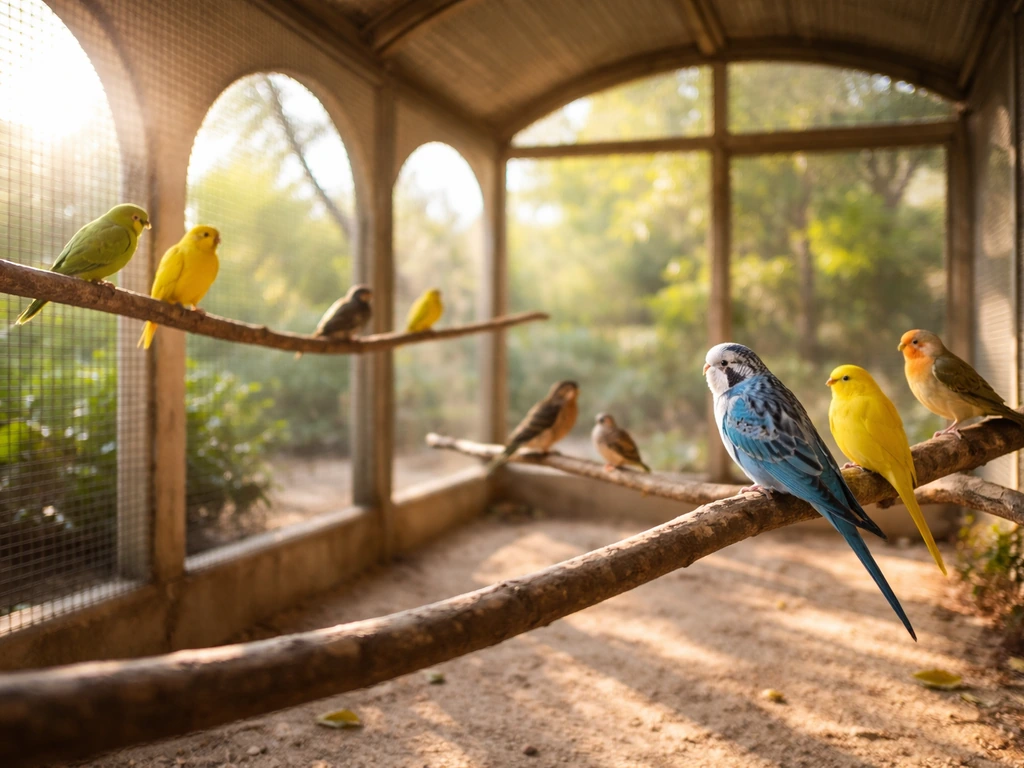
The Latin root is avis, meaning bird. So etymologically, an aviary is simply a bird place. In practice, that "place" ranges from a backyard flight cage built by a hobbyist to the National Aviary's walk-through habitats where birds fly freely around visitors. Lincoln Park Zoo's McCormick Bird House runs a tropical free-flight aviary where guests observe multiple species doing what they actually do in the wild. The common thread is space, enough room for real flight, and multiple birds living together in a managed but relatively naturalistic setting.
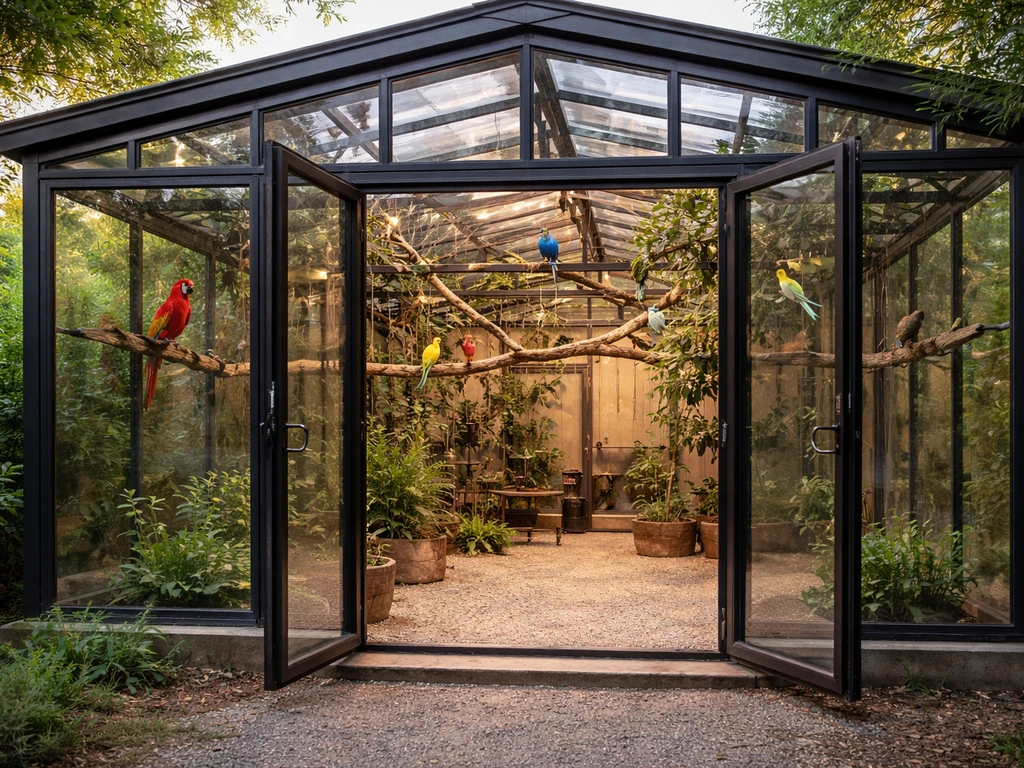
Functionally, aviaries often have two zones: a sheltered, sometimes heated interior structure and an attached wire-mesh outdoor flight area. The 1911 Encyclopaedia Britannica describes exactly this design, a built house for winter that opens into a wire enclosure for summer. The RSPCA recommends aviaries specifically because they allow birds to do what birds need to do: move, fly, and engage in species-typical behavior. Many designs also include a safety porch or walkway at the entrance so keepers can close one door before opening another, keeping birds from escaping during maintenance.
Aviary vs cage vs birdhouse: what's the difference
These three terms get mixed up constantly, and the confusion matters when you are trying to interpret what "aviary" means in a specific context. Here is how they actually differ:
| Term | Size | Purpose | Occupants | Who enters? |
|---|---|---|---|---|
| Aviary | Large: room-sized to building-sized | Exhibition, breeding, welfare housing | Multiple birds, often mixed species | Keeper and sometimes visitors |
| Cage (birdcage) | Small to medium: tabletop to floor-standing | Household pet housing | One or a few birds | Nobody; accessed through a small door |
| Birdhouse | Very small: nest-box sized | Wild bird nesting | One breeding pair | Nobody; designed for wild birds only |
The RSPCA is explicit on this: a large outdoor enclosure called an aviary is the best way to meet pet bird needs, and keeping a bird in a standard indoor cage should only be a short-term arrangement, not a permanent substitute. OnlineEduHelp notes that in casual speech, people sometimes call any roomy birdcage an "aviary," which muddies the meaning in everyday use. If someone says their bird lives in an aviary, they likely mean a dedicated outdoor structure with real flight room, not a decorative living room cage.
A bird haven is a related but distinct concept worth separating out: a haven is usually about refuge and safety for wild or rescued birds, while an aviary implies a managed, enclosed structure with controlled entry. A bird haven meaning is about refuge and safety, especially for wild or rescued birds, rather than the managed enclosure implied by an aviary A bird haven is a related but distinct concept worth separating out. The goals overlap but the setups differ.
Common symbolic and spiritual meanings of an aviary
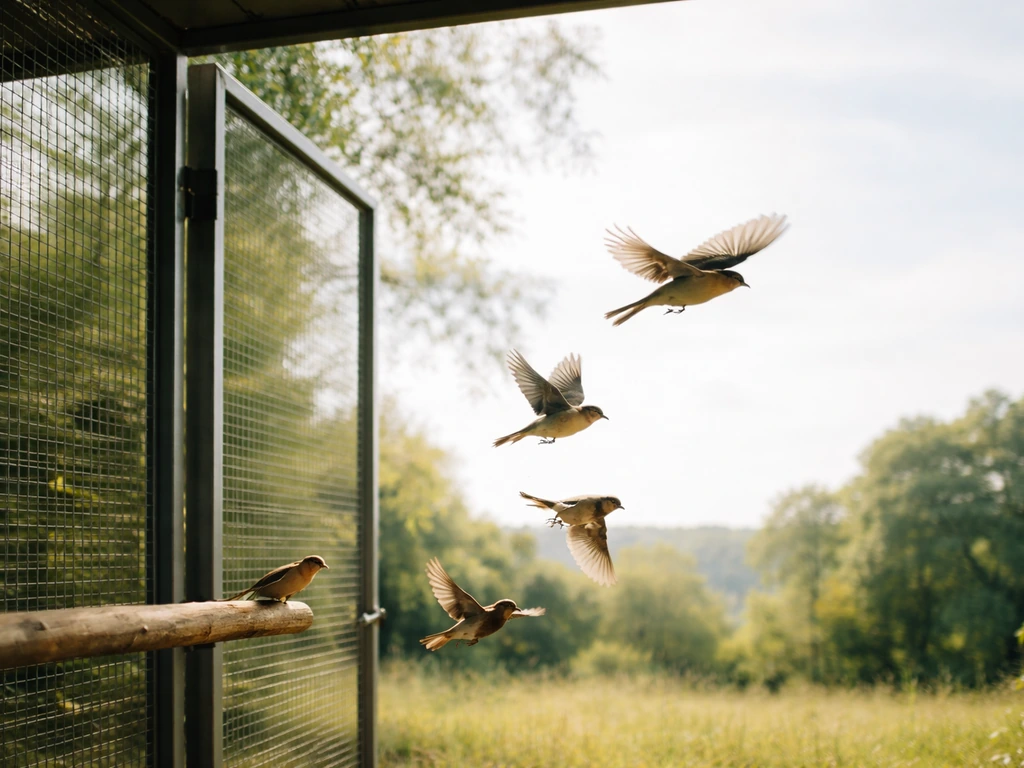
Symbolically, an aviary sits at an interesting tension point between freedom and containment. Birds carry some of the most consistent symbolic meaning across cultures: freedom, the soul, transcendence, communication between worlds. An aviary holds birds in a managed space, so what it symbolizes depends heavily on how you read that act of enclosure.
In many cultural readings, an aviary represents abundance and variety, a place where beauty is collected and preserved. Think of the aristocratic aviaries of Renaissance Europe, built to display rare birds as a sign of wealth, knowledge, and worldly reach. That sense of curated richness still echoes in how people use the word: a space that holds many kinds of bird energy in one place.
On the spiritual side, an aviary can be read as a liminal space, neither wild nor fully domesticated. The birds inside are free within limits, which maps onto a lot of spiritual ideas about the soul: connected to something greater, but working within the conditions of a current life. Some folk traditions read aviaries as places of watchfulness or gathering, spaces where spiritual messages accumulate because so many birds (traditionally associated with omens and communication) are present together.
There is also a shadow reading: an aviary as a symbol of something beautiful that has been caged. This connects to broader bird symbolism around restriction and longing, and it is the lens that shows up most often in literature and art. The Cleveland Museum of Art holds a watercolor titled "The Aviary" depicting a crowded enclosure filled with birds, using the image to evoke a sense of compression and contained life.
Interestingly, the word aviary has carried slang meaning in French culture: "La Volière" (French for aviary) was historical slang for a brothel, a meaning Man Ray explicitly played with in his artwork of the same name. This is a reminder that symbolic meaning is always culturally situated. The same word can carry wildly different freight depending on who is using it and when.
Dream interpretation: what a bird aviary can mean
Dreaming of an aviary is one of the more layered bird-dream scenarios, because it layers the symbolism of birds (freedom, soul, communication) with the symbolism of enclosure (structure, control, safety, limitation). Before diving into common interpretations, one important caveat: Psychology Today and the Sleep Foundation are both clear that blank" rel="noopener noreferrer">dream meaning is not a universal code. What an aviary means in your dream depends on the emotional tone of the dream, your personal associations with aviaries, and what is happening in your life. blank" rel="noopener noreferrer">Dream dictionaries are starting points, not verdicts.
With that framing in place, here are the most common threads that appear in aviary dream interpretations:
- Freedom within structure: Many interpretations, including those on Dream-Dictionary.com, read aviary dreams as signaling a desire for freedom or liberation. The birds can fly, but they are still enclosed, which often reflects a feeling of being capable of more than your current situation allows.
- Emotional containment: If the aviary in your dream felt crowded or tense, it may reflect feelings of being hemmed in, perhaps in a relationship, a job, or a social role. Dream Encyclopedia connects bird-and-cage imagery to difficulty freely expressing thoughts or emotions.
- Community and belonging: A healthy, well-populated aviary with birds moving freely can represent a rich social world or a sense of belonging to a group with shared values.
- Watchfulness or accumulated messages: Because birds carry strong associations with omens and communication in many traditions, a dream aviary full of birds can feel like a place where important signals are gathering, waiting to be read.
- Care and responsibility: If you were tending the aviary in the dream, maintaining it or feeding the birds, that often reflects feelings about caretaking, stewardship, or managing something complex that depends on you.
Mirror Within's aviary dream interpretation takes an analytical-psychology approach, treating the aviary as a reflection of the dreamer's belief systems and emotional responses rather than a fixed symbolic prediction. That framing is actually the most useful one: ask yourself how the aviary felt in the dream, whether confining or spacious, chaotic or peaceful, and what relationship you had to the birds inside. Those emotional details tell you far more than the image alone.
Everyday behavioral and cultural interpretations
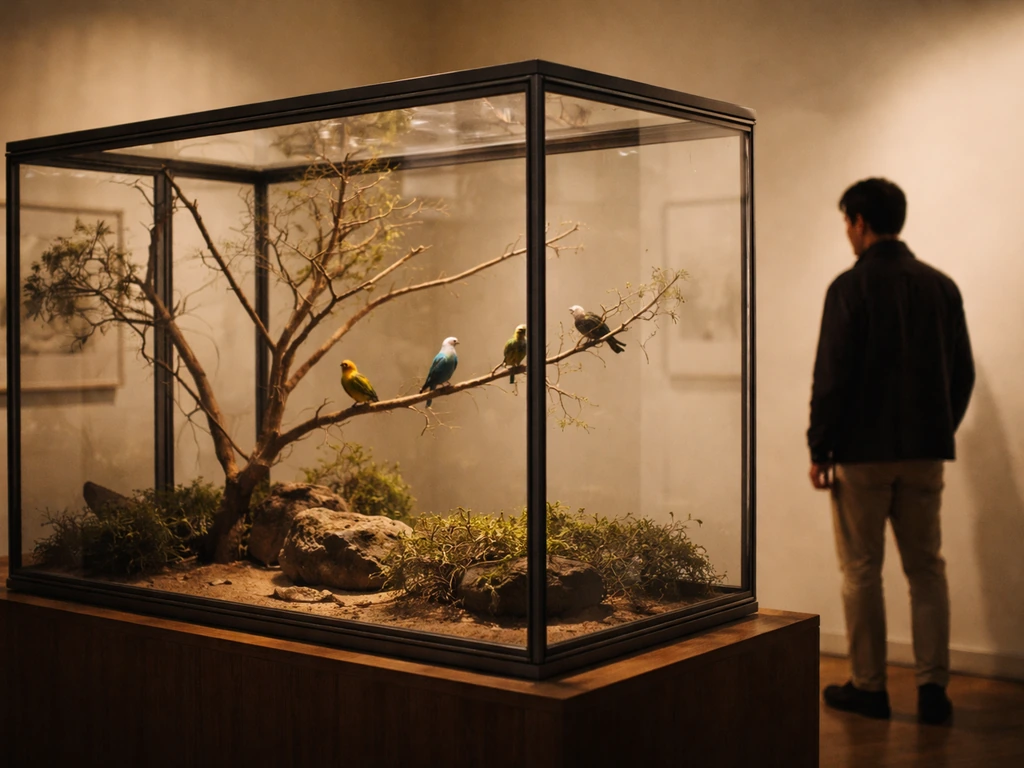
Outside of dreams and formal symbolism, people read meaning into aviaries in a few consistent ways in everyday life and culture.
In literature and film, an aviary is almost always a symbol of something preserved or controlled, often with an undercurrent of longing. A character who keeps a private aviary is usually being coded as someone with the power to collect beauty but also someone who holds things captive. It is a morally ambiguous image, which is exactly why writers reach for it.
In animal welfare and behavioral terms, an aviary has taken on a distinctly positive meaning over the past few decades. As the RSPCA and PetMD both emphasize, an aviary represents adequate, enriched living for birds. Saying a bird "lives in an aviary" rather than "lives in a cage" carries a strong behavioral signal: this bird has room to move, fly, and engage with other birds. The word has become shorthand for appropriate bird welfare.
In cultural contexts, visiting a public aviary (like the National Aviary or a zoo's bird house) is often described in terms that blend proximity and wonder: guests walk through and birds fly around them. That experience is culturally coded as a moment of connection with nature, being inside something wild rather than observing it from outside. It is a very different emotional register than visiting, say, a reptile house.
People also read aviaries through a lens of abundance and variety. An aviary with many species carries associations with biodiversity, with the richness of the natural world compressed into one accessible space. That is part of why the word gets used metaphorically for any place that holds a diverse, lively, and somewhat unpredictable collection of personalities, whether a school, a creative studio, or a busy household.
Myth-busting and misconceptions
A few persistent misunderstandings come up whenever people search for aviary meaning, and they are worth clearing up directly. If you're also curious about the bird name meaning behind the term, you can look at the name's origin and how it is used for symbolism.
- An aviary is not just a big cage. The scale difference is meaningful both practically and symbolically. A cage is individual confinement; an aviary is a managed community habitat with flight space. Treating them as synonyms misses most of what makes an aviary symbolically or practically distinctive.
- Aviaries do not have automatic spiritual significance. Some dream-interpretation sites treat "aviary" as if it always signals something profound. But a dream about an aviary at a zoo you visited last week is probably just a processing dream, not a cosmic message. Context and emotional tone matter far more than the symbol itself.
- An aviary is not the same as a bird sanctuary or rescue facility. A sanctuary focuses on rehabilitation and wild-bird welfare (organizations like International Bird Rescue work on scientifically-based rehabilitation for injured wildlife). An aviary is a designed enclosure for birds that live there permanently, whether as pets, exhibit birds, or breeding populations.
- "Aviary" does not always mean outdoor. Many commercial and zoo aviaries are fully indoor climate-controlled structures. The defining feature is size and multi-bird capacity, not outdoor placement.
- The word aviary has no single cultural-slang meaning in English. The French slang usage (La Volière as brothel slang) is a historical and culturally specific meaning, not something that carries over into modern English usage. Do not assume that meaning unless you are reading a French-language or specifically art-historical context.
How to interpret aviary meaning in your specific context
The most useful thing you can do when you encounter the word or image "aviary" is to identify the context first, then apply the appropriate interpretive lens. If you are also wondering about how letters shape meaning, check out bird plus letter meaning as a related way to think about word signals. Here is a practical way to work through it.
- If you saw it in a dream: Start with the emotional tone. Did the aviary feel expansive or confining? Were the birds healthy and active, or distressed? Were you inside it or observing from outside? A spacious, lively aviary dream leans toward themes of abundance, community, or managed freedom. A crowded or anxious one leans toward feelings of restriction or accumulated pressure. Your personal history with birds and aviaries matters here more than any dictionary definition.
- If you read it in a book, poem, or piece of art: Look for what the author is using the aviary to contrast against. Is it set against an image of wild nature? Against a human home or prison? Aviaries in literature almost always function as a middle space, neither free nor fully captive, and the meaning comes from what that middle space is being used to say about a character or situation.
- If someone used the word casually or as a metaphor: Check whether they mean it literally (a bird enclosure) or figuratively (a place full of diverse, lively, somewhat chaotic individuals). The figurative use is common and usually warm in tone.
- If you are considering a real aviary for pet birds: The practical meaning here is straightforward: an aviary is the recommended housing standard for most pet birds. It provides flight space, social opportunity, and behavioral enrichment that a standard cage cannot. The RSPCA recommends it as the best way to meet pet bird needs.
- If you encountered it in a cultural or historical context: Consider the era and language. French-language contexts, especially art history, may carry the La Volière slang meaning. Renaissance or aristocratic contexts carry associations with wealth, rare-species collection, and status. Modern zoo or wildlife contexts lean toward conservation and public education.
The through-line in almost every reading of an aviary, literal, symbolic, or metaphorical, is the tension between containment and freedom. If you are specifically trying to understand bird aviary meaning, focus on whether the aviary in your context feels more like care and abundance or more like restriction and longing. Birds want to fly; an aviary gives them flight while still holding them within limits.
In a similar way, the bird-hold-on-to-meaning idea behind “bird thou never wert” plays with freedom, soul, and longing in language that feels more than literal aviary gives them flight. Whatever context you encountered the word in, that tension is probably doing some work. Sit with it: is the aviary in your context a place of care and abundance, or a beautiful restriction? That answer is usually the one you were actually looking for.
If you are exploring related layers of bird meaning, the broader ideas around bird animal meaning and bird haven meaning connect naturally to this territory, since all three concepts deal with how we understand birds in relation to space, freedom, and human relationship with the natural world. If the poem you are reading features a bird, those same bird symbolism ideas can help you unpack what the words are pointing to bird animal meaning. For the word meanings themselves, it can also help to look at bird plus letter meaning resources to decode how specific terms and letters are used in bird-related language. If you are also curious about individual bird name meaning, it can add another layer to how you interpret birds and their symbolism in your life.
FAQ
How is “bird aviary meaning” different from just “birdcage” or “cage”?
In most everyday English use, “aviary” implies an intentional, multi-bird setup with enough space for true flight (often outdoor), while “birdcage” is typically associated with a single-bird or limited movement enclosure. A helpful check is whether the description includes communal housing, walk-in space, and flight-focused design, not just decorative containment.
Can an aviary be a positive symbol and a negative symbol at the same time?
Yes, an aviary can be both a welfare improvement and a containment symbol. If the birds have space to fly, access to species-typical behaviors, and safe, managed entry for keepers, the word often leans positive. If the dream or story emphasizes captivity, distress, or restricted choice, the symbolic reading shifts toward longing or limitation.
If I see the word “aviary” in different places (pets, art, dreams), which interpretation should I trust?
Context changes the meaning. In a pet-care context, aviary usually signals enriched housing and behavioral needs, while in literature or art it often highlights abundance plus controlled beauty. In dreams, your emotional tone (calm vs panicked, open vs locked, watching vs trapped) usually matters more than the dictionary image of the word.
What dream details most strongly change the meaning of an aviary dream?
Look for “emotional cues” rather than the object alone. Ask whether the dreamer feels responsible, powerless, fascinated, or resentful, and what the birds do (flight, hiding, attacking, singing, escaping attempts). A spacious aviary with active birds often points to agency and growth, while a cramped or sealed one commonly reflects pressure, fear, or boundaries you feel trapped by.
How can I avoid relying on dream dictionaries as if they were fixed truth?
A recurring misunderstanding is treating dream dictionaries as predictions. A practical alternative is to treat the aviary as a metaphor for your current relationship to structure, safety, and freedom, then map it to what is happening in real life (a job change, a relationship boundary, a new routine). If nothing in your life matches those themes, the dream may be processing a different, older association with birds or enclosures.
What does it mean if I am managing, visiting, or watching an aviary in a dream?
If your dream includes other people or caretaking, the meaning often shifts toward roles and responsibility. For example, being the person opening/closing doors can relate to setting limits, while being the visitor or observer can relate to wanting connection without direct control. The key is who has power over access and outcomes in the dream.
What’s the practical difference between bird haven meaning and bird aviary meaning?
“Bird haven” tends to emphasize refuge and protection, especially for wild or rescued birds, while “aviary” emphasizes a managed enclosure where multiple birds live with controlled entry and (ideally) flight opportunity. If the scenario centers safety from harm, it will likely read like refuge, but if it centers daily housing and environment design, it will read like aviary.
How can I tell when someone is using “aviary” loosely versus accurately describing a real setup?
If the aviary is described as heated, sheltered, and connected to an outdoor flight space, that often signals seasonal care and consistent welfare planning. If you only hear “large cage indoors” with no flight room, people may be using the word loosely, and the symbolic reading might still occur, but the literal welfare claim probably does not match how aviaries are commonly defined.
Next Article
Bird Plus Letter Meaning: Decode the Symbol, Code or Dream
Decode bird plus letter meanings: symbolism, behavior, dreams, codes, and folklore, with how to identify the right conte