
A bird nest necklace most commonly means home, family, protection, and nurturing love. In today's jewelry market, it typically takes the form of a small wire-wrapped or cast-metal pendant holding one to four bead 'eggs,' sold as personalized mother or family jewelry where each egg represents a child, often set with a birthstone. Beyond the retail meaning, the nest is one of the oldest and most cross-cultural symbols in human visual language, carrying threads of fertility, refuge, new beginnings, and ancestral lineage depending on the tradition and the specific design details.
Bird Nest Necklace Meaning: Symbolism, Gifts & Variations

Marcus Holloway
5 Aug 2026
What a bird nest necklace actually is
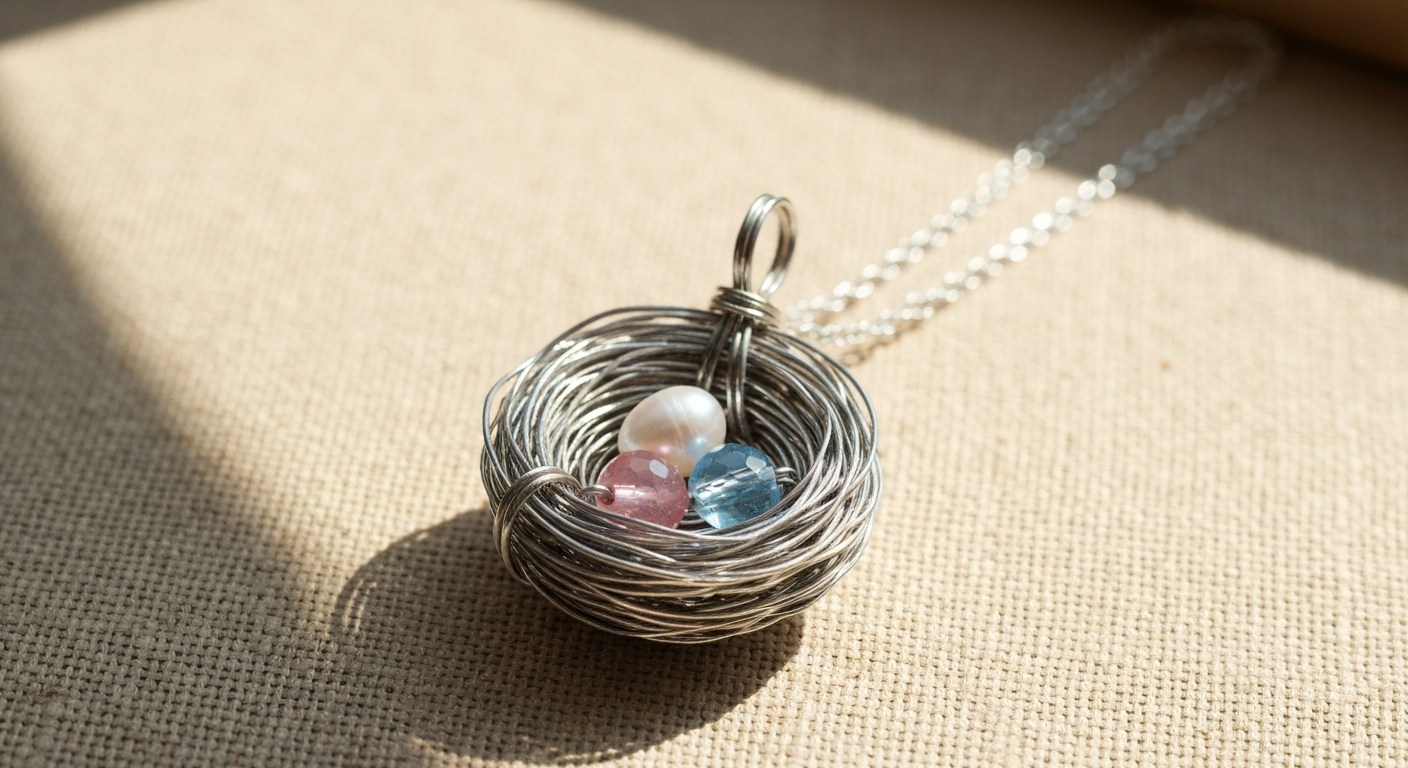
At its most basic, a bird nest necklace is a pendant shaped like a small woven nest, usually made from fine-gauge wire (sterling silver, gold-filled, or copper) twisted into a cup shape and holding tiny bead eggs. Some versions are cast rather than hand-wrapped. The eggs are the customizable element: pearl beads signal purity or a newborn, birthstone beads represent specific children or family members, and colored glass beads simply echo nature.
Retailers and Etsy sellers market these almost universally as 'Mama,' 'Mother,' or family necklaces. Customizable birthstone egg necklaces for mothers, grandmothers, and new-baby gifts dominate the category. Gift guides consistently position them for Mother's Day, baby showers, and milestone family celebrations. That commercial framing is not accidental: it maps almost perfectly onto the symbol's deeper cultural roots, which we'll unpack below. The number of eggs in the nest is often the single most personal detail, since it directly represents how many children the wearer has or honors.
The core symbolic themes
Philosopher Gaston Bachelard, in 'The Poetics of Space,' describes the nest as a primary image of intimate refuge, a kind of 'womb' or private house that shelters nascent life. That reading maps onto how people intuitively respond to nest imagery: it feels safe, contained, and warm. Classic symbol reference works like Jean Chevalier and Alain Gheerbrant's 'Penguin Dictionary of Symbols' list the nest as a complex symbol covering home, fertility, protection, regeneration, and paradise across multiple traditions. Those five themes show up again and again regardless of culture or era.
- Home and belonging: the nest is the original domestic space, a place built with care and intention specifically to hold what matters most.
- Family and motherhood: eggs in a nest are universally understood as children, making the motif a direct visual metaphor for parenthood.
- Protection: birds are fiercely protective of their nests; wearing one signals a protective, sheltering love.
- Fertility and new beginnings: eggs carry the potential of life not yet realized, linking nest jewelry to pregnancy, birth, and fresh starts.
- Renewal and resilience: birds rebuild nests each season, associating the symbol with recovery, starting over, and perseverance.
- Memory and legacy: filling a nest with birthstone eggs for children or loved ones turns the piece into a wearable memorial or record of family history.
Cultural and religious symbolism across traditions
Judeo-Christian traditions
The Hebrew Bible uses nest imagery with notable specificity. Deuteronomy 22:6-7, known in rabbinic literature as 'shiluach hakein' (sending away the mother bird), instructs that a person who finds a bird's nest must send the mother away before taking the eggs. Rabbinic commentaries elaborate this into an ethical teaching about compassion for creatures and the restraint of human appetite. Rabbinic literature and later Jewish commentaries elaborate the Deuteronomy 22:6–7 command (blank" rel="noopener noreferrer">shiluach hakein) as an ethical teaching about compassion for animals and restraint, reinforcing nest imagery as a moral and protective motif. The nest here is a moral space, a site of care that even a stranger is obligated to respect. Psalm 84:3, 'the sparrow finds a house and the swallow a nest for herself, where she may lay her young,' uses the nest as a metaphor for divine sanctuary and worship. In Christian exegesis, this passage has long been cited as imagery of refuge and God's provision, which is why nest motifs appear in pastoral art and ecclesiastical decorative traditions.
Islamic perspectives
Qur'anic and hadith literature present birds as part of God's created signs (ayat), and birds in flight are described in the Quran as held aloft only by God. Contemporary Islamic legal guidance (fatawa) from sources like the Jabatan Mufti Wilayah Persekutuan explicitly encourage compassion toward bird nests and discourages their disturbance or destruction, framing nests as trust objects within creation. While Islam does not have a jewelry tradition that specifically encodes nest symbolism, the underlying ethos of stewardship and care aligns with the broader symbolic meaning.
Hindu and Vedic cosmology
The Rigveda's Hiranyagarbha hymn describes a 'golden womb' or cosmic egg from which the universe was born, establishing an ancient South Asian symbolic lineage where egg and nest imagery carry cosmic weight. See blank" rel="noopener noreferrer">The Rigveda: authorized translation with notes (Hiraṇyagarbha hymn reference) for the Hiranyagarbha ('golden womb'/cosmic egg) hymn describing the universe's birth. Nest and egg motifs in South Asian religious thought index origins, fertility, and the source of all creation, not just biological birth. This makes a nest pendant a resonant symbol in Hindu contexts, particularly around themes of new life, divine origins, and the prosperity of offspring.
Chinese and East Asian traditions
In Chinese folk belief and feng shui, swallows are among the most auspicious birds, and a swallow choosing to nest on a house historically signaled incoming good fortune, fertility, and family prosperity. The nest as an auspicious sign is therefore deeply embedded in Chinese visual culture. Separately, the edible swiftlet nest (yanwo, used in bird's-nest soup) carries associations of health, longevity, status, and special-occasion gifting in China and Southeast Asia. These two streams, the symbolic swallow's nest and the luxury culinary nest, sometimes blur together in contemporary Chinese art and ornament, both pointing toward abundance and familial well-being.
Japanese visual tradition
Japanese family crests (kamon) include the mokko motif, historically described as a stylization of a seed, fruit, or nest-like shape and interpreted as a symbol of the fertility and prosperity of descendants. The connection between nest-shaped motifs and lineage themes runs deep in Japanese decorative arts, reinforcing the idea that a nest is an emblem of one's people and their continuation.
Native American and Indigenous traditions
Ethnographic and mythological sources from various Plains and Woodland nations show nests and eggs functioning in creation stories, kinship metaphors, and ritual imagery. Scholars like Robert Hall, in 'An Archaeology of the Soul,' note the nest as a locus of kin, creation, and protective care in several Indigenous North American traditions. It's worth being specific here: these meanings vary significantly by nation and tradition, and they should not be flattened into a single 'Native American meaning.' If you are drawn to Indigenous nest symbolism, seeking out the specific tradition you're referencing is the respectful approach.
Spiritual, dream, and fortune-telling interpretations
In spiritual contexts, the nest is broadly understood as a symbol of the soul's home, the inner sanctuary where you return to yourself. Wearing a nest necklace is sometimes interpreted as an intention to protect your inner life or to signal that you are actively building or tending to something precious. In new-age and holistic spiritual frameworks, nest imagery aligns with root chakra themes of security, groundedness, and belonging.
In dream interpretation, dreaming of a bird's nest is commonly read as a sign of domestic harmony, anticipated family growth, or a desire for security and stability. An empty nest in a dream often points to a transition, such as children leaving home, a relationship ending, or a phase of life completing. A nest full of eggs signals potential, fertility, and new beginnings on the horizon. A broken or fallen nest tends to be interpreted as anxiety about home life, family stability, or a disruption in one's sense of belonging. These dream readings align closely with folk traditions and are largely consistent across Western dream-symbol literature.
Fortune-telling and omen traditions (discussed more in the folklore section below) have long used bird nests as predictive signs. Wearing a nest pendant can be seen as an act of sympathetic magic, inviting the positive omens associated with nests (abundance, family, good fortune) into your life by keeping the symbol close.
Superstition, folklore, and popular stories about nests
Bird nest superstitions are genuinely ancient and remarkably consistent across unconnected cultures. The most widespread belief: a bird choosing to nest on or near your home is a good omen, signaling coming prosperity, a new baby, or divine protection over the household. Swallows in particular are considered lucky nesters across European, Chinese, and South Asian folk traditions. Disturbing or destroying a bird's nest, on the other hand, is widely considered bad luck, sometimes specifically inviting fire, illness, or family discord. This near-universal folk prohibition tracks with the Deuteronomy commandment and Islamic guidance discussed above, suggesting that the 'don't disturb the nest' rule has both religious and pre-religious roots.
European folk traditions include the belief that robins' nests near a house protect it from lightning, and that finding a nest with eggs intact (without disturbing it) brings luck to the finder. In some Appalachian and rural American traditions, a swallow building a nest under the eaves was seen as a guarantee that the house would not burn. These stories feed directly into the appeal of nest jewelry: wearing the nest is a way of keeping its protective qualities with you, not just in your home.
The 'empty nest' metaphor in modern Western culture carries its own folklore weight. The phrase 'empty nest syndrome,' coined in the 20th century, reflects a much older anxiety about the nest as a symbol of purpose and identity. When the nest empties, something meaningful has ended. This cultural resonance explains why nest necklaces are also given as gifts to mothers whose children have grown or left home, as a reminder that the nest they built is permanent and meaningful even after the birds have flown.
How related bird jewelry pieces carry their own meanings
The nest necklace belongs to a broader family of bird-themed jewelry, and understanding how it sits within that family helps sharpen what makes it specific. A bird necklace (featuring the bird itself rather than the nest) tends to emphasize freedom, flight, and the bird's own qualities, such as wisdom for owls, joy for hummingbirds, or peace for doves. For more on the broader symbolism of birds in jewelry, see bird charm meaning. The nest necklace, by contrast, grounds that energy in the domestic, the protective, and the familial. See bird necklace meaning for a focused overview of bird pendant symbolism and how it differs from nest jewelry.
A bird pendant, as a general category, often focuses on the symbolic qualities of a particular species. A bird charm worn on a bracelet is similarly species-specific but carries the added meaning of collected talismans, protective tokens you choose and accumulate. A bird bracelet can hold multiple bird charms representing different aspects of a life or different family members. The nest necklace is more singular in its message: it is about the home and the people in it.
A bird cage necklace shifts the meaning considerably, introducing themes of confinement, protection by enclosure, and the tension between freedom and safety. Where the open nest represents willing nurturing and natural shelter, the cage introduces control, sometimes as a protective gesture and sometimes as a cautionary one. The interpretation depends heavily on whether the cage is open or closed and whether a bird is inside. For more on the contrasting themes of confinement and protection, see bird cage necklace meaning.
A bird stone, such as a carved jade bird or a bird-shaped crystal, carries the mineral's own symbolic properties alongside the bird's meaning. The material matters: turquoise bird stones carry protection and travel meanings in Southwestern traditions, while jade bird carvings in Chinese tradition add longevity and nobility to the bird's natural symbolism. A bird bell tota (the hanging ornamental bird-bell found in South Asian decor and jewelry traditions) adds sound, movement, and warding energy to bird symbolism, often associated with auspicious chiming and the invitation of good spirits.
One colloquial outlier worth noting: 'bird launcher' is a term used in hunting contexts to describe a mechanical device that releases birds for retrieval training, and it occasionally appears in slang for someone who gets things moving or initiates action. It has no symbolic relationship to nest jewelry, but curious readers who encounter it in a bird-meaning search context are looking at a completely different register of meaning.
How design details change the meaning
The nest pendant is one of the most design-sensitive symbols in bird jewelry: small changes in what is inside the nest, how many elements are present, and what material the nest is made from all shift the meaning meaningfully. Here is a practical breakdown.
| Design Element | Common Meaning | Notes |
|---|---|---|
| 1 egg in the nest | A single child, a new beginning, a pregnancy announcement | Most common for new-baby gifts |
| 2–4 eggs | Multiple children; family size | Each egg can be a birthstone for a specific child |
| 5+ eggs | Large family, extended family, or abundance | Often given to grandmothers to represent grandchildren |
| Mother bird sitting on nest | Active nurturing, maternal love, protection in action | The 'mama bird' design variant |
| Empty nest | Transition, loss, the 'empty nest' life stage, or potential unfilled | More ambiguous; context determines positive or bittersweet reading |
| Open nest (no cage) | Natural shelter, freedom within protection, unconditional love | The most common form |
| Cage-enclosed nest | Protective but constrained; can also suggest overprotection | Closer to bird cage necklace symbolism |
| Wings incorporated | Freedom, spiritual elevation, the soul's flight from the home | Often seen in memorial or angel-themed designs |
| Tree of life base | Ancestry, lineage, rootedness across generations | PhoenixFire Designs and similar makers use this combo |
| Pearl eggs | Purity, new life, innocence | Classic for birth or christening gifts |
| Birthstone eggs | Personalized family identity; each stone = one person | The dominant contemporary custom variant |
| Gold metal | Warmth, abundance, prestige, solar energy | Also associated with longevity in East Asian contexts |
| Silver metal | Lunar energy, intuition, feminine protection | Sterling silver is the most common material choice |
Movement in the design also matters. A static cast-metal nest reads as settled, permanent, and grounded. A wire-wrapped nest with a hanging pendant beneath it (sometimes a dangling stone or charm) adds the idea of things in motion, of life continuing to grow and change beneath the shelter of the family structure. This is a subtle difference but it is one that buyers and gift-givers often intuit before they can articulate it.
Gifting a bird nest necklace: what it says and to whom
The nest necklace is one of the clearest 'message jewelry' pieces you can buy, because its visual language is almost universally understood. Giving a personalized nest necklace with birthstone eggs to a mother says: I see the home and the family you have built, and I think that is worth carrying close. Giving one to a grandmother with eggs for each grandchild has become a well-established tradition in its own right. Giving an empty nest to someone starting over, after a divorce, a loss, or a move, frames new beginnings as full of potential rather than absence.
A few practical things to consider before buying: the number of eggs matters enormously, so if you are personalizing, confirm the exact count before ordering. Birthstone accuracy varies by convention (there are multiple birthstone charts in use), so clarify whether the maker uses modern, traditional, or mystical birthstone lists. Wire-wrapped nests are more delicate than cast pieces and can deform under regular wear, so they are better as display or occasional pieces than everyday chains. Sterling silver is the most common and durable base metal for everyday wear, while gold-filled offers a warm aesthetic without the cost of solid gold.
Common misconceptions worth clearing up
One persistent misconception is that touching or wearing a nest symbol 'takes something' from nature or carries bad luck from nest disturbance folklore. This conflates the actual act of disturbing a living bird's nest (which folk traditions do treat as unlucky) with the symbolic wearing of nest imagery, which operates in a completely different register. The jewelry is not a literal nest; it is a symbol, and wearing a symbol of protection and home is not subject to the same folk prohibitions as disturbing an actual bird's nesting site.
Another common misreading is that a nest necklace with no eggs means loss or an empty life. An unfilled nest can equally represent potential, readiness, or a blank slate. Context and intention matter more than a fixed rule. If someone is going through infertility treatment, a nest necklace might be a hopeful symbol of the family they are building toward, not a reminder of absence. Read the symbol in light of the person's story, not in isolation.
Finally, not every bird nest necklace is a 'mother' piece. While that is the dominant contemporary retail framing, the symbol's deeper roots in home, lineage, and protection make it equally appropriate for anyone who is building something meaningful, whether that is a home, a creative practice, a business, or a community. The nest is about what you shelter and what you return to, and that is not exclusively maternal.
FAQ
What is a bird nest necklace in contemporary usage?
A bird nest necklace is a pendant designed to resemble a woven nest, typically holding one to four small beads or stones that represent eggs. Retail versions are often wire‑wrapped or cast metal and are marketed as personalized 'mother' or family jewelry, with the beads used as birthstones or pearls to symbolize children or loved ones.
What are the most common symbolic meanings of a bird nest necklace?
Common meanings include home and domesticity, protection and shelter, motherhood and nurturing, family and lineage, fertility and new beginnings, and the idea of carrying loved ones close to the heart. These readings are used by retailers, gift guides, and cultural symbol references.
How do cultural and religious traditions interpret nest imagery?
Meanings vary by tradition: in Western Judeo‑Christian texts nests are metaphors for refuge, care and divine provision; in Jewish law the nest (shiluach hakein) is linked to compassion; in Hindu/Vedic literature egg/nest imagery relates to cosmic origin (Hiranyagarbha); Chinese folk belief regards swallows’ nests as auspicious for fertility and fortune; Japanese motifs associate nest/seed shapes with lineage; Indigenous North American sources use nests in creation and kinship metaphors. These interpretations are culturally specific and should not be generalized across all groups.
What spiritual or dream interpretations are associated with a bird nest necklace?
Spiritually, a nest pendant often signals security, inner life, spiritual incubation, and readiness to nurture a project or relationship. In dreams, nests commonly symbolize home, family concerns, the need to protect something fragile, fertility, or the emergence of new possibilities. Interpretation depends on the dreamer’s personal associations, emotional tone, and surrounding dream elements.
How do design elements change the meaning of a bird nest necklace (eggs, number of beads, bird, cage, stones)?
Eggs/beads: singular eggs often represent self, rebirth, or a single child; multiple eggs evoke family, siblings or multiple projects. Number and birthstone choice personalize genealogical meanings. Cage elements: a cage overlay can shift meaning toward confinement, protection taken to excess, or social restriction. Presence of a bird: a perched bird emphasizes guardianship or the active parent; an absent bird may stress independence or loss. Stones/gems: pearls connote purity and motherhood; birthstones explicitly identify individuals; rough stones or raw materials emphasize naturalness and resilience. Metal and finish: gold/precious metals read as permanence, status or heirloom quality; rustic metals suggest groundedness and simplicity.
What do variants like bird charm, bird pendant, bird cage necklace, bird bracelet, bird bell tota, and slang terms mean in relation to nesting symbolism?
Bird charm/pendant/necklace: general bird imagery emphasizes freedom, messenger roles, or the personality traits of a particular species. Bird cage necklace: adds themes of restraint versus protection; may be chosen to signal overcoming limitation or conversely the desire to protect. Bird bracelet: wearable family symbolism similar to necklaces but more casual. Bird bell/tota (regional jewelry/ornament motifs): often cultural, used in ritual or as a protective/talismanic sound object. 'Bird launcher' (colloquial slang) is not a standard symbolic term and likely refers to non‑symbolic uses or niche internet jargon; interpret contextually.
Next Article
Bird Launcher Meaning: Takeoff, Symbolism, Dreams, and Signs
Bird launcher meaning explained with bird takeoff symbolism, dream and omen interpretations, plus how to confirm context