A bird mask most commonly refers to a mask designed to look like a bird's face, complete with a beak and feathered details. In contrast, a bird suit meaning is usually about what a bird-themed outfit communicates in fashion or symbolism rather than a mask tradition. Depending on the context you saw it in, it could mean anything from a ceremonial ritual object tied to a specific Indigenous or cultural tradition, to a theatrical costume, to a cosplay statement, to a historical medical uniform. The bird species on the mask matters a lot, and so does the setting. Here's how to figure out which meaning actually applies to what you saw.
Bird Mask Meaning: Literal, Cultural, and Superstition Uses

Marcus Holloway
30 Jun 2026
What 'bird mask' actually refers to
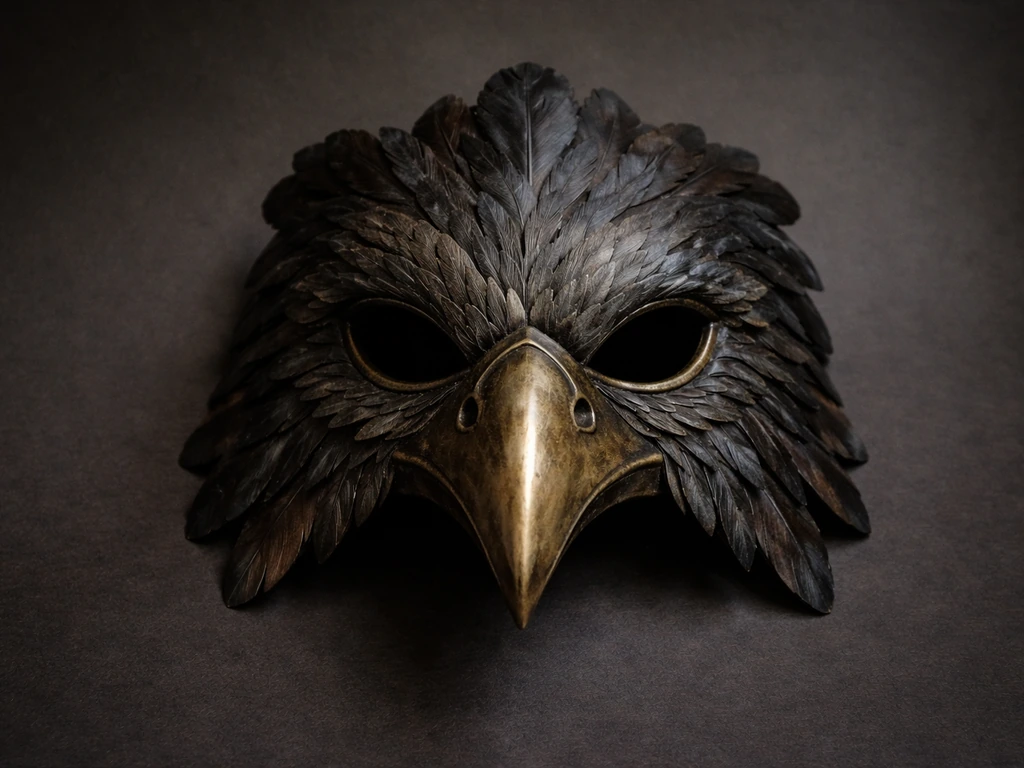
At the most basic lexical level, a bird mask is a mask that imitates a bird, covering the face and incorporating beak-like structure and feather-style decoration. That definition holds across pretty much every context you'll encounter. The variation comes in what the mask is for.
There are four broad categories worth knowing. First, ritual and ceremonial masks used in Indigenous and religious traditions, where the mask is a sacred object rather than a costume. Second, theatrical and performance masks, used in stage productions, masquerades, and cultural festivals where the bird imagery is symbolic but not spiritually prescriptive. Third, costume and cosplay masks, worn at events like Comic-Con, Halloween, or Renaissance fairs, often tied more to fandom or aesthetic preference than symbolism. Fourth, historical or novelty masks, the most famous example being the plague doctor's beak mask, which looked like a bird but was designed for a very specific (and deeply practical) medical purpose.
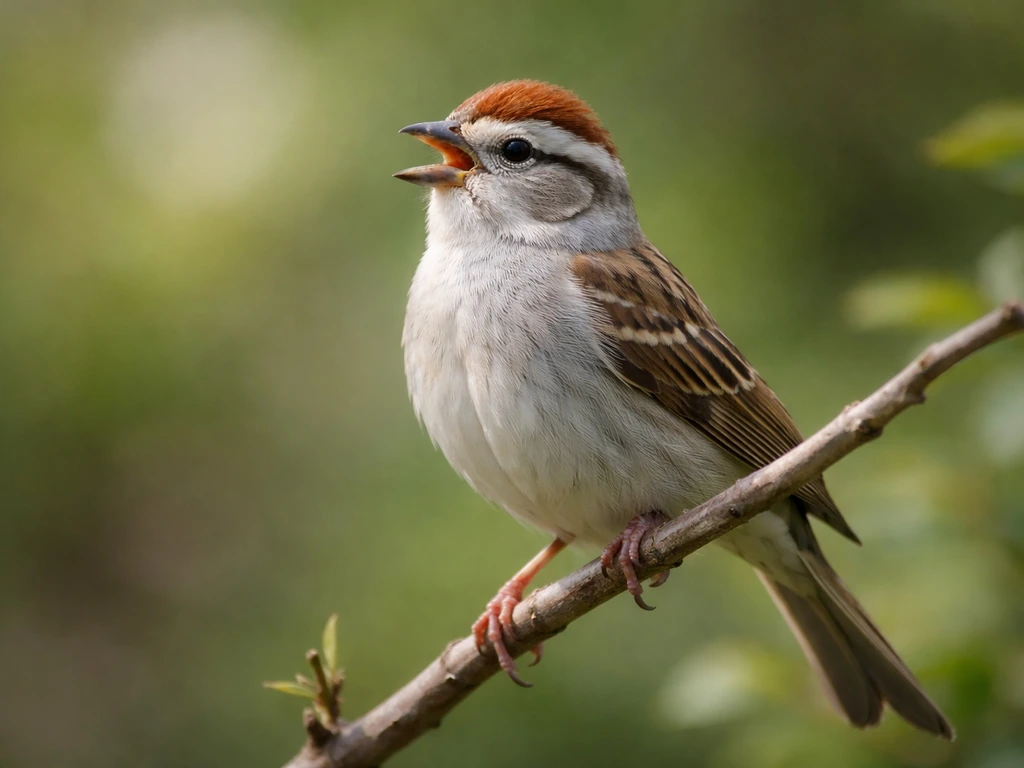
Most people searching 'bird mask meaning' have seen one in a photo, at an event, or in a piece of art and want to know what tradition it belongs to. A bird mouth open meaning is usually about how the beak pose is being depicted and what the image is trying to communicate in that context bird mask meaning. The honest answer is that you need at least two pieces of information before guessing: what bird is depicted, and what context the mask appeared in. Without those two anchors, you're just picking from a very long list.
What the bird on the mask usually symbolizes
Bird symbolism in masks tends to cluster around a few recurring themes regardless of the specific tradition. Transformation is the most consistent one. In many cultures, wearing a bird face allows the wearer to take on the qualities of that bird, whether that's the wisdom of an owl, the vision of an eagle, or the trickster nature of a raven. This isn't just poetic metaphor. Museum documentation of a Northwest Coast bird mask (cataloged as 'Ge Gon') describes how the wearer was understood to literally give up their own identity and assume the spirit of the bird depicted. That's a fundamentally different concept than 'dressing up.'
Beyond transformation, common symbolic themes tied to bird masks include:
- Communication between worlds: birds are widely seen as messengers between the living and the dead, the earthly and the divine, which is why bird masks appear in funeral rites and spirit ceremonies
- Protection: certain bird faces, especially eagle or hawk, are believed to ward off harmful spirits or illness
- Vision and perception: bird eyes are associated with seeing what others cannot, making bird masks a symbol of insight or prophecy
- Freedom and transcendence: the obvious flight association, used in masks tied to initiation or coming-of-age ceremonies
- Trickery and ambiguity: corvid masks (crow, raven) carry a shapeshifter or trickster meaning in many North American and Norse traditions
The specific bird matters enormously here. An owl mask carries very different weight than a hummingbird mask. Eagle masks appear in Indigenous traditions across North America, Africa, and South Asia and each assigns the bird its own distinct meaning. Don't assume a bird mask 'means wisdom' just because owls mean wisdom in popular Western culture. If you want a quick check on how to interpret a specific bird symbol, see bird head meaning. Check the bird and the source tradition separately.
Cultural and spiritual traditions that use bird masks
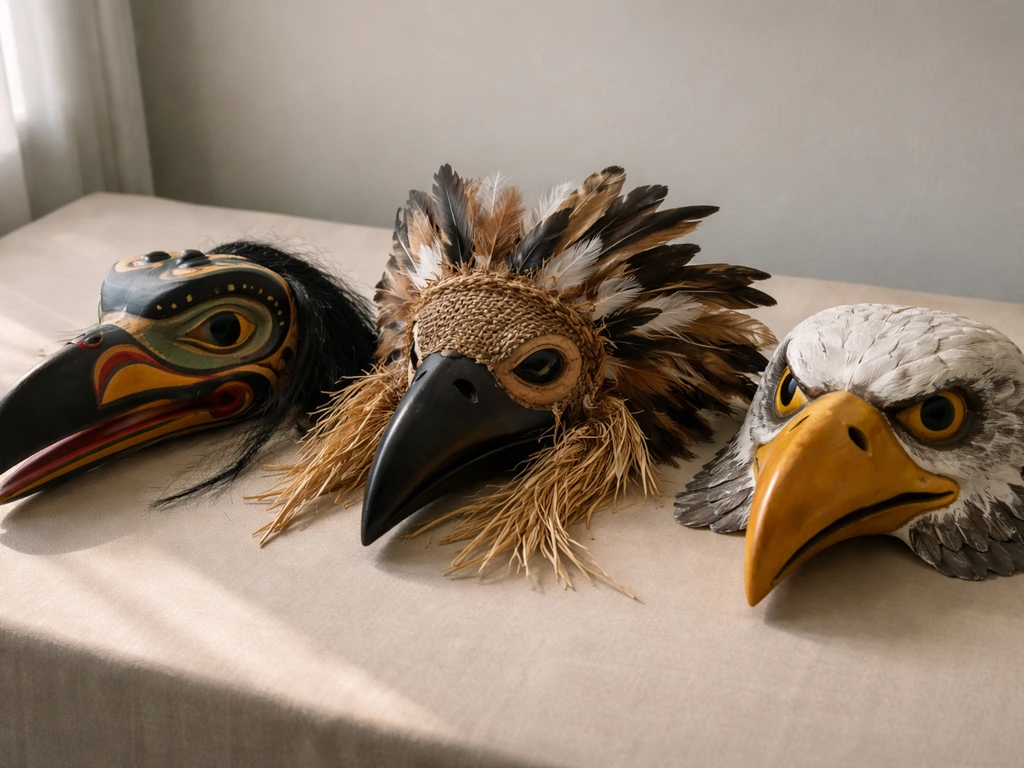
Bird masks show up across an impressive range of traditions worldwide, and this is actually one of the clearest ways to narrow down what you're looking at. Here's a rough breakdown by region and tradition.
| Tradition / Region | Bird Mask Type | Primary Meaning |
|---|---|---|
| Northwest Coast Indigenous (North America) | Transformation masks, including bird forms like Thunderbird or Raven | Spirit possession, identity shift, clan lineage |
| West African ceremonies (e.g., Yoruba, Dogon) | Stylized bird-face masks for masquerade societies | Ancestral communication, social authority, fertility |
| Venetian Carnival (Europe) | Bauta or bird-beak masks (beaked Medico della Peste style) | Anonymity, social leveling, theatrical tradition |
| Hopi and Pueblo peoples (Southwest US) | Kachina bird masks for ceremonial dances | Spiritual intermediaries, weather/harvest invocation |
| Tibetan Buddhist traditions | Garuda (eagle/bird deity) masks in Cham dance | Destruction of ego, protection from evil spirits |
| Japanese Noh theater | Tengu (bird-nosed spirit) masks | Pride, supernatural power, martial skill |
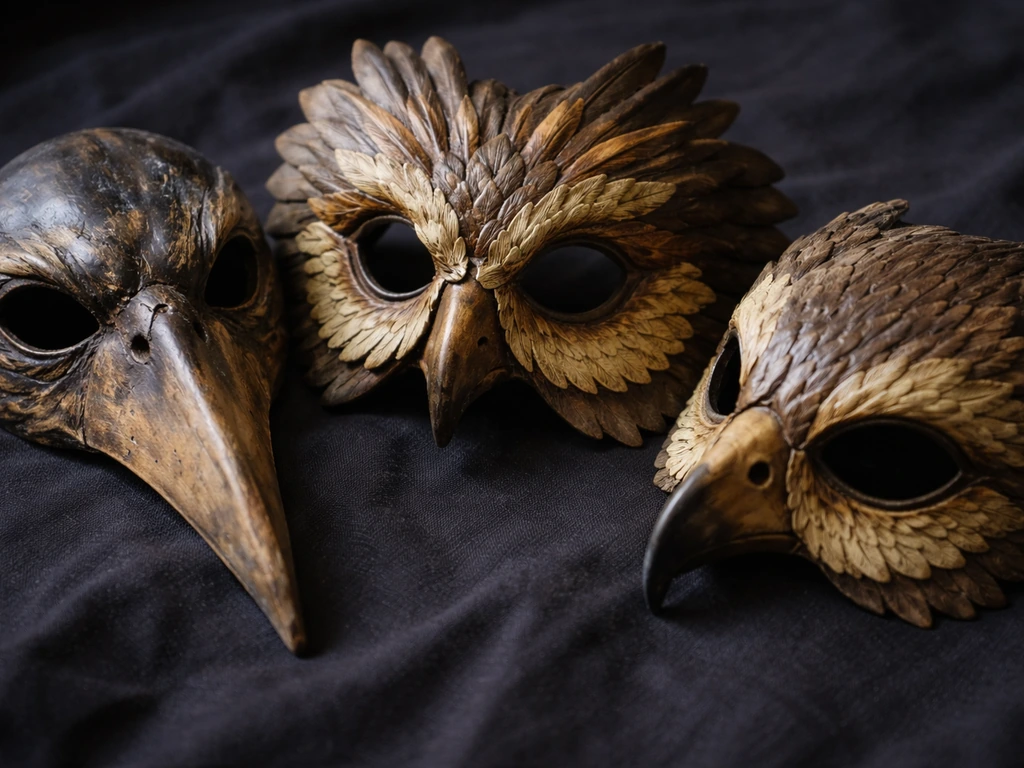
To identify which tradition a specific bird mask comes from, look at the craftsmanship style first. Northwest Coast masks tend to use bold formline graphic designs in red, black, and blue-green. West African masks are often carved from wood with geometric abstraction. Venetian carnival masks are usually painted papier-mâché or resin with a long hooked beak. The materials and construction style will usually narrow your search before you even know the exact cultural origin.
When someone wears a bird mask today
Outside of formal ritual contexts, bird masks carry a different but still readable set of signals in modern life. Cosplay and costume culture has made bird masks a recognized genre of their own. Inside the world of elite bird costuming, enthusiasts invest serious time and money into these pieces. Collectors have paid over $1,000 for a single high-quality bird mask, and competitive bird costume communities evaluate construction detail, accuracy to species, and overall presentation. In this context, the meaning is primarily about craft identity, community membership, and personal expression.
Psychologically, masks in general do something specific: they create distance between the person's everyday identity and the role they're inhabiting. Bird masks amplify this because birds are already symbolic of freedom, otherness, and non-human perspective. In a bird lips meaning context, the “bird lips” clue often points to the specific bird or the artwork or slang where the phrase appears. When someone wears a bird mask at a party, a protest, or an online avatar, they're often signaling a desire to be seen as something other than their ordinary self. It's worth noting that this overlaps with themes you'd also find in bird head imagery more broadly, where disembodied bird heads in art and meme culture carry their own layered meanings about identity and transformation.
In street performance and live art, bird masks specifically signal theatrical ambiguity. They mark the wearer as a character rather than a person, which gives them a kind of social permission to behave outside normal rules. That's not superstition. That's just how theater and costume have worked for centuries.
Superstitions about bird masks: what holds up and what doesn't
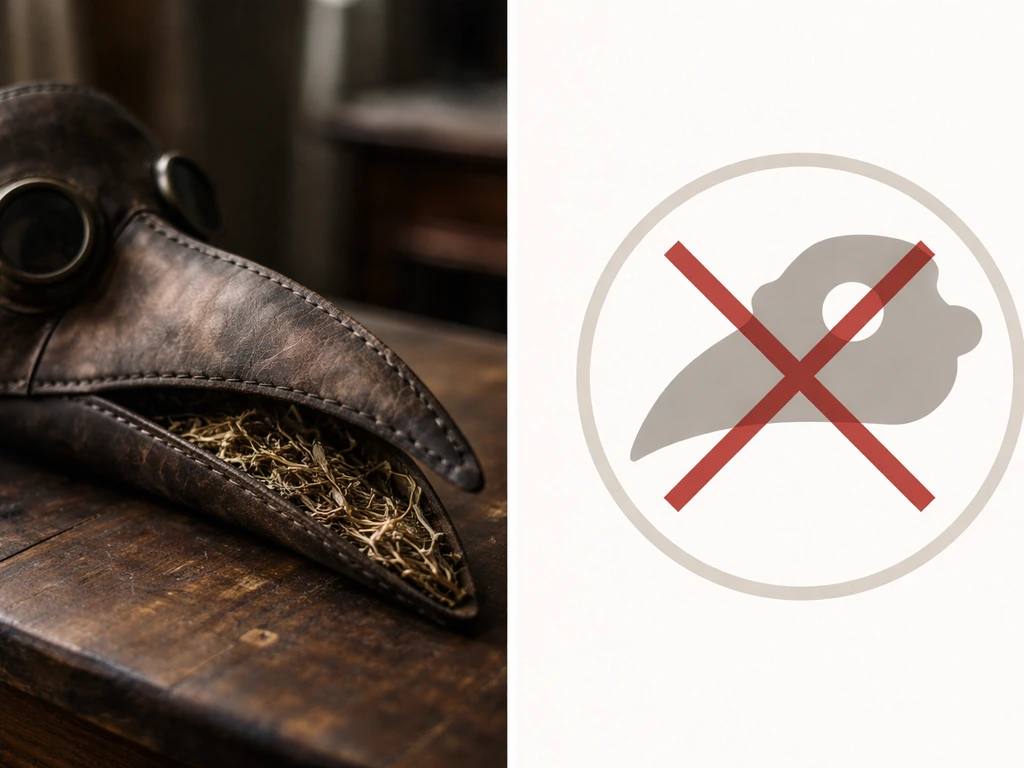
The biggest misconception I see floating around is the idea that the plague doctor's beak mask was a form of spiritual protection or that it symbolized death. The beak mask was a practical medical device. Physicians filled the long beak compartment with aromatic herbs and flowers, because the dominant theory of disease transmission at the time was miasma, the idea that bad air caused illness. The herbs were meant to filter or counteract the smell. It looks ominous in hindsight, and it's since been absorbed into the visual language of death and pestilence, but the original intent was purely functional. The 'death symbolism' was applied retroactively by people who saw the costume and associated it with the mass death happening around the doctors who wore it.
A few other commonly repeated claims about bird masks that deserve scrutiny:
- Claim: 'Seeing a bird mask in a dream means death is coming.' Reality: Bird masks in dreams are far more likely to reflect themes of identity, transformation, or a desire to see things from a different perspective. Dream symbolism for masks typically points to concealment or role-playing, not omens.
- Claim: 'Wearing a raven or crow mask attracts bad luck.' Reality: In many traditions, the raven is a creator figure and a guide, not a bringer of misfortune. This Western European superstition doesn't transfer universally.
- Claim: 'All bird masks are sacred and shouldn't be worn casually.' Reality: This is true of specific ceremonial objects in specific traditions, but it doesn't apply to costume or theatrical bird masks as a category. Context is everything.
- Claim: 'A bird mask with its beak open has a different spiritual meaning than one with a closed beak.' Reality: This is actually rooted in real iconographic tradition for some cultures, particularly Northwest Coast masks where open beaks can signal transformation or active spiritual engagement, but it's not a universal rule.
The general principle: if someone is claiming a specific bird mask carries a powerful spiritual or ominous meaning, ask them which tradition they're drawing from. Vague 'ancient symbolism' explanations without a cultural anchor are almost always folk mythology layered on top of something that had a much more specific original meaning.
How to figure out what the bird mask you saw actually means
Here's a practical checklist to walk through whenever you're trying to pin down the meaning of a specific bird mask. Some people search for the bird headed man with bison meaning because they think of how animal imagery is used to convey identity and symbolism in art bird mask.
- Identify the bird species if possible. Look at beak shape (hooked = raptor, long and straight = heron or crane, stubby = corvid or parrot), feather coloring, and any stylized crests. This one step eliminates most of the ambiguity.
- Note the context you saw it in. Ceremony, museum, costume party, street performance, meme, film, or art installation all point in very different directions.
- Look at the construction materials and style. Wood carving with bold graphic designs suggests Indigenous North American or African traditions. Resin or papier-mâché with a long hook beak suggests Venetian or theatrical. Feathers and fiber suggest ceremonial traditions from Central or South America.
- Ask whether the mask was worn or displayed. Worn masks are almost always about transformation or performance. Displayed masks (in a case or on a wall) may be sacred objects removed from active use, or they may be decorative.
- Search the bird name plus 'mask tradition' or 'mask meaning' with a geographic region if you have one. For example, 'raven mask Northwest Coast' or 'owl mask Yoruba' will get you far more specific results than 'bird mask meaning' alone.
- If you saw it online, check the original post for context tags. Cosplay and costume communities tag their work consistently, and so do cultural institutions sharing archival material.
One final note: if the bird mask you encountered was part of an active ceremony belonging to a specific Indigenous or religious community, the most respectful and accurate source of its meaning is that community's own documentation or representatives, not a general symbolism guide. The meaning of a ceremonial mask is owned by the tradition it belongs to, and that tradition's own explanation will always outrank any outside interpretation.
Bird masks carry real symbolic weight, but that weight is specific, not generic. If you meant the bird emoji meaning instead, the key is to note which bird is shown and how it’s used in the conversation. Nail down the bird, nail down the context, and you'll have a much more honest and interesting answer than any single 'bird mask means X' shortcut can give you.
FAQ
How can I tell if a bird mask I saw was ceremonial versus just a costume?
Look for indicators like performer instruction, a specific community name or language on accompanying materials, and whether the mask was treated as an object with rules (for example, limited handling, restricted use, or ritual sequencing). If it was worn spontaneously for photos with no formal structure, it was more likely theatrical or cosplay rather than ceremonial.
Does the same bird species always mean the same thing across cultures?
No. Even when the same bird appears in different regions, the meaning can shift based on local mythology, social role, and even the mask style. Use the bird identity and the source tradition together, because “owl equals wisdom” is a common shortcut that fails outside popular Western symbolism.
What should I do if the mask’s beak is open, closed, or exaggerated?
Beak pose is often a compositional choice tied to the artwork or performance rather than a universal “bird mouth open meaning.” Use it as a clue for the depicted action or character, then confirm with the overall design elements (bird species, materials, color palette) and the setting where you encountered it.
Is it appropriate to assume a bird mask is Indigenous spiritual practice just because it resembles one?
Be careful. Visual similarity is not proof of cultural origin. Many communities also create bird-themed costumes and festival masks that are not the same as sacred ceremonial regalia. When in doubt, check for attribution, creator context, or whether the community itself is cited as the source.
Why do some bird masks look more like animals while others look highly stylized?
Craft style usually signals category and region. Highly stylized, graphic linework and specific construction patterns often point to traditional art schools, while highly realistic or aerodynamic designs often align with modern costume fabrication. The more the mask follows a known artistic tradition’s conventions, the more likely it has a codified meaning.
Are bird masks ever used for protective or spiritual purposes outside ceremonial settings?
Sometimes, but it is rarely safe to generalize. If someone claims protection or ominous power, ask for the exact tradition, the specific community source, and what the mask was originally used for. Claims based only on vague “ancient symbolism” are usually not grounded in a particular practice.
How do I interpret a bird mask in online avatars or memes?
In digital use, the meaning is usually about identity signaling (alter ego, aesthetic preference, or group affiliation) rather than a fixed spiritual definition. Focus on what bird is shown and how it is used in that specific post or conversation, since context often changes the implied message.
What’s the difference between a bird mask and a “bird suit” in meaning?
A bird mask typically changes how the face and identity are presented, often emphasizing transformation or role-play. A bird suit usually communicates a broader costumed persona or theme, with less emphasis on the symbolic “species depiction” that mask traditions often rely on. Treat them as related, but not interchangeable.
I keep seeing the plague doctor beak mask associated with death, is that accurate?
The beak mask’s original design was functional, meant to hold aromatic substances because contemporary medicine emphasized miasma and smell. The death-and-pestilence symbolism is mostly a later interpretation people attached after seeing the costume in the context of outbreaks.
What’s the fastest way to identify the origin of a specific bird mask design?
Start with the bird species depiction and then match the construction and materials to known styles (for example, carving approach, paint or graphic palette, and overall form). After that, use any available context like location, event name, or artist attribution to confirm the tradition.
Next Article
Bird Mouth Open Meaning: What It Really Indicates
Learn bird mouth open meaning: real behaviors behind an open beak plus myths, symbolism, and how to confirm fast.