A bird drawing generally means freedom, aspiration, spiritual transcendence, or communication, but which of those readings applies depends entirely on the context: the species depicted, the artistic style, the posture of the bird, the cultural tradition the image comes from, and the setting in which you encounter it. A soaring eagle drawn in crisp heraldic lines carries a different message than a loose ink sketch of a sparrow, or a minimalist black silhouette on a brand's homepage. Rather than one universal meaning, a bird drawing is a layered sign that rewards a structured reading.
Bird Drawing Meaning: Symbols, Styles, and Interpretations

Marcus Holloway
11 Aug 2026
How to read a bird image, the visual cues that actually matter
Before diving into specific styles and traditions, it helps to have a practical toolkit for looking at any bird image. Visual semiotics, the study of how images produce meaning, gives us a useful two-step approach borrowed from theorist Roland Barthes: first note what is literally shown (denotation), then consider the cultural associations layered on top (connotation). Applied to bird drawings, that means asking five specific questions about the image in front of you.
Posture
A bird's body position is probably the single most informative cue. Wings spread wide and body upright typically reads as power, confidence, or authority, this is why heraldic eagles are almost always shown 'displayed' (wings and legs fully extended). A bird hunched or perched with wings folded reads as calm, waiting, or vulnerability. A bird mid-dive signals focus, danger, or precision. These aren't arbitrary: they mirror real ornithological postures that anyone who has spent time birdwatching will recognize from species accounts in resources like the Cornell Lab of Ornithology's Birds of the World.
Direction
In Western visual tradition, a figure moving or facing to the right (the viewer's left) conventionally implies forward motion, progress, and the future. A bird facing left suggests return, memory, or guardianship. This is codified formally in heraldry, a charge facing right is the default; one facing left is 'contourny' and is noted specifically because it deviates from the norm. In East Asian art the convention is less rigid, but directional movement still carries mood, with birds flying upward connoting good fortune and birds descending carrying ambivalence.
Number
A single bird emphasizes individuality, solitude, or a lone messenger. Two birds together almost universally connote partnership or love, think of paired cranes in Japanese and Chinese painting, or paired doves in European wedding iconography. A flock introduces ideas of community, migration, or overwhelming force. In folk tradition worldwide, encountering a solitary bird of ill omen (a single magpie in British superstition, for instance) is treated very differently from seeing a pair.
Color
Color dramatically shifts the reading, and it is the most culturally variable cue of all. White birds, doves especially, carry peace and purity in Judeo-Christian tradition, where the dove's role as a symbol of the Holy Spirit and Noah's messenger is thoroughly documented. Black birds trigger associations with mystery, death, or magic in many Northern European traditions, though the same color carries prestige and power in some Indigenous and Pacific iconographies. Red birds like the cardinal are read as passion, vitality, or spiritual visitation in American folk belief. Treat color meanings as culturally specific, not universal.
Wing position
Wings open and raised imply active energy, ascent, or an announcement. Wings tucked signal rest, peace, or concealment. Half-spread wings, a posture seen on heraldic eagles in some German traditions, distinct from the fully-spread English convention, signal readiness rather than full action. In spiritual and decorative art, enormous wings on a small body (common in angel iconography) amplify the otherworldly quality, while clipped or broken wings almost always signal loss or constraint.
How artistic style changes the meaning, drawings, paintings, silhouettes, top views and shadows
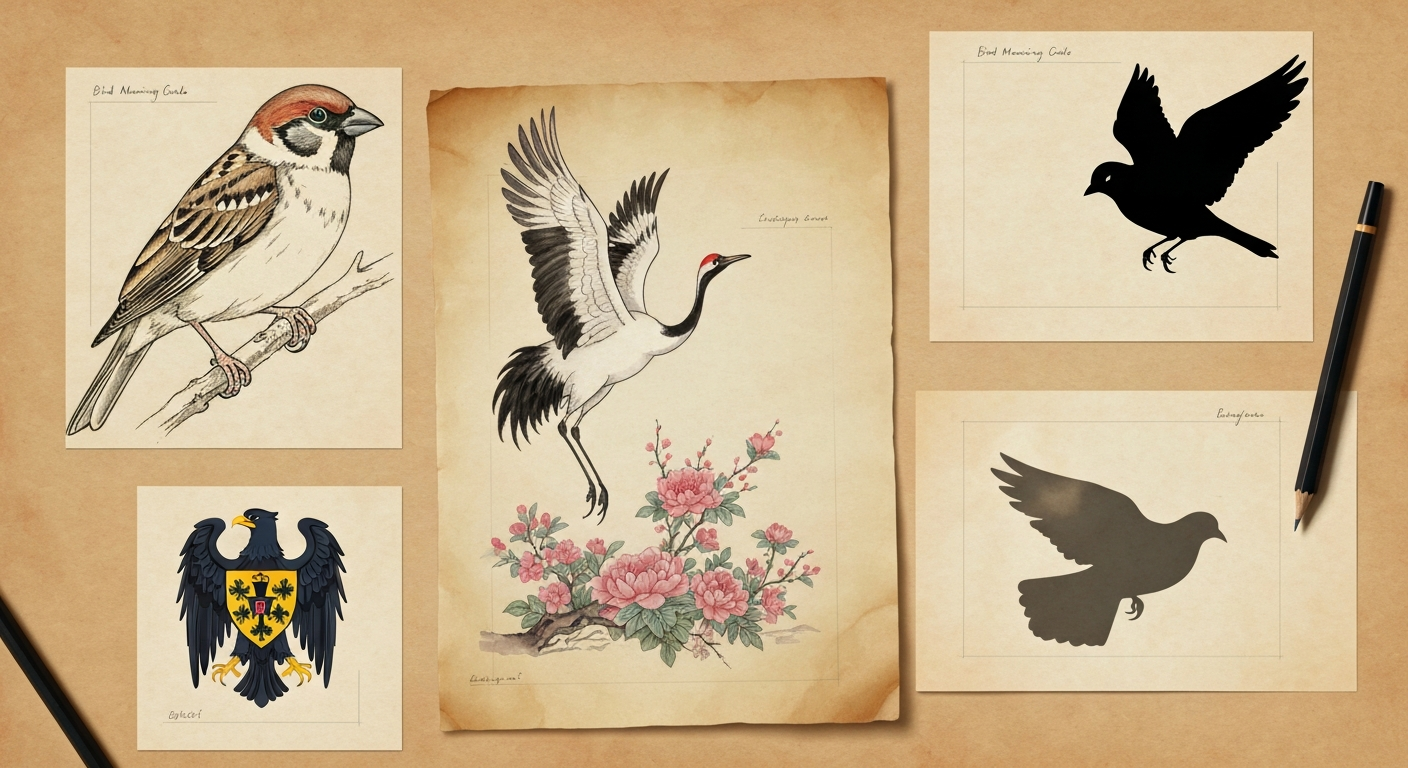
The same bird species drawn in different styles produces genuinely different messages. This matters for anyone trying to interpret an image, design a piece of art, or decode what a brand or crest is communicating. The table below gives a quick comparison across the major styles covered in this guide. For a focused discussion, see bird drawing top view, which explains what looking down on a bird implies.
| Style | Visual character | Primary associations | Typical contexts |
|---|---|---|---|
| Detailed line drawing | Species-specific features, visible feathers, eye detail | Accuracy, nature, scientific record, personal journaling | Field guides, tattoos, editorial illustration, journaling |
| Painting (color, texture) | Medium visible (ink wash, oil, watercolor), mood-driven | Artistic intent, emotion, cultural tradition, luxury | Fine art, East Asian bird-and-flower tradition, home decor |
| Silhouette | Pure outline, no internal detail, high contrast | Anonymity, universality, strong graphic signal | Logos, wayfinding, memorial art, minimalist design |
| Top view (aerial) | Bird seen from directly above, wings spread | Freedom, overview, surveillance, migration, transcendence | Map illustration, aviation branding, spiritual art |
| Shadow | Cast shape only, disconnected from a visible bird body | Indirection, hidden presence, threat or mystery, the unconscious | Horror and thriller imagery, psychological symbolism, poetry |
Bird drawing top view, what looking down on a bird actually implies
A bird seen from directly above, wings fully spread, body foreshortened to a cross-like shape, is one of the most visually powerful orientations in bird imagery. The aerial perspective implies an observer who is higher than the bird, or a bird so high in flight that we see it from a godlike vantage point. Both readings push toward transcendence, freedom from earthly constraints, and the kind of broad overview associated with wisdom or divine sight.
In practical design and illustration, the top-view bird is common in aviation branding, military insignia, and spiritual iconography precisely because it communicates command and elevation at a glance. The spread wings read as maximal, there is nothing held back. Migration imagery leans on this perspective too: think of those Audubon-style flyway maps that show thousands of birds as top-view dots crossing a continental map. The form also has a strong graphic quality, it reads cleanly at small sizes, which is why it appears in stamps, coins, and app icons.
One ornithological note worth keeping in mind: real birds in top-view flight are actually in an energetically demanding phase, actively working their wings rather than soaring. The symbolic reading of effortless freedom doesn't always match the literal physical reality, which is a useful reminder that symbolic meanings layer cultural projection onto natural behavior rather than simply describing it.
Bird painting meaning, when texture, medium and intent shape the message
A bird painting operates differently from a line drawing because the medium itself carries meaning. The visible brushwork in a Chinese ink-wash bird painting signals a trained artist working in a tradition that values the spontaneous gesture as much as the subject. A tightly rendered oil-on-canvas songbird from the Dutch Golden Age signals careful observation, the collector's market, and the vanitas tradition of art that meditates on fragility and the passage of time. The art-historical method, describe what you see, situate the maker and audience, then map plausible meanings while noting what you cannot verify, is the right framework here rather than jumping straight to symbolic claims. For a concise explanation of bird painting meaning, see bird painting meaning.
East Asian bird-and-flower painting (kachoga in Japanese, huaniao in Chinese) is the tradition most associated with layered bird symbolism in fine art. Particular species carry specific meanings: cranes signal longevity and good fortune, mandarin ducks signal marital fidelity, and sparrows signal cheerfulness and simplicity. These meanings are culturally specific and historically documented in museum collections, the British Museum's netsuke collection, for instance, contains numerous bird objects where the species identity is the primary symbolic key. If you are reading a bird painting without knowing its cultural context, hold the symbolic reading loosely.
Texture also matters in Western fine art. A smoothly rendered dove reads as serene; a roughly painted crow with visible impasto reads as raw or disturbing. Medium choices (watercolor versus oil versus etching) carry their own established connotations that compound the bird's symbolic charge. A bird painted in a fragile, translucent watercolor wash reads differently from the same bird carved in bronze, even if the species and posture are identical.
Bird silhouette meaning, simplicity that carries enormous symbolic weight
A bird silhouette strips the image down to pure shape, and in doing so it trades species-specific meaning for universal symbolic force. When you cannot see the color, the eye, or the feather detail, the bird becomes an archetype rather than an individual. That is exactly why silhouettes are the go-to choice for logos, memorial artwork, and wayfinding: the image communicates instantly, at any size, in any color, to any viewer regardless of ornithological knowledge. For a focused explanation of bird silhouette meaning, see the dedicated section on silhouettes.
The meaning of a bird silhouette leans heavily on overall shape and posture. A silhouette of a bird in flight reads as freedom, movement, or aspiration, the reading that Twitter's famous blue bird icon traded on for years. (That logo began as a purchased stock illustration by British designer Simon Oxley and was later refined in-house, a reminder that even iconic symbols have practical, commercial origins.) A perched silhouette reads as watchfulness or calm. A silhouette of a flock in V-formation immediately reads as migration, teamwork, or the changing of seasons.
Because a silhouette is anonymous, it can function as a universal stand-in for any bird you need it to be. That anonymity is also its limitation: if the specific species matters to your message (and in many cultural and spiritual traditions it does), a silhouette is not the right choice. The flip side is that a silhouette is nearly impossible to misidentify culturally, it travels well across different audiences.
Bird shadow meaning, indirection, projection and the unseen presence
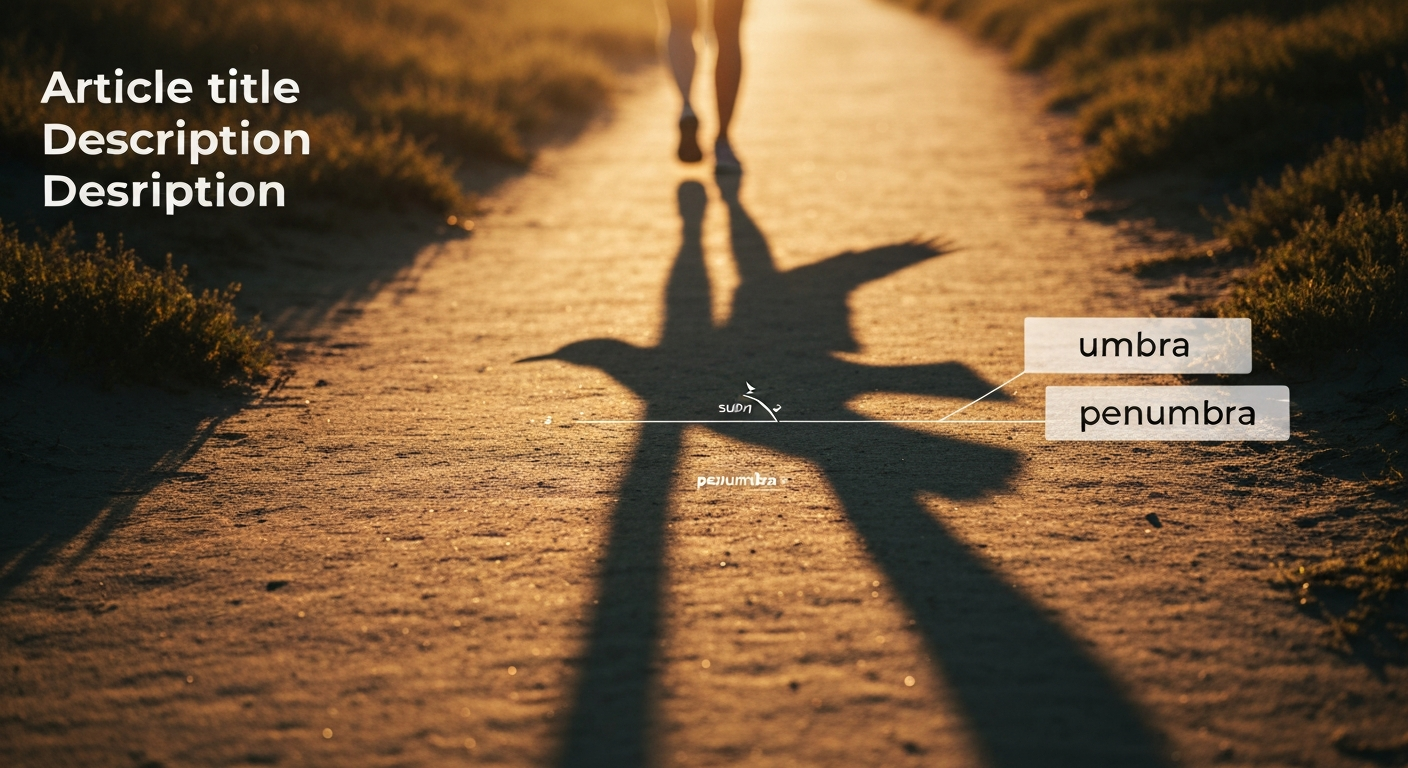
A bird shadow is the most psychologically complex of these visual forms. For a deeper reading, see the section on bird shadow meaning. Unlike a silhouette, which is the bird itself reduced to outline, a shadow implies the bird is present but not directly visible. The bird is elsewhere, out of frame, and what we see is only its projection. That disconnect between cause and visible effect makes the shadow a natural symbol for hidden forces, the unconscious, premonition, and things that influence us without being fully seen.
In horror and thriller visual language, a large bird shadow falling across a figure is a classic signal of threat or doom. In more contemplative contexts, poetry illustration, meditation imagery, spiritual art, a bird shadow can signal the nearness of something transcendent that cannot quite be looked at directly. The shadow of a dove is used this way in some Christian iconographic traditions, where the Holy Spirit's presence is implied rather than depicted literally.
One practical note for interpreters: the distortion inherent in shadows (elongation, flattening, loss of species detail) means that a bird shadow is even more culturally open than a silhouette. Almost any projected meaning can attach to it. That interpretive openness is both its power and a reason to treat shadow-based symbolic claims with a degree of skepticism unless they are grounded in a specific, well-documented tradition.
Emblems and heraldry, bird crest meaning and what traditional crests are actually saying
Heraldry is the closest thing Western culture has to a formal, rule-governed system of bird symbolism, and it is a genuinely useful reference point for anyone trying to decode a crest, coat of arms, or emblem. See bird crest meaning for a concise guide to heraldic terminology and common interpretations. The foundational text in English heraldry, Arthur Charles Fox-Davies's A Complete Guide to Heraldry (1909), dedicates substantial space to birds as heraldic charges and their conventional postures, and those conventions are still the basis for how bird crests are read today.
In heraldic practice, the eagle is the most prestigious bird charge and almost always appears 'displayed', facing forward, wings spread, both sets of talons visible. This posture signals sovereignty, imperial power, and martial strength. It is not an arbitrary choice: the fully displayed eagle is physically impossible for a living bird to hold for long, which is part of what makes it read as superhuman. The dove 'close' (wings folded, standing) signals peace, purity, or the Holy Spirit, and has been used in the arms of religious institutions for centuries. The raven in heraldry signals wisdom or, in some regional traditions, battle and death. The crane 'in its vigilance', standing on one leg with a stone in the raised foot, is a specific heraldic emblem for watchfulness and care.
English and German heraldic conventions differ notably in how they depict the eagle specifically. English heraldry uses the fully displayed posture as default; some German traditions use the single-headed eagle with wings in a half-spread 'vol' position. Both mean power, but the visual form differs enough that cross-reading them without knowing the regional tradition can lead to errors. Contemporary heraldry summaries from practice communities confirm these distinctions remain meaningful in active use. A recent SCA/LoAR summary, 'Some birds and the postures in which they are found in period English heraldry (SCA/LoAR summary)', documents default bird postures and regional (English vs German) conventions for crest interpretations.
For designers working with bird crests or emblems today, the practical guidance is: identify the species first, then the posture using a heraldic glossary, then the tincture (color), because each element is meaningful and conventionally defined. A bird crest is not decorative in the same way a pattern is, each choice was originally intended to communicate specific claims about identity, virtue, and lineage.
Common heraldic birds and their traditional meanings
| Bird | Standard heraldic posture | Traditional meaning | Example use |
|---|---|---|---|
| Eagle | Displayed (wings and legs spread) | Sovereignty, power, imperial authority | Holy Roman Empire, USA Great Seal, German national emblem |
| Dove | Close (wings folded) or rising | Peace, purity, the Holy Spirit | Religious institutions, pacifist emblems |
| Raven | Perched or rising | Wisdom, battle, foresight | Isle of Man, Danish royal history, Nordic traditions |
| Crane | In its vigilance (one leg raised, holding stone) | Watchfulness, vigilance, care | Scottish clan arms, some civic arms |
| Peacock | In his pride (full tail displayed) | Vanity, beauty, incorruptibility | Juno's emblem in classical tradition, some civic arms |
| Martlet | No legs shown (heraldic convention) | Ceaseless motion, younger sons, perpetual quest | Common English family arms for fourth sons |
Spiritual and cultural meanings, a broad but honest map
Across the world's major spiritual traditions, birds appear with remarkable consistency as messengers between the human and the divine. In ancient Egypt, the Bennu bird, a heron-like deity, was associated with solar renewal, the primordial mound of creation, and the resurrection themes that later fed into Greek and Roman phoenix legends. The ibis-headed god Thoth governed writing and wisdom, so the ibis in Egyptian visual culture signals knowledge and the scribal arts. The ba, depicted in the Book of the Dead as a human-headed bird, was the aspect of the soul that could travel between the living world and the afterlife, making it one of the earliest visual symbols for the soul's freedom from the body.
In Judeo-Christian tradition, the dove's symbolic centrality is thoroughly documented: it returns to Noah's ark with an olive leaf, signaling the end of the flood; it appears at Jesus's baptism as a visible form of the Holy Spirit. These two appearances alone cemented the dove as the most loaded single-bird symbol in Western visual culture. In Islamic art, birds appear frequently as souls, messengers, or divine attributes, and Farid ud-Din Attar's twelfth-century poem The Conference of the Birds uses a flock of birds seeking the mythical Simorgh as an extended metaphor for the soul's journey toward God.
Folklore traditions add another layer. The Greenwood Encyclopedia of Folktales documents recurring bird tale motifs across cultures: birds as soul-travelers, birds that can identify a murderer, the contest where the wren outsmarts the eagle to become king of birds. These tale-type motifs are found from Celtic tradition to South Asian folklore, which is evidence of their deep psychological resonance, not evidence, it should be stressed, that they encode a universal spiritual truth.
Bird drawings in dreams, what the research actually supports
Dream interpretation is one of the most popular contexts in which people search for bird drawing or bird image meanings, and it is also where the most caution is warranted. The neuroscientific consensus, anchored by Hobson and McCarley's foundational activation-synthesis model, is that dreams are generated by brain-state processes and that the images produced reflect the dreamer's own stored associations, emotional state, and recent experiences, not universal symbolic messages. See The brain as a dream state generator: an activation–synthesis hypothesis (Hobson & McCarley, 1977, PubMed) for the original framing of dreams as imagery generated by brain-state processes. This doesn't mean dream imagery is meaningless, but it does mean that no pop-psychology list of bird dream meanings can reliably tell you what your dream signified.
What is more useful is to note what the bird in your dream was doing, how you felt about it, and what associations the bird holds for you personally and culturally. A person raised in a tradition where owls signal death will have a very different emotional response to a dream owl than someone raised in a tradition where owls signal wisdom. The bird's behavior in the dream (landing on you, flying away, being injured, singing) and your emotional reaction to it are more diagnostically interesting than the species alone. If recurring dream imagery involving birds is causing distress, that is worth exploring in a therapeutic context rather than through a symbol dictionary.
Bird drawings in logos and motifs, what brands and designers are really communicating
Brand and design use of bird imagery follows patterns that are now well-documented in logo history and branding case studies. The core associations that drive bird use in logos are: freedom, movement, speed, communication, and trustworthiness. Airlines have leaned on wing and bird imagery since the earliest days of commercial aviation, the visual language of feathers and flight maps naturally onto the brand promise of safe, swift travel. The prevalence of bird logos in the airline industry is so consistent that it functions almost as a visual shorthand for the sector.
In tech and communication brands, the bird signals connection and the rapid transmission of messages, which is exactly what Twitter made explicit with its bird icon. For more on how brands use bird imagery, see bird logo meaning. The choice of a small, agile passerine shape (rather than a hawk or eagle) kept the Twitter bird approachable and playful rather than authoritative. This is a design decision, not a symbolic accident: the species-feel of a logo bird is a deliberate tonal choice.
Bird motifs in decorative and textile design function slightly differently from logos. A repeating bird motif on wallpaper or fabric draws on a long history of nature-pattern decoration that signals natural abundance, craft skill, and, depending on the specific birds and style, cultural affiliation. William Morris's bird designs, for instance, draw on medieval tapestry traditions to signal a specific, historically conscious aesthetic. Knowing what tradition a motif comes from is the key to reading it accurately. For a focused discussion of bird motif meaning in decorative arts, see the linked resource.
A practical checklist for interpreting any bird drawing
Whether you are analyzing a tattoo, decoding a coat of arms, trying to understand an album cover, or just curious about an image you encountered, this checklist gives you a structured way in.
- Identify the species if possible. Species identity is the first and most specific layer of meaning. A robin is not a raven; a crane is not a stork. Use a field guide or image-search tool to narrow it down before applying symbolic readings.
- Note the artistic style. Is it a detailed drawing, a painting, a silhouette, a shadow, or a top-view? Each style carries its own symbolic register as outlined in this guide.
- Read the posture. Wings spread or folded? Upright or hunched? Mid-flight or perched? Posture is the most consistent cross-cultural cue.
- Note the direction. Facing or flying right (the viewer's left): forward, future, progress. Facing left: return, memory, guardianship.
- Count the birds. Solo: individuality or solitude. Paired: partnership or love. Flock: community, migration, collective force.
- Consider the color (if present). Treat color associations as culturally specific. White, black, red, and gold each carry very different readings in different traditions.
- Identify the cultural or historical context. A heraldic bird follows heraldic rules. A Japanese ink painting follows East Asian conventions. A brand logo follows design logic. Do not apply one tradition's readings to another.
- Check what you actually know versus what you are inferring. Separate what is documented in the tradition from what feels symbolically plausible. Both can be noted, but keep them distinct.
- If it is a dream image, focus on your personal associations and emotional response, not a universal symbol dictionary.
Separating real bird behavior from symbolic projection
One of the more useful reality-checks when reading bird symbolism is to know what the bird actually does in nature, because symbolic meanings often start from observed behavior and then get amplified or distorted. Migratory birds like swallows and storks have been symbols of seasonal return and renewal for millennia precisely because people observed them disappearing in autumn and returning in spring. That behavioral reality is the root of the symbol. The Cornell Lab of Ornithology's eBird database and the Audubon Bird Migration Explorer now give anyone access to detailed, data-rich migration tracking, so if you want to ground a symbolic reading in actual avian behavior, the tools exist.
Where symbolic readings detach most sharply from literal biology is in attributions of intentionality. A crow is not carrying a message; a raven landing on your roof is not making a prediction. Ravens and crows are highly intelligent birds with complex social behaviors, but their behavior around human structures is driven by food availability, territorial ranges, and learned responses, not supernatural knowledge. The symbolic readings are human projections onto real behaviors. Both the projection and the biology are interesting; conflating them leads to confusion.
Why the same bird drawing can mean very different things
The fundamental reason bird drawings don't have a single fixed meaning is that meaning is always made in context. The same image of an eagle with spread wings means imperial power on a German coat of arms, national identity on a US passport, and free delivery on an e-commerce brand. None of these readings is wrong; all are generated by the specific context in which the image appears and the expectations of the audience reading it. This is the core lesson of visual semiotics and art-historical method: images do not contain meaning the way a container holds water. They produce meaning in the encounter between image, context, and viewer.
That said, certain associations are so consistent across so many different cultures and time periods, birds as freedom, birds as messengers, birds as souls in transit, that they function almost like defaults. When you encounter a bird drawing without any additional context, those default readings are reasonable starting points. Just hold them lightly, and let the specific details of posture, species, style, and setting refine the reading as you gather more information.
FAQ
Quick summary: What does a bird drawing generally mean?
Concise answer: A bird drawing usually signals ideas about freedom, movement, communication, transformation or identity, but its precise meaning depends on context (style, species cues, posture, cultural tradition and the creator’s intent). Treat the drawing first as an image to describe (shape, color, number, direction, posture) and then as a sign carrying culturally layered associations—artistic, emblematic (logo/crest), spiritual/dream, or folkloric—while checking literal bird behavior and avoiding universal symbolic claims without cultural evidence.
How do meanings differ by artistic style (drawing, painting, silhouette, top view, shadow)?
Stylistic breakdown: - Detailed drawing/painting: invites species- or emotion-specific readings (a perched sparrow vs. a soaring hawk); detail signals realism, narrative or portraiture. - Silhouette: emphasizes shape and movement; often used to suggest archetypal ideas (flight, mystery, anonymity). - Top view: unusual viewpoint that can imply surveillance, map-like abstraction, or design/ornithological study. - Shadow: suggests indirect presence, hidden aspects, omen or subconscious content (useful in dream or poetic contexts). For each style, analyze visual cues (pose, size, direction, wing position) and provenance to avoid overreading.
What does a bird mean when used as a logo, crest or motif?
Emblematic uses: - Logo: designers commonly use bird marks to evoke motion, freedom, communication, trust or speed (e.g., social platforms and airlines). Modern branding choices are pragmatic and tested for recognizability. - Crest/heraldry: birds are conventional charges with standardized postures and meanings (e.g., eagle 'displayed' = power, dove = peace); heraldic glossaries and historical practice guide interpretation. - Motif (textiles, decorative art): meanings are culturally specific (East Asian bird-and-flower motifs often connote seasons or auspicious wishes). Check provenance, historical usage and patronage for accurate readings.
What do bird drawings typically signify in spiritual or dream contexts?
Spiritual/dream reading: Birds in dreams or devotional art commonly symbolize transcendence, messages, the soul or renewal. However, neuroscience and dream-research caution against one-size-fits-all decoding: dream images arise from brain-state processes and personal associations. Treat spiritual readings as culturally and personally situated—ask about the dreamer’s emotional tone, recurring motifs and cultural background before assigning meaning.
How do folk superstition and slang treat bird images?
Folk meanings: Folktales and local superstitions assign birds roles as omens, tricksters, messengers or soul-carriers (e.g., the wren as 'king of birds' in some European tales). Slang and proverbs also embed bird images (e.g., 'early bird' = punctuality). These readings are regionally variable—always cite ethnographic or folkloric sources rather than assuming universality.
How can I separate literal bird behavior from symbolic interpretation (behavioral/ornithological checks)?
Literal-check checklist: 1) Identify species cues (beak shape, tail, size). 2) Consult field authorities (Cornell Lab, Birds of the World, HBW) for species behavior (migration, feeding, flocking). 3) Ask whether the image depicts a natural posture or an anatomically impossible gesture (the latter signals symbolic intent). 4) Consider seasonality or habitat cues in the image. 5) If the depiction matches known bird behavior, prioritize naturalistic explanations before symbolic ones.
Next Article
Bird Shadow Meaning: Literal, Dream, and Symbolic Guide
Bird shadow meaning: literal, dream, symbolic, cultural and artistic takes plus how to interpret sightings.