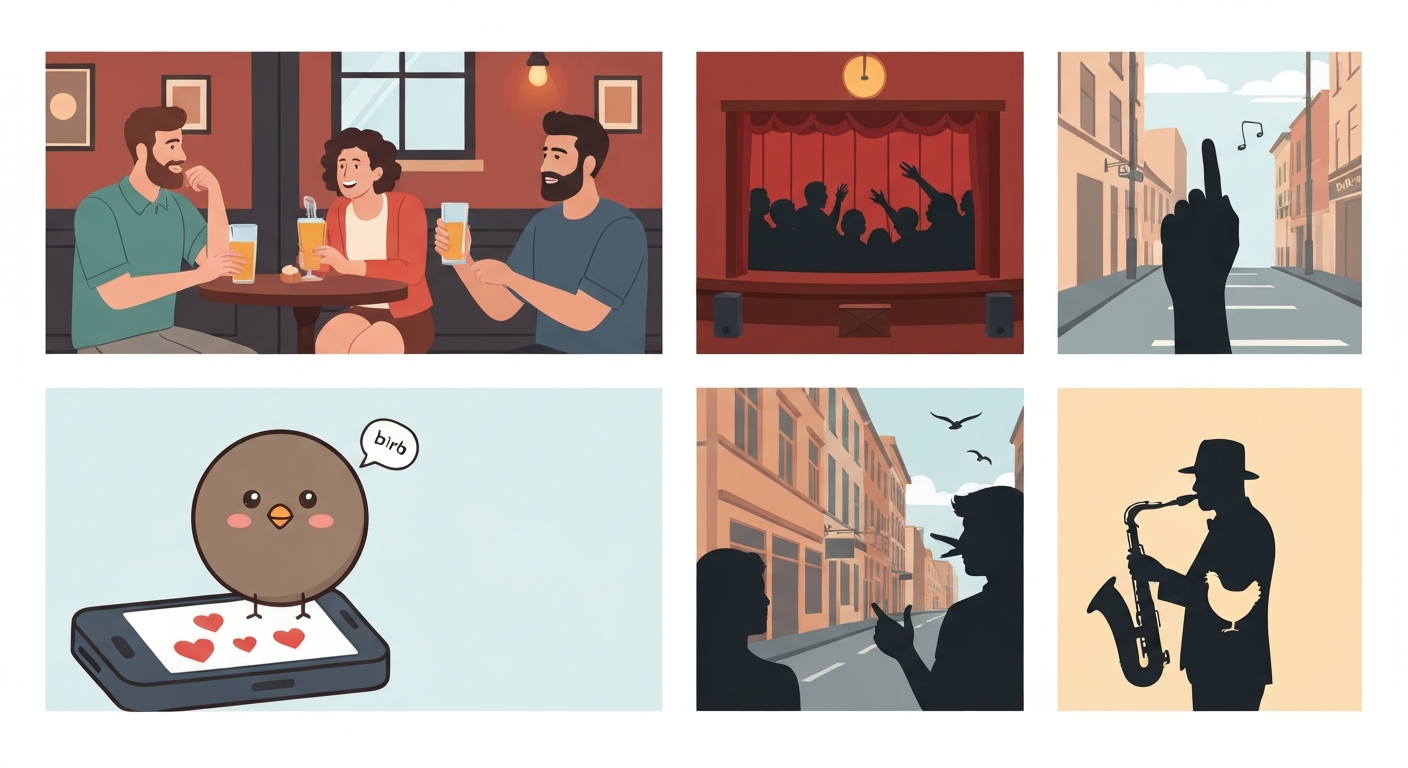
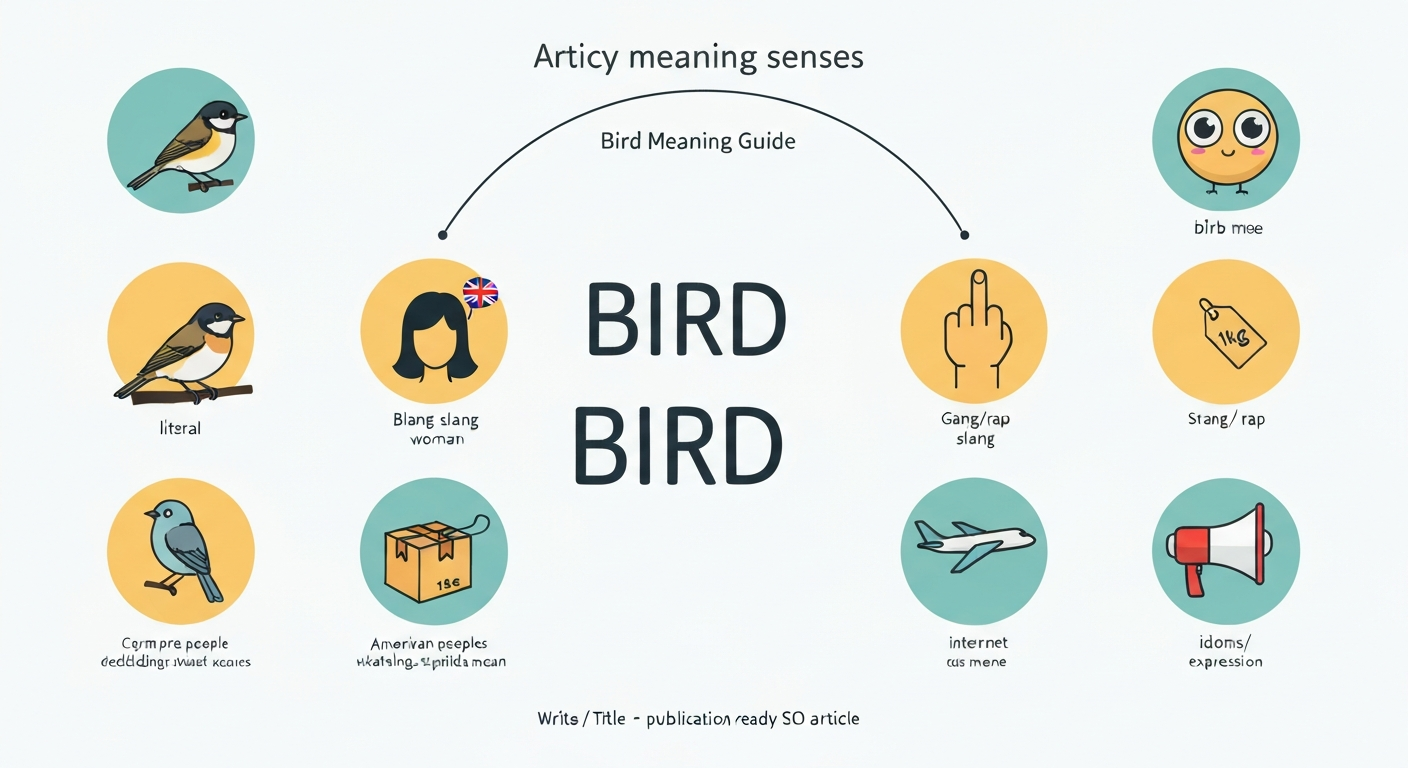
When someone drops a 'bird' joke or uses the word in conversation, they could mean a feathered creature, a woman (British slang), an obscene hand gesture (American slang), a kilogram of cocaine (gang/rap slang), a helicopter or aircraft (aviation), a prison sentence (institutional slang), or simply a quirky internet term of endearment ('birb'). The word 'bird' is one of the most context-dependent words in the English language, and reading it wrong, especially in a joke, can land you somewhere embarrassing. This guide breaks every major sense down so you can decode it correctly, wherever you encounter it.
Bird Joke Meaning: Decode Slang, Idioms & Regional Uses

Marcus Holloway
28 Jul 2026
Why 'bird' means so many different things
The Old English root is bridd, which originally meant a young bird or nestling, not any adult bird. Its broader modern meaning developed through Middle English, and linguists note there are no clear cognates in other Germanic languages, meaning the word's origins beyond Old English remain genuinely uncertain. That ambiguity at the root level mirrors how the word behaves today: it sprawls across literal, figurative, regional, and subcultural meanings with very little shared signaling between them. Jokes exploit that sprawl deliberately, using the word's innocuous surface to hide a sharper or ruder meaning underneath.
If you're already exploring slang senses of 'bird' more broadly, you'll find that the word behaves differently depending on whether you're decoding it as British street slang, American colloquial speech, or a specific subcultural code. The sections below untangle each layer systematically.
Literal vs. slang: the quick answer
In its literal sense, 'bird' means exactly what you learned in school: a warm-blooded, feathered, winged vertebrate. Cambridge's primary dictionary entry gives this biological definition first, then notes the informal human sense: 'a particular type of person' (for example, 'He's a tough old bird'). That person-sense is where things branch. In the UK, 'bird' most commonly refers informally to a woman or girlfriend. In the US, the most culturally loaded use is 'flip someone the bird,' meaning to make the middle-finger gesture, which Merriam-Webster documents as standard American slang. In gang and rap contexts, 'bird' can mean a kilogram of a controlled substance. In aviation, it's a casual word for any aircraft. The literal sense only applies when the conversation is genuinely about animals, and even then, speakers occasionally use it as a pet name or a proper noun (think 'Bird' as a nickname for jazz musician Charlie Parker).
How to decode 'bird' in a joke
Jokes using 'bird' almost always rely on one of two mechanisms: a pun that exploits two meanings simultaneously, or a punchline that reveals a slang sense the audience didn't expect. To read it correctly, check four things before assuming meaning.
- Tone and delivery: Is the joke playful and family-friendly, or edgy and adult? A children's riddle about a parrot uses 'bird' literally. A stand-up comedian setting up a punchline about gestures is almost certainly heading toward the American slang sense.
- Audience and setting: A UK pub joke and a US Twitter post carrying the same phrasing can mean completely different things. British audiences will read 'bird' as woman or girlfriend by default in casual speech; American audiences usually won't.
- Region and variety of English: British English, American English, and Australian English all have overlapping but distinct conventions. A joke that reads as innocent in one variety can read as rude or sexist in another.
- Punctuation and emojis: The bird emoji (especially the middle finger emoji or a combination like the hand + bird emoji) in an online context almost always signals the American 'flip the bird' sense. The simple bird or parrot emoji tends to be playful or literal. Context in comments and replies shapes meaning further.
When 'bird' is genuinely literal
Sometimes a bird is just a bird. Ornithology writing, wildlife journalism, birdwatching content, and children's media use the word in its straightforward biological sense. Proper nouns and nicknames also borrow the word without carrying slang weight: 'Bird' was the widely recognized nickname for jazz alto saxophonist Charlie Parker, and it functions as a name with no secondary coding. 'The Bird' is a sports nickname several athletes have carried over the decades. In these cases, capitalization and context signal that you're reading a name, not a slang term. Wildlife behavior writing, for instance, uses phrases like 'the bird pecked at the feeder' that have no double meaning whatsoever. When a nature documentary or field guide is the source, literal is almost always the right read.
British uses: calling someone a 'bird' and giving them 'the bird'
In British English, calling someone a 'bird' has been informal slang for a woman or girlfriend since at least the mid-20th century and remains common in casual speech today, particularly in England. 'She's his bird' means she's his girlfriend. Cambridge lists this use as informal UK slang. It's affectionate in intent among speakers who use it routinely, but it reads as dated or mildly sexist to many listeners, especially younger ones or those outside British working-class vernacular. Using it casually with people you don't know well can misfire.
A separate British expression, 'give someone the bird,' means to boo, jeer, or dismiss someone with contempt. The Oxford Dictionary of Word Origins traces this to theatrical slang from the early 19th century, when audiences would hiss at a bad performance. The hissing of a goose was described as 'the big bird,' and the phrase evolved from there. This is a distinctly different sense from the American 'flip the bird' (the middle-finger gesture), though both involve hostility. In a joke or story set in a British context, 'he got the bird' means he was booed off stage or dismissed rudely, not that anyone made a hand gesture.
American and Australian informal uses
In American English, the most dominant slang use is 'flip (someone) the bird,' which Merriam-Webster defines as making the obscene middle-finger gesture toward someone. It's firmly documented, widely understood, and appears regularly in mainstream media. The gesture itself is the message; the phrase just names it. In casual conversation, 'bird' alone rarely carries this meaning, you need 'flip' or 'give' in front of it for the gesture sense to activate.
In gang and rap slang, especially in American urban speech, 'bird' or 'birds' can refer to kilograms of cocaine or, by extension, other controlled substances. This sense appears heavily in hip-hop lyrics and requires subcultural knowledge to decode. If a song lyric or street conversation refers to 'moving birds' or 'trapping birds,' this is the likely meaning. Treat this reading carefully and never assume it applies outside clearly subcultural contexts.
In Australian English, 'bird' picks up some of the British woman-sense but also carries the general informal sense of 'person' (as in 'tough old bird,' which is widely understood across British and Australian English alike). Australian slang skews toward the British model more than the American one for this word, so the hissing/theatrical 'bird' and the woman-sense both translate reasonably well across the two varieties.
Common idioms with 'bird' and what they actually mean
Several bird idioms are so established they appear in major learner's dictionaries (Oxford Advanced Learner's, Cambridge, Merriam-Webster) as standard entries. Here's a concise rundown with sample lines and verified origin notes. For a focused list and clear explanations, see the guide on bird idioms meaning.
| Idiom | Meaning | Sample sentence | Origin note |
|---|---|---|---|
| The early bird catches the worm | Acting earlier than others gives you an advantage | 'I was at the gate before opening — the early bird catches the worm.' | Recorded in John Ray's A Collection of English Proverbs (1670) |
| Kill two birds with one stone | Accomplish two goals with one action | 'I'll stop by the post office and the pharmacy — kill two birds with one stone.' | Attested in English by the 1650s |
| A little bird told me | You received information from an unspecified (often secret) source | 'A little bird told me you're leaving the company — is it true?' | Familiar form appears in print at least by Frederick Marryat's Peter Simple (1833/1834) |
| Bird's-eye view | A view from above; a broad overview of a topic | 'Let me give you a bird's-eye view of the project before we dive into details.' | Listed in Merriam-Webster and Cambridge; both literal and figurative senses are standard |
| Birds of a feather (flock together) | People with similar characters, interests, or habits tend to associate | 'Those two are always together — birds of a feather.' | Proverbial; attested in English since the 16th century |
| Free as a bird | Completely free, unencumbered | 'Once the contract ended, she was free as a bird.' | Attested since at least the 17th/18th centuries; invokes flight as a metaphor for liberty |
| Birdbrained | Silly, scatterbrained, or stupid (informal insult) | 'Don't be birdbrained — read the instructions first.' | First attestations around the 1920s; documented in Dictionary.com |
What Urban Dictionary adds, and why to use it carefully
Urban Dictionary entries for 'bird' capture a wide range of user-submitted, community-voted definitions that formal dictionaries haven't caught up with yet. See Urban Dictionary's 'bird' entry for crowd-sourced examples of contemporary slang and meme uses. For a concise glossary of slang senses, see our bird definition slang resource. The top-rated entries typically cover: the British woman/girlfriend sense (contributed by UK users), the drug-quantity sense (heavy US representation), playful internet variants like 'birb' (the affectionate misspelling used in meme culture for cute bird photos), and occasionally more crude or derogatory applications. Some entries are sharp and genuinely useful for decoding a specific subculture. Many others are joke entries, personal grudges, or regional in-jokes that reflect one city block rather than any widespread usage.
The practical rule: Urban Dictionary is a useful starting point for identifying that a slang sense exists, but it shouldn't be your only source. Check how many upvotes an entry has, look at the example sentences (they often reveal the actual register and context more than the definition does), and cross-reference with a major dictionary or a corpus like COCA or the BNC if you're relying on it for something important. Treat UD the way you'd treat overhearing one person explain something at a party: informative but not definitive. The 'birb' usage, for instance, is genuinely widespread in online communities as an affectionate term for small birds, you'll see it across Reddit, Twitter, and TikTok, but it's humor-coded and self-aware rather than neutral slang.
Yard bird and other specialized terms
The term 'yard bird' (or 'yardbird') has a few distinct meanings depending on the context, and getting them confused is a common mistake. In its most basic sense, it refers to a chicken, a bird kept in a farmyard. In World War II US military slang, 'yardbird' meant a new recruit or a soldier assigned to menial outdoor labor, often as punishment. In prison slang, it refers to an inmate, particularly one who spends time in the prison yard. And it was the original nickname behind Charlie Parker's 'Bird', 'Yardbird Parker' was his full nickname before it shortened to 'Bird,' a reference to his love of chicken. When you encounter 'yardbird' in a song lyric, a historical text, or a joke, the context (military, culinary, musical, or institutional) determines which sense applies.
Similar specialized bird-terms include 'jailbird' (a person who has been in prison), 'snowbird' (someone who migrates to warmer climates in winter, or in drug slang a cocaine user), and 'stool pigeon' (an informer). Each borrows from actual bird behavior or appearance and maps it onto human behavior, which is a pattern worth recognizing as its own category of meaning.
Behavior-based metaphors: when bird habits describe people
A substantial category of 'bird' meanings draws directly from how birds actually behave. See bird behavior meaning (slang) for a focused look at how actual bird behavior maps onto slang senses. These metaphors are grounded in observation, which is part of why they've stuck.
- Flighty: A person described as 'flighty' is restless, unreliable, or prone to sudden changes of mind — drawn from the image of birds that startle and take off without warning.
- Nesting: 'Nesting behavior' in humans refers to the instinct (particularly associated with late pregnancy) to prepare and organize a home environment, directly borrowed from birds building nests before hatching eggs.
- Pecking order: The social hierarchy within a group — who has authority over whom — comes directly from observations of chicken and bird flocks, where dominant animals literally peck subordinates. The term is now standard in business and social commentary.
- Early riser: The 'early bird' metaphor (from the proverb) applies to any person who wakes or acts before others, framing punctuality and initiative as bird-like virtues.
- Bird's-eye view: Beyond the idiom, describing someone as having a 'bird's-eye perspective' on an issue implies they can see the whole picture from above, unencumbered by ground-level detail.
- Free as a bird: Used to describe someone who has escaped obligation, debt, a relationship, or a legal situation — the flight metaphor emphasizes total freedom of movement.
These behavior-based metaphors are rarely slang and rarely rude. They're embedded in standard English and tend to be understood across all regional varieties. When a joke uses one of these, the humor usually comes from applying the metaphor in an unexpected or exaggerated way rather than from the word 'bird' itself carrying hidden meaning.
Regional and language-specific meanings
'Bird ka meaning' and Hindi translations
Searches for 'bird ka meaning' come predominantly from Hindi-speaking users looking for the English-to-Hindi translation or vice versa. In Hindi, the standard word for bird is pakshi (पक्षी), which is rooted in Sanskrit and used in formal and written contexts. The more commonly used everyday word in spoken Hindi and Urdu is panchhi (पंछी) or chidia (चिड़िया), the latter especially for small birds. If someone is asking about 'bird ka meaning' in a slang context (for instance, after seeing it in an English song or meme), they're likely looking to understand whether the English slang sense applies, and the answer depends entirely on which English slang sense (British woman, American gesture, drug quantity) was in use in the source material.
For other languages and regional English varieties, the mapping is similarly context-dependent. In Australian English, 'bird' as woman is understood but slightly more dated than in UK English. In Irish English, 'bird' as girlfriend or young woman remains in common informal use. In Caribbean English varieties, different bird-based terms carry their own local meanings and should be checked against regional dictionaries rather than assumed to follow British or American conventions.
Offensive, dated, and problematic readings to watch out for
Several 'bird' senses carry real potential for offense, and it's worth naming them directly. Using 'bird' to refer to a woman in professional or formal settings is widely considered sexist and reductive, even in the UK where the slang originated, it reduces a person to an object of casual labeling. If you're repeating a joke that hinges on 'bird' meaning woman, be aware of who's in the room and what the joke is actually doing.
The 'birdbrained' insult, while common and dictionary-documented, is ableist in framing: it equates low intelligence with a small brain size and uses that as a put-down. Dictionary.com records 'birdbrain' (also bird‑brained) as an insulting slang noun for a stupid or scatterbrained person, with attestations dating from the early 20th century (around the 1920s) Dictionary.com entry for 'birdbrain'. This doesn't mean you can't explain what it means, but repeating it as a joke at someone's expense lands differently depending on context.
Some Urban Dictionary entries for 'bird' are deliberately provocative, misogynistic, or racist, submitted as jokes or cultural aggression rather than genuine documentation. Encountering one of these doesn't mean the meaning is real or widespread, it means someone posted it. Upvote counts and example sentences help you gauge whether a UD entry reflects actual use or just one person's attempt at edginess. When in doubt, cross-reference with a mainstream dictionary before deciding something is common usage.
Quick cheat sheet: one-line meanings at a glance
| Sense | Meaning | Example |
|---|---|---|
| Literal | A feathered, winged animal | 'A bird landed on the feeder this morning.' |
| British slang (woman/girlfriend) | An informal, sometimes dated term for a woman or girlfriend | 'Is that his bird?' (UK casual conversation) |
| American slang (gesture) | To flip someone the middle finger | 'She flipped him the bird in traffic.' |
| Give someone the bird (British) | To boo, jeer, or dismiss with contempt | 'The crowd gave the comedian the bird.' |
| Gang/rap slang | A kilogram of cocaine or similar substance | Used in hip-hop lyrics; requires subcultural context |
| Yardbird (chicken) | A farmyard bird; a chicken | 'Fried yardbird' on a Southern American menu |
| Yardbird (prison/military) | An inmate or a low-ranking soldier on labor duty | WWII military slang; still appears in historical fiction |
| Bird (aviation) | Any aircraft, informally | 'The bird is on the runway.' (pilot or aviation slang) |
| Birb (internet) | Affectionate misspelling for cute birds in meme culture | 'Look at this tiny birb!' |
| Bird (jazz nickname) | Charlie Parker's nickname, short for Yardbird | 'Bird played alto sax like no one before or since.' |
| Behavior metaphor | Describing human traits via bird behavior (flighty, nesting, etc.) | 'She's been nesting all week — baby's almost due.' |
Where to look next
If you're trying to decode a specific bird-related joke or expression and none of the above senses fit cleanly, there are a few directions worth exploring. For a concise overview of those slang senses, see our article on bird slang meaning. For symbolic or spiritual meanings, for instance, if a dream or a recurring encounter with a particular bird feels significant, dream interpretation and cultural symbolism resources go much deeper than slang dictionaries can. Different bird species carry their own symbolic weight across cultures: owls, ravens, robins, and hummingbirds all have rich interpretive traditions that are separate from the slang landscape entirely.
For idiom lists beyond the ones covered here, Oxford Advanced Learner's Dictionary and Cambridge both maintain searchable entries. For regional and corpus-verified frequency data, if you want to know how often 'bird' appears as woman-slang in British vs. Australian English, for example, the British National Corpus (BNC) covers late-20th-century British English in spoken and written genres, while the Corpus of Global Web-Based English (GloWbE, ~1. For corpus documentation and overviews see COCA / GloWbE (Mark Davies, BYU corpora), and British National Corpus documentation (NatCorp) COCA / GloWbE (Mark Davies, BYU corpora) — and British National Corpus documentation (NatCorp);%20https://www.natcorp.ox.ac.uk/%20(BNC%20documentation)). 9 billion words across 20 countries) lets you compare country-by-country patterns directly. These tools are free to access and far more reliable than relying on any single dictionary or Urban Dictionary entry when usage frequency or regional spread matters.
For language-specific queries like 'bird ka meaning,' a bilingual dictionary (Hindi-English) combined with understanding which English slang sense you're translating will give you a much cleaner result than a general web search. The literal translation is straightforward; the slang translation requires knowing which slang you started with.
FAQ
What are the literal meanings of 'bird' used in speech or jokes?
Literally, 'bird' refers to a feathered, winged vertebrate (songbirds, raptors, poultry). In jokes or everyday speech a literal reading applies when the speaker is clearly talking about animals, nature, pets, birdwatching, or a physical action like a bird flying or eating. Example: 'Look at that bird on the feeder' = literal. Origin note: English 'bird' comes from Old English bridd, originally meaning a young bird or nestling.
How is 'bird' used as slang for people?
Informally, 'bird' can mean a type of person and carries different connotations by region and tone. British/Australian: 'a bird' often means a woman (colloquial; can be affectionate or dismissive depending on context). 'Tough old bird' = hardy person. U.S. slang: rarer as 'bird' for a person except set phrases (e.g., 'yard bird' for a prisoner or chicken). Playful internet form: 'birb' used to affectionately describe small, round birds. When you hear it, judge tone, speaker relationship, and region.
What common idioms and fixed expressions use 'bird' and what do they mean?
'Bird' appears in many idioms — short list with meanings and examples: - 'The early bird catches the worm' = early action gains advantage. - 'A little bird told me' = I heard this from an unnamed source. - 'Kill two birds with one stone' = accomplish two aims with one action. - 'Bird's-eye view' = an overview or view from above. - 'Free as a bird' = completely free. - 'Birdbrain' = insult for someone perceived as stupid. - 'Flip (someone) the bird' / 'give someone the bird' = make an obscene gesture (U.S.) or boo/jeer (theatrical origin). Use depends on tone; some are proverbs, others are slang or insults.
What does 'yard bird' mean?
'Yard bird' has specialized senses: - U.S. slang: historically slang for a chicken kept in a yard (literal). - Prison jargon/older U.S. slang: an inmate assigned to outdoor yard duties or, by extension, a prisoner. - Military/air force contexts sometimes use 'yardbird' to mean a ground crew member or novice. Read context (setting, era) to pick the right sense.
How should I read 'bird' in a joke — what cues tell me literal vs figurative/slang meaning?
Use context cues: - Topic: nature/animals → literal. - Audience/setting: pub banter, regional comedy → likely slang/colloquial. - Tone: affectionate or whimsical → playful 'birb' or 'a little bird told me'; hostile or mocking → 'birdbrain' or obscene gestures. - Grammar: fixed idioms signal figurative meanings ('early bird...'), whereas modifiers like 'old', 'tough', or 'young' can suggest person metaphors. - Region: British speakers more likely to use 'bird' = woman. If unsure, ask for clarification or consider speaker’s social distance and the audience.
Are any 'bird' uses offensive or dated?
Yes. Some uses can be sexist, insulting, or vulgar: - Calling someone 'a bird' to mean 'woman' can be dismissive or misogynistic depending on tone. - 'Birdbrain' is an insult. - 'Flip the bird' is an obscene gesture. - 'Kill two birds with one stone' is widely used but may offend those sensitive to animal‑violence metaphors; some style guides recommend alternative phrasing. Always consider audience, formality, and whether a less loaded expression would work.
Next Article
Bird Meaning in Slang: Uses, Origins & Regional Variants
Explore 'bird' in slang: insults, affectionate uses, idioms, regional variants, origins, and usage guidance.