In slang, "bird" most commonly means a girl or young woman, especially a girlfriend, in British English. But that's only one slice of the picture. Depending on the phrase, region, and tone, "bird" can also mean a prison sentence, an obscene gesture, or even just a chicken on a diner menu. The word carries completely different meanings depending on who's saying it, where they're from, and what verb or phrase surrounds it. This guide cuts through the confusion and gives you a fast, practical way to decode any "bird" slang sentence you come across.
Bird Definition Slang: Meaning by Context and Examples

Marcus Holloway
8 Apr 2026

What "bird" actually means as slang

The most widely documented slang sense of "bird" is the British English meaning: a girl or young woman, including one's girlfriend. Collins English Dictionary lists this explicitly, and the usage has been tracked in British slang since roughly the early 1900s. If someone in the UK says "she's my bird," they almost certainly mean girlfriend or romantic partner. That's the baseline definition most people searching for "bird definition slang" are looking for.
But the word has a second, completely separate slang life: prison time. This one comes from Cockney rhyming slang, where "bird-lime" rhymes with "time," so "bird" became shorthand for a jail sentence. Green's Dictionary of Slang records "do bird" as serving a prison sentence, and "throw bird" as meaning to imprison someone. Those two meanings, the romantic nickname and the prison term, share nothing except the word itself.
There's a third major phrase-level meaning: "give someone the bird," which Merriam-Webster and Collins both define as making an obscene gesture, specifically the middle finger. And finally, in food and diner contexts, especially in the US, "yard bird" or "yardbird" is straight-up slang for chicken. Four very different meanings, one word. Context is everything.
Common slang uses and example phrases
Here's a quick breakdown of the most common slang constructions involving "bird" and what each one actually means in plain English.
| Phrase / Construction | Plain English Meaning | Region / Context |
|---|---|---|
| "She's my bird" | She's my girlfriend | UK (especially British/Cockney) |
| "Yer bird" / "your bird" | Your girlfriend / your girl | UK slang (informal, lad culture) |
| "Do bird" | Serve a prison sentence | UK (Cockney rhyming slang) |
| "He did bird" / "throw bird" | He served time / to imprison someone | UK prison/criminal slang |
| "Give someone the bird" | Flip someone off (obscene gesture) | UK and US |
| "Yard bird" / "yardbird" | Chicken (the food) | US (diner/food slang) |
| "Birb" | Cute/funny bird (playful internet misspelling) | Online/social media globally |
The phrase "yer bird" is a good example of how regional slang compounds quickly. Know Your Meme documents it as a UK slang term meaning "your girl" or a guy's female partner, and it spread online partly because it sounds both affectionate and casual. Know Your Meme describes “yer bird” as U.K. slang meaning “your girl,” a guy’s female partner or girlfriend UK slang term meaning "your girl". If you see it in a meme or social media comment from someone in the UK, it almost always refers to someone's girlfriend.
The prison slang is worth understanding because it surfaces in British crime dramas, rap lyrics, and older literature. The mechanism is pure Cockney rhyming slang: bird-lime rhymes with time, time equals jail time, so "bird" equals the sentence. Wikipedia's overview of Cockney rhyming slang confirms this as a classic example of the word-construction technique, and multiple slang dictionaries trace the same path. If you're reading a sentence like "he's doing bird" or "she got three years' bird," that's the prison meaning, not anything romantic.
How to tell if "bird" is metaphorical or literal
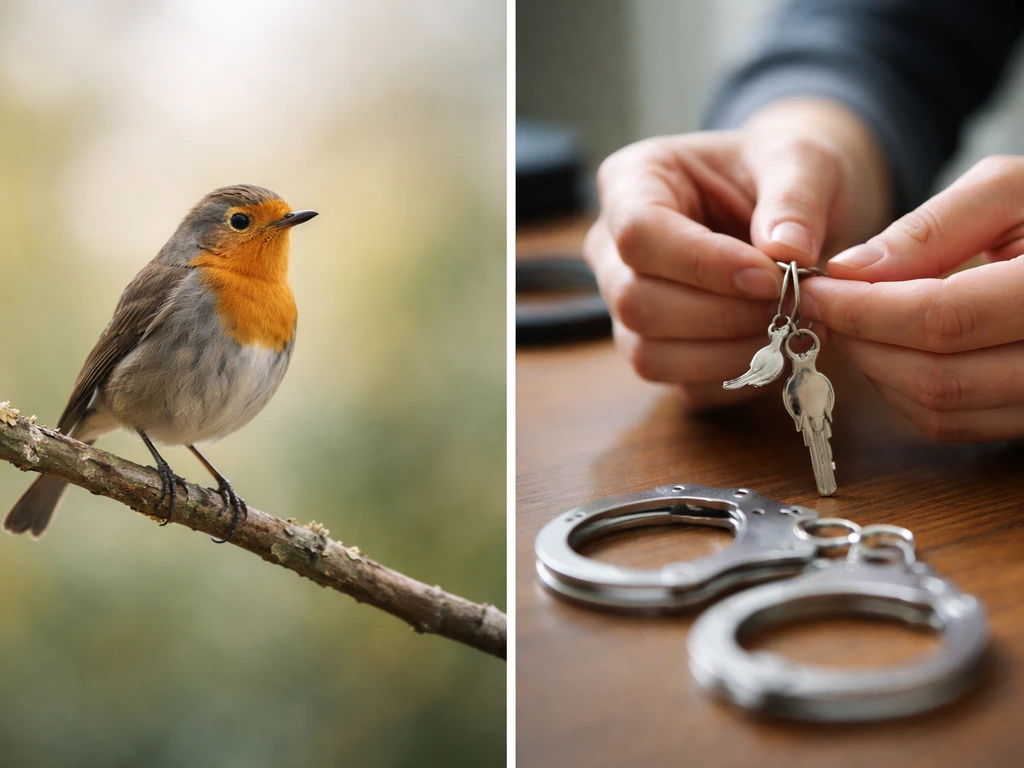
The fastest way to tell: look at what surrounds the word. Actual birds, the feathered kind, almost always appear with species-specific language ("a robin," "the flock," "nesting") or in clearly natural settings. Slang "bird" almost never does. Here are the clearest cues:
- Possessive pronouns signal the girlfriend meaning: "my bird," "his bird," "your bird" = romantic partner.
- Verbs like "do" or "serve" before or after "bird" = prison sentence ("do bird," "serving bird").
- "Give someone the bird" as a complete phrase = obscene gesture, not a literal animal.
- Food-adjacent language (diner, menu, "yard," fried, grilled) + "bird" = chicken, especially in US contexts.
- Playful misspelling as "birb" with cute or meme-style language = internet slang for a literal bird, used affectionately.
- No surrounding context clues + UK speaker = default to the "girlfriend" or "woman" meaning.
The Audubon Society actually documented "birb" as a separate internet phenomenon, a playful misspelling that spread through social media to describe cute or funny birds in photos and videos. If you see "birb" rather than "bird," that's almost certainly the wholesome internet meme version referring to an actual bird, not slang for a person or a prison term.
One more thing to keep in mind: on this site we cover birds across a lot of contexts, from dream symbolism to behavioral interpretation. But this article is specifically about colloquial slang usage. If you heard or read "bird" in a conversation, text, or social media post and you're trying to decode it, you're in the right place. If you're trying to understand what a bird encounter might mean spiritually or symbolically, that's a different lens entirely.
How meaning shifts by region, age, and tone
"Bird" as slang for a woman or girlfriend is predominantly a British thing. In the US, Canada, or Australia, most people won't use it that way, and many won't even recognize it. If a British person says "that's his bird," an American might genuinely think they're talking about a pet parakeet. The London Prat and similar British cultural sources note that the slang emerged in UK English around the early 1900s and has stayed stubbornly regional ever since.
Age matters too. Younger British speakers still use it, but often more ironically or casually in lad culture contexts. Older generations may use it more naturally. The Reddit community on Ask a Brit has documented this nuance: users describe "bird" as something their parents or older relatives say unselfconsciously, while younger speakers are more aware it can come across as dated or slightly dismissive depending on tone. A man using "bird" to describe his girlfriend in a warm, affectionate tone reads very differently from someone using it dismissively to refer to a woman he doesn't know.
Tone is the final filter. "Bird" in a flirty or affectionate context ("she's a lovely bird") reads as a compliment in traditional UK slang. The same word in a condescending or objectifying context can read as reductive. The Know Animals resource on using "bird" for a person explicitly flags that the term can be misconstrued or taken as offensive depending on audience and delivery, so context and relationship matter here just as much as the word itself.
For a broader look at how slang meanings evolve across different bird-related expressions, the article on bird behavior meaning slang explores how even the way a bird acts in everyday observation has inspired informal language over time.
Common misconceptions worth clearing up
The biggest misconception is that "bird" has one slang meaning. It doesn't. A lot of people search for "bird definition slang" expecting a single answer, find the girlfriend definition, and assume that's it. They then misread something like "he did bird" as romantic slang, when it's actually about incarceration. The two meanings are completely unrelated in origin and usage.
Another common mix-up is assuming "give someone the bird" is a British thing because "bird" is associated with British slang. Actually, this phrase is used in both the UK and the US and refers specifically to the middle-finger gesture. Merriam-Webster, an American dictionary, includes it, and the obscene-gesture meaning has nothing to do with the girlfriend/woman meaning. They just share the same word.
People also sometimes confuse "yard bird" with the other slang senses. If you see yard bird definition come up in a search and you're thinking romantic partner or prison time, pump the brakes. Wiktionary and The Free Dictionary both confirm that "yardbird" in US slang means chicken, as in the food you order at a diner. In Wiktionary, “yardbird” is chiefly US slang meaning “a chicken.” blank" rel="noopener noreferrer">yardbird as chiefly US slang meaning a chicken. It has no connection to the girlfriend or prison meanings.
Finally, don't assume slang "bird" is always dated or archaic. While some uses (especially the prison slang via Cockney rhyming slang) are older in origin, the girlfriend meaning is still actively used in British English today, and it appears regularly in UK media, music, and casual conversation. It's dated in the sense that it has roots in the early 1900s, not in the sense that nobody says it anymore.
How to decode a specific sentence with "bird" in it

If you've heard or read a specific sentence and you're trying to figure out what "bird" means in it, work through this quick checklist.
- Identify the verb: Is it "do," "doing," "did," or "serve"? If yes, you're almost certainly in prison-time territory ("do bird" = serve a sentence).
- Check for a possessive: "My bird," "his bird," "yer bird" = girlfriend or female partner, almost without exception in UK usage.
- Look for food context: If there's a menu, a kitchen, a diner, or cooking language nearby, "yard bird" or just "bird" likely means chicken.
- Is it a complete phrase: "Give someone the bird" = obscene gesture. That phrase doesn't decompose, it reads as a fixed idiom.
- Is it spelled "birb"? That's internet meme language for an actual, literal bird, usually used adoringly.
- Who said it and where are they from? A British speaker defaults to the woman/girlfriend sense. An American speaker using "bird" colloquially is more likely referencing the gesture idiom or using it ironically.
- What's the tone? Affectionate and casual = likely girlfriend meaning. Aggressive or confrontational = possibly the gesture or an insult.
If you want a deeper dive into how "bird" fits into broader English idiom patterns, the piece on bird idioms meaning is a useful companion, particularly for phrase-level constructions where "bird" operates as part of a fixed expression rather than a standalone slang term.
Where to verify the meaning and what to look up next
If you've narrowed down the context but still aren't sure, here's where to go. For dictionary-backed definitions, Collins English Dictionary is the most reliable for UK slang senses, including the girlfriend meaning. Merriam-Webster is better for US-centric or cross-Atlantic phrases like "give someone the bird." Green's Dictionary of Slang is the gold standard for historical slang including the prison usage. Wiktionary is surprisingly thorough for phrase-level entries like "do bird" and compound terms like "yardbird."
For online and internet-specific uses, Urban Dictionary is the practical first stop, though you'll want to cross-reference because entries vary widely in quality. If you're navigating that space, the article on bird definition urban dictionary breaks down what you're likely to find there and how to read those entries critically.
For more on the full landscape of what "bird" can mean in colloquial English across multiple registers and contexts, the overview at bird slang meaning is a strong next read. It maps the semantic territory more broadly and is especially helpful if you're encountering the word in written text where you can't hear tone or ask the speaker.
If the phrase you're decoding involves "bird" in a joke format, like a setup-punchline structure or a play on words, check the resource on bird joke meaning, which looks at how humor uses bird language in ways that can look like slang but are actually built on wordplay. And if you're working through a phrase where "bird" appears in a non-English sentence or with a foreign-language modifier, bird ka meaning covers cross-linguistic uses that are easy to confuse with English slang.
The short version: pin down the verb, the speaker's region, the surrounding words, and the tone, and you'll get to the right meaning fast. "Bird" in slang is not one thing. It's a cluster of meanings that happen to share a word, and once you know the cluster, decoding any specific sentence takes about ten seconds.
FAQ
How can I tell which “bird” slang meaning is being used in a sentence quickly?
If you want to decode it fast, treat “bird” as a “slot” word and read the whole expression. “She’s my bird” and “that’s his bird” almost always mean girlfriend or young woman in British English. “Do bird” or “three years’ bird” points to prison time, while “give someone the bird” refers to the middle-finger gesture (UK and US).
Is “bird” for a woman only appropriate when talking about a girlfriend?
In the British girlfriend sense, the most natural targets are a partner you date or a young woman you know, not strangers or groups. Using it about a woman outside your relationship can sound dismissive or objectifying, especially if the tone is flat or critical.
What’s the most common misunderstanding people make with “bird” slang?
If you misread it, the likely mix-up is confusing the girlfriend sense with the prison sense. Phrases that pair “bird” with numbers, time, serving, or sentencing typically are not romantic. A simple check is whether “bird” is being used like a noun for a sentence length (months, years, serve) rather than a label for a person.
Does “give someone the bird” always mean the middle finger, even outside the UK?
Yes. The obscene gesture is usually attached to the fixed expression “give someone the bird” (and close variants), and the meaning depends on whether the sentence is about an action you do to someone. If “bird” appears without that action-style frame, it’s more likely to be the girlfriend, prison, or chicken sense depending on the surrounding words.
How do I distinguish “yardbird” (chicken) from other “bird” slang meanings?
For “yardbird” or “yard bird” in US diner talk, the key cue is food ordering or menu language. If you see “yardbird” next to words like “order,” “meal,” “chicken,” “tenders,” or “diner,” it is almost certainly the chicken meaning, not any human-related or prison-related slang.
What should I assume if I see “birb” instead of “bird”?
“Birb” is typically the harmless internet meme misspelling for cute birds, not a slang code for people or prison. If the context includes comments about photos, videos, cuteness, or bird species, “birb” points to the literal bird, not slang.
Can “bird” sound offensive, even when it seems like a compliment?
Tone and audience matter. A warm, affectionate delivery in British English can read like teasing or flirty, while the same word can sound rude or old-fashioned if used to dismiss someone or if the speaker is not the speaker’s culture/age norms. If you are unsure, safest behavior is to ask for clarification rather than assume the compliment meaning.
How can I decode “bird” when I can’t hear tone, only read text?
If you see it in writing without audio cues, look for whether it behaves like a nickname for a person or like a reference to time. British partner usage tends to appear with possessives (“my,” “his,” “her”) and relationship verbs (“she’s,” “he’s seeing”). Prison usage tends to appear with verbs for sentencing or service (“doing,” “serving,” “got,” “years”).
Should I translate “bird” differently depending on whether my audience is US or UK?
Yes, and the region cue is important. The girlfriend sense is predominantly British, while the middle-finger phrase “give someone the bird” is shared more widely across the UK and US. If you’re translating for an audience outside the UK, you may need to avoid “bird” and use a clearer equivalent like “girlfriend” or “middle-finger gesture.”
What’s a practical rule I can follow when the context is confusing?
Avoid treating any one slang meaning as universal. If the sentence includes a verb frame that looks like sentencing, it’s almost certainly the prison meaning, even if the rest of the text seems like relationship talk. When in doubt, do a second pass: identify the verb phrase first, then map “bird” to the matching cluster.
Next Article
Bird Blindness Meaning: Causes, Signs, and What to Do Now
Bird blindness meaning: spot signs, tell vision loss from other issues, and take safe action or get urgent vet care.