Title: Bird Behavior Meaning Slang: Every Sense of "Bird" Decoded, From British Slang to Yardbird
Bird Meaning in Slang: Uses, Origins & Regional Variants

Marcus Holloway
14 Jul 2026
Meta description: What does "bird" mean in slang? Covers British, American, Australian, and Hindi uses, idioms, yard bird, Urban Dictionary entries, and tone guidance. For a focused explanation of regional and online uses, see a concise guide to bird slang meaning.
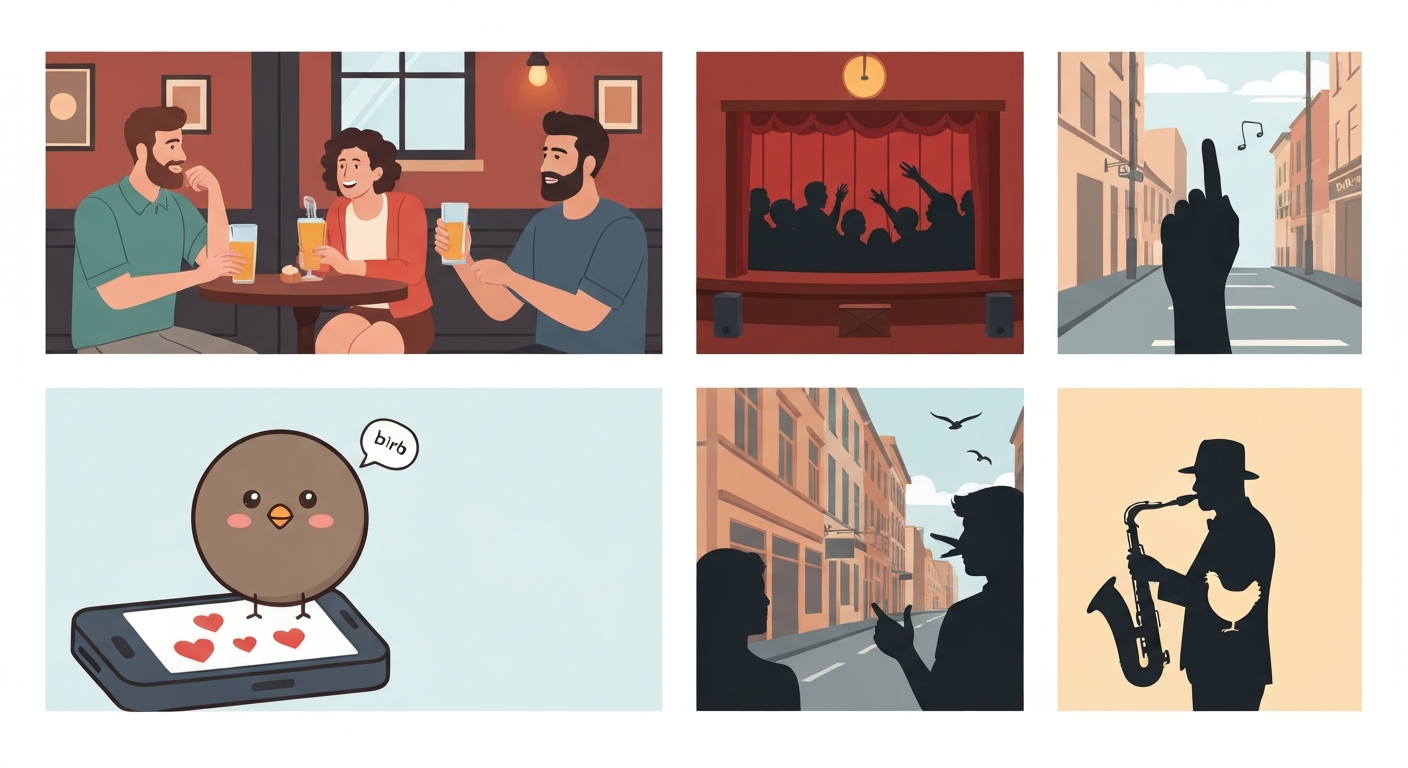
In slang, "bird" carries several distinct meanings depending on where you are and who is speaking. For a concise bird definition (slang), see the dedicated guide on bird definition slang. In British English it most commonly means a young woman or girlfriend. In American prison and military slang it can mean a chicken (food), a sentence in jail, or a helicopter. In street and internet slang it can flip between a mild insult and a term of endearment. And across every English dialect, "giving someone the bird" means either booing them off stage or showing them a particular finger. None of those meanings have anything to do with wings.
What you'll learn in this article
- The core slang senses of "bird": insult, affectionate use, gendered usage, and how insults can become terms of praise
- Sample sentences showing correct tone and register for each sense
- Common idioms, jokes, and wordplay that use "bird"
- How to read Urban Dictionary and Reddit entries critically
- Specific fixed expressions: "yard bird," "do bird," "birdbrain," and "birb"
- "Bird ka meaning" in Hindi and other non-English contexts
- A region-by-region comparison table of the most important slang senses
- Which uses are outdated or potentially offensive, and how to navigate them
Where "bird" comes from (the short history)
The English word traces back to Old English bridd or brid, which meant specifically a young bird or nestling, not birds in general. The broader sense of "any bird" developed later, and the ultimate pre-Old English origin is genuinely uncertain even to etymologists. The slang senses are a separate evolution layered on top of that. The British use of "bird" for a woman appears to have revived or strengthened around 1915 after an earlier Middle English period when "bird" could refer to a girl or maiden. The prison slang sense, covered below, came through Cockney rhyming slang and is documented independently. So when you look at the full word history, "bird" has always been a shapeshifter.
The core slang senses: insult, affection, gender, and the flip
"Bird" as a word for a woman
Cambridge Dictionary labels this sense as UK, slang: a young woman or girlfriend. Collins English Dictionary records it as "chiefly British." Oxford's Advanced Learner's Dictionary goes further and adds a usage note that the term is old-fashioned, slang, and can be offensive, particularly when used by men to describe women they don't know. That's important context. In everyday British speech the word still circulates, but awareness of its dismissive undertone has grown. A 2026 TikTok trend in the UK brought this tension back into public conversation, with some users reclaiming the word playfully while others pushed back on its use as reductive. Whether it lands as affectionate or offensive depends heavily on who says it, to whom, and in what setting.
"Bird" as a term of praise or affection
Within some communities, especially in Northern English dialects and certain online spaces, "bird" has been reclaimed or used with genuine warmth. Someone might call a close female friend "my bird" without any derogatory intent, similar to how "mate" or "lass" function regionally. The shift from insult to endearment is a well-documented pattern in slang: words acquire positive charge when in-group speakers adopt them on their own terms. This doesn't neutralize the word's potential to offend in different contexts, but it does explain why the same term can sound warm in one conversation and jarring in another.
"Bird" as a general insult or dismissal
In American English especially, calling someone a "bird" or a "silly bird" is a mild put-down, roughly equivalent to calling someone a fool or an airhead. This connects loosely to the compound "birdbrain," which Merriam-Webster records with a first known use around 1916 and defines as a stupid or scatter-brained person. It's worth noting that modern ornithology has largely debunked the idea that birds are cognitively simple: corvids solve multi-step problems, parrots demonstrate symbolic reasoning, and many species show social intelligence that rivals mammals. The insult survives on cultural inertia rather than biological accuracy.
"Give someone the bird": the theatrical and gestural meanings
This is probably the most widely known "bird" idiom in both British and American English, and it has a layered history. In British theatrical tradition, the "big bird" was the collective hissing sound an audience made to boo a performer off stage, because a goose's hiss was the comparison. blank" rel="noopener noreferrer">GIVE SOMEONE THE BIRD – educalingo (summarises Oxford/Chambers note) documents that the idiom originated in British theatrical hissing/jeering (the ‘big bird’ = goose) and later in American usage fused with the raised‑middle‑finger gesture. Over time, "getting the bird" came to mean being publicly rejected or dismissed. In American usage, the phrase fused with the raised middle finger gesture, and today "giving someone the bird" almost universally implies that specific hand signal in North American contexts. Merriam-Webster confirms this dual sense: blank" rel="noopener noreferrer">to boo or make an obscene gesture. The two meanings share a core of contemptuous dismissal even if the physical expression differs.
Usage examples and tone notes
Context changes everything with this word. Here are sample sentences across different registers so you can see how tone shifts:
| Register | Example sentence | Tone / note |
|---|---|---|
| Casual British (affectionate) | "That's my bird over there, we've been together two years." | Neutral to affectionate in Northern UK; may feel dated to younger speakers |
| Casual British (potentially dismissive) | "She's just some bird I met at the pub." | Can read as reductive; avoid in professional or formal contexts |
| American English (mild insult) | "Don't be such a birdbrain about it." | Light put-down; generally not deeply offensive but still a dig at intelligence |
| Theatrical / idiomatic (UK) | "The crowd gave him the bird after the first five minutes." | Means booing/jeering; perfectly safe in most written or spoken contexts |
| American idiomatic (gesture) | "He cut her off in traffic and she gave him the bird." | Refers to middle-finger gesture; informal, colloquial, understood universally in North America |
| Prison slang (UK) | "He did bird for three years before getting out." | Neutral in context of discussing UK criminal justice; from Cockney rhyming slang |
| Internet / affectionate (any region) | "Look at this absolute birb, I cannot cope." | Deliberately cute misspelling; positive, humorous, no offensive dimension |
| Jazz / historical (US) | "Parker was called Yardbird before anyone shortened it to Bird." | Historically specific; not pejorative |
Common idioms, jokes, and wordplay
"Bird" shows up in English idioms far more than most people realize. Some of these are genuinely old; others are playful modern coinages. Here are the most commonly encountered ones: See our separate guide to bird idioms meaning for a focused list of common idioms and their explanations.
- A bird in the hand is worth two in the bush: certainty is more valuable than uncertain potential; attested since at least the 15th century
- Kill two birds with one stone: accomplish two goals with a single action
- Birds of a feather flock together: people with similar interests or character tend to associate
- The early bird catches the worm: being proactive or prompt gives you an advantage
- Give someone the bird: boo them (UK theatrical origin) or make the middle-finger gesture (US usage)
- Do bird: serve a prison sentence, from Cockney rhyming slang bird-lime = time
- Free as a bird: completely unencumbered, without obligations
- Birdbrain: a scatterbrained or foolish person
- Birb: internet affectionate spelling for a cute or funny bird (or used jokingly for any small creature)
Bird jokes follow predictable patterns: puns on flight, freedom, and the word's slang double meanings. The classic format plays the literal sense against the slang sense. For example: "Why did the bird get a job at the bank? Because he was already good at tweeting deposits." Groan-worthy, yes, but the structure shows how the literal and slang meanings of bird words get exploited for humor. The intersection of bird idioms, jokes, and wordplay is its own rich topic and worth exploring in more depth if language play is what brought you here.
How to read Urban Dictionary (and Reddit) entries on "bird"
Urban Dictionary entries for "bird" and related terms like "yardbird" are useful as cultural evidence but need to be treated carefully. Each entry is user-submitted, and a single word can accumulate dozens of competing definitions with wildly different connotations. The site does show submission dates and vote totals, which gives you a rough sense of which definition a community found most accurate or relatable at a given time. A definition with 8,000 upvotes from 2009 tells you something meaningful about how American urban slang used the word in that period. A definition with 12 upvotes from 2023 tells you much less.
Reddit threads operate differently. On language-focused subreddits like r/etymology or r/linguistics, users often cite dictionaries and corpora and engage in genuine debate about historical usage. On general subreddits, "bird" slang discussions tend to be regional and anecdotal. Neither source should be treated as authoritative in isolation, but both are legitimate windows into how real people use and understand the word. When I look at crowd-sourced entries, I treat them the way I treat field notes: evidence of usage patterns, not prescriptive definitions.
For rigorous frequency and register data, the Corpus of Contemporary American English (COCA) and the British National Corpus (BNC) are the right tools. These are large, genre-balanced corpora accessible through the BYU English-Corpora portal. Searching "bird" in spoken vs. written registers, or comparing COCA (American) against BNC (British), quickly shows which senses dominate in formal writing versus casual speech. That kind of corpus evidence is far more reliable than vote counts.
Specific terms worth knowing: yardbird, do bird, birdbrain, and birb
Yardbird and Bird (Charlie Parker)
"Yardbird" is one of the more interesting slang journeys in American English. See the yard bird definition for a short history and the term's main senses. Its oldest common sense is simply a chicken, the kind kept in a farmyard. In US military slang it was applied to new recruits or soldiers assigned to menial duties, suggesting they were as lowly as barnyard fowl. In restaurant and food slang, "yardbird" still means chicken to this day. Then there is Charlie Parker. Parker picked up the nickname "Yardbird" (later shortened to just "Bird") while touring with Jay McShann's band, reportedly from an incident involving a chicken. He leaned into the name so thoroughly that he titled a composition "Yardbird Suite," and within jazz circles "Bird" became synonymous with Parker himself. That's a clean example of a slang word traveling from barnyard to insult to iconic personal brand inside a few decades.
"Do bird": the prison slang sense
Cockney rhyming slang works by replacing a word with a phrase that rhymes with it, then often dropping the rhyming word entirely. "Bird-lime" rhymes with "time," and in UK prison slang "time" means a sentence served. So "bird-lime" became "bird," and "doing bird" means serving a jail sentence. Collins English Dictionary records this sense explicitly. It's specifically British and specifically working-class in origin, though it's widely understood across UK English speakers today.
Birb: the affectionate internet spelling
"Birb" is a deliberate misspelling of "bird" that emerged on platforms like Tumblr, Twitter, and Reddit as part of a broader internet tradition of using altered spellings to signal affection or humor (similar to "doggo" or "smol"). Audubon has documented the rise of birb culture and describes it as a way of expressing that a bird is particularly cute, round, or comedically endearing. A puffin, a fat sparrow, or an owl looking confused is a birb. It carries zero negative connotation and is purely affectionate. The meme has crossed into mainstream birding communities and even into some wildlife photography circles.
"Bird ka meaning": the Hindi context and other non-English uses
"Bird ka meaning" is a common search phrase from Hindi-speaking users looking for a translation or explanation of the English word "bird." In Hindi, the standard translation is pakshi (पक्षी) for bird in a general or formal sense, or chidiya (चिड़िया) for a small bird, which is also the word most children learn first. When someone searches "bird ka meaning" they are usually asking for the literal translation, not slang, but they may encounter slang results if they are navigating English-language media or social platforms. If you are a Hindi speaker learning English slang, the most important thing to know is that "bird" in informal British English often means a young woman, which has no direct parallel in standard Hindi usage and can cause genuine confusion when encountered in subtitles or conversations.
Beyond Hindi, other languages that borrowed or adapted the English slang differently: in Australian English, "bird" for a woman is understood but less commonly used than in British English, where "sheila" historically served a similar function. In Irish English, "bird" for a girlfriend is reasonably common and largely neutral in tone. In South Asian English more broadly, the word is most likely to be encountered in its literal ornithological sense rather than slang, given that the British slang sense was not strongly exported through colonial-era formal English education.
How "bird" slang varies by region and register
| Region / Variety | Primary slang sense(s) | Tone / register | Notes |
|---|---|---|---|
| British English (general) | Young woman or girlfriend; prison sentence (do bird) | Informal; woman-sense is old-fashioned to some speakers | Cambridge, Collins, Oxford all record; woman-sense flagged as potentially offensive by Oxford |
| Northern British English | Girlfriend or female friend (often affectionate) | Casual, warm in-group use | More likely to be used affectionately than in Southern British contexts |
| American English | Birdbrain (fool); give the bird (middle finger); yardbird (chicken or soldier) | Light insult to neutral; gestural idiom is very common | Prison and woman senses are not primary American uses |
| Australian English | Understood as British woman-sense; less commonly used | Informal; not a core Australian slang term | Sheila historically served a similar role in Australian slang |
| Irish English | Girlfriend, female friend | Casual, relatively neutral | Similar to Northern British usage |
| South Asian English (incl. Hindi) | Primarily literal (actual birds); "bird ka meaning" queries seek translation | Neutral, educational context | British slang sense not widely adopted; potential for confusion in media consumption |
| Internet / global | Birb (cute bird meme); birdbrain (mild fool insult) | Humorous, affectionate (birb); light pejorative (birdbrain) | Birb is entirely positive; birdbrain is negative but rarely deeply offensive |
| Jazz / historical US | Bird / Yardbird = Charlie Parker; yardbird = chicken | Culturally specific, reverential in jazz contexts | Yardbird as insult (lowly soldier) is a separate, older US military sense |
What about the ornithological and spiritual meanings?
The slang senses of "bird" exist in a completely separate register from its ornithological and cultural-spiritual meanings, but they sometimes collide in interesting ways. When someone dreams of a bird, or notices a bird behaving strangely outside their window, those experiences belong to a different interpretive framework altogether: one rooted in cultural symbolism, spiritual tradition, and behavioral observation. Calling a person a "birdbrain" draws on an outdated folk assumption about avian intelligence that real ornithology has thoroughly challenged. Similarly, the freedom implied in phrases like "free as a bird" tracks with genuine facts about avian biology (flight, migration, minimal territorial attachment) even if the idiom is cliché.
If you arrived here looking for what it means when a bird lands near you, flies into your window, or behaves in an unusual way, those questions belong to the behavioral and symbolic dimension of bird meaning rather than the slang dimension. The cultural and spiritual symbolism of birds across traditions runs deep: from the Celtic association of ravens with prophecy to the Hindu reverence for Garuda to the widespread superstition around magpies in British folk tradition. Slang meanings and symbolic meanings share only the word; the interpretive frameworks are entirely different.
A note on offensiveness and appropriate use
Several of the senses covered here carry real potential to offend, and it is worth being explicit about which ones and why. Using "bird" to refer to a woman you don't know, particularly in a professional or formal context, risks coming across as dismissive or objectifying regardless of intent. Oxford's Advanced Learner's Dictionary flags the sense as offensive for a reason: the word historically treated women as objects to be categorized rather than individuals. The 2026 TikTok discourse around the term showed that younger British speakers are actively renegotiating its social meaning, with some reclaiming it and others firmly rejecting it.
"Birdbrain" is a mild insult that most people will take in stride, but it is still a put-down. "Give someone the bird" in the gestural sense is obviously not appropriate in formal settings but is well understood as colloquial. "Yardbird" in its military sense (a lowly soldier) was derogatory in origin, though it has largely faded from active use. The Charlie Parker sense is purely honorific. "Birb" is completely inoffensive. In general: the older British gendered sense requires the most care; the idioms and compound words require ordinary social awareness; and the internet meme sense is safe in any casual context.
Debunking a few common misconceptions
- "Birdbrain" is scientifically accurate: it isn't. Corvids, parrots, and many other birds show complex problem-solving, social learning, and tool use. The insult relies on a debunked folk assumption.
- "Bird" meaning a woman is only British: it also appears in Irish English and is understood across most English dialects, though it is most active in British and Irish speech.
- "Give someone the bird" always means the middle finger: in British English it originally meant booing or jeering, with the gesture meaning being primarily American. Both senses are current.
- "Yardbird" is purely a jazz term: it predates jazz as general American slang for a chicken and as military slang for a low-ranking soldier. The jazz connection comes from Charlie Parker's nickname, which itself came from the food slang.
- Urban Dictionary is a reliable dictionary: it documents how people use words but entries are unvetted and competitive. High vote totals suggest community consensus, not linguistic authority.
FAQ
What are the main slang meanings of “bird” in English?
“Bird” is a homograph with several distinct slang senses: (1) Insult/pejorative — e.g., “birdbrain” (stupid person) or calling someone a “bird” in annoyance; (2) Affectionate/cutesy — internet meme spelling “birb” or calling a person a “bird” playfully; (3) Gendered/British — informal British slang for a young woman or girlfriend (labelled UK, slang); (4) Prison‑related — UK/Cockney sense in phrases like “do bird” = serve time; (5) Food/US slang — “yardbird/yard bird” = chicken. Authoritative dictionaries (Merriam‑Webster, Cambridge, Collins, Oxford) list and label these senses; corpora (COCA/BNC) show distribution by register and region.
How did these slang senses originate (short etymology)?
The base word derives from Old English bridd meaning a young bird (Etymonline). The woman‑sense developed in 20th‑century British informal usage; the prison sense links to Cockney rhyming slang pathways (bird‑lime → time), recorded in British dictionaries. “Yardbird” as chicken and Charlie Parker’s nickname (“Yardbird” → “Bird”) comes from US/restaurant slang and jazz history. The idiom “give someone the bird” traces to theatrical jeering and later gestures. (Sources: Etymonline; Collins; Oxford; jazz biographies.)
What idioms and common jokes use “bird”?
Common idioms/jokes include: “give someone the bird” (boo/jeer or obscene gesture), “do bird” (serve prison time, chiefly UK), “yardbird/yard bird” (chicken/food), “birdbrain” (stupid), “the bird has flown” (gone away — analogous idioms exist). Internet jokes use “birb” for cute birds with captions like “sneezing birb” or “angry birb.” Dictionaries and meme coverage (Audubon) document these usages.
How do crowd‑sourced sites like Urban Dictionary reflect these meanings? How reliable are they?
Urban Dictionary shows many user‑submitted senses (insult, affectionate, regional variants like “yardbird”), often with slangy examples and up/down votes. UD is useful to capture emerging or community senses but is user‑generated and unvetted: treat it as evidence of usage trends or online attitudes rather than authoritative proof. For frequency and register, consult corpora (COCA/BNC/GloWbE) and mainstream dictionaries (Cambridge/Collins/Oxford).
What is “yard bird” / “yardbird” and how is it used?
“Yardbird”/“yard bird” commonly refers to chicken (culinary slang) in US English and appears in diner/BBQ contexts. It was also Charlie Parker’s nickname; jazz histories link Parker’s early nickname to the term and his compositions (e.g., “Yardbird Suite”). Urban Dictionary and pop culture extend the term to other informal senses, but mainstream usage for food and the Parker nickname are well attested (encyclopedias, music histories).
What does “bird ka meaning” refer to (Hindi/regional variants)?
In India, English slang senses of “bird” often transfer into conversational Hinglish. “Bird ka meaning” literally asks “meaning of ‘bird’”; common local uses mirror British slang (calling a woman a “bird” can appear in Indian English but may be considered rude/outdated). No separate classical Hindi lexical equivalent carries the same slang network; regional usage must be judged by context and local norms. Consult bilingual dictionaries and regional corpora for specific instances.
Next Article
Yard Bird Definition: Meaning, ID Tips, and Practical Signs
Yard bird definition plus ID tips, habitat and seasonal clues, and folklore meanings to separate fact from superstition.