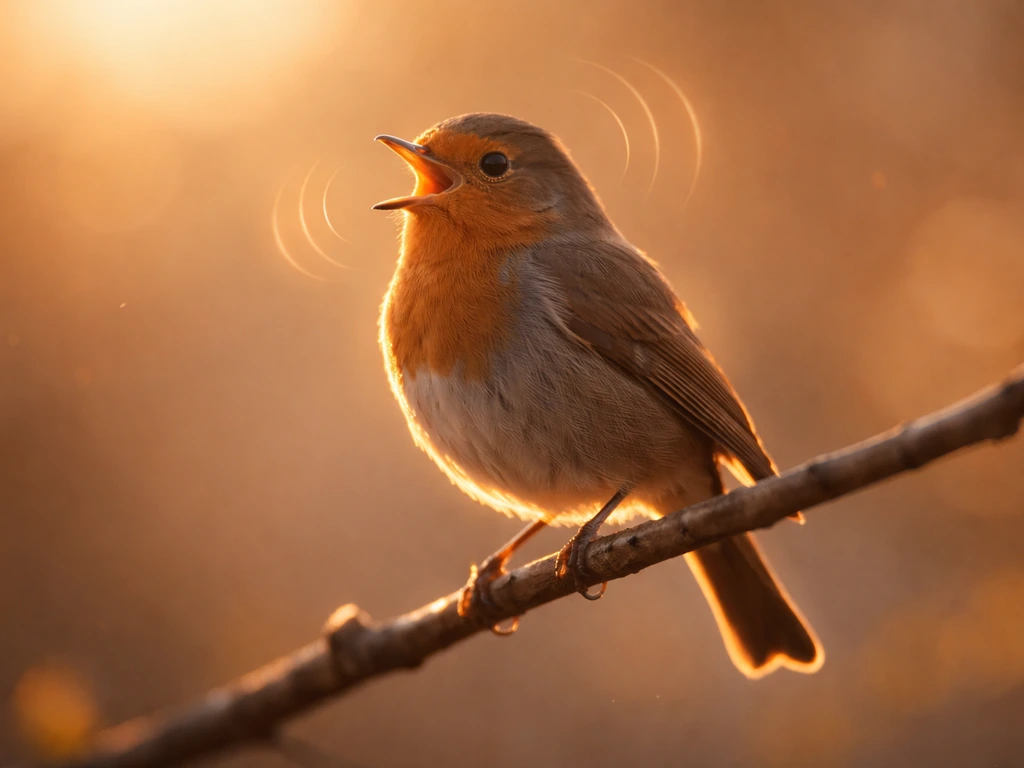
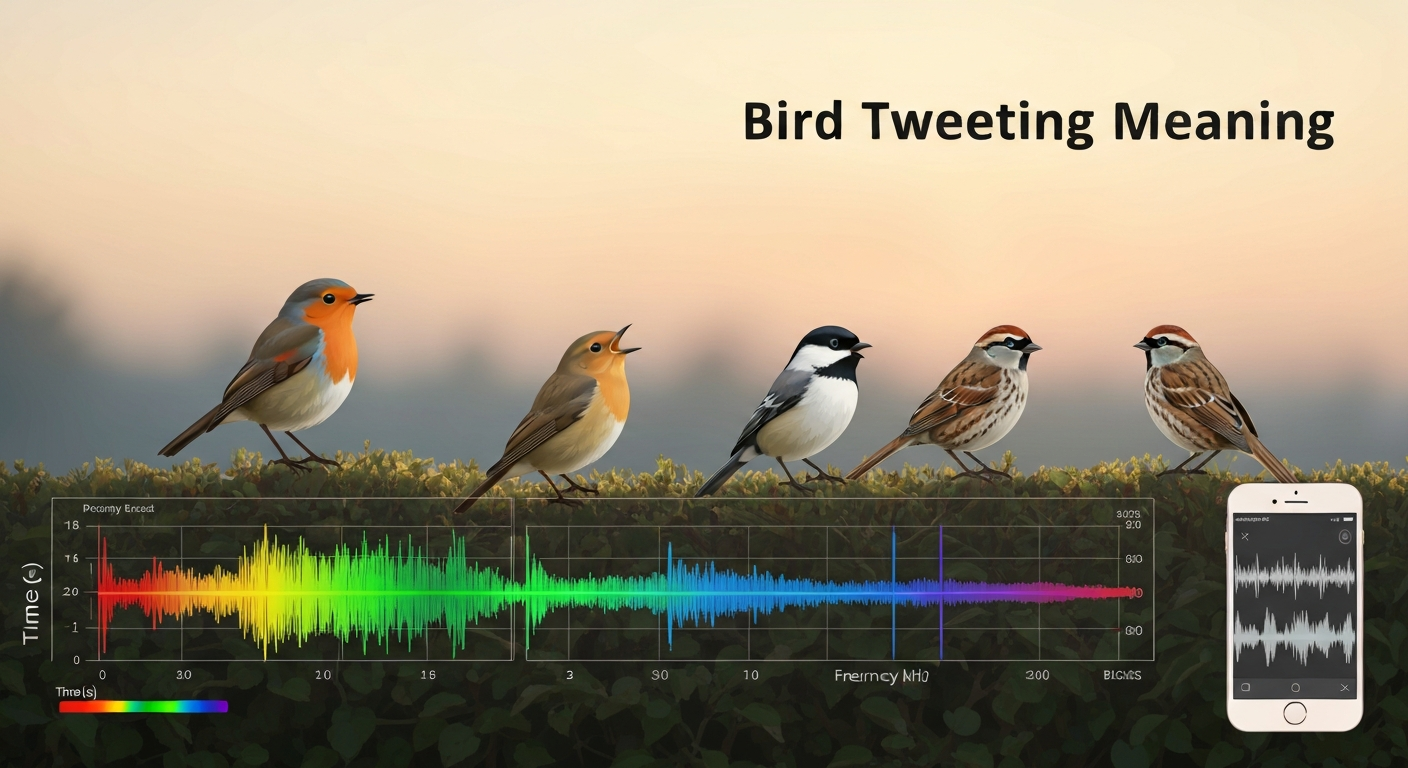
Bird tweeting refers to the short, high-pitched vocalizations birds produce to communicate with each other, and depending on your context, it also means the act of posting on the social media platform X (formerly Twitter), or a slang gesture (a whistle or call directed at a person). Most of the time when someone searches 'bird tweeting meaning,' they want to understand what a bird is actually saying with those sounds, but the word has picked up enough cultural and digital baggage that this guide covers all of it: the ornithological reality, the folklore, the dream symbolism, the slang, and how to actually go outside and listen for yourself. For a focused explanation of bird sounds meaning, see the related internal resource (ID 62214bc4-465c-4d6c-a5a7-999392f3982a).
Bird Tweeting Meaning: Calls, Songs, Signs & Slang

Who this guide is for
Whether you woke up to a bird singing outside your window and felt it meant something, you're a new birdwatcher trying to figure out what you're hearing, or you came across 'bird tweeting' in a cultural or spiritual context, this article covers the full picture. It's also useful if you're untangling slang, 'bird whistle' and 'bird call' mean very different things in street slang versus ornithology, and that distinction matters. The goal here is to give you accurate, grounded information from each angle without dismissing any of them.
What 'bird tweeting' actually means
In ornithology, 'tweeting' is a casual, informal term for the shorter, simpler vocalizations birds make, generally what scientists call 'calls' rather than full 'songs.' The word itself mimics the thin, high sound many small birds produce, a 'tweet' is phonetically descriptive. Technically, a tweet is a brief, often single-note or two-note sound used for quick communication: alerting flock members, keeping in contact during flight, or signaling alarm. It is not the same as the elaborate melodic sequences a Song Sparrow or Nightingale produces, though all of those are also bird vocalizations. The scope of 'bird tweeting meaning' therefore splits into two lanes: what the bird intends by the sound (behavioral function), and what humans have interpreted it to mean across cultures and traditions.
Tweets, calls, songs, and whistles, what's the difference?
These terms get used interchangeably in everyday speech, but they describe meaningfully different things. According to Cornell Lab of Ornithology's All About Birds framework, 'songs' are typically longer, more complex, and learned vocalizations associated with mating and territory, while 'calls' are shorter, simpler, often innate sounds used for immediate communication. A 'tweet' is colloquially a call, brief and functional. A 'whistle' describes a specific tonal quality: a pure, smooth sound with little harmonic complexity, like the 'fee-bee' of a Black-capped Chickadee. Understanding these distinctions helps you interpret what you're hearing and connects naturally to related topics like bird calls meaning, bird sounds meaning, and the specific tonal qualities covered under bird whistle meaning.
| Sound Type | Length | Complexity | Primary Function | Typical Examples |
|---|---|---|---|---|
| Tweet / Call | Short (under 1 sec) | Simple, 1–3 notes | Alarm, contact, location | Chickadee 'chick-a-dee', Robin 'tut-tut' |
| Song | Long (several seconds) | Complex, patterned | Territory, mate attraction | Song Sparrow, Nightingale |
| Whistle | Short to medium | Pure tone, smooth | Contact, territory boundary | Chickadee 'fee-bee', Whip-poor-will |
| Alarm Call | Very short, sharp | Simple, often broadband | Predator warning | Robin 'seee', Blackbird 'pink-pink' |
| Contact Call | Short, repeated | Simple, consistent | Flock cohesion, location | Budgerigar contact chirp, Crossbill 'jip' |
What birds are communicating, the science behind tweets
Birds are not singing randomly. The Handbook of Bird Biology (Cornell Lab/Wiley) lays out the core functions of avian vocalizations clearly: alarm and predator warning, territory advertisement, mate attraction, contact maintenance within a flock, and parent-offspring communication. Most of what casual listeners call 'tweeting' falls into the alarm and contact categories, the quick, repeated chips and peeps that keep a flock informed and cohesive. The more elaborate sounds, what Catchpole and Slater in 'Bird Song: Biological Themes and Variations' call 'songs' in the strict sense, serve mating and territorial functions and tend to be learned, not innate. The distinction matters because it changes how you interpret what you're hearing: a sharp, repeated chip from a robin almost always means disturbance or alarm, while a slow, musical phrase from a Song Sparrow is almost certainly about territory or courtship.
Alarm calls and warning signals
Alarm calls are arguably the most information-dense sounds in the bird world. Research on Black-capped Chickadees by Hailman and colleagues showed that the 'chick-a-dee' call actually encodes threat level information: the more 'dee' notes appended to the call, the higher the perceived threat. A small, agile predator like a pygmy owl generates far more 'dee' notes than a large, slow-moving hawk. This is not superstition, it is measurable and reproducible acoustic encoding. Other species produce sharp, broadband 'seet' or 'seee' sounds for aerial predators (these are hard to localize, making it safer for the caller) and lower, more directional chips for ground predators. Common species to learn by ear for alarm calls include the American Robin ('tut-tut-tut' for ground disturbance, thin 'seee' for aerial), Blackbird (sharp 'pink-pink'), and Song Sparrow (sharp 'chimp' chip).
[IMAGE PLACEHOLDER: Sonogram of Black-capped Chickadee 'chick-a-dee-dee-dee' alarm call showing increased 'dee' note repetitions. Source: Macaulay Library or xeno-canto (check individual recording license, typically CC BY-NC-SA; credit recordist and include license line in caption). Sonogram produced with Raven Lite.]
Territory and boundary signals
When a bird sings from a prominent perch early in the morning, it is almost always broadcasting territorial ownership. The Song Sparrow is one of the most studied examples: males have repertoires of several distinct song types, and research has shown that repertoire size correlates with initial mating success. Territorial songs are delivered repeatedly, often from the same elevated spots, and neighboring males typically respond in kind, a process called countersinging. The American Robin's rich, caroling song serves dual purposes (territorial and mate attraction) and is one of the most recognizable early-morning territorial broadcasts in North American gardens. In European contexts, the Common Blackbird performs similarly, a long, leisurely, fluting song from high in a tree that marks and defends its patch.
[IMAGE PLACEHOLDER: Sonogram of Song Sparrow territorial song showing multi-phrase structure. Source: Macaulay Library (request media via Cornell's terms workflow for editorial use) or xeno-canto (confirm CC license per recording). Sonogram exported from Raven Lite.]
Mating and courtship vocalizations
Mating songs are the most complex and elaborate vocalizations in the bird world. The Common Nightingale's reputation across European folklore is directly tied to its mating song: males sing both by day and at night, producing an extraordinarily varied sequence of phrases that functions to attract females and exclude rival males. Catchpole and Slater's research framework confirms that song complexity in many species signals male quality, females in several species demonstrably prefer males with larger repertoires or more complex phrasing. Some species take courtship vocalization further through duetting, where male and female exchange notes or overlap in tight coordination. African shrikes and some wrens duet so precisely that the resulting sound appears to come from a single bird, which can serve both pair bonding and joint territorial defense.
[AUDIO PLACEHOLDER: Common Nightingale mating song (nocturnal recording). Source: Macaulay Library or xeno-canto (verify CC BY-NC-SA license; credit recordist). Note: full song sequence, typically 4–8 second phrases with rapid modulation.]
Contact calls and keeping the flock together
Contact calls are the quiet, often overlooked glue of bird social life. These are the thin 'sip' chips you hear from warblers moving through a hedgerow, the short repeated 'jip' of Crossbills in flight, or the soft churring exchanges of a group of long-tailed tits moving through woodland. Their function is straightforward: keep the flock spatially cohesive, especially in dense vegetation or during nocturnal migration when visual contact is impossible. Cornell's All About Birds notes that many species produce distinct contact calls that differ from their alarm and territorial vocalizations. The American Robin's soft 'tup' between individuals foraging on a lawn is a good garden example of a contact call that most people hear without recognizing it as communication.
[AUDIO PLACEHOLDER: American Robin contact call ('tut' series). Source: All About Birds species page (Cornell Lab) for reference; Macaulay Library for licensed audio asset. Sonogram exportable from Raven Lite for visual comparison with alarm call.]
How birds learn their tweets, juveniles, dialects, and mimics
Not all bird vocalizations are hardwired. Oscine songbirds (the largest subgroup of passerines, which includes sparrows, finches, thrushes, and starlings) learn their songs through a process of listening and practice, much like human language acquisition. The foundational work here is Marler and Tamura's 1962 study on White-crowned Sparrows, which demonstrated that young males must hear an adult song during a critical developmental window to produce a normal song themselves. This produces geographic 'dialects': White-crowned Sparrows in one valley sound measurably different from birds of the same species thirty miles away, and the dialect boundaries can be mapped. More extreme learning is shown by European Starlings and Common Ravens, both of which incorporate sounds from their environment, including human speech, machinery, and other bird species, into their vocal repertoire. Vocal learning reviews by Jarvis and colleagues confirm these patterns across taxa.
[IMAGE PLACEHOLDER: Spectrogram comparison of White-crowned Sparrow dialects from two geographic populations, illustrating measurable phrase-structure differences. Cite dialect studies (Marler & Tamura 1962 lineage); produce or source via xeno-canto recordings from distinct regions (verify CC license per recording).]
Cultural, mythic, and spiritual meanings of bird tweets
Across nearly every human culture that has documented birds, vocalizations carry meaning beyond the ornithological. The core motif is consistent: bird song as a bridge between the human world and something beyond it, the divine, the dead, the future. In many European folk traditions, the first bird call of the year from specific species (cuckoo, robin, wren) predicted fortune or health for the year ahead. In various Indigenous North American traditions, particular bird calls are understood as messages from ancestors or as indicators of spiritual presence, these are living belief systems that deserve respect rather than reduction to 'superstition.' In Chinese cultural tradition, the singing of certain birds near the home signals good fortune and domestic harmony. Celtic traditions often associate bird songs, particularly from wrens and ravens, with prophetic or otherworldly messages. What's consistent across all these frameworks is the idea that bird sound carries intentionality, that it is directed at the listener for a reason.
Bird tweets in dreams, what they're commonly thought to mean
Dreams featuring bird sounds are widely interpreted in folk dream traditions as signals of incoming news, messages from the subconscious, or contact from deceased loved ones. Hearing birds tweet happily in a dream is commonly associated with optimism, freedom, or a period of positive communication ahead. Sharp, alarming bird calls in dreams are often read as warning signals, the dreaming mind drawing on the real-world function of alarm calls even in sleep. It is worth being direct about the epistemic status here: dream interpretation is not predictive science. It is a framework for self-reflection, and its value lies in what it surfaces about the dreamer's emotional state and preoccupations, not in literal prophecy. If you hear a bird calling in your dream and feel anxious, that anxiety is real and worth examining, the bird is a symbol your mind chose, not a messenger from outside.
How bird tweet meanings vary around the world
Cultural meanings for bird sounds vary significantly by region, species, and tradition, and it is important not to flatten them into a single 'universal symbolism.' In parts of Japan, the call of the bush warbler (uguisu) is associated with the arrival of spring and poetic renewal, it features prominently in classical poetry and is celebrated as a seasonal marker rather than an omen. In some West African traditions, specific nocturnal bird calls are associated with witchcraft or spiritual danger, a belief that reflects deep local ecological and spiritual knowledge rather than mere fear. Indigenous Australian traditions connect bird calls to specific country (land) and kinship systems in ways that are not portable into generic symbolism frameworks. In Northern European folklore, a robin singing close to the house was historically read as a sign of death approaching, yet in contemporary British culture, robins are overwhelmingly associated with Christmas cheer and good luck. The same bird, different centuries, different meanings. Treat any cultural reading you encounter as local and contextual, not universal.
Slang meanings: 'tweet,' 'bird call,' and 'bird whistle'
The word 'tweet' as most people under forty understand it first refers to a post on X (formerly Twitter), a platform named for the short, frequent nature of bird calls. That metaphor was intentional: the founders chose 'twitter' to evoke rapid, brief, chatty communication, which maps reasonably well onto contact calls. In street slang, 'bird call' can mean a signal between people (often a specific sound used as a recognition code between friends or groups), while 'bird whistle' in many urban contexts refers to a wolf-whistle directed at a person, a practice widely considered harassing. The slang landscape around these terms is addressed more fully in articles on bird call meaning slang and bird whistle meaning, but it is worth knowing the distinction here: if someone says they got 'bird called,' the meaning depends entirely on context and region. In British slang, 'bird' itself is informal for a young woman, which adds another layer to 'bird whistle' in that context.
Reading intent when 'tweet' shows up in conversation
Context is everything. When someone uses 'tweeting' in an online context, they almost always mean posting short messages. When someone describes hearing birds tweet and asks what it means, they are usually asking either about ornithological behavior or spiritual/cultural significance, and you can tell which by what else they say. Someone who mentions a specific species, time of day, or unusual behavior is asking an ornithological question. Someone who describes the experience as feeling significant, recurring, or emotionally charged is likely exploring the symbolic or spiritual dimension. Neither framing is wrong. The interesting territory is where they overlap: real bird behavior (a bird returning to the same spot daily, or calling at an unusual hour) can have both a scientific explanation and personal resonance, and holding both simultaneously is not contradictory.
How to actually go out and listen
The best time to hear birds tweet and sing is the dawn chorus, roughly 30 minutes before to 60 minutes after sunrise, when vocal activity peaks dramatically. This is especially pronounced from April through July in the Northern Hemisphere. Habitat matters: woodland edges, hedgerows, wetland margins, and garden shrubs hold far more vocal activity than open fields or city centers, though urban parks can be surprisingly productive. You do not need expensive equipment to start. Cornell's Bird Academy recommends beginning with just your ears and a notebook, noting what you hear, where, and when. See Bird Academy (Cornell Lab), How to Record Bird Sounds course and recording tips for beginner equipment recommendations and submission/metadata requirements Bird Academy (Cornell Lab) — How to Record Bird Sounds course and recording tips. When you are ready to record, a directional (shotgun) microphone connected to a smartphone or digital recorder produces surprisingly good results. Gain settings matter: start low and adjust upward to avoid clipping on loud, close calls. Cornell's 'How to Record Bird Sounds' guidance via Bird Academy and Macaulay Library's submission resources are the best free starting points for technical details.
Quick field checklist, what to note when you hear a tweet
- Rhythm: Is it a single note, a repeated chip, or a longer phrase? Count how many notes per second.
- Pitch: Is it high and thin, mid-range, or low and buzzy? Can you whistle it back approximately?
- Quality: Is it pure and whistled, raspy, or buzzy? Does it sound musical or mechanical?
- Repetition: Does the bird repeat the exact same phrase, or vary it each time?
- Behavior: Is the bird visible? Is it perched high and singing, moving through cover, or diving at something?
- Habitat: Note the vegetation type, time of day, and weather — these narrow down species significantly.
- Response: Are other birds responding? Silent alarm or mob response?
- Duration: How long does the calling last? Brief and urgent, or sustained and leisurely?
Ethical listening and recording
Playback of bird calls to attract birds, using a smartphone speaker to broadcast a territorial song, is effective but carries real risks. Repeated playback can cause birds to abandon territories, waste energy responding to phantom rivals, or interrupt breeding behavior during critical periods. Most birding organizations, including the American Birding Association and the RSPB in the UK, advise against playback during breeding season and near threatened or rare species. If you are recording in the field, keep your distance, minimize time near active nests, and avoid trampling vegetation to get closer. Under the U.S. Migratory Bird Treaty Act and equivalent legislation in the UK, Europe, and many other jurisdictions, disturbing nesting birds is illegal, not just inadvisable. When using recordings for publication, always confirm the license on each Macaulay Library or xeno-canto asset: Macaulay recordings are rights-managed and require a formal media request for editorial or commercial use, while xeno-canto recordings are typically Creative Commons (often CC BY-NC-SA) but licenses vary by recording. Always credit the recordist and include the license line in your caption.
Common misconceptions worth clearing up
- Not all bird vocalizations are 'songs': most of what people call tweeting is technically 'calls,' which are shorter and often innate rather than learned.
- Birds do not sing to entertain humans or because they are happy: vocalizations serve specific biological functions — alarm, territory, mating, contact — regardless of how they make us feel.
- A bird tapping or singing at your window is almost certainly responding to its own reflection, not delivering a spiritual message — though what you make of the experience is entirely your own.
- The dawn chorus is loudest in spring and early summer because that is peak breeding season, not because birds are celebrating the sunrise.
- Mimicry by Starlings or Mockingbirds is not random or playful: it is a learned behavior that serves real social and territorial functions.
- No bird call universally means the same thing across all cultures — always treat cultural interpretations as local and contextual.
Where to go deeper
For ornithological accuracy, the Cornell Lab's All About Birds species accounts are free, well-sourced, and include audio for every North American species. The Macaulay Library is the authoritative archive for audio and video media. For European recordings, xeno-canto and the British Library Sounds archive are excellent starting points. For the science behind what you are hearing, the Handbook of Bird Biology (Cornell/Wiley) and Catchpole and Slater's 'Bird Song: Biological Themes and Variations' are the two most comprehensive English-language references. xeno-canto, community bird sound library (CC-licensed recordings) is a large, community-curated archive where many recordings are offered under Creative Commons and each recording page shows full technical and location metadata plus sonogram downloads (verify the license per recording) xeno-canto — community bird sound library (CC-licensed recordings). For spectrogram work, Raven Lite from Cornell's K. Lisa Yang Center is free, capable, and used by researchers worldwide. For the cultural and symbolic dimensions, approach regional traditions through sources rooted in those traditions rather than aggregator 'meaning' websites, which often strip cultural specificity and accuracy from what they publish.
FAQ
What are the essential research questions to answer when writing a publication-ready article on the meaning of "bird tweeting" that balances ornithology with folklore and dream interpretation?
Core research questions to address: - Definitions & distinctions: What do ornithologists mean by "tweeting" versus "calls," "songs," "whistles," and other vocalizations? Which technical features (duration, frequency, phrase structure) differentiate them? - Functions & mechanisms: What are the primary behavioral functions of bird vocalizations (alarm, territory, mate attraction, contact, learning)? What proximate mechanisms produce these sounds (syrinx anatomy, learning vs. innate production)? - Species examples & evidence: Which species serve as clear, well-studied examples for each function (e.g., Black‑capped Chickadee for alarm encoding, Song Sparrow for territorial song, Nightingale for mating song, corvids/starlings for vocal learning)? What peer‑reviewed studies or authoritative species accounts document these examples? - Acoustic resources: Where can high‑quality audio and sonograms be obtained (Macaulay Library, xeno‑canto) and what metadata/licenses apply? What sonogram examples will best illustrate differences between tweets, calls, and songs? - Cultural, mythic & spiritual meanings: What are documented cultural or regional beliefs about bird sounds and what primary/secondary sources (folklore collections, ethnographies, dream-interpretation texts) support them? How do interpretations vary regionally and historically? - Dream & spiritual symbolism: What reputable sources summarize symbolic meanings of birds and bird sounds in dreams and spirituality, and how can these be presented as interpretation options rather than empirical facts? - Slang & modern usage: How has "tweet" been adopted in human contexts (social media "tweet," slang uses like "bird whistle/call") and what sociolinguistic or media sources document these shifts and intent-reading strategies? - Listening & ID guidance: What are best practices for field listening, timing (dawn chorus, breeding season), recording gear and settings, and quick ID tips? What step‑by‑step guidance exists from authoritative labs (Cornell Bird Academy) and bioacoustics tools (Raven)? - Ethics & citizen science: What ethical observation guidelines should readers follow (distance, nesting disturbance, recording consent)? What citizen‑science platforms accept observations/recordings and what metadata do they require? - Misconceptions & verification: What common myths need debunking (e.g., specific calls always mean the same thing across species)? What primary scientific sources and sound libraries can be used to fact‑check claims? - SEO & audience targeting: What primary and sibling keywords (bird tweeting meaning, bird calls meaning, bird sounds meaning, bird call meaning slang, bird whistle meaning) and long‑tail queries should be answered to optimize searchability? These questions guide what source material you will need and how to structure the article for clarity, accuracy, and reach.
What authoritative sources and archives should be consulted to ensure ornithological accuracy and high-quality media for the article?
Recommended primary and archive sources: - Cornell Lab of Ornithology — All About Birds species guides, Bird Academy resources (definitions, listening courses, recording guidance). (Tier 1) - Macaulay Library (Cornell) — high‑quality, rights‑managed audio/video with metadata and request workflows for publication. (Tier 1) - xeno‑canto — large community sound archive with many CC‑licensed recordings and downloadable sonograms (check per recording license). (Tier 2) - The Cornell Lab of Ornithology Handbook of Bird Biology (Wiley) — authoritative, peer‑reviewed chapters on vocal behavior. (Tier 1) - Catchpole & Slater, Bird Song: Biological Themes and Variations (Cambridge) — canonical synthesis on song function and evolution. (Tier 1) - Key peer‑reviewed studies (e.g., Marler & Tamura on dialects; Hailman on chickadee calls; song‑sparrow repertoire research) for species‑level functional evidence. (Tier 2) - Bioacoustics tools/documentation — Raven Lite/Raven Pro for generating sonograms and captions. (Tier 2) - British Library Sounds and other national archives for historical/UK examples and public‑domain audio. (Tier 1) - Reviews on vocal learning and cultural transmission (e.g., Frontiers, Jarvis et al.) for learning/imitation claims. (Tier 2) - Ethnographic and folklore sources for cultural meanings; reputable dream‑symbolism compendia and academic folklore reviews for spiritual/dream interpretation context. (Tier 2) - Media & sociolinguistic sources documenting the adoption of "tweet" in social media and slang usage for human‑intent analysis. (Tier 2) Use these sources to cite definitions, functional claims, species examples, recording metadata, licensing info, and step‑by‑step listening/recording recommendations.
What specific types of media and metadata should be gathered and how should licensing be handled for publication?
Media and metadata checklist: - Audio files: high‑quality WAV/FLAC when possible; include sampling rate, bit depth, and recording length. - Sonograms/spectrograms: publication‑quality images exported from Raven Lite/Pro or other software with axis labels (time, frequency) and consistent color schemes. - Photographs: habitat and species images (photographer credit, date, license). - Captions & metadata template: species name (common + scientific), recording date/time, location (lat/long if allowed), recordist credit, equipment (if provided), license (exact CC string or rights statement), link to source page (Macaulay/xeno‑canto ID). - Licensing workflow: prefer Macaulay Library for rights‑managed, request permission following their terms; use xeno‑canto CC recordings only under the recorded license and include recordist credit and license line. For any reused sonogram/image, confirm derived work licensing; sonograms often inherit the audio license. - Archive citations: link to stable recording pages (Macaulay, xeno‑canto, British Library) in captions and reference list. - For custom recordings: collect full metadata on device, settings, date/time, and GPS; follow Bird Academy and Macaulay best practices for consent and data submission if sharing.
Which species and studies should be used as clear, citable examples for each vocal function (alarm, territory, mating, contact, learning)?
Useful species & key references: - Alarm encoding: Black‑capped Chickadee (chick‑a‑dee/fee‑bee studies; Hailman et al.). Use sonograms to show call‑structure variation. - Territorial song: Song Sparrow (song structure, repertoire studies linking to mating/territory). Cite song‑sparrow repertoire research. - Mate attraction/complex mating song: Common Nightingale or European Nightingale (classic studies on nocturnal song complexity). - Contact/soft calls: American Robin (All About Birds species account describing contact and alarm calls). - Vocal learning & imitation: Common Raven and European Starling (reviews on vocal learning; Jarvis/Frontiers reviews). - Dialects & cultural transmission: White‑crowned Sparrow (Marler & Tamura dialect classic and modern reviews). Cite species pages (All About Birds), primary experimental papers (peer‑reviewed), and relevant archive recordings (Macaulay/xeno‑canto) for audio/sonogram examples.
What practical listening, recording, and identification guidance should be researched and included for general readers and beginner birders?
Practical guidance topics and sources to include: - When to listen: dawn chorus, breeding season, and daily peak activity times for temperate species; cite Bird Academy/All About Birds guidance. - Where/how to position: minimize noise, approach quietly, observe from a respectful distance, note habitat cues. - Recording gear & settings: smartphone vs. field recorder vs. shotgun mic vs. parabolic (recommendations from Bird Academy and Macaulay), suggested sampling rates and file formats. - Recording technique: gain control, wind protection, metadata capture (date/time, GPS), and log notes for submission. Cite Bird Academy recording course. - Quick ID tips: note rhythm, pitch range, repetition pattern, phrase length, context (perch vs. flight), and song vs. call indicators. Provide short checklists and a simple comparison table of common call types (tweet, whistle, trill, chirp, alarm, song). - How to use sonograms: basic reading tips (time on x‑axis, frequency on y‑axis) and recommended tools (Raven Lite). - Submitting recordings: xeno‑canto, Macaulay Library, eBird for occurrence records; include metadata requirements and licensing notes.
What cultural, mythic and dream‑interpretation sources and approaches are needed to responsibly present non‑scientific meanings without making unsupported claims?
Sources and approaches: - Ethnographies and folklore collections: regional folklore compendia, peer‑reviewed cultural‑anthropology articles, or reputable folklore archives for documented beliefs about bird sounds. - Comparative religion/spirituality texts: scholarly works on bird symbolism in major traditions (e.g., classical, Indigenous, Christian, East Asian), cited for regional variation. - Dream interpretation sources: cite reputable dream‑studies or psychological treatments (with caution), and clearly label symbolic interpretations as culturally contingent or subjective. Avoid asserting universal meanings. - Present interpretive frameworks: offer multiple plausible interpretations (e.g., omen, messenger, inner reflection) and recommend readers treat them as culturally informed perspectives rather than empirical facts. - Fact‑checking: where possible, link cultural claims to primary ethnographic citations; avoid unverified internet folklore sources. - Ethics & sensitivity: consult Indigenous/descendant communities or authoritative sources when covering culturally specific beliefs; attribute properly.
Bird Whistle Meaning: Calls, Omens, and Dream Interpretations
Bird whistle meaning from bird calls to alarms, folklore omens, and dream symbols, with species cues and next steps.