When you hear a bird sound and wonder what it means, you are actually asking two different questions at once: what species is making that sound, and what is the bird communicating right now? Both questions have real, practical answers. The key is knowing that bird vocalizations fall into two broad categories (songs and calls), that context changes everything, and that a handful of common sounds cover the majority of what most people hear in a backyard, park, or woodland. Here is how to work through it.
Bird Sounds Meaning: How to Interpret Calls and Songs

Marcus Holloway
18 Apr 2026
Songs vs calls: the basics that unlock everything else
Ornithologists draw a clear line between songs and calls, and it is not just about complexity. A song is longer, more structured, and tied to territory advertisement and mating. When a male robin sings from a fence post at sunrise, he is broadcasting ownership of that yard and trying to attract a female. A call, by contrast, is shorter and more functional: alarm notes, contact chips between flock members, begging sounds from nestlings, and flight notes all count as calls. The same bird uses both throughout the day, but for very different reasons.
The practical upside of this distinction is that it immediately narrows meaning. If you hear something long, musical, and repeated, it is almost certainly a song, which points toward a breeding male defending territory or seeking a mate. If you hear a sharp, abrupt chip or a raspy scolding note, that is a call, which usually means alarm, contact, or aggression. Knowing which category you are dealing with is more useful than memorizing individual species sounds, at least at the start.
Matching the sound to a species
You do not need to be an expert to narrow down what bird is making a specific sound. A few sound types cover a huge portion of what people encounter, and each has a relatively short list of likely suspects depending on where you live.
Rich, melodic songs
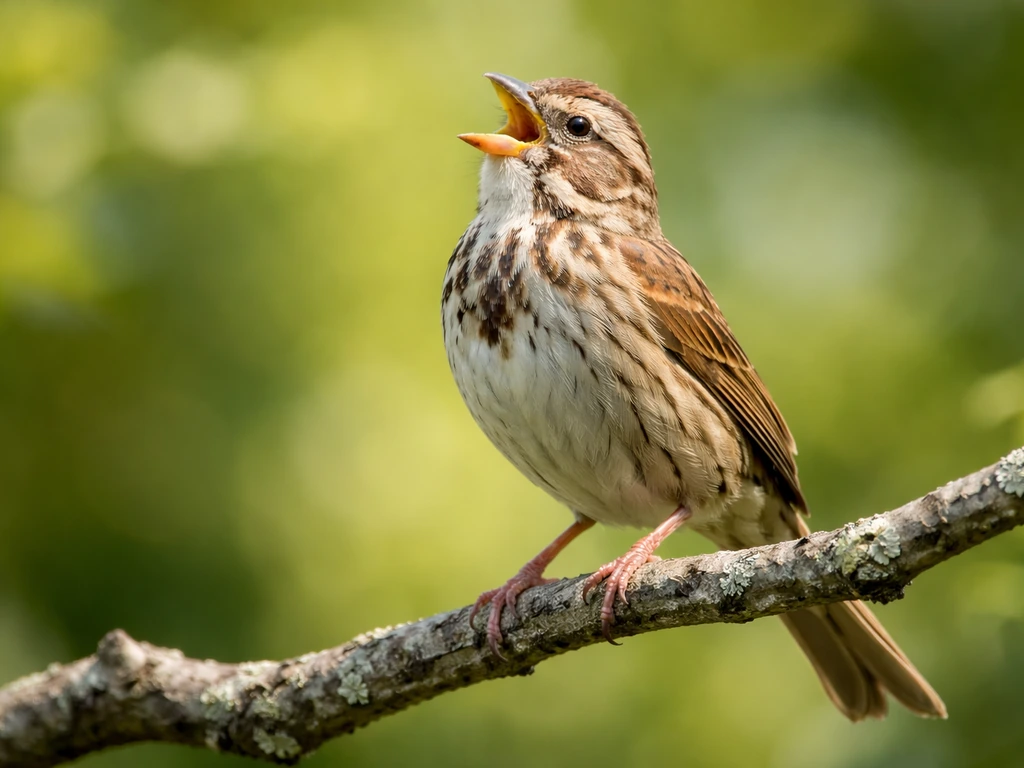
Complex, fluid songs with varied phrases typically come from songbirds (passerines). In North America, the usual suspects are American Robins, Song Sparrows, House Finches, Northern Cardinals, and thrushes like the Wood Thrush or Veery. In Europe, the Common Blackbird and Nightingale are the classic melody-makers. These are birds singing to hold territory or attract mates, so hearing one usually means a male is nearby and actively breeding.
Sharp chips and chattering
Short, clipped chip notes are contact calls. Warblers, sparrows, and finches use them constantly while foraging to stay in touch with flock members. A rapid burst of chattering, almost scolding in tone, often comes from wrens or chickadees and usually signals mild irritation or alerting nearby birds to something unusual, like you standing too close to a nest.
Cawing and harsh calls
Loud, flat, repeated cawing is almost always American Crows or Common Ravens in North America, Carrion Crows or Rooks in Europe. Crows use cawing for many things: rallying family members, mobbing a predator, or announcing their presence to a rival group. If you hear a whole group cawing and diving toward a tree, they have almost certainly spotted an owl or hawk and are mobbing it.
Drumming and tapping
Rhythmic, rapid drumming on wood is woodpecker territory advertisement, not foraging. When a Downy, Hairy, or Pileated Woodpecker drums fast and repeatedly on a resonant surface (often a dead tree or even a metal drainpipe), it is doing the same job as a songbird's song: claiming space and attracting a mate. Slow, irregular tapping is more likely actual feeding.
Hooting and nighttime calls
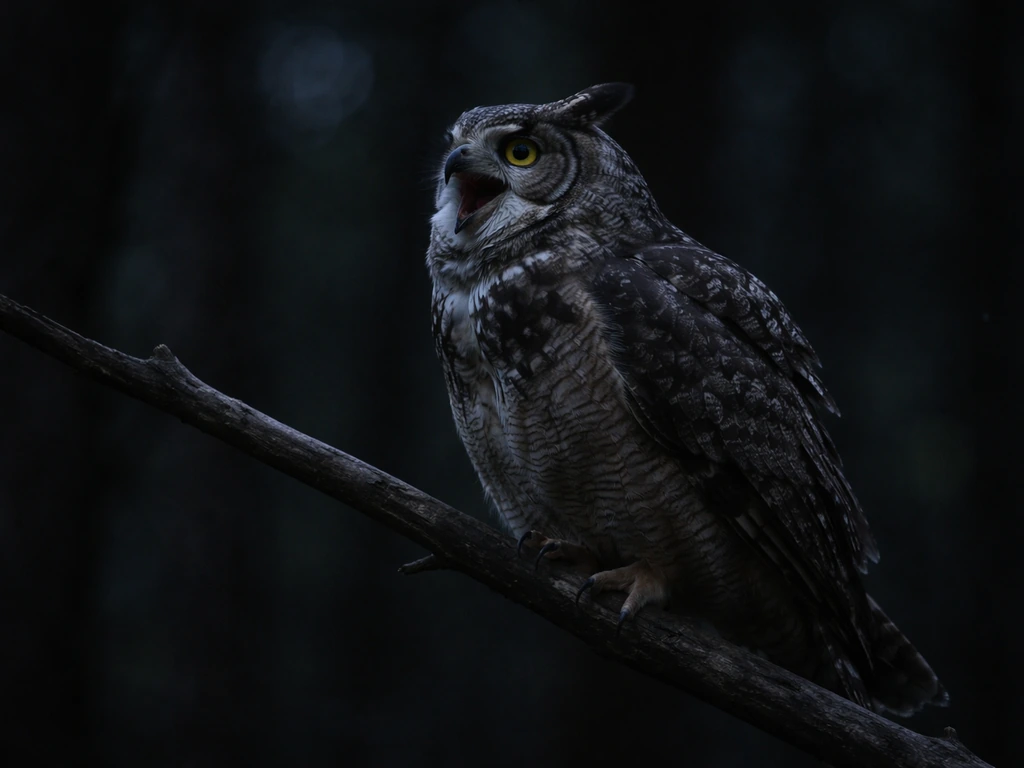
A deep, soft, stuttering hoot in the dark is almost certainly a Great Horned Owl. Cornell Lab describes their classic call as a series of four or five low hoots in a rhythm sometimes described as 'who's awake? me too.' Breeding pairs will duet, with the male and female alternating hoots back and forth. Smaller owls, like the Eastern Screech-Owl, produce a descending whinny or a long tremolo instead. Nighttime chirping or singing that surprises people often turns out to be a Northern Mockingbird, which is famous for singing through the night, or a Whip-poor-will, which repeats its own name relentlessly.
Whistles
Clean, clear whistles with a human quality often come from Northern Cardinals (a repeated, slurring whistle), Eastern Wood-Pewees, or various thrushes. High, thin whistles from above during migration are flight calls from warblers and sparrows moving overhead at night, something most people never think to associate with birds. The bird whistle meaning can shift depending entirely on context, and this is worth exploring in its own right alongside these sounds. The bird call meaning slang online often centers on “alarm” or “attention” vibes, so matching the sound to context matters bird whistle meaning.
The bird whistle meaning can also vary by species and whether the whistle is a song or a call. If you want a deeper dive, see bird calls meaning by type and situation. Bird call meaning slang is usually about people repurposing the sounds into modern, informal phrases rather than any fixed biological interpretation.
What the context actually tells you
The same sound from the same species can mean different things depending on when and where you hear it. Context is not a bonus layer of interpretation; it is the main event.
Time of day
The spring dawn chorus (typically starting 30 to 45 minutes before sunrise) is the peak of territorial singing. Research on Savannah Sparrows confirms that early-morning dawn chorus singing in the breeding season is primarily directed at rival males for territorial defense, while later in the day the same songs may shift toward attracting females. The short answer: birds singing loudly at first light in spring are overwhelmingly defending territory. By mid-morning, song rates drop. By afternoon, you are more likely to hear calls than songs. Nighttime sounds, outside of owls and mockingbirds, are less common and worth noting as unusual.
Season
Spring and early summer are dominated by song and territory behavior. Fall brings contact calls and migration flight calls. Winter flocks use soft chip notes to stay cohesive while foraging. Hearing a full, elaborate song in December from a species that should have migrated is a genuine flag worth noting, either a species wintering over or a rare stray. Seasonal expectations matter: a wood thrush's flute-like song in May is completely normal; that same sound in October would be worth a closer look.
Location
Proximity to a nest changes everything. A bird scolding you from two feet away while you walk past a shrub is almost certainly nest-guarding behavior. That same alarm call from across a field means something different: a predator is nearby, or the bird is simply reacting to a disturbance. Black-capped Chickadees are well documented to vary their alarm call structure based on the size and type of threat: higher-pitched, longer 'seet' calls for aerial predators (hawks overhead) and the familiar 'chick-a-dee-dee-dee' with more 'dee' notes added for smaller, more immediate threats. blank" rel="noopener noreferrer">The more 'dee' syllables, the higher the threat level, at least in chickadee terms.
Behavior you can see
Watching the bird while it vocalizes tells you a lot. A bird singing from a prominent exposed perch is almost always broadcasting (territorial song or mate attraction). A bird moving low through dense cover while chipping quietly is foraging and keeping contact with others. A bird mobbing another species while calling loudly is in alarm mode. If you can combine the sound with even a few seconds of visible behavior, your interpretation accuracy jumps dramatically.
Folklore, spiritual symbolism, and what to actually believe
Bird sounds have carried cultural meaning for as long as humans have paid attention to the natural world. It is worth taking these traditions seriously as cultural artifacts, even if the scientific evidence does not support treating them as literal predictions.
Owl hoots and death omens
The association between owls and death is ancient and widespread. In older English and European folklore, hearing a Tawny Owl's call near a home was taken as a death omen. The reasoning is not hard to follow: owls are nocturnal, their calls are haunting and unexpected in the dark, and they were rarely seen. That combination made them easy to associate with the unknown and with mortality. The association appears in Shakespeare and in pre-Columbian Mesoamerican traditions as well. The real-world explanation is simpler: owls hoot to establish territory and find mates, exactly as they do year-round, with no connection to household events.
Whip-poor-wills and death folklore
The Whip-poor-will carries one of the most specific documented superstitions in North American folklore. A 19th-century account published in the American Journal of Folklore describes the bird's repetitive call near a home as an omen of death or illness in the household. JSTOR Daily traces this belief across multiple cultural accounts. The bird's habit of singing persistently near human dwellings at night (it breeds in woodland edges and open areas close to where people live) made it an easy target for omen-building. What it is actually doing is exactly what any breeding male does: advertising its territory and trying to attract a female.
Common bird sound omens in brief
| Sound / Bird | Common Folklore Belief | What It Actually Means |
|---|---|---|
| Owl hooting near a home | Death omen (widespread across cultures) | Territory advertisement, mate-finding, or pair communication |
| Whip-poor-will calling repeatedly | Death or illness in the household (North American folklore) | Territorial breeding song from a male near its habitat |
| Crow cawing near a window | Bad luck or warning of misfortune | Crows reacting to reflections, food sources, or flock communication |
| Rooster crowing at unusual times | Omen of change or disaster | Disrupted light cycle (artificial light, clouds, predator disturbance) |
| Birdsong inside a home (bird enters) | Death omen (various European traditions) | A disoriented bird following light or a gap into an enclosed space |
The pattern across bird sound folklore is consistent: unusual timing, unfamiliar calls, or proximity to humans in situations where birds are not expected gets interpreted as supernatural messaging. These beliefs deserve respect as cultural history, but they should not cause anxiety. A crow cawing outside your window is a crow doing crow things.
Bird sounds in dreams: what people believe and what holds up

Searches for 'bird sounds meaning' often come from people who heard birds in a dream, not outside their window. That is a genuinely different question, and it is worth addressing directly rather than ignoring it.
In popular dream interpretation traditions, bird sounds in dreams are frequently linked to messages, change, new beginnings, or spiritual communication. Hearing songbirds is often framed as a sign of joy or incoming good news. Hearing an owl hoot in a dream sometimes carries the same ominous associations it does in waking folklore. These interpretations are widespread in dream symbolism traditions across many cultures and they are worth knowing about as a framework people use.
The scientific take is more grounded. Psychology Today describes dreams primarily as a form of emotional processing, an 'emotional thermostat' rather than a reliable prophecy system. Research on dream interpretation specifically has found that people's interpretation of their own dreams can be strongly shaped by suggestion: the same dream can be given very different meanings depending on what framing is offered first. That does not make the emotional experience of a vivid dream meaningless. It does mean that treating a dreamed owl hoot as a literal omen of death is putting a lot of weight on something that neuroscience treats as memory consolidation and emotional regulation.
A balanced approach: if a bird sound in a dream felt significant, ask what emotion it carried and what was happening in your life at the time. That reflection is genuinely useful. Using it as a predictive tool for external events is where the evidence runs out. For a deeper look at how specific sounds and tweets get interpreted symbolically, the topic of bird tweeting meaning covers that symbolic and cultural ground well. For that, see bird tweeting meaning, which explains how specific tweets are interpreted symbolically and in culture.
How to actually figure out what you heard
If you heard something and want a real answer, there is a practical workflow that works well and does not require any birding experience.
- Record it if possible. Even a phone recording through a window is useful. Try to get 10 to 30 seconds of clear audio without wind noise or conversation in the background.
- Note the basics immediately: time of day, date, your location (habitat type: backyard, forest edge, wetland, urban park), and any visual detail you caught (size, shape, color, behavior).
- Open the Merlin Bird ID app from Cornell Lab and use the Sound ID feature. Tap the microphone, let it listen live, or import a recording. Merlin will suggest species in real time. You can then tap the suggested species name to jump to the exact moment in your recording that matched.
- Cross-check against the All About Birds species pages, which include multiple recorded examples of songs and calls for each species, often with written descriptions of the sound.
- Filter by location and season. Merlin lets you set your location and date so that only species actually expected in your area appear. This cuts out false matches significantly.
- If you are still unsure, post a written description or audio file to a platform like iNaturalist. Note that iNaturalist does not offer automated AI identification for audio the way it does for photos, so community experts will review it manually, which takes a bit longer but is reliable.
- Avoid over-interpreting a single sound in isolation. Wait to see if you hear it again, in what context, and whether any visual is available.
Writing a useful sound description when you have no recording
If you could not record it, write a description immediately while the memory is fresh. The Natural History Museum recommends describing pitch (high, low, mid), rhythm (fast, slow, repeated, irregular), tone quality (clear and pure, raspy, buzzy, nasal, flute-like), and any pattern (rising, falling, repeated phrase, one-note). Something like 'a single, clear, descending whistle, medium pitch, repeated every five seconds from a treetop' is far more useful than 'some kind of bird call.' That level of description is usually enough for an experienced birder to narrow it to two or three species.
Resources worth bookmarking
- Merlin Bird ID app (Cornell Lab): the most practical real-time sound identification tool available for free
- All About Birds (allaboutbirds.org): species accounts with multiple audio examples and written sound descriptions
- Xeno-canto: a global crowd-sourced library of bird sound recordings, searchable by species and region
- iNaturalist: useful for posting audio with location and date data for community identification
Putting it all together
Most bird sounds you hear have a perfectly straightforward explanation: a male advertising territory, a flock staying in contact, a bird alarming at a predator, or an owl doing its nightly rounds. The meaning of a specific sound is almost always a combination of what species it is, what type of vocalization it is (song or call), and what the context around it tells you (time, season, location, visible behavior).
Cultural and spiritual interpretations add a rich layer of meaning that humans have built around bird sounds for thousands of years, and those traditions are worth knowing. But they work best as a lens on human psychology and culture, not as a field guide to what is actually happening outside your window. When in doubt, record it, describe it, and let the evidence lead you to the answer.
FAQ
If I hear a bird sound but I cannot tell if it is a song or a call, how do I interpret it anyway?
Start by classifying the sound you heard, then use timing and location to narrow species. For example, a long repeated melody at dawn in spring is usually territorial song, while a short sharp chip during foraging is usually a contact call. If you cannot tell whether it is a song or a call, focus on structure (clear phrases and repetition suggests a song) and whether the sound happens in bursts (often calls) versus continuous sequences (often songs).
Why does the same bird sound sometimes seem friendly in one moment and alarming in another?
Many people misread “more noise equals more aggression.” Instead, look at visible behavior and proximity. If multiple birds are mobbing, diving, or rapidly calling while staying close to a tree, that is likely anti-predator behavior. If a single bird is calling from a perch without other birds joining, it may be contact or territory rather than direct aggression.
What if the bird sounds differently than what my general seasonal expectations say?
Bird vocal activity changes by season, but also by latitude and weather. In cold snaps or heavy rain, birds may sing less and rely more on short contact calls, so you should not treat “no singing” as evidence of absence or illness. If you want a meaningful interpretation, compare today’s soundscape to nearby days with similar weather.
How can I get a more accurate bird sounds meaning when I cannot identify the species yet?
If you see the bird first, use what it is doing to override your assumptions about meaning. A bird singing from an exposed branch is usually advertising or attracting, while a bird low in dense cover giving quick chips is more likely staying in contact during foraging. If you only rely on sound, you can confuse alarm calls with nest-guard scolding, especially when you are near shrubs or a nest site.
How do I tell whether cawing means mobbing, contact, or territory?
Crow and raven calls can overlap, and both can be highly variable. A reliable next step is to separate “group behavior” from “single bird sound.” If a whole group is cawing and moving together, you are often seeing mobbing or rallying. If one bird is calling while foraging or moving, it is more likely contact or presence signaling.
What’s the quickest way to distinguish woodpecker drumming from foraging tapping?
Woodpecker drumming is often confused with feeding sounds, but the rhythm matters. Fast repeated drumming on a resonant surface typically signals territory advertisement, especially when it is loud and regular. Irregular softer tapping usually points to foraging, particularly if the bird is actively probing bark.
I heard something at night, could it be an owl, or are there non-owl birds that sound similar?
Some birds sing at night or in low light, and it does not automatically mean an owl. Northern Mockingbirds can sing through the night, and Whip-poor-wills repeat distinctive phrases, so use the sound pattern (melody-like mimicry versus a single repetitive name-like call) plus behavior (perched and active versus hidden and calling) to avoid false assumptions.
If I hear a bird call in the “wrong” month, what should I check first?
When a sound seems “wrong” for the season, check two alternatives before concluding it is unusual. First, confirm your local timing, because breeding and migration schedules vary by region and microclimate. Second, consider whether the species is shifting its vocal pattern (some birds sing less or more depending on weather), so record a second occurrence rather than judging from one event.
If bird sounds in a dream feel ominous, how should I interpret it without overreacting?
Treat dream bird sounds as meaning about your emotions and current life context, not as a direct forecast. A practical approach is to note the emotion (comfort, fear, urgency) and any major events happening around the dream. If the same symbol keeps appearing with the same emotion, that pattern is more informative than literal predictions.
What is the best next step after I hear a bird and want to identify the meaning more reliably?
If you can record audio, prioritize clean capture and timing. Start recording a few seconds before the sound begins, then record through the full phrase sequence, and include ambient context like whether other birds join in. If you cannot record, a good written substitute is the pitch, rhythm, and tone quality you hear, plus how often it repeats (every few seconds, continuous burst, single note).
Next Article
Bird Blindness Meaning: Causes, Signs, and What to Do Now
Bird blindness meaning: spot signs, tell vision loss from other issues, and take safe action or get urgent vet care.