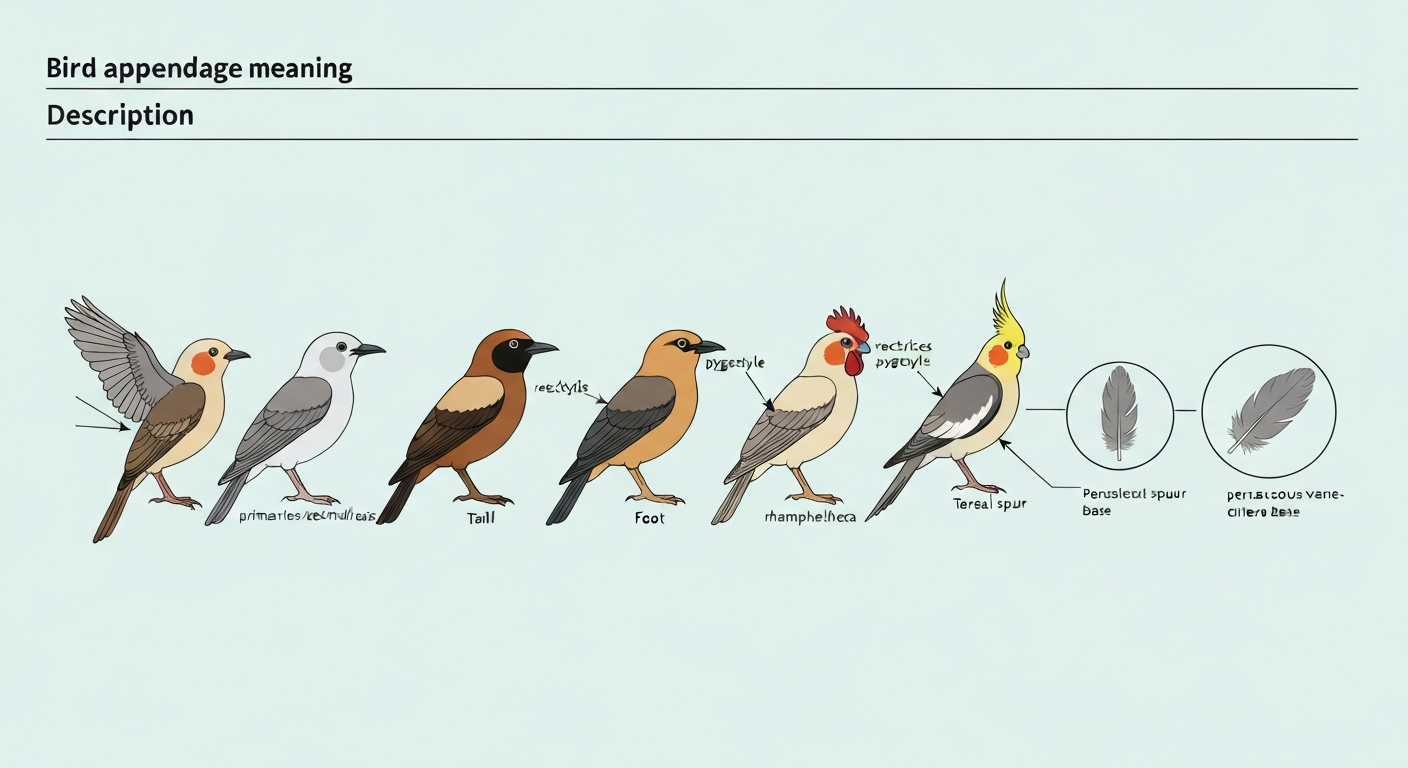
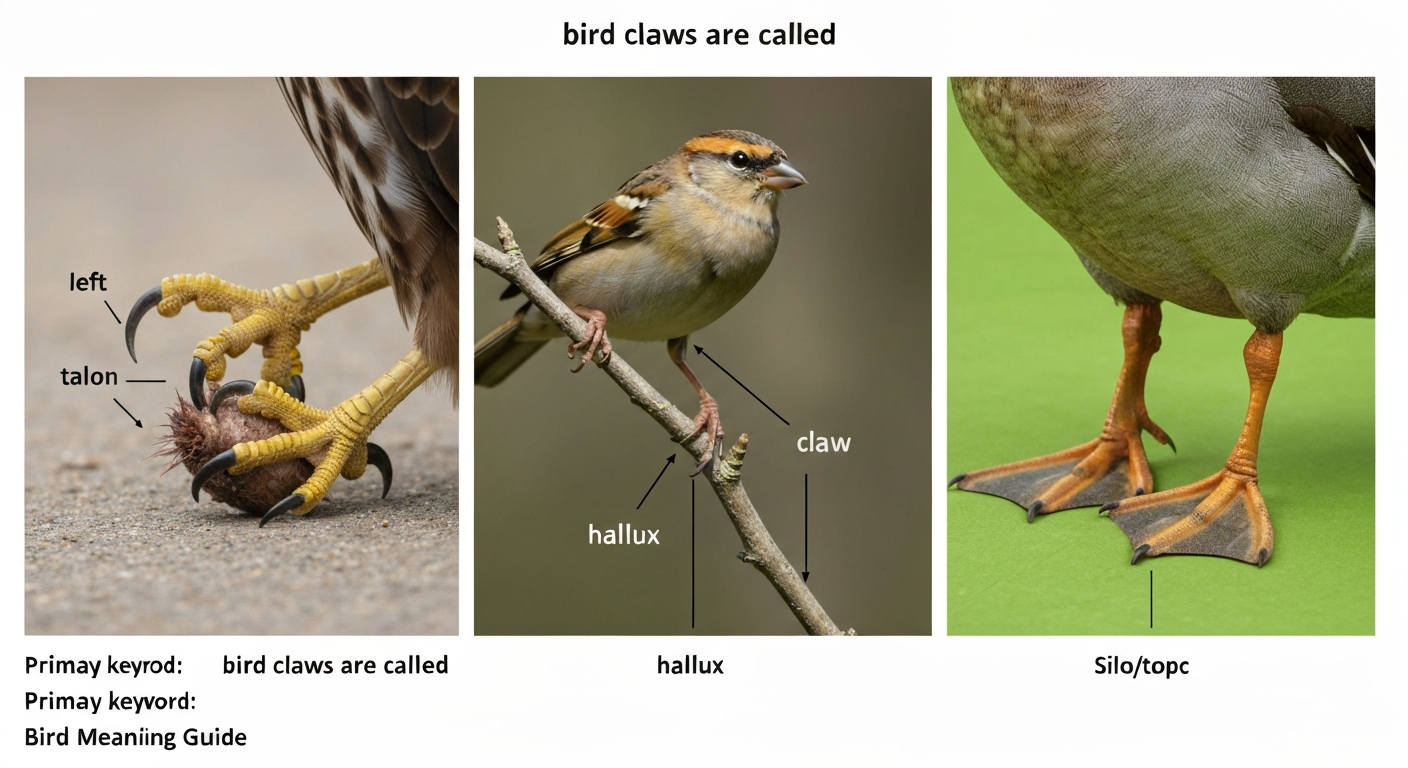
Bird claws are most commonly called talons when they belong to a bird of prey, and simply claws for all other birds. In strict anatomical terms, the visible curved structure is a keratinous sheath grown over a bone called the ungual phalanx, and the whole digit is built from smaller bones called phalanges. In everyday English, 'talon,' 'claw,' and even 'nail' all get used, sometimes interchangeably, but they each carry distinct meanings worth knowing whether you are a birdwatcher, a student, a dream interpreter, or just curious about the hawk circling your backyard.
Bird Claws Are Called: Talons, Toes, Nails & Meanings

Marcus Holloway
26 Jul 2026
Talon, claw, nail, or toe: which word is actually correct?
The short distinction is this: 'talon' is reserved in both popular and scientific writing for the claws of raptors (hawks, eagles, owls, falcons, and osprey). Every other bird has claws, and small passerines like sparrows are sometimes described as having toenails in casual speech. In ornithology, 'claw' is the correct general term for any bird. 'Talon' is not a separate anatomical structure but a conventional English label that signals function and ecology: a large, hooked, keratinous weapon used to catch and hold prey. Merriam-Webster defines talon as 'a large, hooked claw,' and Dictionary.com notes the common usage overlap, reflecting how the two words bleed into each other in everyday language. The word 'toe' refers to the whole digit, bones and all, while 'claw' or 'talon' refers specifically to the terminal keratinous structure.
At a glance: the key distinctions
| Term | Applies to | Technical basis | Everyday use |
|---|---|---|---|
| Talon | Birds of prey (raptors) | Conventional English; not a separate anatomical structure | Eagle, hawk, owl, falcon, osprey |
| Claw | All birds (including raptors) | Correct general ornithological term for keratinous tip | Chicken, crow, sparrow, parrot |
| Nail | Passerines, waterfowl (informal) | Analogy to mammal fingernails; not preferred in ornithology | Finch, duck (casual speech only) |
| Ungual / ungual phalanx | All birds (scientific writing) | The terminal bone beneath the keratinous sheath | Scientific papers, anatomy texts |
| Toe | All birds | The whole digit: bones, tendons, and claw combined | Field guides, species accounts |
One-sentence answer: bird claws are called claws (the universal term), with 'talon' reserved for birds of prey, and 'ungual phalanx' used in scientific anatomy. Key distinction: all talons are claws, but not all claws are talons.
Anatomy glossary: the parts you need to know
Bird foot anatomy is more layered than it first appears. Here are the core terms, each defined plainly enough to use in conversation or research.
Phalanges
Phalanges (singular: phalanx) are the individual toe bones. Each toe is made up of a series of phalanges connected by joints, much like human finger bones. The number of phalanges per toe varies: the inner toe (digit I) typically has two, while the outer toes have progressively more. The terminal phalanx in each toe is the ungual phalanx, the bone that supports the visible claw or talon.
Tarsus (tarsometatarsus)
What most people call the 'lower leg' of a bird is technically the tarsometatarsus: a single fused bone formed from the distal tarsal bones and the metatarsals. This is the long scaly section between the bird's 'knee' (which is actually the ankle) and where the toes begin. In raptors it is often feathered; in wading birds it is proportionally very long. When field guides describe a bird's leg length, they are usually measuring this bone.
Hallux
The hallux is digit I, the hind toe that points backward in most perching birds. It is functionally critical: when a passerine lands on a branch, flexor tendons automatically lock the toes closed, and the hallux pressing backward against the branch creates a secure, passive grip the bird can maintain even while sleeping. Cornell Lab's All About Birds references the hallux explicitly in species accounts, noting for the American Pipit that it has 'a long hind toe (called a hallux) and toenail.' In raptors, the hallux talon is often the largest and most powerful, used to deliver the killing puncture.
Spurs
Spurs are bony or keratinous projections found on the legs of certain birds, most famously roosters and some pheasants. They are not toes or claws in the usual sense but are outgrowths of the tarsometatarsus used primarily in combat and territorial defense. Jacanas also bear wing spurs. Spurs are worth distinguishing from claws because they sometimes appear in cultural symbolism and cockfighting traditions, where they carry their own set of meanings separate from talons.
Ungual phalanx
This is the bone that sits inside every claw or talon. The keratinous 'claw' visible to the eye is a sheath grown over the ungual phalanx, the same way a human fingernail grows over the bone beneath. Scientific papers studying claw evolution use the terms 'ungual' or 'ungual phalanx' rather than 'talon' or 'claw,' because those terms are precise and independent of the animal group being studied.
Foot and toe arrangements: five main types
Bird feet are not all built the same way. The arrangement of toes is one of the most reliable indicators of how a bird lives, what it eats, and where it spends its time. blank" rel="noopener noreferrer">Zygodactyl feet (two toes forward, two back) are characteristic of parrots and many woodpeckers and support climbing, vertical clinging, and manipulation of food, making parrots and woodpeckers classic ID examples. There are five main configurations worth knowing. External Anatomy (Santa Cruz Bird Club PDF), toe arrangement summary lists the standard toe arrangements (anisodactyl, zygodactyl, heterodactyl, syndactyl, pamprodactyl) and gives exemplar species for each External Anatomy (Santa Cruz Bird Club PDF) — toe arrangement summary.
| Arrangement | Toe configuration | Key function | Example species |
|---|---|---|---|
| Anisodactyl | 3 toes forward, 1 (hallux) back | Perching, gripping branches | Robins, sparrows, most raptors |
| Zygodactyl | 2 toes forward (II, III), 2 back (I, IV) | Climbing, clinging to vertical surfaces, food manipulation | Woodpeckers, parrots, some owls |
| Syndactyl | Two front toes partially fused at the base | Digging, nest excavation in earthen banks | Kingfishers, bee-eaters |
| Pamprodactyl | All 4 toes can rotate forward | Clinging to vertical surfaces (chimneys, cliffs) | Swifts |
| Webbed (palmate) | Toes connected by skin webbing | Swimming, paddling, walking on soft mud | Ducks, geese, pelicans, gulls |
The osprey deserves a special mention here. It is technically anisodactyl as a baseline, but it can actively reverse its outer toe (digit IV) to produce a two-forward, two-back zygodactyl grip when catching fish. Its foot pads are also covered in tiny spicules, spiny projections that increase friction on slippery prey. For more on the role and symbolism of these spiny projections, see bird spikes meaning. This adaptability makes the osprey one of the most studied feet in raptor biomechanics.
Raptor talons vs. other bird claws
The physical difference between a raptor talon and a perching bird's claw is dramatic once you know what to look for. Raptor talons are typically longer, more deeply curved (recurved), and have a sharper, more tapered cross-section designed for puncturing and gripping. Peer-reviewed functional morphology research confirms that talon curvature and cross-section are tuned to prey size and hunting technique, not simply to body size. In other words, two raptors of similar weight can have noticeably different talon shapes if they hunt differently.
Within raptors, there is meaningful variation between families. Accipitrids (hawks, eagles) show hypertrophied inner and rear talons (digits I and II) used to restrain large, struggling prey. Falcons rely more on the impact of a high-speed strike and their notched beak (the tomial 'tooth') to dispatch prey quickly, so their talons, while sharp, are less massively recurved than an eagle's. Owls, particularly large species like the great horned owl, generate grip forces that are very high relative to their body size, using constriction to immobilize prey before it can injure them.
Non-raptor bird claws tend to be shorter, less curved, and blunter. A perching sparrow's claw is not designed to pierce flesh but to wrap securely around a branch. A woodpecker's claws are stout and curved just enough to dig into bark. A duck's claws are small and almost flat because webbing between the toes handles the locomotion work. If you are trying to identify whether a bird has true raptor talons or perching claws, the curvature and relative length compared to the toe itself is the most reliable visual cue.
Quick ID tips: raptor talon or perching claw?
- Length: raptor talons are typically longer than the toe segment they sit on; perching claws are usually shorter or roughly equal
- Curvature: raptor talons curve sharply and consistently from base to tip; perching claws are gently curved or nearly straight
- Cross-section: raptor talons taper to a fine, knife-like point; perching claws end more bluntly
- Color and texture: raptor talons are often dark (black or dark grey) and smooth; many passerine claws are lighter, sometimes horn-colored
- Hallux talon: in raptors, the rear hallux talon is large and often the most powerful; in passerines, it is modest and used mainly for perching grip
- Foot size relative to body: raptors have proportionally very large feet for their body mass compared to non-predatory birds
What bird claws and talons are actually used for
- Hunting and prey capture: raptor talons grip, puncture, and immobilize prey; the hallux talon delivers the primary killing force in many species
- Prey restraint and carrying: large eagles use their talons to hold struggling prey while delivering a killing bite or waiting for it to expire; ospreys carry fish headfirst to reduce drag
- Perching and sleeping: the anisodactyl foot with its passive tendon-locking mechanism allows passerines to grip a branch without muscular effort, making it safe to sleep on a perch
- Climbing: zygodactyl woodpeckers and parrots use their opposing toe pairs to move up vertical surfaces and manipulate food items; the claws provide purchase on rough bark
- Digging and nest excavation: kingfishers use their partially fused (syndactyl) toes and short claws to excavate burrows in earthen banks
- Swimming and wading: webbed-footed birds use their feet as paddles; claws are small and largely incidental to propulsion
- Courtship and display: some raptors carry prey to potential mates in their talons as part of courtship feeding; the size and condition of talons can signal fitness
- Defense: birds of many species use their claws defensively against predators or rivals; herons can deliver powerful talon strikes when cornered; roosters use leg spurs in combat
- Preening and grooming: many birds use their claws to scratch their head and neck feathers in areas the bill cannot reach; owls have a comb-like 'pectinate' middle claw adapted for this
Behavioral cues from claw and foot use
Watching what a bird does with its feet and claws can tell you quite a lot about its immediate state, though it is worth being careful not to over-read behavior. These are observational notes, not definitive psychological diagnoses of what the bird is 'feeling.'
Gripping and perch pressure
A bird gripping tightly with all toes flexed is often alert or mildly stressed. Relaxed perching in passerines typically shows loose toe contact, not a white-knuckle clench. In raptors, a bird mantling (spreading wings over prey and gripping hard) is displaying both food-guarding behavior and some level of arousal or competition pressure. This is observable, consistent behavior, but inferring specific emotional states from it goes beyond what the evidence supports.
Head-scratching and preening
When a bird raises one foot to its head and scratches methodically, it is engaged in maintenance preening, removing parasites, debris, or damaged feather barbs from areas its bill cannot access. Owls and some other species have a specialized serrated (pectinate) middle claw precisely for this purpose. This is routine comfort behavior with no reliable deeper meaning, cultural associations aside.
Foot-dangling and loose grip while roosting
A bird hanging loosely from a perch with one foot is often in a deep resting state. The passive tendon lock in anisodactyl feet means the bird is not exerting effort; it is resting on a closed fist, essentially. Seeing a bird do this during daylight hours without disturbance is generally a sign of a calm, safe environment from the bird's perspective.
Foot displays in courtship and aggression
Some raptors perform aerial talon-grappling displays during courtship (sometimes called 'cartwheeling'), where two birds lock talons and spin toward the ground before separating. Whether this is purely courtship or partly competitive is debated in ornithology: in some species the same behavior appears in territorial disputes between rivals. Observing it tells you something significant is happening between those two birds, but attributing a single meaning to the behavior without knowing species, season, and individual history is speculative.
Scratching the ground
Ground-scratching in gallinaceous birds (chickens, turkeys, pheasants) and some thrushes is straightforward foraging behavior: the bird is using its claws to displace leaf litter and expose invertebrates or seeds. It tells you the bird is actively searching for food rather than alert to a threat.
Cultural and spiritual symbolism of claws and talons
Across cultures, bird talons have carried enormous symbolic weight, almost always centered on the same cluster of ideas: power, protection, precision, and danger. See the related entry on bird claws meaning for a focused exploration of symbolic interpretations. These are folk and spiritual interpretations, not ornithological claims, and they are worth taking seriously on their own terms.
In many Indigenous North American traditions, eagle talons are held as powerful protective and warrior symbols. They appear in regalia, medicine bundles, and ceremonial objects, where they represent the eagle's strength brought into human use. Wearing or carrying a talon is understood in some traditions as carrying the bird's power as a protector or spiritual guardian. These traditions are specific and varied: what an eagle talon means in one nation's ceremony is not necessarily what it means in another's.
In European heraldry, the bird of prey shown 'armed' (talons displayed) was a standard way of signaling martial power, nobility, or protection. The eagle's talon gripping a bundle of arrows in the U.S. Presidential Seal is a direct descendant of this tradition, signaling military readiness. In contrast, folk traditions across parts of Africa, Asia, and the Americas associate the curved talon with fate, the inevitable grip of death or destiny, with the idea that what the raptor seizes cannot escape.
In spiritual and metaphysical frameworks, talons are often read as symbols of decisiveness, the ability to seize an opportunity or an idea with precision and not let go. This connects to the broader symbolic meaning explored elsewhere on this site around bird appendages more generally. See the article on bird appendage meaning for broader symbolic meanings of claws and other bird parts. A bird's claws in this context represent earthly grounding: the part of the bird that connects it to the physical world even while it soars.
Talons and claws in dreams and idioms
Dream interpretation traditions (Jungian, folk, and modern popular) consistently associate talons with themes of control, being seized by a force larger than yourself, or conversely, with your own capacity to take firm hold of a situation. Being grabbed by talons in a dream is widely interpreted as feeling controlled by an external authority or pressure. Holding talons or acting as the bird whose talons grip something is read as confidence, decision-making power, or even aggression. These are archetypal readings, not empirical science, but they are remarkably consistent across Western and Eastern dream interpretation traditions.
In English idioms, 'in the talons of' something means firmly and inescapably controlled by it, with a connotation of danger or predatory intent. 'Showing your claws' means revealing a previously hidden capacity for aggression or sharpness of character. 'Clawing your way' to something describes effortful, determined, sometimes ruthless progress. These idioms have mostly negative or cautionary undertones in everyday speech, though in motivational contexts 'clawing back' a loss or lead carries a positive, tenacious meaning.
Common misconceptions worth clearing up
- Not every bird has talons: 'talon' correctly refers only to the claws of raptors; calling a pigeon's or sparrow's claw a talon is inaccurate in both scientific and careful popular writing
- Talons are not a separate structure from claws: a talon is a type of claw, not a different anatomical part; the word describes function and the bird group, not a unique anatomy
- Bird claws are not the same as insect claws or mammal claws in structure: insect tarsal claws are arthropod structures with no anatomical relationship to bird unguals; mammal claws and bird claws are both keratinous but evolved differently and have distinct structural layers
- Owls do not have the largest talons relative to body size by default: talon size scales with prey size and hunting technique, not simply with owl size; a great horned owl has powerful constricting grip force, but a harpy eagle has some of the largest talons of any living raptor
- The 'backward knee' visible on birds is actually the ankle, not the knee: the true knee is hidden close to the body under feathers; what bends backward in the middle of a bird's visible leg is the ankle joint
- Spurs are not the same as claws or talons: spurs are separate keratinous outgrowths from the leg used in combat, not modified toes or toe-tip structures
- Webbed feet still have claws: waterfowl like ducks have small claws on each toe even with full webbing between them; the webbing does not replace the claw
How this connects to broader bird meaning
The feet and claws of a bird are its point of contact with the physical world, the part that grips, scratches, hunts, and holds. Understanding what they are called and how they work gives you a much firmer foundation for interpreting the symbolism, too. Whether you are researching what a sparrow's delicate perching claw might mean in a dream, exploring the full anatomy of bird appendages, or tracing what a hawk's talons symbolize across different traditions, the literal anatomy is always the grounding point. The cultural meanings of bird claws and talons are rich and varied across traditions, and if you want to go deeper on that angle, the symbolic dimensions of bird claws are explored in detail alongside related ideas about bird wings and bird appendages more broadly on this site.
FAQ
Search‑optimized title and meta description for the article
Title: "What Are Bird Claws Called? Talons, Claws, Unguals & Foot Types Explained". Meta description (≤160 chars): "Clear answer: bird 'claws' may be called talons, claws, or unguals — plus foot types, functions, ID tips, and cultural meanings."
Concise primary answer: are bird claws called talons, claws, nails or toes?
Plain answer: the visible horny tip is usually called a "claw." In birds of prey (raptors) the large, hooked claw is commonly called a "talon." The bony elements are toes/phalanges and the terminal bone is the "ungual (ungual phalanx)." "Nail" is a casual synonym but less precise in ornithology.
Anatomy glossary (simple definitions for lay readers)
Tarsometatarsus: fused lower‑leg bones forming the bird's 'ankle'/'foot' column. Phalanges: toe bones (digits). Hallux: digit I, the rear or backward‑facing toe used in perching. Ungual/ungual phalanx: the terminal bone that supports the keratinous sheath. Claw (keratinous sheath): the horny outer covering of the ungual. Talon: popular/field term for a raptor's large, recurved claw. Spur: a small bony/keratinized projection on the leg or wing in some species.
Common foot/toe arrangements and what they do
Anisodactyl (3 forward, 1 back): typical passerines and many raptors — good for perching. Zygodactyl (2 forward, 2 back): parrots, woodpeckers — excellent for climbing and manipulation. Syndactyl: partially fused toes (some kingfishers) — stability for hopping/feeding. Pamprodactyl: toes can rotate forward (some swifts) — clinging to vertical surfaces. Webbed/semipalmate: partial/full skin between toes for swimming or wading.
How do raptor talons differ from other bird claws?
Raptor talons are typically larger, more strongly curved, laterally compressed or hooked, and paired with powerful flexor tendons. Functionally they are specialized for gripping, piercing, and restraining prey. Non‑raptorial birds often have straighter, blunter claws optimized for perching, scratching, walking, or swimming.
Primary functional uses of bird claws/talons
Hunting and prey restraint (raptors), perching and roosting (passerines), climbing/vertical clinging (woodpeckers, parrots), swimming and paddling (webbed species), scratching and preening maintenance, courtship/display (spurs, toe‑grasp displays), and defense/weapon use.
Next Article
Bird Appendage Meaning: Anatomy, Symbolism & Interpretation
Bird appendage meaning: clear anatomy, signals, symbolism, sparrow example, dream & slang interpretation.