A bird appendage is any external body part attached to a bird's main trunk: wings, tail, beak or bill, feet, claws or talons, crests, spurs, and feathers. People search this phrase for very different reasons: a student learning anatomical terminology, someone trying to decode what a bird's posture meant in a dream, or a homeowner confused about whether the metal spikes on a nearby ledge are somehow related to the bony spurs on a rooster's leg. They are not, and that confusion alone is worth clearing up. This guide walks through what each appendage is actually called, what it does biologically, how birds use it to communicate, and what cultural and spiritual weight people have attached to it across centuries.
Bird Appendage Meaning: Anatomy, Symbolism & Interpretation

Marcus Holloway
17 Jul 2026
What people mean by 'bird appendage': definition and scope
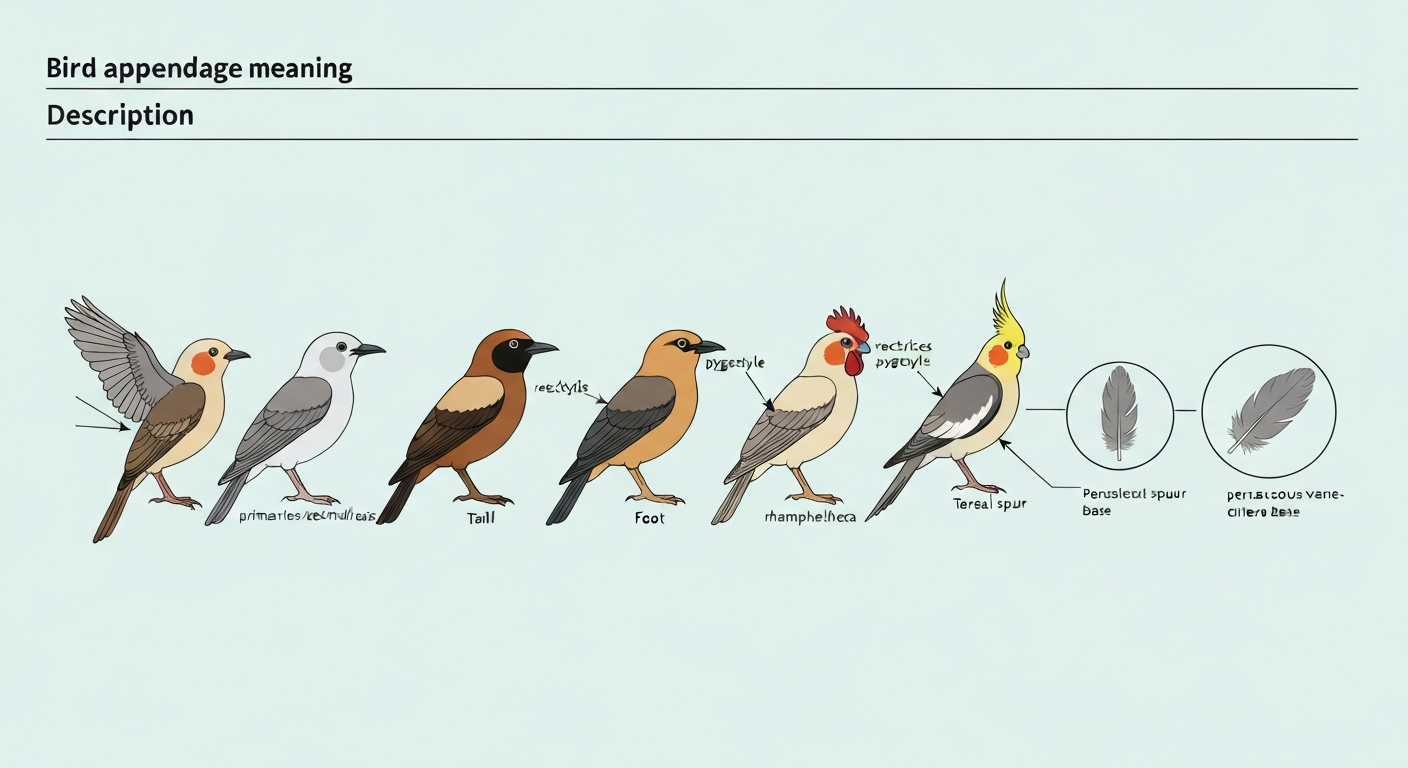
In everyday usage, 'bird appendage' is an umbrella phrase for any projecting external structure on a bird's body. It shows up in school worksheets, crossword puzzles, dream journals, and Google searches where the person knows they are thinking about a bird's body part but is not yet sure of the correct term. Anatomically, the word covers structures that grow from or are borne by the skeleton and integument: the paired wings (modified forelimbs), the tail (supported by the pygostyle), the beak or bill (the jaw structure covered by a keratinous sheath), the feet and legs, the claws and talons, and elaborations like crests, spurs, and the feathers themselves.
The scope expands further when you consider the contexts in which people interpret these structures. Ornithologists focus on form and function. Behaviorists focus on signaling and communication. Dream interpreters and spiritual traditions focus on symbolic meaning. Slang users borrow appendage names as metaphors. All of those uses are legitimate, and this article treats them as separate but related lenses rather than ranking one above the others.
Glossary and correct terminology for common appendages
The standardized source for bird anatomy terms is the Nomina Anatomica Avium (Baumel et al., 2nd ed.), which provides formal Latin and English equivalents. Here are the terms you will actually encounter, with their correct usage:
- Wings: the modified forelimbs. The flight feathers of the wing are divided into remiges (singular: remex): primaries attach to the hand bones, secondaries to the forearm. Together they generate lift and thrust.
- Tail: the fan of feathers supported by the fused terminal vertebrae (pygostyle). The individual tail feathers are called rectrices (singular: rectrix). Colloquially called 'tail feathers' or simply 'the tail.'
- Beak or bill: both terms are correct and interchangeable in most contexts. The structure consists of the bony upper jaw (premaxilla and maxilla) and lower jaw (mandible), both covered by a keratinous sheath called the rhamphotheca. 'Beak' tends to be used more often for raptors; 'bill' is preferred for waterfowl and passerines, though there is no strict rule.
- Claws: the keratinous, curved terminal structures on each toe. All birds have claws. This is the generic, correct term.
- Talons: the enlarged, strongly curved claws of raptors (hawks, eagles, owls, falcons) that are used to seize and subdue prey. 'Talon' is not a synonym for claw in general; using it for a sparrow's foot claw is technically imprecise.
- Spur: a distinct, bony or keratinized projection from the tarsus (lower leg), found in many gallinaceous birds such as roosters, turkeys, and some pheasants. Used in male-male combat. Not to be confused with anti-roosting spikes placed on buildings.
- Crest: an erectile tuft or plume of feathers on the head. Found in species like the Northern Cardinal, cockatiel, great crested grebe, and hoopoe. Position (raised or flat) communicates mood and arousal.
- Feathers: the keratinous integumentary appendages that cover the body. Structurally divided into pennaceous feathers (stiff-vaned, for flight and display) and plumulaceous feathers (downy, for insulation and some display). Both types serve multiple functions simultaneously.
Ornithological overview: biological roles of each appendage
Understanding what each appendage does biologically is the foundation for everything else in this article, because symbolic meanings almost always grow from observed function. Wings generate aerodynamic lift and thrust via a system of primary and secondary flight feathers working alongside powerful flight muscles: the pectoralis (downstroke) and supracoracoideus (upstroke). Wing shape and bone proportions determine flight style, as summarized in biomechanical reviews by Tobalske and others. Broad, rounded wings suit slow maneuvering in forest cover; long, narrow wings suit sustained gliding over open water.
The tail is far more aerodynamically active than it looks. Measured flow studies by Usherwood et al. (Journal of Experimental Biology, 2020) demonstrated that in gliding raptors the tail generates lift in a way that reduces induced drag on the wings, contributing meaningfully to both stability and maneuverability. Beyond aerodynamics, the rectrices function as visual signals in countless species, from the fanned peacock tail to the pumping tail of a palm warbler.
The beak is a composite tool: the keratinous rhamphotheca covers a vascularized bone structure, which means bills can carry color signals tied to an individual's physiological condition. Research on zebra finches shows that redder bill color correlates with higher carotenoid intake and immune competence, making the bill a genuine honest signal in mate choice and dominance interactions, not merely decorative. See Studies of beak coloration, vascularization and condition‑dependence in zebra finches (PMC review and empirical work) for review and empirical evidence linking carotenoid-based bill colour with condition and social signaling. Bills also serve preening, nest building, foraging, and in some species weapon-like defense.
Feet and claws are adapted to ecological niche in ways that rival bill diversity. Raptors carry enlarged talons on toes arranged for gripping prey. Woodpeckers use zygodactyl feet (two toes forward, two back) to brace against tree trunks. Ducks have webbed feet for paddling. The spur of a rooster is a separate structure from a claw: a bony core covered by keratin projecting from the tarsus, which can reach several centimeters in length in mature males.
Feathers, as Richard Prum's evolutionary work has shown, evolved before powered flight, initially serving thermoregulation and visual display. The same feather can manage multiple roles at once: the pennaceous vane of a flight feather generates aerodynamic force through stiff, interlocked barbules, while the plumulaceous base of the same feather traps an insulating air layer. This functional overlap is worth keeping in mind when evaluating symbolic claims, because feathers have always been multifunctional, which is partly why they carry such rich cultural weight.
Quick reference: appendages, biology, and symbolic meanings at a glance
| Appendage | Correct term(s) | Core biological role | Common symbolic meanings |
|---|---|---|---|
| Wings | Remiges, primaries, secondaries | Flight, lift, thermoregulation, display | Freedom, transcendence, protection, power, divine connection |
| Tail | Rectrices, tail feathers | Aerodynamic control, balance, visual signaling | Balance, direction, status, identity, communication |
| Beak / Bill | Rhamphotheca, rostrum | Feeding, preening, nest building, signaling | Voice, provision, truth-telling, tools, identity |
| Claws (generic) | Unguis, claws | Gripping, climbing, defense | Persistence, tenacity, earthly grounding |
| Talons (raptorial) | Talons | Seizing and subduing prey | Power, danger, predatory strength, swift justice |
| Spur | Calcar, tarsal spur | Male-male combat in galliforms | Aggression, masculine competition, martial energy |
| Crest | Crest, plume, erectile feathers | Threat, courtship, alertness display | Royalty, alertness, pride, nobility, divine crown |
| Feathers (general) | Pennae, plumae, remiges, rectrices | Insulation, flight, display, waterproofing | Protection, spiritual elevation, truth (Ma'at), grace |
Behavioral signals: how birds use appendages to communicate
Birds do not speak, but they talk constantly through body posture and appendage movement. Recognizing these signals transforms a casual sighting into a readable conversation. Here are the main behavioral categories:
Crest and head-feather position
Species with erectile crests, such as the Northern Cardinal, cockatiel, and blue jay, raise them during threat encounters and courtship and flatten them when relaxed or submissive. Cornell Lab field materials describe crest-raising in Blue Jays as part of a threat display that can accompany aggressive calls. A raised crest in a parrot typically signals excitement or arousal, whether positive or negative; reading it correctly requires watching the whole body posture alongside it.
Wing spreading and flashing
Wing-spreading serves several distinct functions. Vultures and cormorants spread wings for thermoregulation after bathing. Mockingbirds and killdeer flash wing patches to startle predators or competitors. Displaying male birds like peacocks and lyrebirds spread wings as part of courtship performance. In sparrows and other small passerines, quick wing flicking between perches is an alarm and assessment behavior observed in agonistic interactions, not random fidgeting.
Tail pumping, fanning, and cocking
Tail movement is one of the most species-diagnostic signals you can observe. Palm warblers pump their tails almost constantly as a foraging and identity signal. Phoebes pump their tails downward in a characteristic motion that distinguishes them from similar flycatchers. Fantails and peacocks fan their rectrices in courtship. A cocked-up tail in a wren signals alertness and mild agitation. In field guide terms, tail posture is often the first thing experienced observers look at when identifying a bird at distance.
Foot and talon displays
Raptors use foot and talon displays both in intraspecific competition and in mate-selection. Aerial talon-grappling in eagles and some hawks serves as a direct dominance and courtship test. Gallinaceous birds like roosters use tarsus spurs in ritualized and direct combat, often accompanied by wing-spreading and head-feather raising. Observing the feet and lower legs, not just the bill and wings, often reveals what interaction is actually happening.
Grooming and allopreening
Preening with the bill to maintain feather structure is partly maintenance, but in social species allopreening (two birds grooming each other) is a direct social-bonding behavior. When you see a bird nibbling at its own feathers or at a partner's neck, it is doing real maintenance work on feather barbule alignment, but it is simultaneously signaling trust and pair-bond strength.
Symbolism of wings: freedom, protection, power, and cultural variants
Wings are probably the most symbolically loaded appendage in the entire animal kingdom, and bird wings specifically carry meanings that cross every major cultural tradition. The core associations are flight, freedom, transcendence, and protection, and they are not arbitrary: they come directly from the observable fact that a winged creature can leave the earth and go where groundbound creatures cannot.
In Abrahamic religious texts, wings serve as explicit metaphors for divine shelter. Psalm 91:4 reads: 'He will cover you with his feathers; under his wings you will find refuge.' The image works because a bird genuinely covers its chicks with spread wings for warmth and protection, a biological reality that the metaphor borrows directly. Egyptian religious iconography gave wings to deities like Isis and to protective amulets, associating them with both guardian power and the soul's ability to travel between worlds. The Hindu Garuda, a giant eagle-like bird, is a vehicle of Vishnu and a symbol of speed, strength, and divine authority.
In dream interpretation traditions, dreaming of wings generally signals a desire for freedom, a transition or rise in circumstances, or a sense of being protected. Dreaming of broken or clipped wings tends to be interpreted as feeling restricted, unable to fulfill potential, or experiencing an authority that limits movement. These interpretations are consistent across Western popular dream guides and many indigenous North American traditions, though specific feather types and bird species add nuance.
Cultural variants are worth noting rather than flattening into a single universal meaning. In many West African traditions, wings are associated specifically with messenger birds and ancestors who travel between the living and the dead. In Japanese visual culture, crane wings in origami and art symbolize longevity and good fortune specifically, not freedom in the general Western sense. The wing of a specific bird carries that bird's full symbolic weight, which is why species context always matters.
For more on the specific meanings that different wing configurations carry, the article on bird wings meaning on this site goes deeper into cultural variants and visual iconography.
Symbolism of tails: balance, status, and signaling across cultures
The tail carries a different symbolic register than the wing. Where wings mean ascent and transcendence, tail symbolism tends to cluster around balance, grounding, and identity. Biologically, the tail is primarily a steering and stabilizing organ, and that functional meaning maps directly onto its symbolic uses.
The peacock's tail is the most globally recognized example of tail-as-status-signal. The dramatically long and eyed rectrices of the male peacock have been symbols of nobility, immortality, and cosmic awareness in Hindu, Persian, and Byzantine Christian traditions. The 'eyes' in the feathers have been read as all-seeing divine vision, as danger tokens (the evil eye in some Mediterranean contexts), and as protective amulets. Biologically, the tail is a genuine honest signal: maintaining those feathers is metabolically costly, so a male with a full, symmetric tail is advertising real genetic and physiological quality.
In Chinese symbolism, the tail feathers of the phoenix (Fenghuang) represent the five virtues: benevolence, righteousness, propriety, wisdom, and faithfulness, each associated with a specific color. Here the tail is not merely decorative; it is a moral inventory. In Celtic and Norse folklore, a bird's tail direction when it first appears to an observer is read as an omen: flying away suggests departure or missed opportunity, while a tail visible as a bird arrives often signals something coming to meet you.
In dream contexts, a bird's prominent or beautiful tail tends to be read as a sign of approaching recognition, social status, or a period of influence. A missing or damaged tail in a dream typically signals lost direction or instability. These readings are broadly consistent across Western folk-interpretation literature.
Symbolism of beaks and bills: voice, provision, truth, and common folklore
The beak is the bird's primary interface with the world: it gathers food, shapes nests, delivers calls and song, and in many species broadcasts the bird's physical condition through color. The symbolic meanings that have attached to it follow those functions closely.
Voice and speech are the dominant symbolic association. Because song and call emerge from the open bill, many cultural traditions link the beak directly to truthfulness, proclamation, and the power of naming. In ancient Egypt, the ibis-headed Thoth, scribe of the gods, was depicted with a long curved bill associated with precise language, record-keeping, and divine knowledge. In many indigenous North American traditions, certain birds whose calls carry far, such as cranes and ravens, are considered messengers precisely because of the vocal power of their bills.
Provision is the second major theme. A bird carrying food in its bill, especially to a nest, is an almost universal image of nurture and parental care. Seeing a bird with food in its bill in a dream is frequently interpreted in folk traditions as a sign of incoming abundance, nourishment, or care arriving from an unexpected source.
It is worth separating verified biology from folklore here. The biological fact is that bill color in species like the zebra finch is a condition-dependent carotenoid signal tied to immune competence and foraging success (supported by published empirical work in the ornithological literature). The folklore extension, that a brightly colored bill on any bird signals health, luck, or divine approval, is a metaphorical leap, not a biological claim. Both layers are interesting; knowing which is which keeps you from misreading either one.
Idioms and slang borrow from bill and beak heavily. 'Keep your beak out of it' (British English) means stay out of someone else's business. 'Beaking off' means speaking aggressively or rudely. 'Using your bill' can refer colloquially to eating or talking, depending on regional slang. These expressions all draw on the beak's role as the feeding and vocalizing tool.
Claws, talons, spurs, and crests: the appendages people mix up most
These four terms generate more confusion than any others in the 'bird appendage' search space, partly because the distinctions matter both scientifically and symbolically.
Claws and talons are the most commonly conflated. As established above, claws are the generic term for keratinous toe-tip structures on all birds. For clarity, bird claws are called claws, while talons refer specifically to raptors' enlarged, grappling claws. Talons refer specifically to the raptorial claws of hawks, eagles, owls, and falcons: enlarged, strongly curved, and biomechanically specialized for gripping live prey. The Cornell Lab's raptor anatomy materials make this distinction clearly. Symbolically, talons carry much stronger connotations of power, precision, and predatory authority than the generic claw. See our guide on bird claws meaning for a focused discussion of the symbolic and cultural interpretations of claws and talons. An eagle's talon in heraldry signals the power to seize and hold; a sparrow's claw does not carry that charge.
Spurs are a third distinct category. Roosters and other gallinaceous males grow a bony-cored, keratinized spur from the tarsometatarsus, used in male-male combat. Poultry science literature documents spur growth and its welfare implications in managed flocks. Symbolically, spurs represent martial aggression, masculine competition, and readiness for conflict. The spur of a fighting cock is a potent cultural symbol in many traditions across South and Southeast Asia, Latin America, and the Caribbean.
Crests are head-feather elaborations, not hard structures. Their symbolic profile is linked to royalty, nobility, and elevated status across many traditions: the crested helmets of Greek and Roman soldiers were almost certainly borrowing visual language from crested birds. A cockatiel's raised crest signals internal arousal, which maps straightforwardly onto the symbolic meaning of a crown or crest in heraldry: authority declared through visible elevation.
How species context changes the meaning: the sparrow as a case study
Appendage meanings do not exist in isolation from the bird carrying them. The wings of a sparrow and the wings of an eagle both represent flight, but the cultural weight attached to each is completely different, and the behavioral signals those wings carry are species-specific.
The house sparrow (Passer domesticus) is a small, granivorous passerine with a stout, seed-cracking bill, short rounded wings suited to quick bursts of flight between close perches, and a modestly sized tail used in short-range balancing and agonistic tail-flicking displays. Cornell Lab species accounts document typical sparrow behavior: the bill is used primarily for husking seeds rather than catching prey, which is why the house sparrow's bill carries no associations with danger or predation. Wing and tail movements in sparrow agonistic interactions are rapid, small-scale, and oriented toward competitive assessment with conspecifics rather than the dramatic aerial displays of raptors.
Culturally, the sparrow's small size and commonness are precisely what give it symbolic weight. In Matthew 10:29, two sparrows sold for a penny are used to make the theological point that even the most insignificant creature is not outside divine notice. The sparrow's appendages here are not the focus; it is the bird's ordinariness that carries the argument. In many folk traditions, the sparrow is specifically a bird of the common people: its modest wings and plain feathers mark it as a symbol of humility, community, and perseverance rather than power or transcendence.
This means that seeing a sparrow flutter at a window, spread its wings briefly on a fence post, or engage in wing-flick agonistic behavior needs to be read through a sparrow-specific lens. The article on bird sparrow meaning on this site covers the full cultural and spiritual range of sparrow symbolism in more depth.
Bird spikes vs. biological spurs: clearing up a common urban confusion
If you have searched 'bird appendage' after seeing metal spikes on a building ledge and wondering if they are somehow related to a bird's body, the answer is: no, they are entirely unrelated. Anti-roosting bird spikes are manufactured deterrent products made of stainless steel or polycarbonate, installed by property owners and pest-control services to prevent pigeons, gulls, and other birds from landing on ledges, signs, and structural edges. Manufacturers like Bird-B-Gone describe them explicitly as humane, non-lethal deterrents that work by altering the geometry of the landing surface, not by harming birds.
Biological spurs, as described above, are anatomical structures that grow from a bird's own leg. They share nothing with commercial spike products except the word that sometimes gets used loosely. The article on bird spikes meaning on this site explores the full context of anti-roosting spikes and what they do and do not represent symbolically and practically.
Dream interpretation and folklore: practical questions to ask
When an appendage appears prominently in a dream or feels significant in a real-world bird encounter, the interpretation is only as good as the contextual information you bring to it. Experienced bird-meaning interpreters tend to run through a quick checklist before settling on meaning.
- Which species? A raven's wing carries different cultural weight than a hummingbird's. Identify the bird if you can, or note its size, color, and behavior even if you cannot name it.
- Which appendage was prominent? Wings spread wide, tail fanned, beak open, talons extended, crest raised: each signals something specific rather than a generic 'bird energy.'
- What was the appendage doing? A bird landing on your hand with claws is different from a bird flying away with wings spread. The action matters as much as the body part.
- What was the emotional tone of the encounter? Fear, wonder, calm, or grief in the observer changes the interpretive frame significantly.
- What is your cultural tradition? Wing symbolism in West African cosmology, Native American traditions, and Western European folklore do not always point in the same direction. Your own cultural background is a valid and primary reference.
- Is there a biological explanation that satisfies the question? Sometimes a bird spreading its wings on a warm rock after a bath is just thermoregulation. Knowing the biology first prevents over-interpretation.
- What was the season and location? Many appendage displays are seasonal: breeding-season crest and tail displays mean something different from post-breeding molt behaviors.
These questions do not eliminate the symbolic layer; they sharpen it. The most useful interpretations come from people who know what the bird was actually doing before they reach for cultural meaning.
Slang and idiomatic uses of bird appendage terms
Appendage vocabulary from birds has seeded everyday English and other languages with expressions that most speakers use without thinking about their origins. Wings appear in 'winging it' (improvising, like a bird using its wings instinctively), 'under someone's wing' (protected and mentored), and 'spread your wings' (take on greater independence). Feathers show up in 'feather in your cap' (an achievement), 'feather your nest' (accumulate personal comfort and wealth), and 'ruffle someone's feathers' (upset or provoke them). Beak and bill generate 'beaking off,' 'footing the bill,' and 'that's a bit rich coming from the bird with the biggest beak.' Talon is rarer in common idiom but appears in descriptions of powerful grip or ambition: 'she got her talons into that contract' uses the raptorial seizure image directly. Claw shows up in 'clawing your way up' and 'getting your claws into something,' both drawing on the persistent, gripping function of the real appendage.
Common misconceptions: what the evidence actually says
Several specific errors appear repeatedly in discussions of bird appendages, and they are worth addressing directly.
- All bird claws are talons: false. Talons are specifically the raptorial claws of birds of prey. Using 'talon' for a pigeon's foot is colloquially common but ornithologically inaccurate.
- Feathers evolved for flight: the evolutionary evidence, as synthesized by Prum and others from fossil and developmental data, indicates feathers evolved before flight and initially served insulation and display. Aerodynamic function came later.
- A crest always means aggression: crest position signals arousal broadly, which can mean aggression, fear, courtship excitement, or general alertness. A raised crest without other threat postures is often just heightened attention.
- Bird spikes on buildings are related to bird spurs: no shared anatomy, biology, or meaningful relationship exists between them. They share the word 'spike' in casual usage and nothing else.
- Bill color is purely decorative: in many species bill color is a condition-dependent, carotenoid-based signal that honestly reflects immune function and nutritional status, supported by empirical research in zebra finches and other species.
- Sparrow wing symbolism is the same as eagle wing symbolism: the species carrying the appendage determines the symbolic context. Small, common, plain birds and large apex predators carry completely different cultural and spiritual charges even when the appendage is anatomically similar.
FAQ
What does the term “bird appendage” mean in ornithology?
In ornithology, “bird appendage” refers to external body parts projecting from the body that have defined anatomical names and functions (wings, tail/rectrices, beak/bill with rhamphotheca, feet/toes with claws, crests/spikes/spurs). Standard nomenclature is given in the Handbook of Avian Anatomy (Nomina Anatomica Avium, Baumel et al.). (See: Nomina Anatomica Avium; Frank B. Gill, Ornithology.)
What are the correct anatomical names for common bird appendages and their basic biological functions?
Brief mapping (terms + primary biological roles): - Wings (with remiges: primary & secondary feathers): flight, lift, maneuvering, display. - Tail (rectrices): flight control, braking, stability, display. - Beak/Bill (skeletal premaxilla/maxilla + rhamphotheca): feeding, nest building, preening, thermoregulation, signalling (bare‑part colour). - Feathers (contour, flight/pennaceous, down/plumulaceous): insulation, flight surface, visual display. - Feet/toes (tarsus, phalanges) + claws: perching, climbing, grasping, locomotion; claws/talons used in prey capture in raptors. - Spurs (bony/keratinized outgrowths on tarsus in some species): male–male combat. - Crests/erectile feathers: short‑range visual signalling (alarm, courtship, aggression). Sources: Nomina Anatomica Avium; Gill’s Ornithology; Prum reviews; Cornell Lab materials.
How are appendages used as behavioural signals?
Many appendages double as communication tools: raised crests signal arousal/threat, wing‑flashing can signal distraction or courtship, tail‑fanning shows threat or display, bare‑part/bill colour conveys condition and dominance, and specific foot/leg postures accompany territorial displays. Interpretation depends on species, posture, vocalization and context. (Sources: Cornell Lab All About Birds; behavioural ecology literature.)
Which symbolic meanings are commonly attached to wings, tails, beaks, claws/talons, crests/spurs/spikes, and feet?
Common symbolic associations (summarized from cultural, religious and folkloric sources—distinguish folklore from biology): - Wings/Feathers: freedom, protection, transcendence, messengers (biblical and cross‑cultural). - Tail: navigation, balance, direction/foresight; fanned tail often linked to pride/display. - Beak/Bill: communication, provision, survival/skill; brightly coloured bills interpreted as vitality. - Claws/Talons: strength, predation, protection; raptor talons symbolize power. - Crests/Plumes/Spikes (biological): status/arousal; in cultural dress, denotes rank/beauty. - Spurs (animal): aggression, martial prowess. - Feet/Legs: groundedness, journey, stability. Note: these are folkloric/cultural meanings; biological roles are distinct and documented in ornithological literature (Gill; Prum).
Can you provide a concise table mapping each appendage to its biological role and typical symbolic meanings?
Appendage mapping: - Wings (remiges): biological—flight, lift, display; symbolic—freedom, protection, spiritual ascent. - Tail (rectrices): biological—steering, brake, display; symbolic—direction, pride, signaling. - Beak/Bill (rhamphotheca): biological—feeding/manipulation, preening, display (colour); symbolic—provision, communication, skill. - Feathers (contour/down): biological—insulation, aerodynamics, ornamentation; symbolic—purity, messages, status. - Claw/Talon: biological—grasp/prey handling, locomotion; symbolic—power, defense, aggression. - Crest/Erectile feathers: biological—short‑range signalling; symbolic—alertness, vanity, identity. - Spur (tarsal spur): biological—combat weapon in some species; symbolic—masculinity, ferocity. (Biological sources: Nomina Anatomica Avium; Prum; Gill. Cultural sources: religious texts, folklore summaries.)
How does species context change the meaning of an appendage? (Example: sparrow)
Appendage meaning depends on species ecology and behaviour. Example — House Sparrow (Passer domesticus): - Bill: stout conical bill adapted for seeds; symbolically, a sparrow’s bill evokes resourcefulness and everyday survival rather than raptor strength. - Wings/tail: short rapid flights and tail flicks are signals in social interactions; seeing a sparrow flash its wings often means alarm or social agitation, not long‑distance freedom symbolism. - Cultural meaning: sparrows are often used in religious texts (e.g., Matthew 10:29) to symbolize smallness and divine care. Sources: Cornell Lab All About Birds (House Sparrow species account); behavioural notes on passerine displays.
Next Article
Bird Spikes Meaning: Literal, Figurative, and Practical
Understand bird spikes meaning in sightings, dreams, and omens, with practical cues and misconceptions debunked.