Bird metaphors are figures of speech that use a bird, its behavior, or its qualities to describe something human or abstract. When you call someone a "night owl," describe a plan as "harebrained" (originally applied to flighty birds), or say a politician is "a hawk," you are using a bird metaphor. These expressions work because birds have been close neighbors to humans for millennia, and their visible behaviors, such as migrating, nesting, soaring, and scavenging, map naturally onto how we think and talk about our own lives. This guide collects the most useful examples, explains how bird metaphors differ from analogies and idioms, traces cultural and spiritual meanings, and gives you practical tools to use them accurately and creatively.
Bird Metaphors Examples: Guide to Meaning, Usage & Tips 2026

Marcus Holloway
10 Aug 2026
What Exactly Is a Bird Metaphor?
A metaphor is a direct, implicit comparison that calls one thing another without using "like" or "as." Linguists George Lakoff and Mark Johnson, in their foundational work "Metaphors We Live By," argue that metaphors are not just poetic flourishes but the basic architecture of human thought. When we say "she spread her wings," we are not describing feathers; we are mapping the concept of a bird gaining flight onto a person gaining independence. That mapping happens automatically, culturally, and often without the speaker noticing it. Bird metaphors are a subset of this broader system, and they appear in every language and tradition on earth precisely because birds are universally visible and behaviorally rich.
It is worth noting that not all bird language is metaphor. Some bird expressions are idioms (fixed phrases whose meaning cannot be deduced from the individual words), some are analogies (explicit comparisons used to explain something), and some are straightforward similes. Getting the distinction right matters if you are writing precisely or teaching language, so let us look at each category side by side before diving into examples.
Metaphor, Analogy, and Idiom: What Is Actually Different
These three categories overlap enough to cause real confusion. A bird metaphor replaces one thing with another directly: "He is an eagle in the boardroom" calls the person an eagle. A bird analogy makes the comparison explicit, usually to explain or clarify: "Choosing a business partner is like choosing a bird for your wrist, you need one that will actually return." A bird idiom is a fixed cultural phrase whose meaning is conventional rather than logical: "a bird in the hand is worth two in the bush" is not really about birds at all. Phrases.org.uk traces this phrase back to 15th-century falconry, when keeping a hawk on the fist was genuinely preferable to chasing quarry. Today the birds are irrelevant; the phrase just means certainty beats speculation.
| Type | Definition | Bird Example | Plain Meaning |
|---|---|---|---|
| Metaphor | Direct, implicit comparison — one thing IS another | "She is a hawk when negotiating." | She is aggressive and sharp-eyed in negotiations. |
| Analogy | Explicit comparison used to explain or illuminate | "Running a startup is like being a bird learning to fly: clumsy at first, then instinctive." | Both require trial, failure, and gradual mastery. |
| Idiom | Fixed phrase; meaning is conventional, not literal | "A bird in the hand is worth two in the bush." | Take what you have; do not risk it for something uncertain. |
| Simile | Comparison using 'like' or 'as' | "He sang like a nightingale." | He has an exceptionally beautiful voice. |
Bird analogy examples deserve their own attention because they are the most useful tool for writers and teachers trying to explain abstract processes. When a scientist says, "The way migratory birds navigate using Earth's magnetic field is analogous to how our smartphones triangulate GPS," the bird is doing explanatory work, not decorative work. That distinction matters for clarity. If you are curious about the full range of bird analogy examples used in science, education, and everyday speech, that topic goes deep and is worth exploring on its own.
Quick Reference: Common Bird Metaphors and What They Mean
| Bird Metaphor / Phrase | Literal Bird Behavior or Trait | Figurative Meaning |
|---|---|---|
| Night owl | Owls are nocturnal hunters | A person who stays up late and is most active at night |
| Early bird | Some birds forage at dawn | A person who wakes early or acts ahead of others (Cambridge Dictionary attests this as an established idiom) |
| Free as a bird | Birds can fly wherever they choose | Complete freedom; no obligations or restrictions |
| Hawk (political) | Hawks are aggressive aerial predators | A person or policy favoring confrontation or military action |
| Dove (political) | Doves are associated with peace across many cultures | A person or policy favoring diplomacy and non-violence |
| Bird's-eye view | Birds see terrain from above | A broad, high-level overview of a situation |
| Spread your wings | Fledglings leave the nest and attempt flight | To explore independence or try new things |
| Ruffle feathers | Birds fluff feathers when threatened or agitated | To upset or irritate people |
| As the crow flies | Crows travel in straight lines rather than following roads | The most direct distance between two points |
| Rare bird | An unusual species sighting | An exceptional, uncommon person or thing |
| Pecking order | Real dominance hierarchy in chicken flocks, described by Thorleif Schjelderup-Ebbe in 1921 | The social or professional hierarchy within a group |
| Albatross (around your neck) | Dead albatross hung on a sailor in Coleridge's "Rime of the Ancient Mariner" | A burden or source of guilt that will not go away |
| Lame duck | A duck unable to fly or keep pace with the flock | An officeholder whose power is waning before leaving office |
| Swan song | Folk belief that a dying swan sings a final beautiful song | A final performance or farewell act before retirement or death |
| Canary in a coal mine | Miners used canaries to detect toxic gases | An early warning indicator of danger |
Categorized Examples for Writers, Students, and Dreamers
Literal Uses That Shade Into Metaphor
Some bird expressions started literal and gradually became metaphorical through repeated use. "Taking someone under your wing" originally described a hen physically covering her chicks. Today it means to mentor or protect a less experienced person. "Flock" is another one: ornithologists use it precisely to describe a group of birds moving together, but we have extended it to congregations of people, data points clustering on a graph, and even social-media followers. The Corpus of Contemporary American English (COCA) shows "flock" used metaphorically in contexts ranging from religion ("a flock of followers") to economics ("investors flocking to safe assets"), confirming how deeply this bird term has naturalized into general English.
Figurative and Literary Uses
Literature is saturated with bird metaphors, and many of the most enduring ones are rooted in the natural history of specific species. Edgar Allan Poe's raven in "The Raven" (available in full on Project Gutenberg) is not just a spooky prop; it functions as a metaphor for unrelenting grief and the mind's tendency to torture itself. The bird's single word, "Nevermore," is the speaker's own despair projected outward. John Keats's "Ode to a Nightingale" similarly uses the bird's song as a metaphor for immortal beauty that human beings can only briefly touch before returning to ordinary suffering. These are not decorative choices; the biological reality of each bird, its actual behavior and cultural associations, powers the metaphor.
Everyday and Conversational Uses
- "The early bird catches the worm" — act promptly and you will benefit (attested in English since at least the 17th century)
- "Kill two birds with one stone" — accomplish two goals with a single action
- "Birds of a feather flock together" — people with similar interests or values associate with each other
- "Fly the coop" — escape from a restrictive situation
- "Nest egg" — savings set aside for the future
- "Counting your chickens before they hatch" — assuming a favorable outcome before it is confirmed
- "Watched pot never boils" is sometimes compared to "a watched bird never sings" in modern rewrites — waiting anxiously prevents the thing you want
- "Pigeon-holed" — classified in a rigid, overly narrow category
Species-Based Meanings: What Each Bird Actually Represents
The most precise and resonant bird metaphors are grounded in real species behavior. When a metaphor says something true about how the bird actually behaves, it carries more weight and is less likely to mislead. Here is a breakdown of the major species most commonly used as metaphors, with their biological basis included.
Eagle
Eagles genuinely have exceptional vision, with some species able to spot prey from over two kilometers away. That biological fact gives the metaphors "eagle-eyed" (extremely observant and sharp) and "soaring like an eagle" (rising above difficulty) real grounding. The bald eagle as a symbol of American national identity funnels into metaphors around power, freedom, and leadership. When someone is called "an eagle" in business or sports commentary, the implication draws directly on the bird's actual predatory precision.
Dove
The dove's association with peace is ancient and cross-cultural, appearing in the Hebrew Bible (the dove returning with an olive branch to Noah), in ancient Greek and Roman iconography, and in Picasso's famous 1949 lithograph. Biologically, doves are not especially peaceful birds; they compete vigorously for food and mates. The metaphor is almost purely cultural rather than ethological, which is an important distinction to make when using it carefully.
Crow and Raven
Corvids are genuinely among the most cognitively sophisticated birds alive. Research by Nicola Clayton, Nathan Emery, and colleagues published in peer-reviewed journals documents episodic-like memory, causal reasoning, and future planning in ravens and crows, behaviors that would have been called uniquely human a generation ago. This science matters for metaphor: calling someone "as clever as a crow" is not poetic exaggeration; it is biologically defensible. The darker metaphors around crows and ravens, such as omens of death, bad luck, or war, are cultural overlays found across Northern European and some Indigenous traditions. Both lenses are valid, but they are doing different things.
Owl
The owl-as-wisdom metaphor is rooted in ancient Greek iconography: Athena's companion was a Little Owl (Athena noctua, which is literally named for the goddess). Whether owls are especially intelligent compared to other birds is debatable by ornithological standards; corvids and parrots likely outperform them on many cognitive tasks. But the metaphor has been culturally stable for over two thousand years. "Night owl" for a person who stays up late is directly biological: owls are primarily nocturnal hunters, and this is one of the most accurately grounded bird metaphors in common use.
Sparrow
Sparrows appear in New Testament passages as symbols of God's care for even the smallest and most ordinary lives (Matthew 10:29). In secular metaphor, the sparrow often represents humility, resilience, and the overlooked. "Not a sparrow falls" functions as a metaphor for close, caring attention to things that seem insignificant. In some East Asian traditions, sparrows carry domestic happiness and good fortune in the home.
Peacock
The peacock metaphor for vanity or showiness has direct biological backing. Sexual selection research by Malte Andersson and others demonstrates that the peacock's elaborate train is a sexually selected signal, evolved because peahens preferentially mate with males displaying larger, more symmetric eye-spot arrangements. "Proud as a peacock" and "peacocking" (showing off to attract attention) are among the most biologically accurate metaphors in everyday speech. Audubon Magazine and ornithological research both confirm the elaborate display as a real and costly signal.
Robin
In British and American culture, the robin has become strongly associated with the arrival of spring, hope, and renewal. This is partly accurate: European robins (Erithacus rubecula) are among the first birds to sing after dawn and are year-round residents, while American robins (Turdus migratorius) are widely seen as a sign of spring's return due to their increased visibility. The metaphor of the robin as harbinger of new beginnings has real behavioral grounding.
Cultural and Spiritual Interpretations Across Traditions
Bird symbolism is woven into the religious and cultural fabric of virtually every civilization, and these traditions are a huge part of why bird metaphors carry the weight they do. Understanding bird lore meaning across traditions enriches any bird metaphor you use and helps you avoid accidentally importing a meaning you did not intend. For detailed cultural interpretations, see the bird lore meaning section.
Ancient Egyptian and Greco-Roman Traditions
In ancient Egypt, the ibis was sacred to Thoth, god of wisdom and writing, which is why "ibis-headed" became a visual metaphor for scribal knowledge. The phoenix, a mythological bird that burns and is reborn from its own ashes, has given English the durable metaphor of "rising like a phoenix" to describe comeback or transformation. In Greco-Roman tradition, the eagle was the emblem of Zeus and Jupiter, directly fueling the eagle-as-power and eagle-as-authority metaphors that persist in national symbols today.
Indigenous Traditions in North America
Many Indigenous peoples of North America use specific birds as clan animals, ceremonial messengers, and directional guides, each carrying precise spiritual meanings within their own nations. The thunderbird of Northwest Coast traditions represents immense power and the force of storms. Eagles and hawks are widely (though not universally) associated with the Upper World and spiritual messages in various traditions. It is important to approach these meanings with respect and specificity: "what does a hawk mean to Native Americans" is not a question with a single answer, because traditions differ significantly across hundreds of distinct nations.
East Asian Traditions
In Chinese culture, the crane is one of the most potent bird symbols, representing longevity, fidelity, and nobility. The phrase "riding a crane to the west" is a classical Chinese metaphor for dying peacefully. The phoenix in East Asian traditions (fenghuang) is distinct from the Western phoenix, representing harmonious union of yin and yang and imperial virtue, often paired with the dragon. In Japan, the crane (tsuru) carries connotations of good fortune and long life, and the practice of folding 1,000 origami cranes (senbazuru) is a living metaphor for hope and healing.
Celtic and Northern European Traditions
Ravens hold an especially prominent place in Norse mythology as Odin's two ravens, Huginn (Thought) and Muninn (Memory), who fly across the world and report back to the god. This is a direct mythological metaphor for omniscience and cognitive power. In Celtic traditions, the crow and raven were associated with battlefield goddesses like the Morrígan, giving them associations with fate, transformation, and the thinning of boundaries between worlds. These associations inform the ominous weight that crow and raven metaphors still carry in English-language poetry and fiction.
Birds in Dreams: Behavioral Patterns as Metaphor
Dream interpretation is one of the richest contexts for bird metaphors, partly because the visual imagery of birds in dreams, especially flight, caging, and song, maps so directly onto common human psychological states. A bird in a cage is an almost universally understood dream metaphor for feeling trapped or constrained. A bird taking flight is interpreted across many traditions as aspiration, freedom, or the release of something held too tightly. These are not arbitrary symbols; they work because the behaviors themselves are so visually and emotionally resonant.
Beyond dreaming, bird behavior in waking life is often interpreted metaphorically by people seeking meaning. A crow appearing repeatedly near your home, a hawk circling overhead at a significant moment, a robin singing outside a hospital window: these observations activate the same pattern-seeking instinct that drives metaphor. Whether or not you subscribe to a spiritual framework, it is worth knowing what the cultural and folk traditions say these appearances signify, because that is often what people around you are drawing on when they describe such experiences. Exploring bird lore meaning gives you the full picture of how these behavioral observations have been interpreted across centuries and cultures.
Common Bird Dream Symbols and Their Interpretations
- Flying birds: freedom, ambition, the desire to escape a current situation, or spiritual elevation depending on the tradition
- Caged bird: feeling restricted, suppressed potential, or longing for independence
- Dead bird: the end of something (a relationship, phase, or ambition), though some traditions read it as transformation rather than loss
- Bird attacking you: anxiety about a specific threat, or a conflict you are avoiding in waking life
- Singing bird: good news approaching, emotional joy, or creative inspiration depending on cultural context
- Bird landing on you: in many folk traditions, a direct spiritual message or an omen of change
- Flock of birds: community, collective movement, or the pressure of group expectations
Modern Slang and Internet Bird Terms: "Bird Nerd," "Bird Theory," and TikTok Uses
Bird metaphors have not stayed frozen in Keats and Poe. A new wave of bird-flavored language has emerged from internet culture, and some of it has real staying power.
"Bird Nerd"
"Bird nerd" is a self-identifying label used affectionately by birdwatchers and ornithology enthusiasts who embrace their passion without embarrassment. For more on the community identity and connotations behind the term, see the bird nerd meaning page on this site. It blends the casual stigma of "nerd" with genuine pride in birding knowledge, and it has become a community badge in birdwatching circles on social media, particularly on Instagram and Facebook groups. Unlike older terms such as "birder" (which carries a more serious, hobby-specific connotation) or "twitcher" (a British term for someone who chases rare bird sightings), "bird nerd" signals enthusiasm and accessibility over expertise. It is also used in merchandise, podcast names, and community event branding.
"Bird Theory" and Its TikTok Meaning
"Bird theory" gained viral traction on TikTok as part of the broader pattern of internet conspiracy-flavored humor. The "birds aren't real" movement (which began as satire by Peter McIndoe around 2017 and grew into a social media phenomenon) spawned a cluster of "bird theory" jokes and videos suggesting birds are government surveillance drones. On TikTok, "bird theory" content blends genuine ornithological curiosity with absurdist humor, and the phrase is now also used more loosely to describe any counter-intuitive or surprising insight about bird behavior. If someone posts "bird theory" alongside a video of a crow using a stick tool or a lyrebird mimicking a chainsaw, they usually mean something along the lines of "birds are stranger and more capable than you thought." The bird theory TikTok meaning specifically tends to oscillate between the satirical (birds are robots) and the genuinely astonished (birds are amazing). Both uses are worth knowing because they produce very different reading contexts when you encounter the phrase.
Other Bird Slang in Current Use
- "Bird" (British slang): an informal, dated term for a young woman, considered offensive in many modern contexts
- "Bird" in hip-hop slang: a kilogram of cocaine, derived from the phonetic similarity of "bird" and "brick" in some regional dialects, popularized in lyrics throughout the 2000s and 2010s
- "Fly" (adjectival): while not strictly a bird metaphor, its origin in the flight metaphor extends to meaning stylish or attractive in African American Vernacular English
- "Cuckoo" (colloquial): crazy or absurd, from the cuckoo's repetitive, distinctive call
- "Goose chase" (as in "wild goose chase"): a futile pursuit, first used by Shakespeare in Romeo and Juliet
A Practical Toolkit for Writing Original Bird Metaphors
The most common mistake writers make with bird metaphors is reaching for the obvious one without checking whether it is accurate, fresh, or right for their audience. Here is a practical process for doing it well.
Start With the Bird's Real Behavior
Before writing a metaphor, spend two minutes on Cornell Lab's All About Birds to check what the species actually does. Barn swallows, for example, are extraordinarily acrobatic aerial insect hunters that travel up to 10,000 km on migration. That makes "swallow" a genuinely apt metaphor for fluid, effortless grace in motion, which is far more specific and interesting than just calling someone "a bird." Real behavior gives real resonance.
Test for Clarity and Unintended Meaning
Bird metaphors carry cultural baggage. If you call a female character "a bird" in a British context, you risk triggering the dated slang reading even if you mean something entirely different. If you use "albatross" metaphorically, make sure the context makes clear you mean burden rather than, say, endurance or ocean wandering (which the actual bird is famous for). Read your metaphor out loud in context and ask whether a reader unfamiliar with your intended meaning could still arrive at it.
Avoid Overworked Clichés, or Subvert Them Deliberately
"Free as a bird," "soaring to new heights," and "ruffling feathers" are so well-worn that they do almost no work in most writing contexts. Either retire them or flip them: "she was as free as a bird that had forgotten how to land" does something more interesting by taking the cliché and breaking its expected resolution. Subversion requires knowing the original cliché well enough to depart from it intentionally.
Match the Species to Your Voice and Audience
A hummingbird metaphor (restless energy, impossible speed, living at maximum intensity) reads very differently than a vulture metaphor (patient, opportunistic, drawing power from what others have discarded). Both can be neutral or positive depending on context and framing, but they carry different tonal weight. Choose the species whose actual behavioral profile matches the quality you want to capture, and make sure your reader knows enough about that bird to receive the metaphor correctly. If you are writing for a general audience, stick with species that are widely familiar. If you are writing for birdwatchers, you can go deeper.
- Look up the species' real behavior on a reliable source like All About Birds before writing the metaphor
- Identify the single most specific quality you want the bird to convey — precision beats vagueness every time
- Read the metaphor in context and check for unintended cultural or slang readings
- Avoid metaphors that rely on false animal traits (owls as the "smartest" birds, for example, is not well-supported by comparative cognition research)
- If using a cultural or spiritual bird symbol, name the tradition — "in Norse mythology, the raven represents..." is more accurate and respectful than "ravens symbolize death"
- Test against a reader who does not share your cultural background, because bird symbolism varies enormously across traditions
Fact-Checking Bird Metaphors: What Gets It Wrong and How to Fix It
A surprising number of bird metaphors rest on biological myths, and using them without checking can embarrass you in front of informed readers. Here are the most common errors and how to verify or correct them.
Common Misconceptions
- "Ostriches bury their heads in the sand" (popular metaphor for denial): False. Ostriches occasionally lower their heads to turn eggs in ground nests, which can look like head-burying from a distance. They do not hide from predators this way. The metaphor persists but has no biological basis.
- "Owls are the wisest birds": Not supported by comparative cognitive research. Corvids and parrots consistently outperform owls on problem-solving and tool-use tasks. The wisdom association is cultural, not ethological.
- "Ravens and crows are just scavengers": Overly reductive. Cornell Lab's American Crow account and peer-reviewed corvid cognition research by Clayton and Emery document caching, deception, tool use, and social learning in these birds. The scavenger-only reading misses most of what makes corvid metaphors so apt.
- "The early bird always wins": Biologically, early foraging is advantageous for many species but costly in others due to temperature and predation risk. The metaphor generalizes a conditional advantage.
- "Peacocks are vain": The peacock's train is a sexually selected honest signal, not vanity in any psychological sense. The metaphor uses human vocabulary (vanity) for a biological mechanism. Useful for expression but important to understand as a projection.
- "Swans sing beautifully before dying": The swan song metaphor comes from ancient Greek and Roman literature but is biologically unverified. Most swans are not especially melodious, though Whooper and Bewick's swans produce resonant calls. The myth is literary, not ornithological.
How to Verify Species Claims
For North American species, Cornell Lab's All About Birds is the most accessible peer-reviewed species reference available to the public. For global species, BirdLife International and the IUCN Red List provide authoritative accounts of range, behavior, and conservation status. For cognitive or behavioral claims (crow intelligence, parrot mimicry), check peer-reviewed sources via PubMed or Google Scholar. For phrase origins and first attestations, Phrase Finder and the Oxford Dictionary of Idioms are solid starting points. For frequency and contemporary usage, the Corpus of Contemporary American English (COCA) and the British National Corpus (BNC) show how often a metaphor appears and in what register. British National Corpus (BNC), What is the BNC? explains the corpus's scope and how it can be used to check contemporary British‑English usage and register blank" rel="noopener noreferrer">British National Corpus (BNC) — What is the BNC?. For long-term historical trends in published books you can also use the Google Books Ngram Viewer, which charts phrase frequency over time blank" rel="noopener noreferrer">For long-term historical trends in published books you can also use the Google Books Ngram Viewer, which charts phrase frequency over time..
Visual Suggestions for This Article
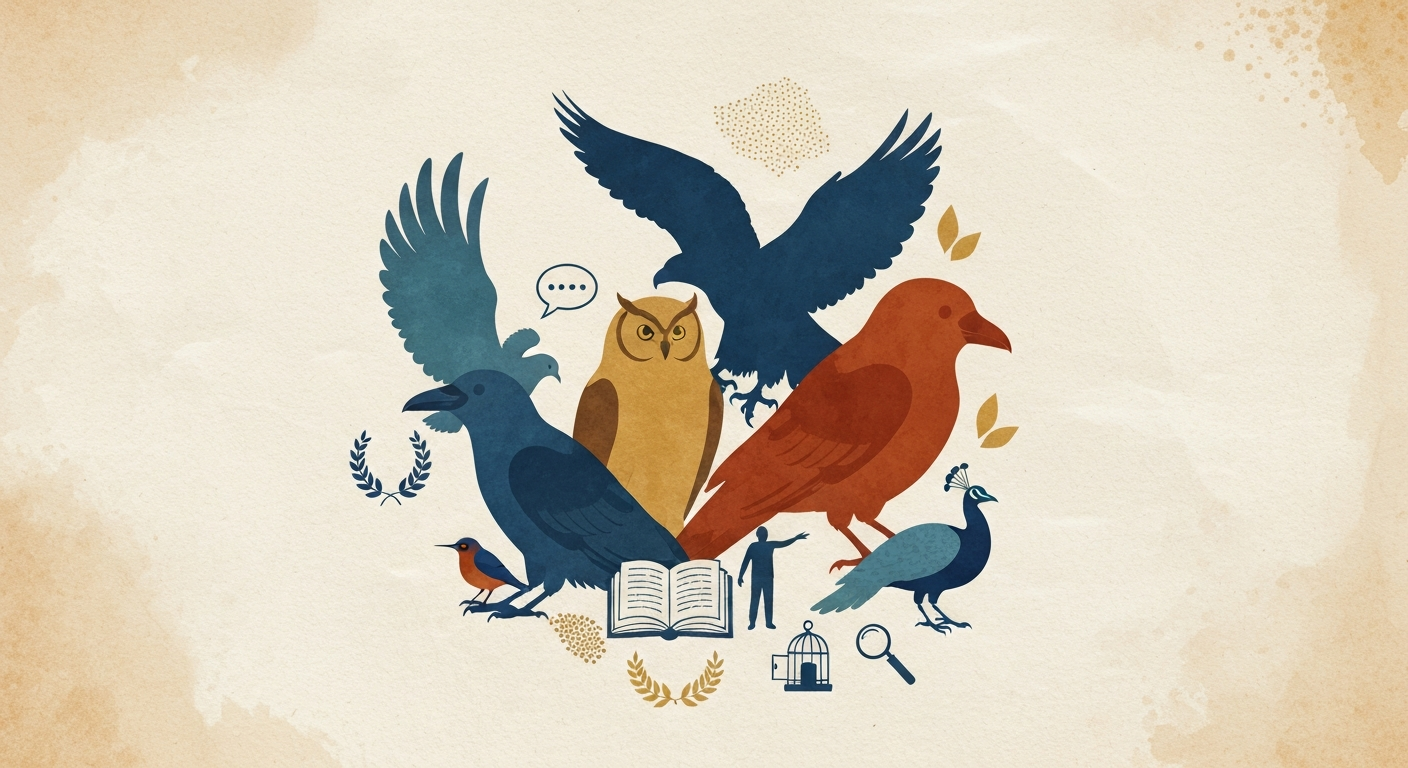
Several placements would strengthen this content visually. An opening header image showing a diverse spread of birds in flight, ideally including an eagle, dove, crow, and owl, would immediately signal the article's scope. An infographic table version of the Quick Reference section works well as a shareable image. For the species-based section, individual portraits of each featured bird placed alongside their metaphor entry help readers connect the abstraction to the actual animal. For the dream interpretation section, a soft, illustrated image of a bird in a moonlit or atmospheric setting reinforces the tone without over-literalizing. For the TikTok and slang section, a contemporary graphic style rather than a nature photograph matches the cultural context.
Where to Go Next on Bird Meaning Guide
This guide covers the landscape of bird metaphors, but each major category here opens onto deeper territory. If you want to explore the specific cultural and historical traditions behind bird symbolism, the bird lore meaning section of this site goes much further into how different civilizations have interpreted the same birds in radically different ways. For the mechanics of comparison and explanation, the bird analogy examples resource is worth reading alongside this article since analogies and metaphors overlap in practice but serve different rhetorical goals. If you are curious about what being a "bird nerd" really means as a community identity, or you want the full breakdown of what bird theory means on TikTok versus in ornithological conversation, both topics have dedicated pages here that go into more depth than this overview can. And if you arrived here through a dream about a specific bird and want a full interpretation, the species pages on this site connect behavioral fact, cultural symbolism, and dream meaning for each bird in one place.
FAQ
What primary reference dictionaries should I consult to verify literal and idiomatic meanings of bird-related words and phrases?
Use tier‑1 lexicographic sources: Merriam‑Webster, Cambridge Dictionary, and Oxford (OED/Oxford Learner’s resources) to confirm literal definitions, attested idiomatic senses (e.g., “early bird”, “night owl”), example sentences, and etymological/attestation notes for accuracy and search optimization.
Which linguistic corpora and tools are essential to check contemporary usage, frequency, and regional differences of bird metaphors?
Use COCA (Corpus of Contemporary American English) for U.S. frequency, collocates, and concordances; the British National Corpus (BNC) for UK usage and formality contrasts; and Google Books Ngram Viewer to chart historical trends and rise/decline in published usage.
What reliable online phrase-history resources help with origins and popular formulations of bird idioms?
Consult Phrase Finder / phrases.org.uk and similar phrase‑thesaurus pages as secondary references for origin summaries, common formulations (e.g., “a bird in the hand”), and attestation anecdotes—always cross‑check claims against primary lexicographic or corpus evidence.
Which ornithological sources should be cited when linking metaphors to real species behaviour or biology?
Cite authoritative natural‑history sources: Cornell Lab of Ornithology’s All About Birds species accounts, National Audubon Society/Audubon Magazine, BirdLife International, and the IUCN Red List for conservation status and distribution. Use peer‑reviewed ethology/cognition literature (e.g., corvid cognition reviews) when making behavioral or cognitive claims.
What academic theory should underpin explanations of why bird imagery maps to abstract concepts?
Use conceptual‑metaphor theory as a theoretical framework—primarily Lakoff & Johnson’s Metaphors We Live By—to explain cognitive mappings (e.g., freedom, wisdom, omen) and to distinguish metaphor from analogy and idiom in the article.
How should I treat cultural, spiritual, and dream interpretations of bird metaphors to remain accurate and responsible?
Frame cultural and spiritual meanings as culturally situated: cite folklore/anthology sources, reputable ethnographic or religious studies where available, and clearly label interpretations as cultural tradition or symbolic practice. For dream interpretations, present commonly reported symbolic meanings but avoid clinical claims—reference dream literature cautiously and provide links to species‑specific dream pages rather than asserting universal psychological diagnoses.
Next Article
Bird Nerd Meaning: Definition, Traits, Symbolism & Uses
Define 'bird nerd': origins, traits, symbolism, dream & social‑media uses, examples, and respectful birdwatching tips.