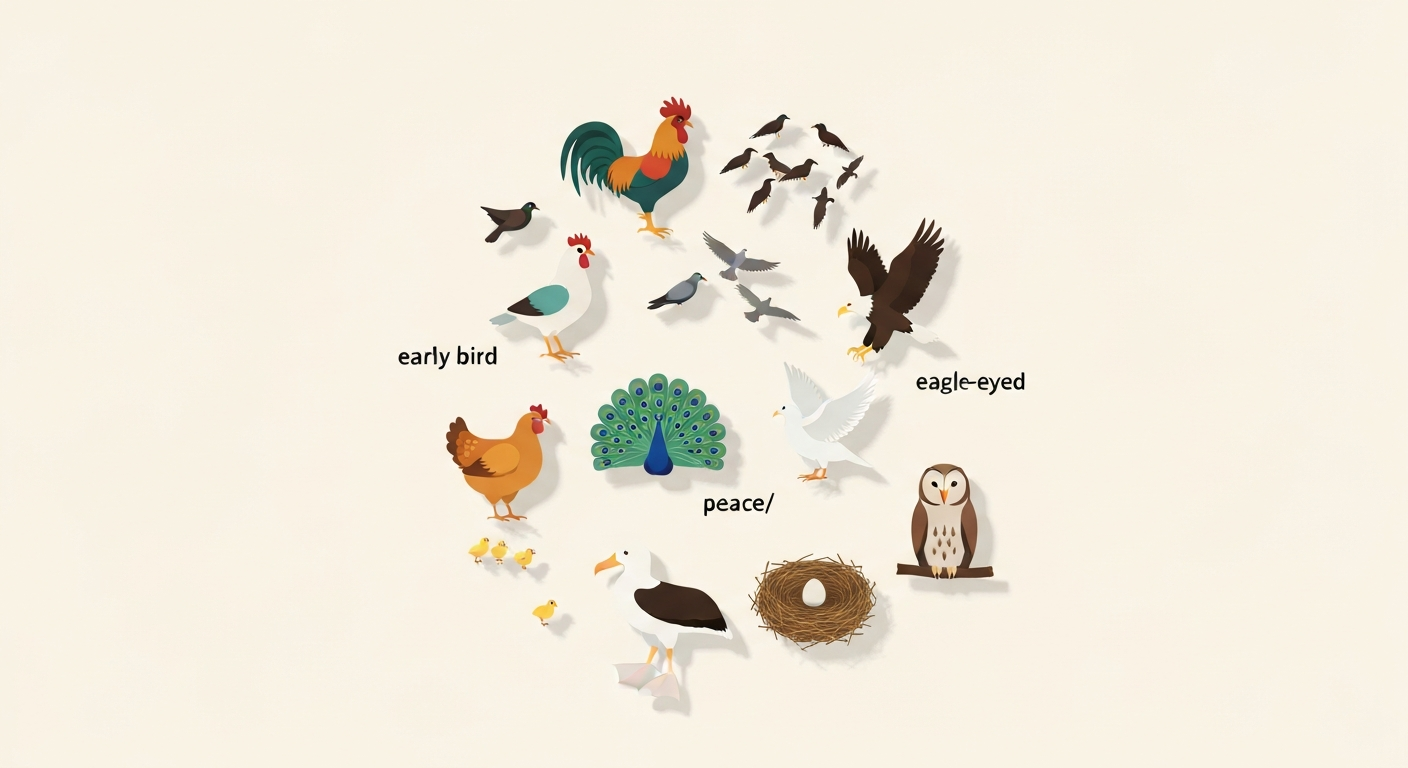
A bird analogy is a comparison that uses a bird, its behavior, or its physical traits as the source domain to explain something about human life, emotion, society, or ideas. Think of 'birds of a feather flock together' mapping social bonding onto flocking behavior, or calling someone 'eagle-eyed' to borrow a raptor's visual acuity and apply it to human attention. These comparisons work because birds are everywhere, their behaviors are vivid and observable, and humans have been watching them long enough to build a shared vocabulary around what they do.
Bird Analogy Examples: Clear Metaphors, Lore, and Uses

Marcus Holloway
29 Jul 2026
What a 'bird analogy' actually is and when to reach for one
Merriam-Webster defines analogy as 'a comparison of two things based on their being alike in some way.' A bird analogy specifically uses a bird (species, behavior, physical feature, or cultural association) as the vehicle for that comparison. George Lakoff and Mark Johnson's foundational work Metaphors We Live By frames this as source-domain to target-domain mapping: the bird is the source, and the human concept you're illuminating is the target. So 'she's a real mother hen' maps the hen's protective, fussy brooding behavior onto a specific style of human caregiving.
Bird analogies differ from pure bird metaphors (which assert identity: 'he is a hawk') and from similes (which signal comparison explicitly: 'she sings like a nightingale'). In practice, the terms blur in everyday writing, and you'll find bird analogies operating across literature, spiritual traditions, behavioral science, slang, and social media. Knowing the distinction matters mostly when you need precision, such as when writing for publication or checking whether a comparison holds up factually.
You should reach for a bird analogy when you want to make an abstract idea concrete and immediate. They work especially well in persuasive writing, teaching, social media captions, and storytelling because birds carry universal recognition across most cultures. The risk is that the analogy collapses if the underlying bird behavior is wrong or if the cultural resonance of that bird differs sharply between your audience's traditions.
Top bird analogies at a glance
| Bird Analogy | Core Meaning | Common Context |
|---|---|---|
| Early bird | Someone who wakes early or acts ahead of others; rewards for getting there first | Productivity, business, motivation |
| Birds of a feather flock together | Similar people tend to associate; shared traits predict social grouping | Social psychology, relationships |
| Eagle-eyed | Extremely sharp-sighted or highly observant and attentive to detail | Work, sport, writing, investigation |
| Free as a bird | Complete freedom from constraint or obligation | Lifestyle, travel, creative writing |
| Bird-brained | Perceived as lacking intelligence or easily distracted | Informal insult (often affectionate) |
| Sitting duck | Easy, unprotected target with no ability to escape | Strategy, security, criticism |
| Wild-goose chase | A hopeless or pointless pursuit leading nowhere useful | Frustration, planning, storytelling |
| Dead as a dodo | Completely extinct, obsolete, or finished | Business, technology, debate |
| As the crow flies | The most direct distance between two points, ignoring terrain | Navigation, geography, real estate |
| Proud as a peacock | Excessively vain or ostentatiously self-satisfied | Personality description, satire |
| Mother hen | An overly protective, fussy caregiver or manager | Parenting, workplace dynamics |
| Nest egg | Savings reserved for the future, especially retirement | Personal finance, planning |
| Feather in your cap | A notable achievement worth displaying with pride | Career, achievement, praise |
| Lame duck | A leader or official in a weakened, end-of-term position with little power | Politics, leadership transitions |
| Take under your wing | To mentor or protect someone less experienced | Mentoring, relationships, education |
Cultural and literary bird analogies, with sample sentences
Birds have carried symbolic weight in literature for as long as writing has existed. Jeremy Mynott's Birds in the Ancient World (Oxford University Press) documents Greek and Roman use of bird omens and analogies as far back as Homer, where the eagle consistently mapped onto Zeus's authority and divine favor. These associations didn't stay in ancient texts; they migrated into English literary tradition and are still productive today.
Birds as freedom and aspiration
The freedom cluster is one of the most durable in English writing. 'Free as a bird' draws on the literal mobility of flight to represent unencumbered living. Maya Angelou's I Know Why the Caged Bird Sings flips the analogy: the caged bird becomes the vehicle for describing constraint, racial oppression, and longing, while the free bird maps onto unchallenged privilege. The contrast between the two makes the analogy structurally rich rather than simply decorative. Sample sentence: 'After the project wrapped, she felt completely free as a bird for the first time in two years.'
Birds as intelligence (or its absence)
Edgar Allan Poe's The Raven uses the bird as an analogy for grief's relentless, irrational persistence. The raven doesn't literally signify doom; it is a surface onto which the narrator projects his own psychological deterioration. On the opposite end of intelligence framing, 'bird-brained' entered popular usage as a derogatory comparison implying small brain, flightiness, and poor memory. This analogy is factually questionable (see the myth-busting section below), but it has remained idiomatic precisely because the folk perception it names is instantly recognizable. Sample sentence: 'Calling the plan bird-brained turned out to be unfair once it actually worked.'
Birds as social behavior
'Birds of a feather flock together' appears in John Minsheu's 1599 work and is one of the earliest attested uses in the idiom tradition. It maps avian flocking, a real behavior driven by predator avoidance and foraging efficiency, onto human social clustering by shared values and background. Sociological research has repeatedly confirmed the human pattern (called homophily), which makes this one of the few bird analogies backed by both ornithological and social science data. Sample sentence: 'The new product team formed quickly; birds of a feather, they'd all come from the same UX background.'
Power, vision, and precision
'Eagle-eyed' borrows from the genuine visual acuity of eagles, whose retinas contain two foveas (areas of high cone density) compared to a human's one, producing estimated visual acuity around four to eight times sharper than ours. The analogy is grounded in biology and transfers cleanly to any context requiring sharp, detail-oriented attention. 'Hawk-eyed' works the same way and is used interchangeably in many registers. Sample sentence: 'The eagle-eyed copy editor caught the inconsistency that everyone else had skimmed past.'
Spiritual and bird-lore symbolism across cultures
Bird analogies in spiritual traditions run deeper than idioms. They often encode theological or cosmological ideas in a single image, which is why they persist across centuries and resist simple rationalization. Bird lore carries a distinct weight in this context: it operates not just as metaphor but as meaning-system, where the bird is read as a messenger, omen, or manifestation.
- Owl as wisdom (Greek/European): Athena's sacred bird became the analogy for philosophical discernment and scholarship. 'Wise as an owl' entered English through this tradition. Sample phrase: 'He approached every problem with an owl's quiet patience, studying before acting.'
- Crane as longevity and good fortune (East Asian traditions): In Chinese and Japanese symbolism, the crane maps onto long life, marital fidelity, and auspicious timing. Paper cranes (origami) carry this analogy into tactile tradition. Sample phrase: 'She folded a thousand cranes as an analogy for the patience the recovery would demand.'
- Raven as transformation and knowledge (Indigenous Pacific Northwest traditions): In many Haida and Tlingit narratives, Raven is the trickster who brings light into the world. The analogy is not simple cleverness but transformative disruption. Sample phrase: 'The startup pitched itself as the raven of the industry, here to rearrange everything.'
- Robin as renewal (British and Celtic lore): The robin's appearance in winter is widely read as an analogy for hope persisting through hardship. Sample phrase: 'Even in the bleakest quarter, a robin analogy rang true: something was still alive in the project.'
- White dove as peace (Abrahamic traditions): The dove returning to Noah's ark with an olive branch maps flight and return onto the arrival of peace after catastrophe. The analogy is now so embedded it functions almost independently of its scriptural origin. Sample phrase: 'They hoped the ceasefire would be the dove at the window: a signal that the worst was over.'
- Albatross as burden (European maritime tradition): Coleridge's The Rime of the Ancient Mariner solidified the analogy of an albatross around the neck as a heavy, self-imposed curse. The bird had previously been considered good luck by sailors; Coleridge inverted that. Sample phrase: 'The failed acquisition became an albatross around the company's neck for years.'
When using analogies drawn from spiritual traditions, it is worth knowing whether the tradition you're borrowing from is living and culturally specific or whether the analogy has already been absorbed into broad secular English usage. The dove-as-peace analogy is so universally adopted that invoking it carries little risk of misrepresentation. Using Raven-as-trickster in a corporate pitch, on the other hand, draws on a specific living tradition and deserves acknowledgment.
Behavioral and nature-based analogies, with ornithological fact-checks
Nature-based bird analogies claim to draw their authority from real bird behavior. That's their rhetorical strength: they feel grounded in observable fact. The problem is that folk perception of bird behavior is often wrong, and an analogy built on a false premise can undercut your credibility if your reader knows the actual biology. Here's how the most common ones actually hold up.
Early bird
Cambridge Dictionary records 'the early bird catches the worm' as a proverb meaning that arriving or acting first produces an advantage. Ornithologically, this is accurate: many songbird species do begin foraging at dawn, and earlier foraging can correlate with better territory and food access. The analogy holds. Sample sentence: 'She set her alarm for 5 a.m., a committed early bird who believed the first hour was worth three of any other.'
Sitting duck
A sitting duck is a duck resting on water rather than flying, which makes it a far easier target for hunters than one in flight. The behavioral observation is accurate. The analogy maps cleanly onto any vulnerable, stationary target in human contexts. Sample sentence: 'Without updated security patches, the server was a sitting duck for anyone who knew where to look.'
Wild-goose chase
Etymonline traces this to Shakespeare's Romeo and Juliet (Act 2, Scene 4, around 1597), where it originally referred to a type of horse race in which other riders had to follow the leader's course exactly, like geese following one another. The goose behavior is incidental rather than central to the original meaning, and the idiom evolved to mean any pointless, exhausting pursuit. The behavioral basis is loose, but the etymology is well-attested. Sample sentence: 'Trying to get a straight answer from the permits office turned into a complete wild-goose chase.'
Flocking behavior
When writers say 'people flock together' or describe group behavior as a 'murmuration,' they're borrowing directly from bird biology. Murmurations, the coordinated mass flights of starlings (Sturnus vulgaris), are genuine phenomena documented extensively in ornithological literature, driven by simple local interaction rules between individuals rather than any central coordination. This makes murmurations a particularly rich and accurate analogy for decentralized collective behavior in social systems, markets, or networks. Sample sentence: 'The protest had no single organizer; it moved like a murmuration, each person responding to the people directly around them.'
As the crow flies
This analogy for straight-line distance is behaviorally accurate in its general implication: crows (and most birds) do fly relatively direct routes between points, unobstructed by roads, rivers, or terrain. The phrase is useful in navigation and real estate contexts. Sample sentence: 'The towns are only twelve miles apart as the crow flies, but the mountain road adds another hour.'
Slang, niche queries, and what's happening on the internet
Beyond literary and behavioral traditions, bird analogies have developed a lively second life in internet slang and niche communities. Some of these have grown large enough to generate their own search traffic, which is worth understanding if you're writing for online audiences.
Bird nerd
'Bird nerd' is an affectionate self-designation within the birdwatching community, an analogy that maps enthusiast identity (the 'nerd' frame) onto the specific hobby. It functions like 'gym rat' or 'book nerd': self-deprecating, community-building, and distinctly non-pejorative in context. Birding communities on social platforms use it as an identity badge. Example context: 'Proud bird nerd here: I drove three hours just to add a buff-bellied pipit to my life list. For a brief definition and usage notes, see a short explainer on bird nerd meaning that covers the identity, tone, and variations of the label. '
Bird theory test
'Bird theory test' circulates in internet culture as a concept-check or pop-psychology framework, sometimes applied to personality tests or social experiments that use bird species as analogies for human types (eagle, owl, dove, parrot frameworks appear in corporate training and personality typing). The analogy structure maps bird traits onto personality dimensions, which is intuitive but not scientifically validated. Example context: 'The company ran a bird theory test during onboarding: I came out as a hawk, apparently, which means goal-oriented and impatient.'
Bird theory on TikTok
On TikTok, 'bird theory' has also referred to relationship and social dynamics content, particularly the idea that birds are analogies for how people attract or signal interest, often framed humorously as 'bird behavior' in dating contexts (preening, displaying, territory defense). Creators use ornithological analogies to describe human social behavior in a way that is both funny and unexpectedly precise. Example context: 'He rearranged his whole living room before she came over. Textbook bird theory. Classic bowerbird behavior.' The viral appeal comes from the way these analogies are simultaneously absurd and genuinely insightful.
British English slang
In British English, 'bird' is well-established informal slang for a woman or girlfriend. This is a distinct usage that has nothing to do with ornithology and operates as its own analogical register: it likely derives from Cockney rhyming slang and older dialect use. Writers and interpreters should be clear about context because the same word can land very differently depending on audience. Example context: 'He spent the whole evening talking about his new bird, and nobody could get a word in.'
Where these analogies came from: etymology and origins
Bird idioms entered English through several distinct routes, and knowing their origins helps you deploy them with more precision and avoid misuse.
- Proverb tradition: Many of the oldest bird analogies came in as folk proverbs transcribed in early modern English collections. 'Birds of a feather' appears in written form by 1545 (attributed to William Turner's The Rescuing of Romish Fox) and was probably circulating orally earlier. 'The early bird catches the worm' appears in John Ray's 1670 collection of English proverbs.
- Literary coinage: Some analogies were effectively fixed or popularized by specific authors. Coleridge crystallized 'albatross around the neck' in The Rime of the Ancient Mariner (1798). Shakespeare's use in Romeo and Juliet (c. 1597) is the first known written instance of 'wild-goose chase' in its idiomatic sense, per Etymonline.
- Technical and trade origins: 'Nest egg' originally referred to a real or artificial egg left in a nest to encourage laying; its financial sense emerged by analogy in the 17th century. 'Lame duck' originated in 18th-century London stock exchange slang for a defaulting broker before migrating into political usage.
- Scientific borrowing: 'Murmuration' is a genuine collective noun for starlings that crossed from ornithological description into broad metaphorical use as behavioral science research on starling flocks became more widely covered in science journalism from the 2000s onward.
- Slang and internet emergence: Newer usages like 'bird nerd,' 'bird theory,' and ornithological analogies in TikTok content emerged organically from online communities without formal literary origin, spreading through platform algorithms rather than publishing.
Google Books Ngram data shows that phrases like 'eagle-eyed' and 'nest egg' have maintained steady presence in print since the 19th century, while 'murmuration' as a metaphor shows a measurable uptick from the 2010s onward, tracking with viral video coverage of starling displays. The historical record, accessible through the OED and corpora like COCA and GloWbE, confirms that bird analogies are not a static set: new ones form constantly as culture changes. Corpus frequency data can be queried in COCA and GloWbE via English‑Corpora.org (COCA / GloWbE), recommended corpora for frequency checks English‑Corpora.org (COCA / GloWbE) — recommended corpora for frequency checks.
Using bird analogies responsibly: cultural sensitivity and ecological accuracy
There are two main failure modes when using bird analogies: getting the culture wrong and getting the biology wrong. Both are avoidable with a small amount of due diligence.
Cultural sensitivity guidelines
- Distinguish between living sacred traditions and broadly adopted secular idioms. The dove-as-peace analogy is genuinely cross-cultural now; using Raven as a throwaway symbol without acknowledging Pacific Northwest Indigenous traditions treats a living spiritual concept as decoration.
- Check whether a bird carries opposite valences in different cultures. The owl is wisdom in Western tradition but is an omen of death in several South Asian and parts of West African traditions. Using 'wise old owl' for a global audience risks unintended dissonance.
- Avoid analogies that flatten complex cultural narratives. When Angelou used the caged bird, she was making a specific political statement. Borrowing that frame casually for minor inconveniences misrepresents both the analogy and its context.
- If you're drawing from a tradition you don't belong to, name it explicitly rather than presenting it as universal.
- Slang uses like British 'bird' for woman can read as dated or sexist depending on context and audience. Flag register clearly, especially in writing aimed at international readers.
Ecological accuracy guidelines
- Before building an analogy around specific bird behavior, verify that the behavior actually exists and is typical for the species. Cornell Lab's Birds of the World and BirdLife International species accounts are reliable starting points.
- Avoid analogies that reinforce false folk beliefs. Birds are not actually 'bird-brained' in the pejorative sense; corvids and parrots demonstrate sophisticated problem-solving and tool use. Building an insult on that premise may land, but it's factually hollow.
- When the biological basis is shaky, signal that in your framing. 'The old saying goes...' or 'as folk wisdom has it...' tells readers you know the analogy is cultural rather than scientific.
- If you use 'dead as a dodo' to mean completely extinct and finished, the behavioral claim is solid (the dodo is genuinely extinct, with the last confirmed sighting cited around 1662 per Nature commentary and IUCN records), but using it for things that are merely outdated rather than completely gone overextends the analogy.
- Collective nouns used metaphorically ('a murmuration of ideas,' 'a parliament of opinions') are evocative but borrowed from formal ornithological nomenclature. Accurate use adds authority; invented ones should be signaled as creative.
How to craft your own bird analogies
Writing a fresh bird analogy that doesn't feel clichéd requires choosing a bird behavior or trait that is specific, accurate, and under-used in your context. The generic birds (eagles, doves, ravens) carry so much accumulated association that they're hard to make surprising. Going more specific, a bowerbird's obsessive interior decorating, an arctic tern's 44,000-mile annual migration, a lyrebird's near-perfect acoustic mimicry, opens up entirely new source domains.
Practical templates
- Behavior template: '[Subject] does [action] the way [bird species] [specific documented behavior].' Example: 'The algorithm curates content the way a bowerbird arranges objects: every choice is about aesthetic signal, not function.'
- Trait template: 'Like a [bird] [trait], [subject] [human parallel].' Example: 'Like a lyrebird's mimicry, the app recreates ambient sound so convincingly the brain stops questioning it.'
- Contrast template: 'Unlike the [bird] which [behavior], [subject] [contrasting action].' Example: 'Unlike the arctic tern, which covers the whole earth to find the right conditions, she stayed put and made the conditions come to her.'
- Caption template for social posts: 'Pure [bird] energy today: [relatable human behavior].' Example: 'Pure albatross energy today: traveling impossibly far for something that probably wasn't worth the trip.'
Tone choices
Bird analogies land differently depending on register. In formal or literary writing, extended analogies (as Angelou or Poe used them) create thematic depth. In social media, compressed analogies with a self-aware humor work better, especially when the bird behavior is surprising or absurdly relatable. In educational or scientific writing, analogies should be accurate enough to withstand scrutiny and brief enough not to distract. Matching the analogy's complexity to your platform prevents the comparison from feeling either shallow or overwrought.
Myth-busting: popular claims about birds that don't hold up
Several common bird analogies rest on folk biology that is either wrong or significantly overstated. Here are the most widely repeated claims and what the evidence actually shows.
| The Claim | The Analogy Built On It | What the Evidence Shows |
|---|---|---|
| Birds are stupid ('bird-brained') | Bird-brained = lacking intelligence | Corvids (crows, ravens, jays) solve multi-step puzzles, use tools, and pass mirror-recognition tests in some studies. Parrots demonstrate abstract reasoning and large vocabularies. The claim that birds have negligible intelligence is false for many species; it reflects outdated neuroscience that equated brain size with intelligence. |
| Ostriches bury their heads in sand when scared | 'Head in the sand' as avoidance analogy | Ostriches do not bury their heads. They lower their heads to tend eggs in ground nests, which can look like head-burying from a distance. The analogy for denial is culturally durable but biologically false. |
| Swans mate for life without exception | Swan love as model of perfect fidelity | Many swan pairs do maintain long-term bonds, but divorce and extra-pair copulation occur in wild populations. The 'swans mate for life' claim is an oversimplification. The analogy holds loosely but should not be presented as a biological absolute. |
| The dodo was 'dumb' and walked into traps | 'Dead as a dodo' implies stupidity caused extinction | The dodo (Raphus cucullatus) went extinct due to introduced predators and habitat destruction following Dutch colonization of Mauritius, with the last confirmed sighting around 1662. There is no credible evidence it was unusually unintelligent; it was simply naive to predators because it had evolved in the absence of mammalian threats. |
| Robin redbreasts always return to the same nest | Robin as symbol of reliable return and renewal | While European robins (Erithacus rubecula) are highly territorial, individuals do not always return to the exact same nest site each year. The renewal symbolism is culturally valid but should not be stated as strict behavioral fact. |
| Crows remember faces and hold grudges indefinitely | Crows as analogy for long-term resentment | Research (including work by John Marzluff at the University of Washington) does confirm that American crows can recognize and respond differently to individual human faces. The 'grudge' framing is anthropomorphic, but the underlying capacity for individual recognition is well-documented. |
Ready-to-use lines and social media caption prompts
If you want to drop a bird analogy into a post, caption, or piece of copy without starting from scratch, these are ready to use or adapt. They're organized by platform tone.
- Instagram / Pinterest (reflective): 'The early bird doesn't catch the worm by rushing. It shows up before the noise starts.'
- Twitter / X (punchy): 'Running this project felt like a wild-goose chase. Turned out the goose was the deadline.'
- TikTok caption (playful/bird theory energy): 'Him rearranging his apartment before I came over. Full bowerbird behavior. I respect it.'
- LinkedIn (professional): 'The best mentors don't lecture. They take you under their wing and let you watch the work happen.'
- Writing / essays (extended): 'She had eagle eyes for inconsistency, the kind that catches a misplaced comma from across the room and a misleading stat from across the meeting table.'
- Environmental / nature content: 'A murmuration of starlings has no conductor. Thousands of birds, one emergent shape. Some teams work exactly like that.'
- Motivational: 'Nest eggs aren't built in a day, but they're also not built by waiting for the perfect moment to start.'
- Humorous / self-aware: 'Proud as a peacock about absolutely nothing in particular this Monday. The feathers are out anyway.'
Image suggestions and alt-text prompts
Visual choices matter as much as the writing when publishing bird analogy content. The right image anchors the analogy and rewards readers who skim. Here are practical recommendations for each major section type.
- Hero image: A tight close-up of a single bird making direct eye contact (a crow, robin, or owl works well) against a clean background. Alt text: 'Close-up of a crow looking directly into the camera, illustrating the intelligence behind common bird analogies.'
- Freedom section: A bird in full mid-flight against an open sky, wings fully extended. Alt text: 'Bird in flight against a clear blue sky, representing the 'free as a bird' analogy.'
- Flocking / murmuration: An aerial photograph of a starling murmuration. Alt text: 'Aerial view of a starling murmuration, used as a metaphor for decentralized collective behavior.'
- Spiritual / lore section: A white dove in natural light or a stylized crane illustration from an East Asian art tradition (ensure licensing for cultural artwork). Alt text: 'White dove in soft natural light, widely used as a symbol of peace in bird-lore traditions.'
- Myth-busting section: An ostrich with head raised (not buried) to directly counter the sand-burying myth. Alt text: 'Ostrich standing with head fully raised, debunking the myth that ostriches bury their heads in sand.'
- Licensing tip: Unsplash, Pexels, and Wikimedia Commons offer free-to-use nature photography. For cultural and historical illustrations, verify Creative Commons licensing and credit requirements before publication.
Related topics worth exploring further
Bird analogies sit at the intersection of several broader topics covered across this site. If you're interested in the deeper cultural and traditional meanings behind birds, bird lore meaning explores how historical traditions assigned significance to species across different civilizations. For a focused look at how birds function as metaphorical vehicles in literature and rhetoric, bird metaphors examples goes further into the structural mechanics of those comparisons. The niche identity questions around 'bird nerd' meaning and 'bird theory test meaning' each deserve their own treatment: the first is about community identity and enthusiast culture, and the second is about personality frameworks that use bird species as human-type analogies. For another relevant comparison, see bird metaphors examples. And if you've encountered bird theory as a TikTok phenomenon, bird theory TikTok meaning unpacks how ornithological behavior has become a lens for social commentary in short-form video.
Further reading and source notes
The foundations for this article draw on a mix of lexicographic, literary, scientific, and corpus sources. For definitions and historical sense development, Merriam-Webster and the Oxford English Dictionary are the primary references; OED institutional access provides dated first-attestation citations for idioms like 'birds of a feather' and 'nest egg.' George Lakoff and Mark Johnson's Metaphors We Live By (University of Chicago Press) provides the theoretical framework for understanding bird analogies as source-to-target domain mappings. Jeremy Mynott's Birds in the Ancient World: Winged Words (Oxford University Press) covers classical bird symbolism and is the scholarly standard for that section. Etymology claims are grounded in Etymonline with verification recommended against OED and primary texts (the Romeo and Juliet first-use for 'wild-goose chase' can be confirmed in annotated editions including Folger Digital Texts). Corpus frequency data comes from the Corpus of Contemporary American English (COCA) and GloWbE, both available via English-Corpora.org. Ornithological fact-checks use Cornell Lab's Birds of the World, BirdLife International species accounts, and Sibley Guides as primary references, with peer-reviewed sources from the Journal of Avian Biology and Ornithology for specific behavioral claims. Authoritative species accounts and life‑history details are available from Birds of the World (Cornell Lab), BirdLife International, Sibley Guides (field guide resources) Birds of the World (Cornell Lab) — BirdLife International — Sibley Guides (field guide resources). Dodo extinction dating draws on Nature commentary and IUCN/BirdLife assessment records, with the last confirmed sighting commonly cited as 1662.
FAQ
What primary reference works should I cite to define "analogy" and to situate bird analogies within metaphor theory?
Cite a standard lexicographic definition (Merriam‑Webster or Cambridge) for a working, searchable definition of "analogy." For theoretical framing use George Lakoff & Mark Johnson, Metaphors We Live By (Conceptual Metaphor Theory) to explain source‑domain → target‑domain mapping and how bird imagery functions in cognition. For historical sense‑dating and first attestations consult the Oxford English Dictionary (OED).
Which language corpora and tools are required to identify common bird idioms, measure frequency, and check registers/genres?
Use COCA (Corpus of Contemporary American English) to measure contemporary frequency and register (spoken, fiction, magazine, news, academic). Use GloWbE to compare world‑English/web frequencies across countries. Use Google Books Ngram Viewer and targeted Google Books searches for diachronic trends and first printed attestations. Supplement with dictionary idiom entries (Cambridge, Merriam‑Webster) for quick examples.
How should I assemble and verify the prioritized list of bird idioms/analogies to feature?
Start with a candidate list from phrase dictionaries and corpora (examples: "early bird," "free as a bird," "bird‑brained," "sitting duck," "dead as a dodo," "as the crow flies," "wild‑goose chase," "birds of a feather," "feather in your cap," "nest egg," "eagle‑eyed," "proud as a peacock," "mother hen," "lame duck," "take under your wing"). Verify contemporary frequency in COCA/GloWbE, first attestations in Google Books/OED/Etymonline, and authoritative definitions in Cambridge/Merriam‑Webster.
What specific corpus queries and metrics should I run for each idiom/analogy?
For each phrase run: token frequency per million words (COCA), register breakdown (spoken/fiction/news/academic), relative change over decades (Google Books Ngram), geographic distribution (GloWbE). Record first‑attested citations (OED or Google Books) and notable historical quotations. Save example sentences from corpora for reuse/adaptation and note any polysemy or changing senses.
Which ornithological sources must I consult to fact‑check behavioural claims made by analogies?
Consult Birds of the World (Cornell Lab) and BirdLife International species accounts for species‑level behaviour (sociality, migration, display). Use standard field guides (Sibley, Peterson) for accessible species facts. For current, peer‑reviewed findings query ornithology journals (The Auk/Ornithology, Journal of Avian Biology) for mating systems, parental care, flocking, and anti‑predator behaviour that analogies invoke.
How do I evaluate whether a popular claim (e.g., "peacocks mate with many females" or "crows are monogamous") is accurate?
Trace the claim to species accounts in Birds of the World and to peer‑reviewed studies on the species' mating system and social behavior. Record primary citations and summarize consensus (e.g., peafowl are polygynous; many corvids form long‑term pair bonds but social structures vary). Where literature is mixed, report uncertainty and link to the primary studies.
Next Article
Bird Theory TikTok Meaning: Origin, Examples, Checklist
Discover what 'bird theory' means on TikTok: origins, viral examples, captions, symbolism, and an interpretation check‑l