Bird lore is a broad umbrella term that covers everything humans have ever believed, observed, studied, or said about birds. At its most literal, it means the knowledge and science of birds (essentially ornithology). But in everyday use, people stretch the phrase to include cultural symbolism, spiritual significance, folk omens, dream interpretation, superstitions, and even slang expressions involving birds. So if you searched 'bird lore meaning' expecting one tidy definition, the honest answer is: it depends on which layer you're looking at. This guide walks through every major layer and gives you practical tools for interpreting birds correctly without mistaking folklore for ornithological fact.
Bird Lore Meaning: What It Includes and How to Interpret

Marcus Holloway
27 Jun 2026

What 'bird lore' actually means
The word 'lore' has two distinct meanings in English, and both apply here. First, lore means a body of traditional knowledge or belief passed down through a community. Second, in a more technical sense, 'birdlore' (one word) is defined as the knowledge or scientific study of birds, making it essentially a synonym for ornithology. Wiktionary lists 'bird lore' as an alternative spelling of 'birdlore,' grounding the phrase in formal bird science as much as in myth.
In practice, when people say 'bird lore' they almost always mean something broader than field ornithology. They mean the full collection of things people know, believe, and say about birds: the myths, the omens, the symbolic meanings, the folk sayings, the dream-dictionary entries, and the real behavioral science that sometimes gets tangled up with all of the above. Think of it as the complete human relationship with birds, not just the biological facts and not just the superstitions, but the entire conversation between people and birds across cultures and time.
- Cultural symbolism (what a raven or an owl 'represents' in a given tradition)
- Spiritual significance (birds as messengers, divine signs, or soul guides)
- Folk omens and superstitions (birds as predictors of luck, death, or change)
- Behavioral interpretation (reading what a bird's actions might 'mean')
- Dream and omen readings (what birds signify in subconscious imagery)
- Slang and idiomatic expressions (bird-based phrases in everyday language)
- Ornithological fact-checking (the science that confirms or corrects the above)
Where bird lore comes from
Bird lore doesn't have one origin. It grew independently in multiple cultures across thousands of years, which is actually part of why it feels so universal. Ancient Greeks and Romans practiced ornithomancy, the formal reading of omens from bird behavior. Augurs (specialist seers) would interpret the direction of a bird's flight, whether birds flew in groups or alone, the type of bird, its calls, and even how it fed. These readings were not casual folk beliefs; they were official religious and political procedures used to determine whether the gods approved of a military campaign or a major decision. The word 'auspicious' literally comes from the Latin 'auspicium,' meaning the observation of birds.
Indigenous traditions across the Pacific Northwest developed their own rich systems of bird meaning, completely independent of European augury. In these traditions, Raven is one of the most central figures in mythology, playing roles as a creator, trickster, and transformer across many nations' oral histories. This isn't a vague 'ravens are mysterious' shorthand; Raven tales are detailed creation narratives where the bird's actions shape the world. That specificity is what separates genuine cultural bird lore from the flattened, sometimes appropriative 'spirit animal' shorthand you see online.
Beyond those two major traditions, bird lore drew from the 'language of the birds' concept found in various mythological and occult traditions, which held that birds possess a mystical or divine mode of communication. This idea appears in Norse mythology, Islamic Sufi literature, and medieval European alchemy. The point is that bird lore has multiple, culturally distinct roots, and lumping them all together under one system misrepresents each tradition.
Spiritual symbolism: what birds are said to represent
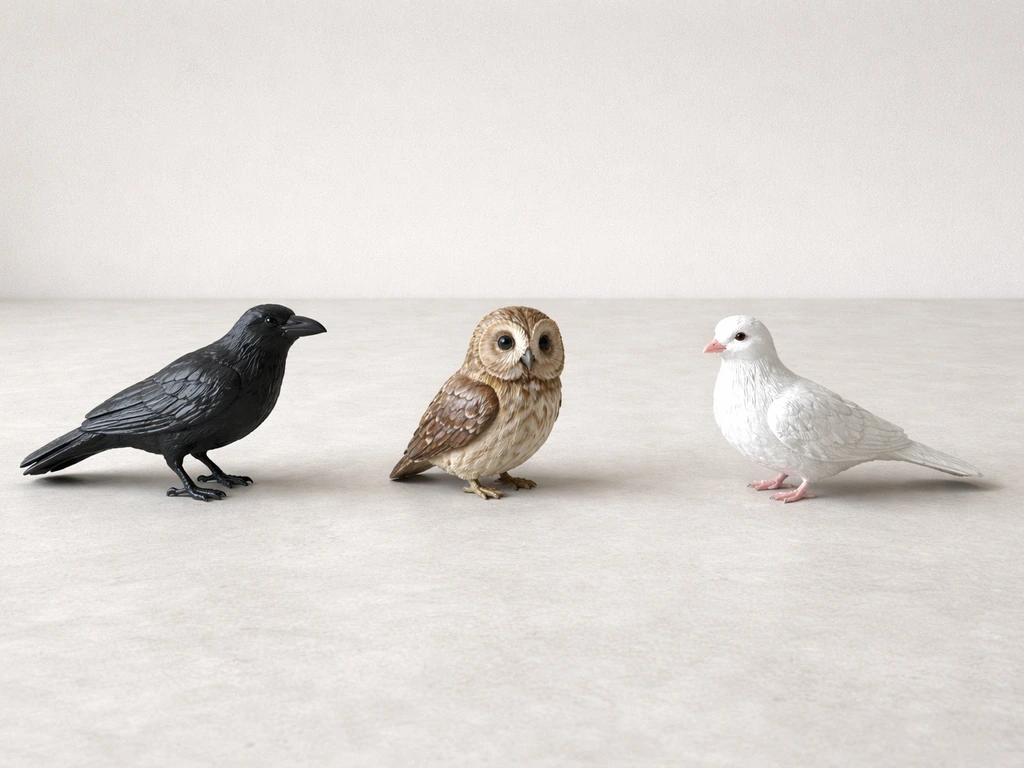
Spiritual bird symbolism varies enormously by tradition, by species, and by context. The same bird can mean completely opposite things depending on the culture and time period. That said, some patterns appear across multiple independent traditions, which is worth noting without over-generalizing.
| Bird | Common symbolic association | Cultural source(s) |
|---|---|---|
| Raven | Creation, trickster, transformation | Pacific Northwest Indigenous nations |
| Owl | Death, wisdom, or protection (varies widely) | Aztec/Maya (death), Greek (wisdom), Barn owl traditions (ghost/evil omen) |
| Albatross | Seafaring luck or curse (killing one = bad luck) | European maritime folklore |
| Eagle | Power, freedom, divine authority | Roman imperial, Indigenous North American, national symbols globally |
| Dove | Peace, purity, spiritual presence | Abrahamic traditions, Greco-Roman mythology |
| Crow | Omen of change, intelligence, liminal space | Multiple European and Indigenous traditions |
The key word in that table is 'common.' None of these are universal laws. The owl is a classic example: in some ancient Aztec and Maya contexts, owls were associated with death and destruction, and the barn owl specifically acquired names like 'death owl' and 'demon owl' in many rural communities. But in ancient Greek tradition, the owl is the companion of Athena and represents wisdom. Neither reading is 'correct' in an absolute sense; both are culturally specific. When someone tells you an owl sighting means something, the honest follow-up question is: according to whose tradition?
Reading bird behavior in everyday life
A lot of people encounter 'bird lore' not through mythology but through noticing bird behavior and wondering what it means. A bird keeps hitting your window. A crow follows you for a block. You hear birds singing unusually loudly before dawn. Here's the thing: bird behavior almost always has a straightforward biological explanation, and knowing that explanation is genuinely more interesting than the omen version.
The dawn chorus is a perfect example. Birds sing intensely at first light during breeding season, and people have assigned all kinds of spiritual meaning to this. Ornithologists at Cornell Lab have studied it extensively: the current evidence points to it being tied to territorial defense, mate attraction, and ecological timing, though researchers note that multiple non-exclusive explanations are still being refined. The behavior is real and fascinating. The 'omen' layer adds nothing to the actual understanding.
Window-strike behavior is probably the single most misread bird action. Birds repeatedly hitting a window during breeding season are almost always responding to their own reflection, mistaking it for a rival intruding on their territory. BLM’s “Eye Spy” bird-behavior activity similarly encourages watching a bird for a short set time and observing multiple individuals from the same species to describe behavior accurately blank" rel="noopener noreferrer">responding to their own reflection. It is a completely predictable territorial response driven by seasonal hormones. The American Bird Conservancy, Audubon, and Cornell's All About Birds all document this consistently. If a robin is attacking your kitchen window every morning in May, it is not a spiritual message. It is a bird losing an argument with itself in a mirror. Understanding that means you can actually fix the problem (window treatments, breaking up the reflection) instead of assigning meaning to it.
Birds in dreams and omens: what's useful and what to ignore

Dream interpretation involving birds has a documented history stretching back to ancient writers like Artemidorus, who developed one of the earliest systematic approaches to reading symbolic dream content, including animal and bird imagery. Later, Jungian psychology treated dream imagery as symbolic and poetic material worth exploring, not as literal predictions. That distinction matters: there's a real difference between using a bird in a dream as a prompt for self-reflection and treating it as a forecast of actual events.
Dream dictionaries (the kind you find online today) tend to cluster bird dream meanings around themes of freedom, spiritual aspiration, transition, and goals, with variations based on the bird's behavior and species in the dream. These readings aren't scientifically validated, but they aren't meaningless either if you treat them as metaphorical prompts rather than prophecy. A dream about a caged bird might genuinely surface feelings about restriction in your own life. That's a useful reflection. It's not a prediction about a caged bird you'll encounter tomorrow.
The rule of thumb I'd suggest: use bird dream imagery as a journaling or reflection tool if it resonates, but resist the urge to treat it as an omen with predictive power. The moment you start scanning your day for 'confirmation' of what the bird dream meant, you've entered confirmation bias territory, where you'll find what you're looking for whether it's really there or not.
Bird slang and sayings you probably use without thinking
Bird lore isn't only about omens and symbolism. A big slice of it lives in everyday language as idioms, slang, and proverbs that most people use without realizing they're invoking bird imagery. If you're also wondering what a bird nerd is, that phrase usually points to someone who loves birding, and the “meaning” depends on the exact context it’s used in Bird slang and sayings you probably use without thinking. These colloquial meanings are their own category of 'bird lore,' and they're worth knowing separately from the spiritual and folkloric material.
- 'A little bird told me' (Cambridge Dictionary): a way of saying you heard something without revealing your source
- 'Birds of a feather flock together': people with similar interests or backgrounds naturally group together
- 'Bird-brained': slang for someone who is stupid or scatterbrained (from an old association between small bird brains and limited intelligence)
- 'Albatross around your neck': a persistent burden or source of guilt (from Coleridge's 'The Rime of the Ancient Mariner')
- 'Free as a bird': unrestricted or unencumbered
- 'Early bird catches the worm': people who act promptly get the best results
- 'Crow about something': to boast or gloat
These phrases are cultural artifacts of bird lore in their own right. They show how deeply bird observation was woven into everyday human communication long before anyone had a field guide. If you're interested in how bird metaphors work more broadly, that's a fascinating adjacent thread to pull on, and the territory of bird metaphors and analogies connects closely to this conversational layer of bird lore. If you want bird metaphors examples in context, the easiest way is to compare how different cultures describe the same species.
Myths worth debunking (and how to fact-check bird claims)

Some of the most persistent pieces of bird lore are simply wrong, and the problem is they get repeated so often they start to feel like common knowledge. The International Owl Center explicitly addresses the 'owls are bad luck / omens of death' belief, noting it's a superstition, not a fact, and directs people toward reputable ornithological sources for actual owl biology. The Chicago Ornithological Society has similarly documented how 'bird entering a house = death omen' beliefs circulate and persist despite having no predictive validity.
The mechanism behind these myths is usually confirmation bias: you remember the one time a bird flew into your house before something bad happened, and you forget the dozens of times it didn't. Confirmation bias, as Wikipedia defines it, is the tendency to seek, interpret, and recall information that confirms what you already believe while discounting evidence that doesn't. Once you know you're susceptible to it (everyone is), you can start checking yourself.
Here's a practical fact-checking process for any bird claim you encounter. First, identify the specific behavior or sighting you're trying to interpret. Second, search for the species and the behavior using a reputable ornithological source: Cornell Lab's All About Birds, Audubon, the American Bird Conservancy, or USGS are all solid starting points. Third, ask whether the behavior has a documented biological explanation. If it does, that's your primary answer. Fourth, ask whether the symbolic or omen meaning you've heard is culturally specific to one tradition or genuinely cross-cultural. If it's one tradition's belief, label it as such. Fifth, notice whether you're seeking confirmation of something you already want to believe, and if so, apply extra skepticism.
How to actually use bird lore today
If you want to work with bird lore thoughtfully, whether for cultural appreciation, spiritual practice, or just satisfying curiosity, a four-step process makes the whole thing much more grounded and honest.
- Observe carefully first. Before you assign any meaning, spend at least five minutes watching the bird. Note the time of day, the season, the bird's behavior (feeding, calling, flying, perching), and the setting. The National Park Service recommends exactly this: patient, attentive observation before labeling. Details like direction of flight, whether the bird is alone or in a group, and whether it seems agitated or calm all matter enormously.
- Identify the species accurately. Misidentifying the bird makes any cultural interpretation meaningless. Use multiple field marks (not just color), listen for calls, note size relative to nearby objects, and use a field guide or app like Merlin (Cornell Lab). Audubon emphasizes using several clues together rather than relying on a single feature, because lighting and angle can make the same bird look very different.
- Interpret with cultural context. Once you know what the bird is and what it's doing, you can look up cultural or symbolic associations if that's of interest. But be specific about which tradition you're drawing from. 'Raven symbolism' in Pacific Northwest Indigenous tradition means something very different from the general 'ravens are mysterious' trope. Respect the source.
- Sanity-check the interpretation. Ask whether the behavior has a biological explanation (usually it does). Ask whether you're applying a folk belief literally or metaphorically. Ask whether the meaning resonates because it's actually meaningful or because you're pattern-matching to something you already believe. If a bird hitting your window 'feels like a sign,' it's worth knowing it's almost certainly a territorial response to its own reflection before you treat it as prophecy.
Bird lore is most rewarding when you hold the scientific and the cultural layers at the same time without collapsing one into the other. The dawn chorus is stunning because it's a massive, coordinated biological event driven by evolutionary pressures. It's also been heard by every human culture that woke up at dawn, and they all made meaning from it. Both things are true. You don't have to choose between knowing the ornithology and appreciating what birds have meant to people across history. That combination is what makes bird lore actually worth exploring, rather than just Googling 'what does it mean when a crow lands near you' and taking the first spiritual-content blog at face value.
Whether you got here because you're curious about a specific bird encounter, interested in cultural mythology, exploring dream symbolism, or just trying to figure out why people say 'a little bird told me,' the honest next step is the same: observe more carefully, identify accurately, contextualize culturally, and check yourself for the confirmation bias that makes every crow seem meaningful when you're already looking for signs. If you saw a viral post like bird theory TikTok meaning, you can still apply the same approach: observe more carefully, identify accurately, contextualize culturally, and check yourself for confirmation bias. That combination of openness and skepticism is what separates genuine bird lore literacy from superstition.
FAQ
How can I tell whether a “bird meaning” claim is actually based on bird behavior or just symbolism?
Yes, you should treat them differently. Ornithology describes what a bird is doing and why (territorial behavior, migration timing, diet, light/visibility factors). Bird-lore meanings are interpretations attached by a community. A good workflow is to first confirm species and behavior, then decide which cultural tradition (if any) you want to use for symbolism, rather than letting symbolism override the biology.
Why do different sources give opposite meanings for the same bird (like owls)?
Most “meaning” lists online are not standardized, and they can mix multiple traditions into one menu. If you want accuracy, look for the specific tradition or region being referenced, and only apply meanings that explicitly match that context. Otherwise, you risk importing a belief that was never part of your local bird-lore history.
Are “bird omens” universal, or are they always tied to specific cultures?
Not necessarily. Treat common interpretations as metaphors unless a tradition is being followed intentionally. If a claim is presented as universal law, predictive certainty, or a single correct meaning across all cultures, it is a red flag that the “lore” has been flattened.
What should I do if a bird keeps hitting my window, and does it count as bird lore?
Window strikes are one of the few scenarios where you can act immediately based on biology. Common fixes include reducing reflective surfaces at the times birds are most active (especially breeding season), using window films or coverings that break up the reflection, and temporarily removing close-by visual attractors (such as feeders near glass). The key is to interpret the behavior as a territory conflict, not a message.
How do I interpret a bird in a dream without turning it into a prediction?
Consider the dream emotionally and contextually. Ask what the bird’s behavior suggested for you (trapped, pursued, free, threatened). Then ask what area of life might fit that feeling right now. This keeps the bird imagery as a reflection prompt, not a literal forecast.
How can I avoid confirmation bias when I think a bird sighting “means something”?
If you notice yourself scanning for “signs” after the dream or sighting, pause and log what you actually observed. A practical rule is to separate your reflection time (meaning-making) from your decision time (planning). Don’t use bird-lore interpretations as hard inputs for major choices until you have grounding evidence.
Does “bird lore” include slang and idioms, and how should I interpret those meanings?
Yes. Slang and idioms like calling someone a “bird nerd” often reflect everyday social identity (who they are, what they do), not spiritual claims about birds. When you’re assessing “bird lore meaning” in language, prioritize usage context, audience, and intent over symbolic associations.
Is it okay to use bird symbolism like a “spirit animal,” or is that oversimplified?
Be careful with “spirit animal” style shortcuts. Those frameworks often treat birds as interchangeable symbols, while many cultures use specific birds with distinct roles, narratives, and responsibilities. If you want to appreciate rather than appropriate, look for the original cultural storytelling structure instead of applying a generic single-word label.
What is the quickest practical way to apply the “bird lore” meaning process to a real sighting?
A strong approach is to ask two questions in sequence: (1) What species and behavior is it (and what time/season/location details matter)? (2) Which interpretation layer am I choosing (biology, cultural symbolism, or metaphorical reflection)? If you can’t answer the first, the second is likely guesswork.
Are online bird dream dictionaries useful, or are they just superstition?
Yes, but only as a starting point. Use dream dictionaries or meaning lists as theme prompts, then replace “the book says X will happen” with “the theme might connect to my feelings or goals.” If the interpretation makes you anxious or pushes you to take drastic action, step back and rely on your real-world context and decisions.
Next Article
Bird Blindness Meaning: Causes, Signs, and What to Do Now
Bird blindness meaning: spot signs, tell vision loss from other issues, and take safe action or get urgent vet care.