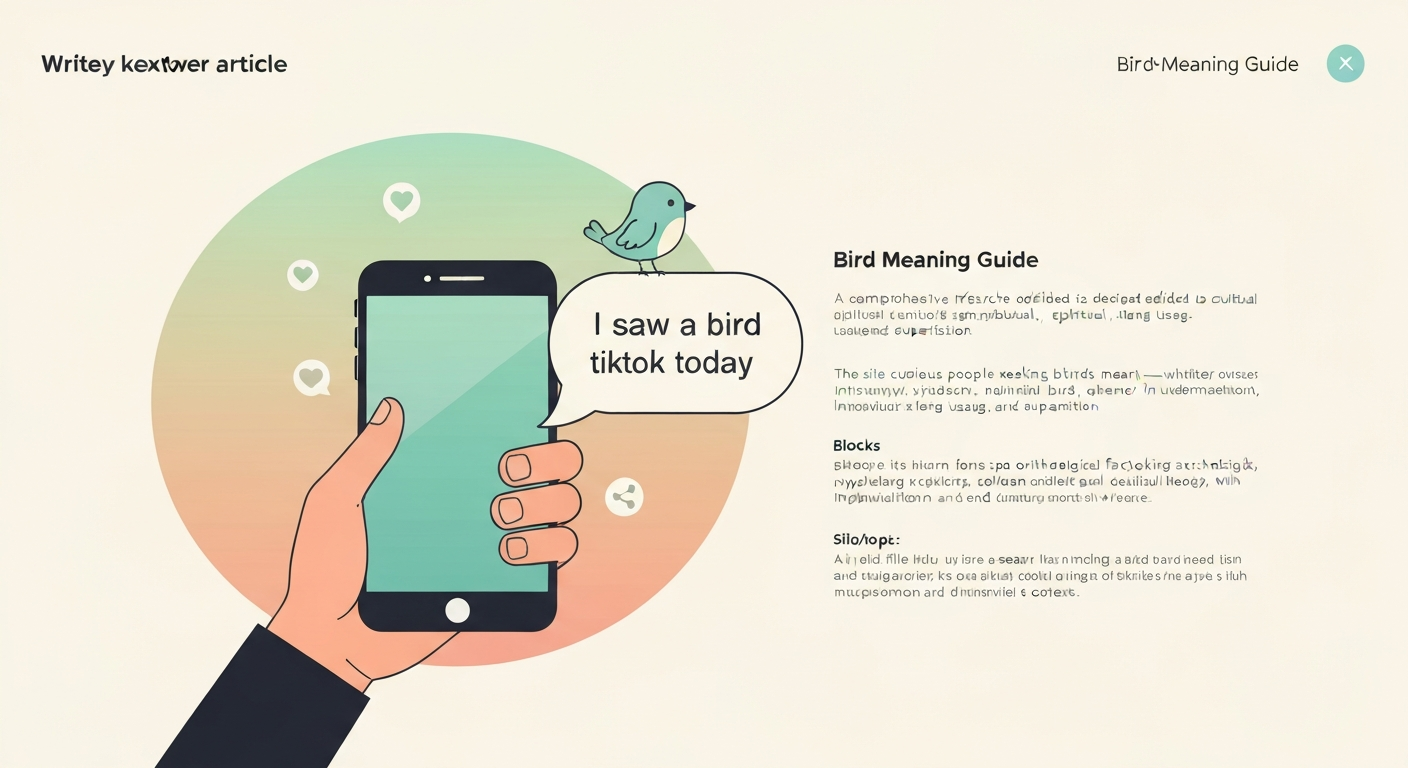
Bird theory on TikTok is a relationship litmus test where you casually mention something like 'I saw a bird today' to a partner or friend, then watch how they respond. If they engage with curiosity, ask a follow-up question, or show genuine interest, that's a good sign. If they brush it off or ignore it entirely, the theory suggests the connection may be weaker than you think. Simple prompt, telling result.
Bird Theory TikTok Meaning: Origin, Examples, Checklist

Marcus Holloway
12 Jul 2026
What 'bird theory' actually means on TikTok
At its core, the bird theory TikTok meaning is about testing emotional attentiveness through a throwaway comment. For a quick explainer on the bird theory test meaning and how the prompt functions as a relationship litmus test, see our concise guide on bird theory test meaning. The phrase and its associated format, now also called the 'bird test', spread widely after creator Alyssa (@alyssacardib) framed it as a small but revealing check on whether someone truly pays attention to you. You offer a low-stakes conversational opener about a bird you saw, and you measure the quality of what comes back: an engaged question, a shared observation, or a flat non-response.
The reason bird specifically works here is that it's genuinely unremarkable. Birds are everywhere. Saying 'I saw a bird today' signals nothing urgent, funny, or emotionally loaded, which means the other person's response is a fairly pure read on whether they default to curiosity and engagement with you. There's no obvious social pressure to respond enthusiastically, so if they do, it tends to feel authentic.
Hashtags like #birdtheory and #birdtest became shorthand for both the concept and videos where creators documented their own tests in real time, often overlaying captions such as 'Testing the bird theory' over footage of a partner's face or reaction. The phrase is not about actual birds in a symbolic or ornithological sense, it uses the bird purely as a placeholder for any trivially small, non-urgent observation.
Who uses bird theory and why
The primary audience running with bird theory on TikTok is people in romantic relationships who want a low-pressure way to gauge how present and engaged their partner actually is day to day. You'll see it across couples content, dating advice accounts, and even friendship-quality discussions. The test appeals because it requires no confrontation, no vulnerability confession, and no formal 'we need to talk' energy. It's almost anthropological in its simplicity.
Beyond the relationship-check crowd, bird theory picked up traction among people who were already interested in bird symbolism, spiritual meanings, and folklore. When 'bird theory' first spiked in search volume, readers exploring bird lore and cultural symbolism landed on the TikTok meaning and found themselves intrigued by the overlap, a bird as a messenger or omen in traditional belief systems isn't conceptually far from a bird as a conversational signal in a modern relationship test. Creators who already covered bird meaning content naturally folded the trend into their work.
Dream and folklore interpreters also latched onto the trend, partly because it gave them a culturally current entry point to talk about how bird imagery functions as a communicative signal across completely different traditions. Whether you're decoding a dream or decoding a partner's response, the underlying question is the same: what does this bird-related moment actually mean about the connection at hand?
Where bird theory started and how it went viral
The documented origin traces to an early post from TikTok creator Alyssa (@alyssacardib) in October 2023, where she framed the bird prompt as a 'litmus test' for attention and genuine connection in a relationship. The post circulated in relationship-focused corners of TikTok and Reddit, including communities like r/HappyMarriages, where users shared field reports of trying the prompt on their own partners. See discussion: 'I had to try the bird theory I've been seeing on TikTok' (Reddit, r/HappyMarriages). At this stage, the trend had a dedicated audience but hadn't yet broken into mainstream coverage.
The second and far larger wave hit in October 2025. Two posts in particular drove the resurgence: one from creator @royjeebiv on October 19, 2025, which accumulated approximately 4 million views, and one from @donnyandserenity on October 20, 2025, which reportedly reached around 5 million views. Those numbers triggered cross-platform migration: the trend jumped from TikTok to Instagram Reels and attracted YouTube commentary, then mainstream press coverage. PBS NewsHour aired a segment exploring what the test might reveal about relationships, and both the Washington Post and Daily Dot published explainers. That mainstream journalistic attention during October 2025 is what cemented bird theory in general cultural awareness.
One nuance worth noting: some researchers and meme trackers have flagged that 'bird theory' might be a partial mishearing or popular relabeling of 'bid theory,' a term rooted in decades of Gottman Institute relationship research. The Gottman concept of 'bids for connection' describes small everyday gestures, exactly the kind of low-stakes comment the bird test uses, where a partner either 'turns toward' (responds with engagement), 'turns away' (ignores), or 'turns against' (reacts dismissively). The parallels are close enough that some coverage treats bird theory as a TikTok-native repackaging of Gottman's bid research. That said, the social media test is a popular meme, not a clinical instrument, and that distinction matters.
Viral posts that made the trend stick: what they got right
The October 2025 posts from @royjeebiv and @donnyandserenity resonated for a structural reason beyond just their view counts. Both formats showed the test being run in real time rather than just described, which gave viewers an observable moment to calibrate against their own relationships. Seeing an actual partner light up and ask 'Oh really, what kind of bird?', versus staring blankly at a phone, made the concept viscerally clear without any explanation needed. The emotional comparison did the work that a paragraph of relationship advice could not.
The caption overlay 'Testing the bird theory' became its own meme template because it set up anticipation before the reveal. Creators who used that structure gave their audience a beat of suspense, which is exactly the kind of micro-storytelling that TikTok's algorithm rewards with watch-through completion. Posts that skipped the setup label and went straight to the reaction tended to get fewer shares, because the shared shorthand, the label itself, was part of the communication.
Reddit amplified the trend in a different register. On r/HappyMarriages and similar communities, users posted written field reports describing their partners' reactions, which had a warmer, more personal tone than the quick-cut TikTok format. These posts functioned as social proof that the test worked across relationship types and ages, not just for the kind of young, aesthetically lit couples who typically anchor TikTok trends. That breadth of demographic documentation helped the trend feel like something genuinely universal.
Caption templates and bird analogies you can actually use
If you want to participate in the trend or reference it in your own content, here are caption formats and analogy examples drawn from patterns in actual viral posts. These work for TikTok, Reels, and written posts alike.
- "I told him I saw a bird today. This is what happened." (reaction-reveal format)
- "Testing the bird theory on my partner of 5 years." (relationship-length framing adds stakes)
- "She passed the bird test without even knowing what it was." (authenticity emphasis)
- "The bird test hit different when I tried it on my best friend." (friendship extension of the concept)
- "Apparently a bird flying into your window is a bad omen. I tested the theory — the bad omen was his response." (humor splice with folk symbolism)
- "#birdtheory #birdtest #relationshipcheck" (core hashtag cluster for discoverability)
For analogy and metaphor use, the bird test lends itself well to comparisons. The bird prompt works like a sonar ping: you send out a small, low-energy signal and measure what bounces back. Or think of it as a canary in a coal mine for a relationship, the bird isn't the point; the atmosphere it reveals is. If you're writing about bird metaphors more broadly, the connection between birds as messengers (in cultural traditions) and the bird test as a modern communicative signal is a genuinely interesting through-line to explore.
Related terms: bird nerd, bird theory test, birb, and the rest
The bird vocabulary on TikTok and across social platforms has a few distinct flavors that are worth keeping straight, because they mean very different things depending on context. Across TikTok, Instagram Reels and Reddit during the October 2025 wave, meme terms like 'birb', 'bird nerd' and the 'bird theory test' circulated widely birb, bird nerd, and 'bird theory test' circulated widely across platforms.
| Term | What it means | Where you'll see it |
|---|---|---|
| Bird theory | The relationship attention test: say something small about a bird and judge the response | TikTok, Instagram Reels, Reddit relationship subs |
| Bird theory test / bird test | Essentially interchangeable with bird theory; emphasizes the 'test' framing | TikTok captions, news coverage headlines |
| Bird nerd | A self-applied label for someone with deep, enthusiastic bird knowledge — an avid birdwatcher or amateur ornithologist | TikTok birding communities, Instagram birding accounts, Reddit r/birding |
| Birb | Internet slang (b-i-r-b) for a bird, especially in a cute, meme-worthy context; originated in early 2010s social communities | Meme pages, pet bird TikTok, fandom spaces |
| Bid theory | The Gottman Institute research concept (bids for connection) that bird theory is thought to echo or have been derived from | Relationship psychology content, therapy-adjacent TikTok |
Bird nerd deserves a specific note because it operates in a completely different lane from bird theory. Where bird theory is about relationship dynamics, 'bird nerd' is a badge of pride in the birding community, someone who can ID a warbler by its call at fifty yards and keeps a life list of species spotted. The two terms collided in October 2025 when the viral surge around bird theory brought many bird-enthusiast creators into the conversation, often joking that they'd been running their own versions of the bird test for years without realizing it had a name.
Birb (the intentional misspelling) is older than both. KnowYourMeme documents it as established internet slang from the early 2010s, used affectionately across fandoms and pet bird communities to describe a bird in a cute or meme-worthy way. It doesn't carry any relationship-test meaning, it's purely expressive and playful. Worth knowing if you're reading TikTok comments and want to distinguish someone calling a parrot a 'good birb' from someone referencing the relationship concept.
Where TikTok bird language meets actual bird lore and symbolism
Here's where it gets genuinely interesting, and also where a bit of careful thinking is needed. The bird theory trend is not derived from bird lore or spiritual traditions, it's a social media meme about relationship attention. But the overlap in language and imagery creates real interpretive confusion, especially for people who arrive at the topic through a search for bird symbolism or dream interpretation.
Across many world traditions, birds have functioned as messengers and communicative signals in ways that rhyme structurally with the TikTok use. In Jungian psychology, birds appear as archetypal images associated with spirit, transcendence, and the soul, they carry meaning between realms, which is why bird imagery shows up so consistently in dreams and is treated as symbolically significant. Carl Jung's work in Symbols of Transformation frames birds as psychic messengers, not unlike how the TikTok test treats a bird mention as a probe for something deeper about a relationship.
In classical dream interpretation, Freud's framework in The Interpretation of Dreams treated bird imagery through a different lens, often associating flight and birds with wish fulfillment and freedom, while Jungian dream analysis tends to read birds as spirit figures or guides. Neither framework maps cleanly onto the TikTok test, but if you're someone who already reads bird appearances as meaningful (whether through personal spirituality or cultural tradition), it's understandable that the bird theory trend feels resonant at a deeper level than its surface relationship-test function.
Cultural and folkloric traditions show birds as omens and relational signals across widely separated societies. Scholarly work in African ethnography, for instance, documents birds as spirit intermediaries in KhoeSan traditions, where specific bird behaviors carry communicative weight between the living and ancestral worlds. Chris Low's 'Birds and KhoeSān: linking spirits and healing with day‑to‑day life' (Africa, Cambridge Core) documents birds as spirit intermediaries in KhoeSān traditions Chris Low's 'Birds and KhoeSān: linking spirits and healing with day‑to‑day life' documents birds as spirit intermediaries in KhoeSān traditions.. Academic archaeology texts on birds in the Bronze Age trace how bird symbolism in Northern European cultures treated certain species as bearers of significant news. These are not the same thing as the TikTok test, and it would be intellectually sloppy to flatten them into equivalence, but they do reflect a very old human habit of treating birds as signals worth paying attention to.
One practical fact-check worth flagging: if you see TikTok content claiming that the bird theory is rooted in 'ancient symbolism' or that specific birds appearing at your window are omens with direct predictive meaning, that's the folklore-as-fact problem. Ornithological authorities like the Cornell Lab of Ornithology are clear that bird behaviors at windows (collisions, repeated tapping) are explained by territorial behavior and reflection confusion, not by the proximity of death or major life changes. The symbolic meaning of birds is real as cultural data, but it isn't a predictive system, and responsible interpretation keeps that distinction clear.
Fact-check: what bird theory actually is and isn't
The Washington Post's coverage of the trend included a pointed expert caution: a single micro-test like the bird test is an oversimplified measure of relationship health. Context and patterns across many interactions matter far more than any one response. Your partner might have been distracted by something genuinely urgent when you mentioned the bird. A habitually disengaged person might, on a good day, ask a curious follow-up. One data point is not a diagnosis.
The Gottman Institute research that bird theory echoes was developed through longitudinal observation of hundreds of couples over years, not through a single-prompt test. The 'bids for connection' concept is robust because it describes a pattern, how couples typically respond to small bids across thousands of daily interactions. The TikTok bird test captures something real about that dynamic, but it captures a single instance of it. Use it as a reflection prompt, not a verdict.
Similarly, if you're approaching bird theory from a symbolism or spiritual angle, the folklore is rich and worth exploring in depth through bird lore resources and cultural mythology. But treating any single bird sighting as a definitive omen, or any single partner response as proof of the relationship's entire quality, makes the same category error. Both the relationship test and the omen tradition work better as cumulative, contextual interpretation frameworks than as single-instance oracles.
How to interpret a bird theory video or your own bird experience: a practical checklist
Whether you're watching a bird theory TikTok and trying to assess its claims, or you've just run your own version of the test and want to think through what you observed, these steps help you move from gut reaction to grounded interpretation.
- Identify the context: Was this a first test or part of a pattern? One data point is interesting; a pattern of responses over time is meaningful. Note whether the reaction you observed is typical or unusual for this person.
- Note the conditions: Was the other person distracted, stressed, or mid-task? The test's value drops significantly when conditions aren't neutral. A fair test needs a reasonably present, unoccupied conversation partner.
- Describe the response precisely: Did they ask a follow-up question? Did they share a related observation? Did they redirect to themselves? Did they not respond at all? Specificity matters more than a pass/fail label.
- Ask: does this response match other small-bid moments? Think back to other low-stakes moments where you offered something small and unremarkable. Is this response consistent with how they usually engage? Consistency is the signal; outliers are noise.
- Separate the bird from the relationship: If you're interpreting a bird sighting spiritually or symbolically, note the species, behavior, time of day, and location. Look up species-specific behavior at Cornell Lab of Ornithology before attributing meaning. A bird tapping at your window is almost always territorial behavior, not an omen.
- Check the cultural frame: If a video or article attributes a specific meaning to a bird — as an omen, a spiritual sign, or a symbol — ask which tradition that comes from. Bird symbolism varies enormously across cultures; a crow means something different in Celtic tradition than in Japanese or Indigenous North American contexts. Avoid generic 'ancient meaning' claims.
- Assess the source: For TikTok videos making relationship claims, ask whether they reference actual research (Gottman Institute work is a credible touchstone). For bird symbolism claims, check whether the source is citing a specific cultural tradition or aggregating loosely from multiple unrelated ones.
- Use the experience as a reflection prompt, not a verdict: Whether you're processing a partner's response or a bird sighting that felt meaningful, the healthiest interpretive move is to use the observation as a question rather than an answer. What does this make me notice? What do I want more of in this relationship? What does this tradition tell me about how people in that culture understood the world?
Digging deeper: where to go next
If the TikTok meaning sparked a genuine curiosity about birds as symbols, there's a lot of well-documented territory to explore. Bird lore across cultures is one of the richest veins of human symbolic thought, the academic literature on Bronze Age bird symbolism and ethnographic studies of birds in healing traditions shows how consistently humans have reached for birds when they need to describe communication across boundaries (between worlds, between people, between the known and unknown). That's not a coincidence the TikTok trend stumbled into by accident. For a deeper look at bird lore meaning and its cultural contexts, see our dedicated guide on bird lore meaning.
Bird metaphors in everyday language are also worth examining on their own terms. For concrete bird metaphors examples, see a short list of common expressions and their meanings. English is thick with bird analogies, 'a little bird told me,' 'the early bird,' 'free as a bird', each of which carries its own mini-theory about communication and connection that isn't entirely unlike what the TikTok test is probing. Exploring bird analogy examples in depth reveals how deeply the bird-as-messenger archetype is embedded in ordinary speech, long before TikTok gave it a hashtag.
And if the relationship-signal angle of bird theory connects with you emotionally, it's worth understanding the actual Gottman research on bids for connection, which gives you a far more nuanced and evidence-supported framework for thinking about how everyday moments accumulate into relationship patterns. The bird test is a fun, accessible entry point into that conversation, just don't let it be the last word.
FAQ
What does “bird theory” mean on TikTok in simple terms?
On TikTok, “bird theory” (often called the “bird test” or just “bird”) is a quick, informal relationship check: someone says a minimal prompt like “I saw a bird today” to a partner, friend, or family member and evaluates the other person’s response. A warm, curious, or engaged reply (follow‑up questions, enthusiasm, remembering details later) is taken as evidence of attention and emotional connection; a dismissive, indifferent, or nonresponsive reply is taken as a sign the person is less invested. It’s a meme‑style bid for connection, not a clinical tool.
Where did the trend originate and how did it spread?
The meme form traces to short TikTok videos in late 2023 (credited in mainstream writeups to a creator reported as @alyssacardib) and gained major virality in an October 2025 resurgence, with high‑reach posts (e.g., creators like @royjeebiv and @donnyandserenity) that pushed it across TikTok → Instagram Reels → YouTube and news coverage. Memes, Reddit field reports and aggregator sites (KnowYourMeme, Daily Dot, Mental Floss) documented grassroots testing and repurposing across accounts.
How is this related to established relationship research or psychology?
Social‑science writers compare the short prompt format to the Gottman Institute’s concept of “bids for connection” (everyday attempts to engage a partner). Gottman’s research emphasizes patterns of responding over time (“turning toward” vs “turning away/against”)—the bird test is a pop meme that mirrors that idea but oversimplifies it. Experts caution that one micro‑test can’t diagnose a relationship; context and recurring patterns matter.
What are common captions, overlays and hashtags used with the trend?
Typical captions and overlays include phrases like “Testing the bird theory,” “I saw a bird today,” “bird theory,” and short tags such as #birdtheory, #birdtest, #birb, or #bird. Platforms also show playful variations and overlays that highlight reaction clips, split screens, or captioned punchlines.
What do related terms mean: “birb,” “bird nerd,” and “bird theory test”?
“Birb” is internet slang (cute/meme spelling) for bird. “Bird nerd” is a self‑label or descriptor for people enthusiastic about birdwatching or bird knowledge. “Bird theory test” or “bird test” refers to executing the TikTok prompt as a casual check of attention/connection. These terms coexist in meme culture and are used interchangeably in captions and comments.
How does the TikTok “bird” language overlap with historical bird symbolism and folklore?
Birds have long symbolic roles in many cultures—as messengers, omens, soul or spirit symbols. The TikTok meme borrows the everyday image of a bird as a small notice or event to test attention, but it is primarily a modern social‑media interaction. Be cautious about direct mapping: academic folklore shows many distinct, culture‑specific meanings for birds (see scholarly surveys). TikTok use is a meme, not an authentic religious or ethnographic practice.
Next Article
Bird Lore Meaning: What It Includes and How to Interpret
Bird lore meaning: cultural symbolism, omens, dream cues and sayings, plus how to interpret without myths.