The bird of paradise napkin fold is a decorative table-linen fold that fans a starched napkin into a tall, petal-like bloom, mimicking the spiky crown of the Strelitzia reginae flower and the dramatic plumage of the birds-of-paradise family. It signals elegance, tropical flair, or a special occasion rather than carrying any fixed spiritual meaning. If you have encountered it at a wedding table, a resort dining room, or even in a dream about elaborate table settings, what it most reliably communicates is intentional hospitality and visual abundance. The deeper symbolic layers depend entirely on cultural context, and this guide unpacks all of them honestly.
Bird of Paradise Napkin Fold Meaning: Symbolism Guide

Marcus Holloway
23 Jul 2026
Who this guide is for
This article is written for curious readers who have spotted the fold at an event and want to know what it signifies, for hosts and event planners deciding whether it fits their table, for people processing a dream that featured elaborate napkin-craft, and for researchers tracking down the actual history rather than recycled internet mythology. I will separate verifiable facts, hospitality tradition, and folk interpretation so you can decide which lens matters most for your situation.
What the fold actually looks like
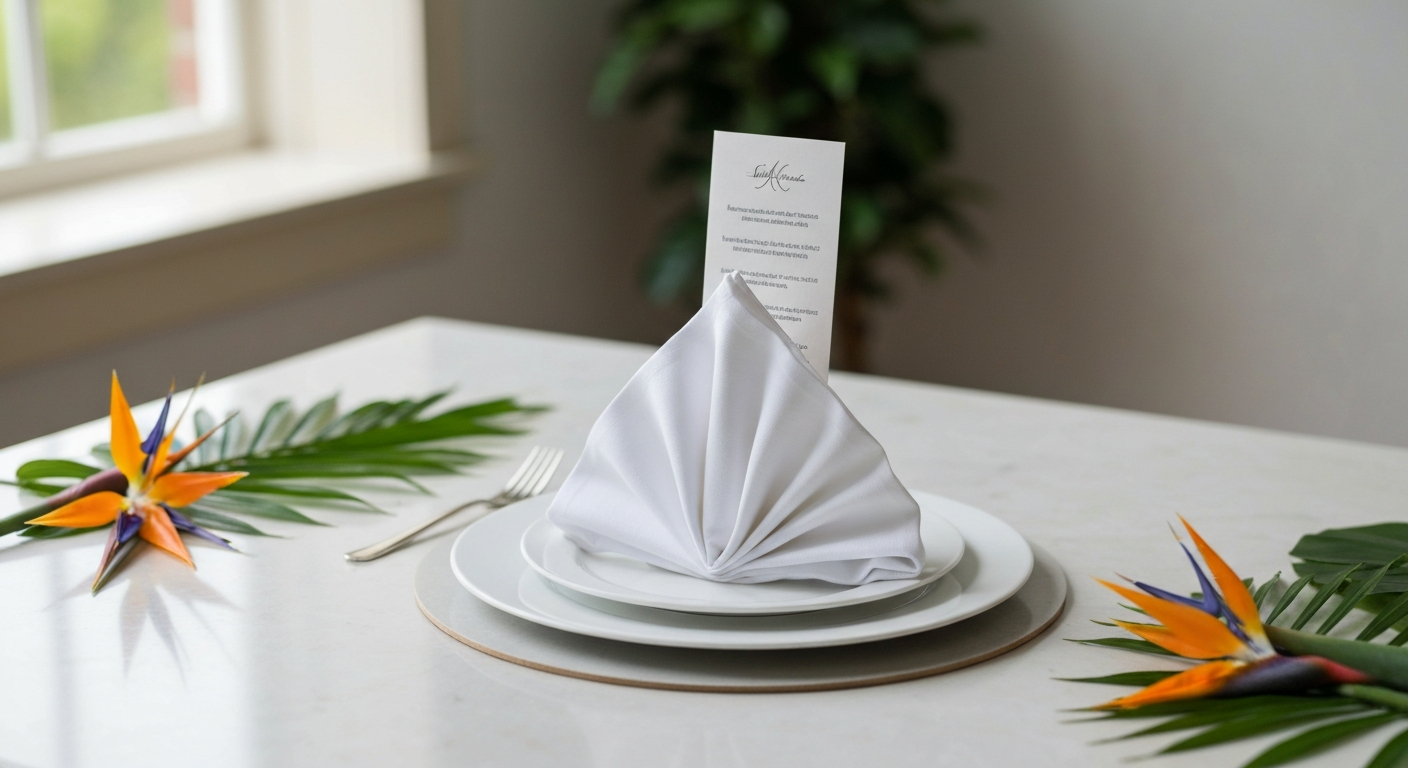
The finished bird of paradise fold stands upright on the plate or in a glass. Four triangular flaps are pulled away from a tight central cone, fanning outward and upward like petals or feathers. Seen from the side it resembles the opened flower head of Strelitzia reginae, with the central cone acting as the flower's long beak-like spathe and the flaps mimicking the orange and blue petals that jut from it. From above, the symmetry gives an impression of a bird with wings spread.
Standard instructions call for a square napkin roughly 40 to 50 centimetres (16 to 20 inches) on a side. Linen works best when it has been lightly starched and ironed flat before you start; a limp fabric napkin will collapse. Crisp paper napkins in a heavier weight can also hold the form. The fold is taught in hospitality training programs worldwide and appears as one of the required named folds in service competitions such as the ProStart and Waiters Relay events organized through bodies like the Florida Restaurant and Lodging Association.
Where the name and form come from
Decorative napkin folding as a formal table art goes back to at least the early 17th century in Europe. Matthia Gieger's instruction manual from around 1639 is among the earliest surviving printed sources, and by the late 19th century the practice was thoroughly codified in professional stewarding manuals. Jessup Whitehead's The Steward's Handbook, published in Chicago in 1888 and now freely available through Project Gutenberg, lists dozens of named ornamental folds complete with diagrams and emphasizes that elaborate folding was expected of skilled front-of-house staff. The point then, as now, was to impress guests and signal the quality of the household or establishment.
The specific name 'bird of paradise' for this fold draws on two overlapping sources of visual inspiration. First, the Strelitzia reginae flower, native to southern Africa and recognized globally as the bird-of-paradise or crane flower, has a bloom structure that botanists at the Royal Botanic Gardens Kew describe as resembling a bird's head, beak, and plumage. Second, the birds-of-paradise (family Paradisaeidae) are renowned throughout natural history for their elaborate feathered courtship displays, a spectacle that has captured human imagination for centuries. The fold brings both references together: the fanned flaps echo both the flower's spiked petals and the bird's fanned tail. There is no evidence the fold was named in any ceremonial or spiritual context; it was named because it looks like the plant and the bird.
Cultural and spiritual interpretations
From a strictly historical standpoint, 19th-century etiquette manuals present decorative napkin folding as an ornamental display rather than a practice loaded with religious or cross-cultural symbolism. The goal was to impress, not to invoke. That said, meaning is always contextual, and different communities have layered genuine significance onto this fold over time.
Weddings and celebrations
In contemporary event styling, particularly in the bridal industry, the bird of paradise fold appears frequently at reception tables as a deliberate visual signal of luxury and joy. Catering and event-planning publications treat it as a tropical or exotic theme marker. At a wedding table it communicates abundance and care: someone took the time to fold each napkin individually, which guests read as attentiveness to detail. In this context it carries a warm, celebratory social meaning even if that meaning is not tied to any particular spiritual tradition.
Hospitality as a symbolic act
Textile and material-culture scholars, including work published by Joan Sallas in The Beauty of the Fold, argue that cloths and textiles gain meanings within specific local social practices rather than carrying a fixed universal symbolism. See The Beauty of the Fold, Sternberg Press / MIT distribution (Joan Sallas; essays by Charlotte Birnbaum) for discussion of how cloth meanings are context-specific The Beauty of the Fold — Sternberg Press / MIT distribution (Joan Sallas; essays by Charlotte Birnbaum). A folded napkin placed at a guest's seat is, across many cultures, a gesture of welcome and preparation. The bird of paradise fold amplifies that baseline gesture by adding visual drama. In hotel and resort dining, particularly in tropical destinations, the fold reinforces a sense of place and occasion: you are somewhere special, and someone prepared for your arrival.
Spiritual resonance in dream and symbolic contexts
The bird of paradise flower carries associations with freedom, paradise, and the exotic across several cultural traditions, informed partly by the flower's South African origins and its name's reference to otherworldly birds. Related notes on bird leaf meaning explore how avian and foliage images combine in symbolic systems. For related floral symbolism, see bird cherry meaning to compare how other 'bird'-named flowers are interpreted. If you encounter the fold in a dream or process it as a symbolic image, those associations are worth noting. For more on the symbolism of the plant itself, see our primer on bird flower meaning which explores the cultural and botanical associations of Strelitzia and related species. Dream interpreters often link bird-related imagery to themes of aspiration, rising above the ordinary, or the arrival of something rare and beautiful. The fold's visual structure, reaching upward and outward, supports these readings intuitively. However, I want to be transparent: there is no documented religious canon or ancient cultural tradition that assigns a fixed spiritual meaning specifically to this napkin fold. Any spiritual interpretation you draw is legitimate as personal meaning-making, but it should not be presented as established doctrine.
Folk beliefs and popular interpretations
A number of folk interpretations circulate online, and it is worth knowing which have some grounding and which do not. The most common claims are listed below with a brief reliability note for each.
| Folk claim | How widespread | Reliability assessment |
|---|---|---|
| The fold symbolizes good luck for the recipient | Common in hospitality and party-planning blogs | No historical sourcing; a modern popular association rather than a documented tradition |
| Placing it on a guest's plate invites prosperity | Occasionally cited in lifestyle content | Not documented in etiquette or cultural scholarship; likely projection from general bird-of-paradise flower symbolism |
| The fold signifies that a host wishes you freedom and joy | Widespread in event-styling content | Plausible as a social intention, consistent with the flower's cultural associations, but not a fixed rule |
| It brings bad luck if knocked over before use | Rare; occasional superstition | No documented origin; almost certainly a recent invention |
| The number of visible flaps carries meaning | Very rare | No evidence; flap count is purely a product of folding method, not symbolism |
The takeaway here is that the fold's meaning lives mainly in the act of hospitality and the visual language of the event rather than in codified folk tradition. That does not make the experience of encountering it less meaningful, but it does mean you should be cautious about any source that presents a very specific spiritual claim without citing a cultural tradition by name.
When to use the bird of paradise fold
The fold works best when the event calls for visual drama alongside warmth. It reads as festive and slightly theatrical, so it suits occasions where guests expect a touch of spectacle. Here are the contexts where it lands well and where it might feel out of place.
| Event type | Fit for this fold | Notes |
|---|---|---|
| Tropical or destination wedding | Excellent | Reinforces theme; pairs naturally with Strelitzia floral arrangements |
| Formal gala or charity dinner | Good with caveats | Use crisp white linen to keep it formal; avoid if the dress code is black-tie conservative |
| Brunch or garden party | Good | Lighter fabric or paper works; the fold adds a playful upscale touch |
| Intimate dinner party (6 or fewer guests) | Moderate | Can feel effortful in a good way; works if the host is known for theatrical presentation |
| Corporate lunch or business meeting | Poor | Too decorative; risks reading as frivolous in a strictly professional context |
| Luau, tropical, or themed party | Excellent | Ideal; the fold anchors the theme visually |
| Everyday family dinner | Poor | Disproportionate effort; reserve for occasions that warrant it |
From an etiquette standpoint, the Emily Post Institute's guidance on napkins focuses on function: the napkin goes on the lap once seated, and a used napkin is left loosely to the left of the plate when leaving the table. Decorative folds are understood by guests to be display pieces that get unfolded on the lap. No etiquette authority requires a guest to admire the fold before using it, but most guests do notice and appreciate the effort. The social expectation is simply that the fold signals care, not that it must be preserved.
How the fold communicates intent through presentation choices
The fold itself is a starting point. The choices you make around it are where the real message lives. Placement, color, fabric, and accompanying elements all adjust what the fold says to a guest before they sit down.
Placement
Standing the fold upright on a charger plate centers it visually and makes it the focal point of the place setting. Placing it inside a wine or water glass, which the fold's cone base allows, draws the eye upward and creates height variation across the table. If you are pairing it with a floral centerpiece, alternate the height: low flowers with napkins in glasses, or tall floral arrangements with napkins flat-presented in a lower variation of the fold.
Color and fabric
White linen reads as formal and classic. Deep jewel tones like coral, gold, or violet push the fold toward festive and tropical. Blush or ivory linen is the reliable choice for weddings. Using the exact orange and blue of the Strelitzia reginae flower is a bold move that works well at tropical-themed events but can feel costume-like at a traditional formal dinner. Fabric weight matters practically: heavier linen or cotton holds the fold without starch; lighter polyester blends almost always need starch to stay crisp.
Accompaniments
Tucking a handwritten place card between the flaps of the fold immediately personalizes the setting and upgrades the gesture from decorative to deeply attentive. A small sprig of greenery or a single bloom (real or silk) inserted into the cone base connects the fold to the wider floral language of the event. Printed menus folded inside the cone serve a practical purpose while reinforcing the theme. These small additions are where the bird of paradise fold moves from a hospitality technique into genuine symbolic communication: you are telling each guest that you thought specifically about their place at the table.
Common folding variations and what they suggest
The classic standing version is the most recognized, but several variations exist within event styling and hospitality training. Each signals something slightly different about the occasion's tone.
- Classic standing: The full upright cone with four fanned flaps. Maximum visual impact, most formal within the tropical/floral category. Requires starched linen. Used at resorts, weddings, and gala events.
- Compact or low-profile: The fold is completed but laid flat or at a lower angle on the plate rather than standing fully upright. Slightly more understated; works at semiformal dinners where the host wants decorative napkins without the theatrical height.
- Layered or double-fold: Two napkins (often in complementary colors) are folded together, so the fanned flaps alternate colors. Creates a richer visual effect; popular in tropical-themed weddings where it doubles as color coordination for the table palette.
- Pocketed variation: The cone base is folded with an internal pocket to hold a menu card, place card, or small favor. Prioritizes function alongside form; the flaps may be slightly smaller to accommodate the insert. Common in event-planning contexts where each guest has personalized printed materials.
- Simplified single-fan: A flatter, easier variation with fewer flaps. Often used in high-volume restaurant service where speed matters but the host still wants a recognizable bird-of-paradise shape. Reads as decorative but less elaborate than the full version.
The rule of thumb across all variations is that more flaps, more height, and stiffer fabric all push the formality reading upward. A simple two-flap version on a paper napkin at a beach barbecue reads as playful; a full four-flap starched linen version at a seated dinner reads as genuinely elegant. Neither is wrong; they are just different registers of the same visual language.
A reliable way to fold it yourself
The core technique, as it appears consistently across hospitality training manuals and tutorial resources, follows these steps. Start with a flat, starched square napkin. Fold it in half to make a rectangle, then fold in half again to make a square. Fold that square diagonally to make a triangle with the open corners at the bottom. Fold the two bottom side corners up to meet the top point of the triangle. Flip the whole piece over and fold the bottom point up toward the middle, then fold the piece in half vertically so the two side points meet at the back. Stand the cone upright on its base and carefully pull the four corner flaps downward and outward, one at a time, to create the fanned feather or petal effect.
The most common failure point is insufficient stiffness in the fabric. If your flaps droop immediately after pulling them out, give the napkin a light spray starch and a quick iron before you start. Commercial linen suppliers including Nisbets publish free diagram PDFs for this fold, and resources like NapkinFoldingGuide.com and the Chinet how-to gallery offer illustrated step-by-step versions that are well-suited to beginners.
For dream interpreters and symbolic thinkers
If you have arrived here because you dreamed of a bird of paradise napkin fold, or because you are giving it as a craft gift and want to understand what it might mean to the recipient, here is a grounded way to think about it. The fold combines three layers of symbolism: the bird (aspiration, exotic beauty, elaborate display), the flower (freedom, paradise, the meeting of earthly and otherworldly beauty), and the act of folding itself (care, preparation, the transformation of something plain into something beautiful for another person). None of these meanings are fixed or universal, but they are all coherent. In a dream, an elaborately prepared table often connects to themes of welcome, anticipation, and being seen. The bird of paradise fold specifically, with its upward-reaching form, can map to aspirational energy or a sense that something special is being prepared.
The flower itself, Strelitzia reginae, connects to a broader web of bird-related symbolism worth exploring. The way bird plumage carries meaning across cultures (from peacock feathers to hummingbird colors) is directly related to why this flower was named after a bird in the first place: elaborate visual display is one of the core symbolic languages birds use, and humans have been reading that language for a very long time. See also a concise guide to bird feathers meaning for more on how plumage conveys symbolism. The bird-of-paradise napkin fold is, in a small way, a table-scale performance of that same visual drama.
What this fold actually means, straight
To bring everything together: the bird of paradise napkin fold means you are at a table where someone made an effort. Its primary meaning is attentive hospitality expressed through a visually striking, named technique with a well-documented 400-year history in European table service. Its secondary meanings, tropical flair, celebration, abundance, joy, are cultural associations borrowed from the flower and the bird it references, and they are genuine even if they are not ancient. Its tertiary meanings, spiritual freedom, arrival of something beautiful, the transformation of the ordinary into the extraordinary, are available to you as personal or symbolic interpretations but are not codified tradition. Use the level of meaning that fits your context, and be transparent about which level you are working at.
FAQ
What is the “Bird of Paradise” napkin fold and how does it look?
Definition/visual: A decorative upright napkin fold that creates a fan or ‘feathered’ shape suggesting the plumage or profile of a bird‑of‑paradise flower/bird. Typically it stands on the table or leans at an angle with multiple pointed flaps (“feathers”) radiating from a central body. Diagrams/photos: hospitality how‑tos and printable PDFs show step diagrams; flower photos (Strelitzia reginae) are useful visual comparisons.
Where does the name come from — the bird or the flower?
Origin of the name: The fold is named for visual resemblance to the bird‑of‑paradise flower (Strelitzia reginae) and the family Paradisaeidae’s dramatic plumage. The plant’s common name itself refers to a perceived likeness to exotic birds; the napkin name borrows that botanical/ornithological imagery rather than any ancient folding tradition.
Is the Bird of Paradise fold historically old or a modern invention?
History: Ornamental napkin folding has printed roots back to the 17th century and became a professional stewarding skill by the 19th century. Named contemporary folds like Bird of Paradise appear in modern hospitality training and competition materials and in mid‑to‑late 20th/21st‑century how‑tos; it is part of the living repertoire of professional service rather than an ancient ritual fold.
What cultural or spiritual meanings are associated with this fold?
Cultural/spiritual interpretations: In most sources the fold functions as visual decoration and a marker of hospitality, not an inherently sacred symbol. Hosts and event stylists use it to signal elegance, skill, exotic/tropical themes, or celebration (weddings, luaus, hotel dining). Any ritual or spiritual reading is context‑specific and should be traced to local custom rather than assumed universal meaning.
Are there ceremonial or wedding meanings I should know about?
Ceremonial use: Planners and bridal guides use the fold as a thematic detail (tropical, formal, or showy tables). It communicates care, attention to presentation, and a celebratory tone. It does not carry fixed liturgical meaning in mainstream etiquette or ceremony manuals—treat it as a stylistic choice unless a particular community has a documented tradition using it symbolically.
How does etiquette view decorative folds like Bird of Paradise?
Etiquette and intent: Etiquette authorities emphasize the napkin’s practical role (lap use, placement) rather than symbolic meaning. Decorative folds are acceptable as table accents; choose stable, easy‑to‑remove placements so guests can access and use the napkin. Avoid obstructing place settings or confusing guests about function.
Next Article
Bird Leaf Meaning: Symbolism, Science, Dreams & ID Tips
Bird leaf meaning: discover symbolic, scientific and dream interpretations plus ID tips, myths, and common misconcepti