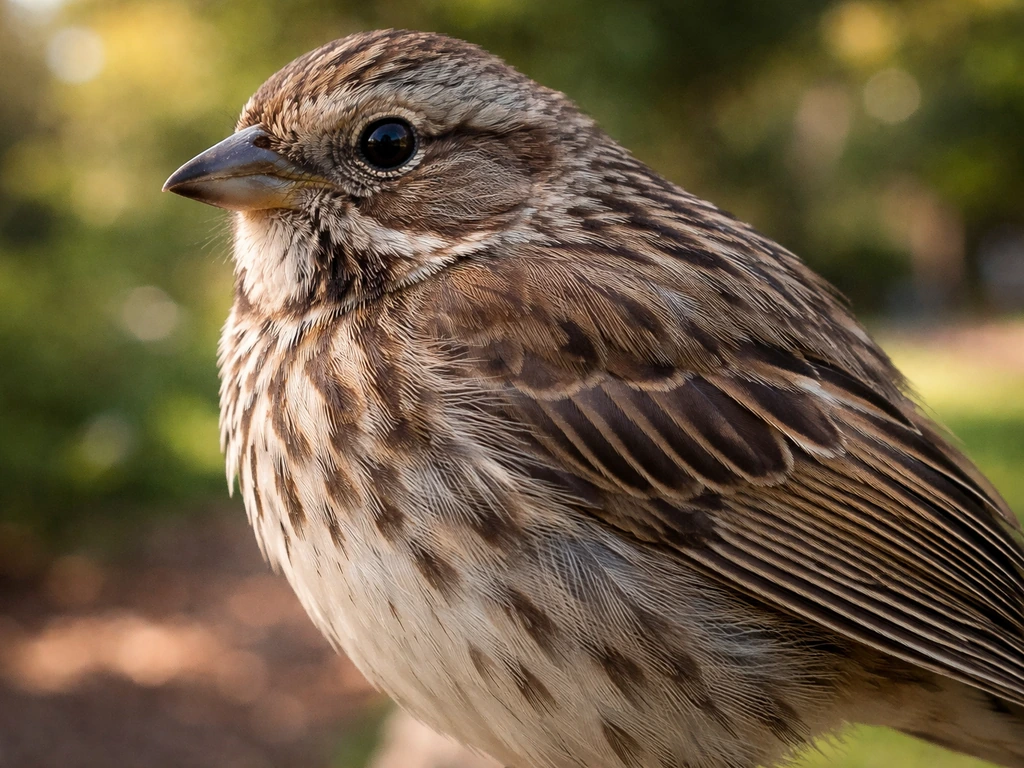
A bird carrying a leaf most often means one straightforward thing: it is building a nest. For the majority of real-world sightings, especially during spring and early summer, the bird you are watching is gathering material for a structure it is actively constructing. That said, some species carry leaves as part of courtship displays, and a small number use leaf-derived tools to extract food. Symbolically, the image draws on one of the oldest peace motifs in Western culture, the dove returning to Noah's ark with an olive leaf, and it carries meanings of renewal, reconciliation, and new beginnings across many traditions. How you read the moment depends entirely on context: what the bird is, what it is doing, and whether your question is behavioral or spiritual.
Bird Leaf Meaning: Symbolism, Science, Dreams & ID Tips

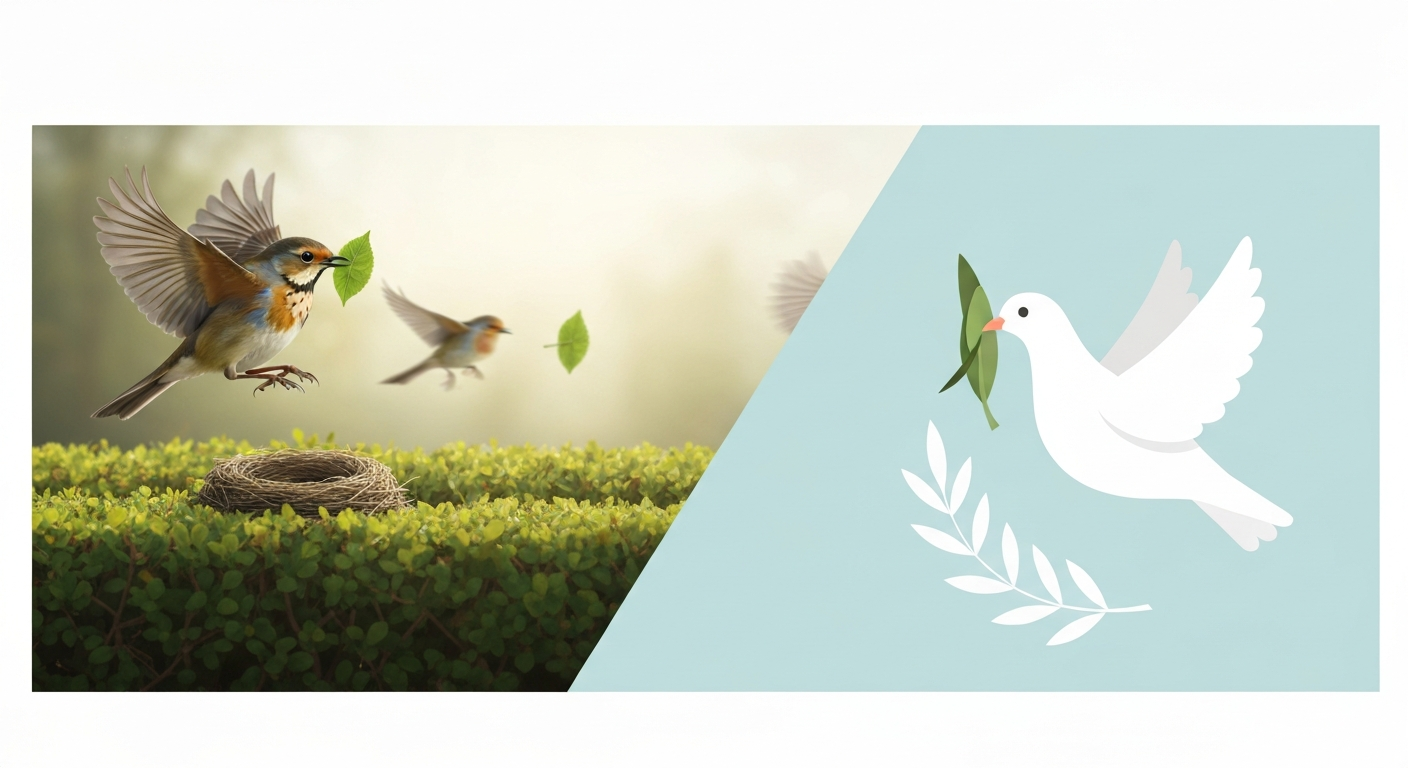
Two ways to read the sighting
There are genuinely two useful lenses here, and neither cancels the other out. The scientific lens asks a practical question: what is this bird actually doing, and why? The symbolic lens asks a different one: what does this image mean to me, within my cultural or spiritual framework? The mistake most people make is applying one lens to a question that belongs to the other. If you see a robin carry a damp leaf toward a hedge in April, that is not a message from the universe; it is a robin building a nest. But if you dream of a white dove dropping a leafy branch at your feet the night before a difficult conversation, the symbolic lens is the relevant one. Starting with behavior first gives you a stable foundation. From there, you can layer meaning consciously rather than by accident.
Why birds carry plant material at all
Birds collect plant material for reasons that researchers are still actively studying. The broadest and most documented function is nest construction. Leaves, grasses, bark strips, mosses, and stems form the structural bulk of nests for hundreds of species worldwide. But a 2025 systematic review and meta-analysis (published as a preprint on EcoEvoRxiv) examined a more specific question: why do birds specifically add fresh green plant material to nests rather than dry material? The review found that the behavior is widespread across many families, and that it likely serves multiple functions that vary by species. Three leading hypotheses are parasite defence (aromatic or chemically active leaves deter mites and blowfly larvae), a signal of male quality during courtship (bringing fresh greenery demonstrates fitness), and direct benefits to chick health and condition. No single explanation fits all species, which is important to keep in mind when you see a particular bird with a leaf. The function depends heavily on which bird it is.
A 1997 study published in the journal Behaviour on European Starlings found that males were primarily responsible for bringing green plant material to nest sites and that the addition of fresh herbs corresponded with breeding activity. This kind of behavior, where one sex takes on the green-material role, points toward the signaling hypothesis in that species. But a Mallard collecting damp leaves near a pond is doing something structurally different: it is lining a ground nest to insulate eggs. Same surface behavior, different function.
Nest-building: what the leaf tells you about timing and species
If you watch a bird pick up a leaf and fly purposefully in a fixed direction, returning multiple times, you are almost certainly watching nest construction or nest maintenance. The timing is your first clue. In the Northern Hemisphere, most songbirds build nests between March and July, with peak activity in April through June. In the Southern Hemisphere, the main breeding window shifts roughly to September through February. A bird carrying leaves outside those windows can still be doing nest-related work, particularly species that attempt multiple broods or rebuild after predator damage, but it is less common.
The type of leaf matters too. Broad, pliable green leaves are often used as lining or as a damp base layer that helps shape a nest cup. Stiff or dry leaves tend to appear in the structural outer walls. Species like the Eastern Towhee, various thrushes, and many warblers incorporate leaves prominently into their ground or low-scrub nests. Cornell Lab of Ornithology's Macaulay Library has thousands of verified photos and videos showing this behavior across species, and comparing your sighting to those records is one of the most reliable identification shortcuts available.
Courtship, display, and gifting: when a leaf is a love letter
In some species, carrying plant material is less about construction and more about attraction. Male European Starlings bringing fresh green herbs to a nest site during the early stages of pair formation are, in effect, advertising their quality to a prospective mate. The greener and fresher the material, the more it may signal that the male is capable, nearby, and invested. This overlaps with the broader category of mate-gift behaviors seen in many bird families, where objects (food, nesting material, objects with no obvious utility) are transferred from one bird to another as part of bonding.
Bowerbirds (family Ptilonorhynchidae) push this behavior into genuinely elaborate territory. Several species, including some avenue-building species studied in Papua New Guinea and Australia, arrange leaves, flowers, berries, feathers, and even man-made objects around constructed bowers purely for courtship display. The bower itself is not a nest; it is a stage built to attract females. Some species carefully select and replace green leaves to keep the display fresh. This behavior has been discussed in detail in accounts like "The Creative Lives of Animals" and makes bowerbirds perhaps the clearest example of a bird for whom a leaf is explicitly a symbol, not just a building block. On that point, if you are interested in how plumage and color factor into display alongside objects like leaves, the topic of bird plumage meaning overlaps interestingly here.
Tool use and foraging: the leaf as an instrument
A small but well-documented category of leaf-carrying behavior is tool use. New Caledonian Crows (Corvus moneduloides) are the flagship example. A landmark 1996 paper in Nature by Gavin Hunt documented these birds manufacturing hooked and barbed tools from pandanus leaves and leaf petioles to extract invertebrates from holes in wood. Classic field observations were published as Manufacture and use of hook-tools by New Caledonian crows (Nature, 1996), documenting hooked and barbed leaf-derived tools made from pandanus leaves and petioles. Subsequent research published in Proceedings of the Royal Society B confirmed that the crows attend to multiple functional properties of their leaf tools, including stiffness, hook profile, and length, and that different populations on the island use different plant materials, which resembles cultural transmission.
If you see a crow or raven manipulating a leaf in a deliberate, focused way, especially probing it into crevices in bark or wood, you may be watching tool use or tool manufacture. This is rare enough outside New Caledonia that verifying it with video is worthwhile. Most leaf-carrying by crows and ravens in other regions is nest-related or exploratory play rather than instrumental foraging, but the possibility is worth knowing about.
What each type of bird is probably doing
Different bird groups tend toward different leaf-related behaviors. This table summarizes the most likely interpretations by broad category, with the caveat that species-level context always matters more than group-level generalizations.
| Bird Group | Most Likely Leaf Behavior | Behavioral Signal | Notes |
|---|---|---|---|
| Songbirds (passerines) | Collecting and transporting nest material | Breeding season underway; nest construction or maintenance | Very common; look for repeated trips in a fixed direction |
| Crows and Ravens | Nest material collection; tool use (New Caledonian Crows specifically) | Breeding activity or, rarely, extractive foraging | Tool use with leaves nearly exclusive to New Caledonian Crows |
| Bowerbirds | Arranging leaves and plant material in or around bower | Active courtship display; advertising to females | Bower is not a nest; behavior peaks at male display season |
| Parrots | Chewing, shredding, or carrying leaves during foraging or play | Foraging enrichment or exploratory play; occasional nest cavity lining | Parrot leaf behavior is often investigative rather than purposive |
| Waterfowl (e.g., Mallard) | Carrying leaves and vegetation to nest site | Ground-nest construction and insulation | Female typically lines nest; behavior common near water edges |
How to identify the bird and verify what you actually saw
Before assigning any meaning to a bird-with-leaf sighting, spend a few minutes documenting what you observed as concretely as possible. Cornell Lab of Ornithology's guidance for field observers recommends noting species (or your best guess), how the leaf was held (in the beak, in the feet, at the tip or base), the bird's apparent destination, whether it returned to the same spot, the habitat type, and the date and time. Even a rough smartphone photo is worth taking.
- Note the bird's size, shape, and any visible markings before it moves out of sight
- Observe how the leaf is held: crosswise in the beak suggests nesting material; held at one end and probed suggests tool use
- Track the direction of travel and look for repeated return trips, which strongly indicate a nest site nearby
- Record the habitat: woodland edge, garden, wetland, urban park, and the approximate height from the ground
- Note the date and your geographic region to cross-check against typical breeding calendars for local species
- Use the Merlin Bird ID app (Cornell Lab) for an on-the-spot species ID from a photo or sound recording
- Search the Macaulay Library with your suspected species name and the term 'nesting material' to find verified visual comparisons
- Submit your sighting to iNaturalist with a photo to get community-verified species ID and contribute to citizen-science records
Seasonality is one of your strongest clues. A leaf-carrying bird in April in the northeastern United States is almost certainly nesting. The same behavior in October deserves a second look and warrants checking whether the species is a year-round resident with atypical breeding timing, or whether you might be seeing something else entirely, such as food caching or play.
Cultural, mythic, and spiritual meanings
The most deeply rooted symbolic meaning associated with a bird and a leaf in Western culture comes directly from Genesis 8:11 in the Hebrew Bible. After the flood waters recede, Noah releases a dove, and it returns carrying a freshly plucked olive leaf, described in Hebrew as 'aleh zayit.' The text is specific: it is a leaf, not a full branch, and the freshness of the leaf signals to Noah that the waters have fallen enough for trees to be above the surface. This single passage gave rise to one of the most enduring peace symbols in the world.
The olive-branch connection has pre-Biblical roots in the Mediterranean world. Greek and Roman art depicted the goddess Eirene (Greek personification of peace) and her Roman equivalent Pax holding olive branches. Christian iconography later merged these traditions with the Genesis dove, producing the now-universal image of a white dove carrying an olive branch as a symbol of peace, goodwill, and divine blessing. This pairing is so widespread today that it appears on United Nations emblems, diplomatic seals, and countless artworks. If you have seen the image recently in a cultural context, that is almost certainly the tradition it is drawing from.
Beyond the olive branch, birds carrying greenery appear in many traditions as symbols of renewal and return. The leaf signals that something has survived, that the earth is producing again, or that a difficult period is ending. In broader spiritual frameworks not tied to specific religious texts, a bird with a leaf is frequently interpreted as a messenger of new beginnings, a sign that a stagnant situation is about to change, or an affirmation that growth is underway. Fertility symbolism also appears in folk traditions where birds nesting near a home were taken as a good omen for the household's prosperity or the family's expansion.
How the same sighting reads differently around the world
Cultural meaning is never universal, and a bird-with-leaf sighting is a good example of how dramatically interpretations can vary. An anthropological and folklore survey of Mediterranean and European traditions published in a PMC article on olive-tree symbolism documents how deeply the olive leaf is embedded in Mediterranean identity while remaining largely absent from the symbolic vocabulary of East Asian, sub-Saharan African, or Indigenous American traditions, where birds carrying vegetation carry entirely different or locally specific meanings. See European identity and cultural heritage: the Mediterranean 'olive tree' as shared symbol (PMC article) for documentation of regional variations in olive symbolism and how the olive leaf is embedded in Mediterranean identity.
- Mediterranean and Judeo-Christian traditions: dove with olive leaf or branch signals peace, covenant, divine favor, and the end of conflict
- Northern European folklore: birds building or carrying material near a home were often read as omens of seasonal change, household fortune, or incoming weather shifts
- Some West African proverbs use birds with branches metaphorically to reference homecoming, safe return from a journey, or the arrival of important news
- In various East Asian contexts, cranes carrying plant material appear in art as symbols of longevity and auspicious beginnings, though the emphasis is typically on the crane itself rather than the leaf
- Indigenous traditions across the Americas vary enormously by nation and region; there is no single pan-Indigenous interpretation, and caution against generalizing is strongly warranted
If you are researching the meaning of a bird-with-leaf sighting within a specific cultural tradition that is your own, the most reliable approach is to consult elders, community resources, or regionally focused folklore scholarship rather than generalist spiritual websites. Local traditions are specific, and the specificity is usually the point. The bird cherry, for instance, has its own distinct symbolic history in Northern European and British traditions that overlaps with bird-and-plant symbolism in interesting ways, a topic worth exploring separately.
What a bird-with-leaf dream might be telling you
Dream interpretation is a genuinely different domain from either behavioral ornithology or cultural folklore, and it deserves its own honest framing. Cognitive neuroscience researcher G. William Domhoff, whose work at the University of California Santa Cruz is among the most cited in empirical dream research, argues that dream imagery is best understood through a continuity hypothesis: dreams tend to reflect the dreamer's waking concerns, recent experiences, and emotional preoccupations rather than delivering fixed symbolic messages. A 2011 review in Frontiers in Human Neuroscience comparing dreaming to mind-wandering reached similar conclusions, finding that dreams recombine elements from recent experience and emotional memory rather than encoding universal symbols.
That does not mean a bird-with-leaf dream is meaningless. It means the meaning is personal. If you dream of a bird carrying a leaf, a useful starting point is to ask what was on your mind in the days before the dream. Were you waiting for news of a resolution to a conflict? Were you hoping for a new beginning in a relationship or project? Were you thinking about home, safety, or belonging? The image may be your sleeping mind's shorthand for a feeling that does not yet have words. Cultural associations (peace, renewal, return) can serve as starting prompts, but they should lead you inward rather than substituting for your own reflection.
- What emotion did you feel during the dream: relief, anticipation, awe, fear, or something else?
- Was the bird flying toward you or away from you, and did that direction feel significant in the dream?
- Did the leaf look like something specific, such as an olive leaf, a large tropical leaf, or a dried autumn leaf?
- Had you recently been in or near a situation involving conflict, change, or a new beginning?
- Did the bird in the dream resemble a specific species you associate with a place or a person?
- How did the dream end, and what was your state of mind when you woke from it?
These prompts are more useful than any symbol dictionary, because they connect the imagery to your actual experience. If the cultural meaning of peace or renewal resonates when you sit with those prompts, that resonance is informative. If it does not, it is fine to set it aside.
Slang, idioms, and the image in modern culture
The phrase 'extend an olive branch' is among the most commonly used diplomatic idioms in modern English. Cambridge Dictionary and Dictionary.com both list it as meaning to make a gesture of peace or reconciliation toward someone you have been in conflict with. You can 'offer an olive branch,' 'accept an olive branch,' or 'reject an olive branch,' and the phrase appears regularly in political reporting, personal advice columns, and workplace communication guides. Its origin is precisely the Genesis passage described above, but most people using it today are not thinking about scripture; they are invoking a widely understood shorthand for de-escalation.
Outside the olive-branch idiom, bird-with-leaf imagery circulates in logo design (peace organizations, environmental groups, and wellness brands frequently use stylized doves with leaves), in tattooing culture where a bird carrying a leaf or branch is a popular motif for new beginnings or personal resilience, and in social media aesthetics where the image appears in mental-health content, seasonal announcements, and motivational posts. In meme culture, the dove-with-olive-branch image is sometimes repurposed ironically to represent someone making a token or insincere peace gesture, which is itself an extension of the idiom's meaning.
Misconceptions worth clearing up
The most common misconception about a bird carrying a leaf is that it is necessarily a spiritual sign or message. The vast majority of real-world sightings have a simple behavioral explanation: the bird is nesting. Treating every such sighting as a personal communication from a divine or spiritual source ignores the biology and, ironically, makes the symbolic reading less meaningful by diluting it. If everything is a sign, nothing is. A more grounded approach is to confirm the behavioral explanation first, and then ask whether the timing, context, or your emotional state makes the symbolic reading feel genuinely relevant.
- Misconception: Any bird carrying a leaf is delivering a spiritual message — Reality: Most are gathering nesting material, a routine seasonal behavior documented across hundreds of species
- Misconception: The dove-with-olive-branch symbol originated in ancient Egypt or Greece — Reality: The specific dove-plus-leaf pairing traces to Genesis 8:11; Greek peace imagery used olive branches but not specifically with doves
- Misconception: New Caledonian Crow tool use with leaves proves general crow intelligence about symbolic communication — Reality: Tool use is a functional foraging behavior, not symbolic; it reflects problem-solving, not message-sending
- Misconception: Dream symbol dictionaries reliably decode bird-with-leaf dreams — Reality: Empirical dream research shows individual context and emotion are far more predictive of dream meaning than fixed symbol lists
- Misconception: The meaning of a bird-with-leaf sighting is the same across all cultures — Reality: Symbolic meaning is culturally specific, and many traditions have no equivalent to the Western olive-branch motif at all
How to watch without causing harm
If a bird carrying leaves leads you to a nest site, you have found something genuinely interesting, and you also have a responsibility at that point. Nesting birds are vulnerable to disturbance, and repeated human presence near a nest can cause adults to abandon eggs or chicks. Cornell Lab's NestWatch program, which invites citizen scientists to monitor and record nest activity, recommends limiting visits to active nests to no more than once every three to four days during incubation, staying back far enough that the adult returns to the nest within a few minutes of your approach, and never touching or moving nest material.
Photography guidance from Cornell's All About Birds site and general wildlife photography ethics both emphasize using longer focal lengths rather than approaching closely, avoiding flash near nests (which can disturb adults and, in some studies, has been shown to alter incubation behavior), and refraining from clearing vegetation around a nest to get a cleaner shot. The best documentation of nest-building behavior is almost always obtained from a fixed, quiet position at a distance, not through repeated close approach. If you are using iNaturalist to submit your sighting, the platform's community guidelines also recommend obscuring exact nest-site coordinates for sensitive species to prevent disturbance from other observers.
Where to go next
The bird-with-leaf topic connects naturally to several adjacent areas worth exploring. Bird feathers meaning and bird plumage meaning both address how visible physical attributes of birds carry behavioral and symbolic weight, and understanding plumage often helps with the species identification step that makes any leaf-carrying sighting interpretable. Bird cherry meaning goes deeper into the symbolism of a specific bird-associated plant and its distinct cultural history in Northern European traditions. Bird flower meaning picks up the courtship-display thread, since flowers and leaves often function similarly in bower-building and display contexts. See the related article 'bird flower meaning' for more on how flowers and leaves function in courtship displays. And if you have encountered the bird of paradise napkin fold, that decorative tradition draws on the same impulse to find meaning in bird-and-plant imagery that runs through much of this topic. If you're curious about the symbolic use of bird-and-plant motifs in decoration, see bird of paradise napkin fold meaning for a short discussion of that decorative tradition.
For verification and further reading, Cornell Lab of Ornithology's All About Birds (allaboutbirds.org), the Macaulay Library's searchable media archive, and iNaturalist are the three most reliable tools for grounding any bird sighting in documented evidence. For cultural and folkloric meanings, region-specific ethnobotany and folklore scholarship will give you far more accurate interpretations than generalist spiritual reference sites. And for dream guidance, Domhoff's DreamResearch.net is a free, research-backed resource that offers a clear-eyed alternative to symbol dictionaries.
FAQ
Concise summary: What does seeing a bird carrying or holding a leaf commonly mean?
Factually: most often it’s ordinary bird behaviour—carrying nest material, courtship decoration, food‑related tool use, or object transport—and the cause depends on species, season and context. Symbolically: many cultures interpret a bird with a leaf as a sign of peace, renewal, message or reconciliation (e.g., dove+olive motif), but meanings vary widely by tradition. To know which applies, verify the species, behaviour and context before assigning a spiritual or cultural interpretation.
Ornithology: Which bird behaviours involve leaves and why?
Birds use leaves in several factual ways: nest building (bringing fresh leaves/stems to line or camouflage nests); courtship and bower decoration (bowerbirds and some passerines select and arrange leaves); tool manufacture/use (New Caledonian crows craft leaf‑derived tools for foraging); and incidental transport (moving materials or food). Functions include parasite defence, signaling mate quality, structural nest needs and extractive foraging. Which function is operating is species‑ and context‑dependent and best determined by repeated observation or species accounts.
What species are commonly seen carrying leaves?
Many passerines and waterfowl carry leaves during nesting (e.g., towhees, wrens, mallards). Bowerbirds (Ptilonorhynchidae) arrange leaves for courtship displays. New Caledonian crows (Corvus moneduloides) are famous for crafting and using leaf tools. Life‑history accounts and photo/video archives (Cornell’s All About Birds, Macaulay Library, iNaturalist) list and illustrate species‑specific examples—use those for verification.
How can I verify whether a real‑life sighting is nesting, courting, feeding, or tool use?
Record and note: species ID, date/time, habitat, how the leaf is held (in bill, foot, worn), destination (carrying toward a nest site, bower or food source), whether one or both sexes do it, repeated trips, and any nest or bower nearby. Photograph or video if possible without disturbing birds. Cross‑check with species accounts (All About Birds, field guides), Macaulay Library media, and citizen‑science records (iNaturalist, eBird) to see if the behaviour is typical for that species in that region and season.
How do scientists test why birds add fresh green leaves to nests?
Researchers use experimental additions/removals and comparative studies across species and populations. Hypotheses include the nest‑protection hypothesis (aromatic/antiparasitic plants reduce parasites), signaling (showing mate quality), and microclimate or structural roles. Meta‑analyses indicate effects vary by species and context—there’s no single universal function—so species‑level study and replication are important for verification.
What are common cultural, mythic and spiritual interpretations of a bird with a leaf?
Common motifs include: the dove carrying an olive leaf as a symbol of peace and reconciliation (Biblical/Western tradition), leaf as renewal or fertility, bird as messenger, and localized omens (weather, seasonal change, socio‑moral signs). Interpretations differ by region, religion and folklore; for example, Mediterranean traditions emphasize the olive as peace, whereas other cultures may read a leaf as a sign of harvest, health or an ancestor’s message. Always consider local cultural context and multiple sources before adopting a single spiritual meaning.
Bird Plumage Meaning: How to Read Color, Pattern, and Condition
Decode bird plumage meaning from color, patterns, and condition to infer age, health, species, plus cultural symbolism.