Title: Bird Japanese Meaning: Language, Symbolism and Culture Explained
Bird Japanese Meaning: Symbols, Birds, Dreams & Culture

Marcus Holloway
30 Jul 2026
Meta description: Learn what 'bird' means in Japanese, literal translations, kanji, key species symbolism, spiritual meanings, superstitions, and cultural context explained.
In Japanese, the standard word for 'bird' is 鳥 (tori). That single kanji carries centuries of layered meaning: longevity, divine guidance, seasonal change, and even urban omen, depending entirely on which bird you are talking about and in which context. Whether you spotted a crane at a shrine, received a gift covered in swallow prints, or are simply trying to translate a Japanese poem or brand name, the species matters as much as the language.
Why Japanese bird meanings are worth understanding
Japan has one of the world's most deeply woven relationships between birds and cultural meaning. Birds appear in its oldest written chronicles (the Kojiki and Nihon Shoki, compiled in the 8th century), in the compressed imagery of haiku, in shrine architecture, in origami, in brand logos, and in everyday superstition. If you are a birdwatcher visiting Japan, a student of Japanese language or culture, someone interpreting a dream or a sighting, or simply someone who encountered a Japanese bird motif online, each of those contexts calls for a slightly different reading. This article covers all of them: the literal language first, then the history, then species by species, and finally the practical question of what to make of a bird you have actually seen.
The core message to take away
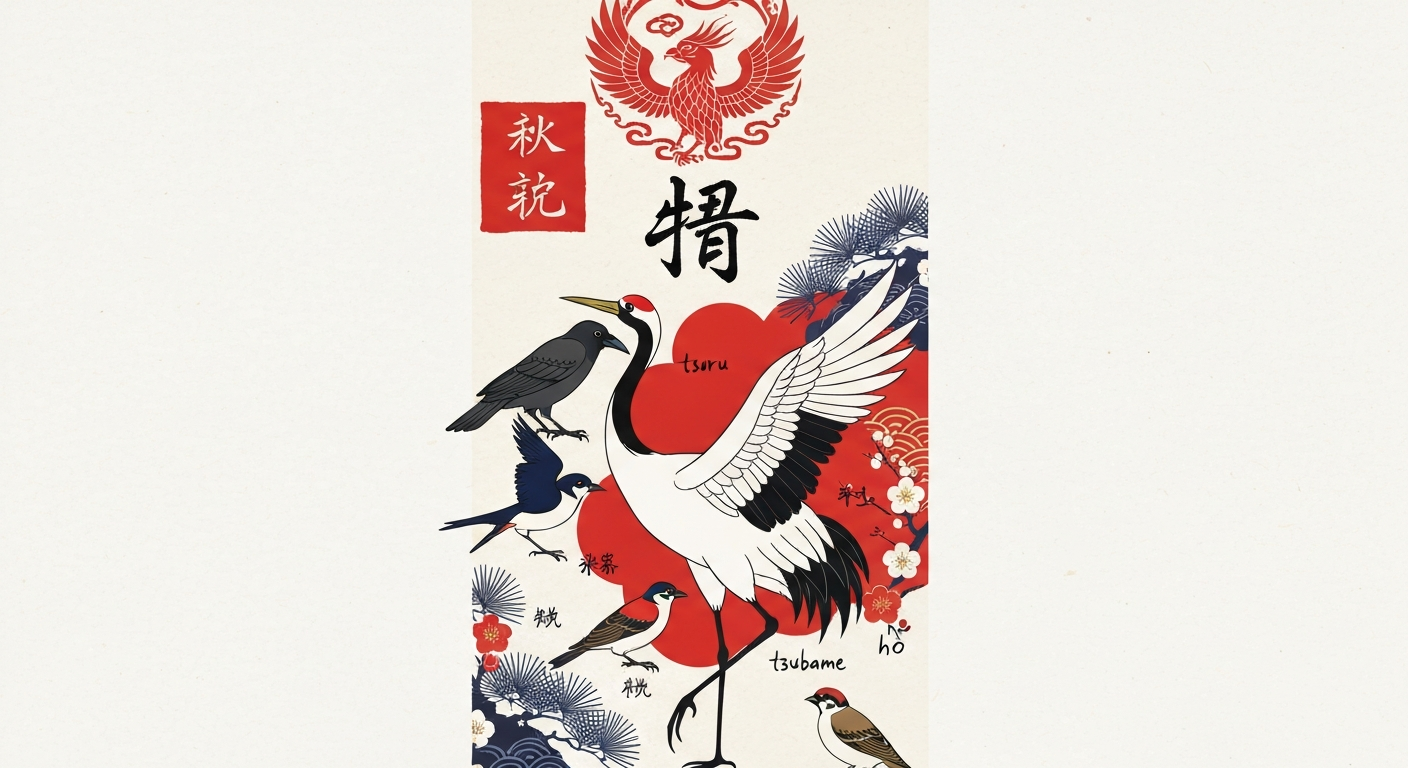
Japanese bird meanings are never generic. The word 鳥 (tori) is just a starting point. The crane (鶴, tsuru) signals longevity and peace. The crow (烏, karasu) is simultaneously a sacred divine messenger and a noisy urban scavenger. The bush warbler (鶯, uguisu) signals spring. The phoenix motif (鳳凰, hōō) signals imperial authority. Get the species right, and the meaning usually follows naturally from either classical literature, Shinto mythology, or everyday folk belief, all of which this article unpacks.
Literal Japanese words for 'bird' and how they work
The single most important word is 鳥 (tori). This is the everyday, general-purpose word for 'bird' and the one you will encounter most often in conversation, signage, and general writing. It uses the kun-reading (the native Japanese reading) of the kanji. When the same kanji appears in formal or scientific compounds, it shifts to its on-reading, ちょう (chō). The most common example is 鳥類 (chōrui), the standard Japanese term for the taxonomic class Aves, which you will see in Ministry of the Environment red list publications and scientific papers.
A few other words and forms come up regularly. 小鳥 (kotori, literally 'small bird') is used affectionately for small songbirds and also as a gentle, poetic term. It carries warmth and intimacy in Japanese, parents use it as a pet name for children, and it appears in song titles and literature. The katakana form トリ (tori) is less common but appears in brand names and stylized contexts. For specific species, Japanese uses either native kun-reading names (like 鶴, tsuru, for crane) or katakana transliterations for species named after Western taxonomy.
It is also worth knowing that 鳥 and 烏 (karasu, crow) are visually almost identical kanji, 烏 simply has one fewer horizontal stroke, representing the crow's dark eye blending into its black body. That visual pun is intentional, and it tells you something about how carefully the Japanese writing system encodes natural observation.
How 'bird' is written and pronounced: kanji, hiragana, katakana, and romaji
| Script | Form | Reading | Usage context |
|---|---|---|---|
| Kanji | 鳥 | tori (kun) / chō (on) | General everyday use; scientific compounds |
| Hiragana | とり | tori | Children's writing; furigana over kanji; phonetic clarity |
| Katakana | トリ | tori | Brand names; stylized/foreign-influenced contexts |
| Romaji | tori / chō | tori / chō | Romanization for learners and international contexts |
| Compound (kanji) | 鳥類 | chōrui | Scientific/taxonomic: class Aves |
| Compound (kanji) | 小鳥 | kotori | Small or pet bird; affectionate/poetic register |
| Compound (kanji) | 野鳥 | yachō | Wild bird (as in 日本野鳥の会, Wild Bird Society of Japan) |
For learners, the practical takeaway is this: use とり (tori) in speech and general writing; expect ちょう (chō) in academic or compound contexts; and pay close attention to the specific kanji when reading classical texts, since different bird kanji (鶴, 鶯, 烏, 燕, etc.) carry very different cultural weight. Major Japanese dictionaries including Kenkyusha's bilingual editions, Daijisen (大辞泉), and the learner-friendly Meikyo (明鏡国語辞典) are the recommended references when you need precise register and usage notes beyond what any translation app will give you. For focused coverage on bird meaning Japanese, see the internal guide on bird meaning Japanese for species-specific symbolism, kanji usage, and cultural context.
Key Japanese birds and their symbolic meanings at a glance
| English name | Japanese name (kanji) | Reading | Core symbolic meaning |
|---|---|---|---|
| Crane | 鶴 | tsuru | Longevity, fidelity, good fortune, peace (senbazuru) |
| Crow / Raven | 烏 / カラス | karasu | Divine messenger (Yatagarasu); also omen of death or misfortune in folk belief; intelligence |
| Japanese bush warbler | 鶯 | uguisu | Herald of spring; poetic beauty; classical elegance |
| Swallow | 燕 | tsubame | Good luck, return home, protection of households |
| Sparrow | 雀 | suzume | Humility, everyday life, folk wisdom; central to 'Tongue-Cut Sparrow' tale |
| Heron / Egret | 鷺 | sagi | Purity, patience; associated with rice paddies and water deities |
| Hawk / Eagle | 鷹 / 鷲 | taka / washi | Strength, ambition, clarity of vision; auspicious in New Year's first dream (hatsuyume) |
| Phoenix motif | 鳳凰 | hōō | Imperial power, divine grace, rebirth; decorative motif in court art |
| Mandarin duck | 鴛鴦 | oshidori | Marital love and fidelity; common wedding gift motif |
| Rooster / Chicken | 鶏 | niwatori | Dawn, vigilance; sacred to Shinto (roosters kept at shrines) |
Historical symbolism: Shinto, Buddhism, court poetry, and classical art
Japan's oldest texts encode birds as divine intermediaries. The Yatagarasu (八咫烏, the three-legged crow) appears in both the Kojiki and Nihon Shoki, Japan's founding chronicles, as a heavenly messenger sent by the sun deity Amaterasu to guide Emperor Jimmu through the mountains of Kumano. The three legs are interpreted as representing the three pillars of heaven, earth, and humanity. Kumano shrines still venerate this bird today, and its image is used in regional iconography throughout the Kii Peninsula. The Yatagarasu is one of the clearest examples of a crow being simultaneously sacred and auspicious in Japanese tradition, which complicates the more familiar Western reading of crows as purely ill-omened.
Buddhism introduced its own bird symbolism when it arrived in Japan via China and Korea from roughly the 6th century CE. The phoenix-like hōō (鳳凰) became a central motif in temple and court art, the Byodoin temple's Phoenix Hall (built 1053 CE) takes its name and architectural form directly from this bird. Unlike the Western phoenix, the hōō does not represent death and rebirth so much as divine presence and imperial virtue. You can trace its appearance through Tokyo National Museum collection records, where hōō motifs appear on lacquerware, imperial palanquins (hōren), and architectural bronzes from the Heian period onward.
In classical court poetry (waka) and later haiku, birds function as seasonal markers called kigo. The uguisu (Japanese bush warbler, 鶯) is the definitive kigo for spring, its first call of the season was recorded by aristocrats in their diaries and celebrated in verse from at least the Manyoshu (8th century). The cuckoo (時鳥, hototogisu) is similarly tied to early summer and carries associations of longing and impermanence. These are not loose metaphors: using a bird's name in a haiku imports an entire seasonal and emotional register that Japanese readers recognize immediately.
The crane's position in Japanese culture is inseparable from its longevity: the traditional belief holds that cranes live for a thousand years. This gave rise to the senbazuru (千羽鶴) tradition of folding one thousand origami cranes as a wish for health or peace. The association became globally known through Sadako Sasaki, a Hiroshima atomic bomb survivor who folded cranes during her illness in 1955, and whose story became the basis of the Children's Peace Monument. It is worth noting that the red-crowned crane (Grus japonensis, 丹頂鶴, tanchōzuru), the species most closely associated with this symbolism, is listed as Vulnerable on the IUCN Red List, making it a conservation priority as well as a cultural icon.
Japanese folklore studies, established largely through the work of Yanagita Kunio (柳田國男) in the early 20th century, documented a rich parallel tradition of regional bird superstitions. In some rural traditions, the owl (梟, fukurō) is an omen of death, while in others its name (ふくろう) is reinterpreted as a lucky pun meaning 'no suffering' (苦労なし, kurōnashi). The sparrow features in the classic folktale 'Shita-kiri Suzume' (Tongue-Cut Sparrow), which teaches generosity and warns against greed. These folk readings often contradict each other regionally, so treating any single bird meaning as universal across Japan is a mistake.
Contemporary cultural symbolism: festivals, brands, pop culture, and everyday life
The crane and the hōō are not just historical artifacts, both remain active in contemporary Japanese visual culture. The hōō appears on the 10,000-yen banknote (the Byodoin image), making it probably the most-seen bird symbol in daily Japanese life. The crane appears on ceremonial occasions: at weddings, on formal kimono, and in gift-wrapping patterns (noshi) that signal celebration. The Wild Bird Society of Japan (日本野鳥の会, WBSJ), founded in 1934 and now the country's principal birding NGO, has done much to shift public perception of birds from symbolic objects to living wildlife deserving active conservation.
Crows occupy a genuinely complex space in contemporary Japan. Two species are common in Japanese cities: the large-billed jungle crow (Corvus macrorhynchos) and the carrion crow (Corvus corone). See The Clever “Karasu”: Wise Old Birds Living Side by Side with Humans, Nippon.com for coverage of these species and their increasing urban synanthropy The Clever “Karasu”: Wise Old Birds Living Side by Side with Humans — Nippon.com. Both have adapted extremely well to urban environments, raiding garbage on collection days and drawing regular complaints from residents in Tokyo, Osaka, and other major cities. At the same time, the Yatagarasu remains a respected sacred symbol, its image used by Kumano shrines and referenced in national cultural contexts. Japanese ornithological research published in journals like the Japanese Journal of Ornithology documents their cognitive sophistication and adaptability, findings that align with the broader corvid cognition research associated with scholars like Emery and Clayton, who demonstrated convergent intelligence between corvids and primates. So when someone in Japan calls a crow clever, they are right on both cultural and scientific grounds.
In pop culture, birds appear frequently in anime, manga, and game design. The swallow (燕, tsubame) is a widely used motif in school emblems, sports teams, and branding, the Tokyo Yakult Swallows baseball team being the most recognizable example. Birds also appear in Japanese idol group imagery, mascot design, and fashion prints, where the crane and sparrow patterns on yukata and furoshiki (wrapping cloth) keep classical symbolism circulating in everyday modern life.
The New Year period (shōgatsu) concentrates a lot of bird symbolism. The hatsuyume, or first dream of the New Year, is considered especially auspicious if it contains Mt. Fuji, a hawk (鷹, taka), or an eggplant, in that order ('ichi-Fuji, ni-taka, san-nasubi'). Hawks in this context represent ambition and a clear upward vision. Roosters, kept at Shinto shrines since ancient times, still crow at dawn at major shrine complexes, connecting the living bird to its ancient role as the herald of light.
Spiritual and dream interpretation: the Japanese framework
Japanese dream interpretation (yume uranai, 夢占い) has its own traditional framework that does not map directly onto Western dream symbolism. A crane appearing in a dream is generally considered very auspicious, an omen of long life, professional success, or a forthcoming celebration. A crow in a dream is more ambivalent: in some folk traditions it signals a warning or approaching hardship, but given the Yatagarasu's role as a divine guide, it can also be interpreted as spiritual direction or a prompt to pay attention to something you have been ignoring. A singing uguisu in a dream typically signals good news or a positive seasonal change in your circumstances.
Shinto practice does not have a formalized dream-interpretation canon in the way some other traditions do, but bird omens (tori no shirabe, loosely) have been noted in shrine contexts and regional folk practice. Birds arriving unexpectedly at a shrine, or behaving unusually near a sacred space, are sometimes read as messages from kami (divine spirits). This is less a codified system and more a living folk intuition, the kind of layered, place-specific knowledge that Yanagita Kunio spent his career documenting.
Common superstitions and omens involving birds in Japan
- A crane sighting (especially the red-crowned tanchōzuru) is almost universally auspicious — good fortune, long life, or a coming celebration.
- A crow calling near a house repeatedly, especially at night, is considered an ill omen in many regional folk traditions, though this conflicts with the Yatagarasu's sacred status.
- The first uguisu call of spring heard from inside your house is considered lucky; hearing it while facing north is considered less favorable in some regions.
- Swallows nesting under the eaves of a house are considered a strong good-luck sign — the household will prosper and be protected from fire and misfortune.
- An owl hoot near the house is interpreted as a death omen in certain Tohoku and rural traditions, though the phonetic pun 'fukurō = no suffering' has softened this in popular culture.
- A hawk circling overhead, particularly around the New Year, is seen as an omen of rising success or ambition fulfilled.
- Killing a swallow is considered bad luck that will bring misfortune to the household — a belief that practically protects nesting birds.
- The hototogisu (cuckoo) heard for the first time in summer while facing away from you is considered unlucky in some classical literary traditions.
Ornithological context: separating fact from folklore
A few common misconceptions are worth addressing directly. The crane's reputation for living a thousand years is, of course, a poetic truth rather than an ornithological one. Red-crowned cranes (Grus japonensis) live roughly 30 to 40 years in the wild and up to about 70 in captivity, impressive, but not immortal. The important ecological fact is that they are genuinely threatened: classified as Vulnerable by the IUCN, with a wild population concentrated in Hokkaido (Japan) and the Korean Peninsula, making their conservation status inseparable from their cultural importance.
Crows in Japanese cities behave in ways that seem to confirm their folkloric reputation for cleverness. Research published in the Japanese Journal of Ornithology documents large-billed crows (Corvus macrorhynchos) using traffic to crack nuts, memorizing garbage collection schedules, and navigating complex urban environments with remarkable adaptability. These are not superstitions, they are documented behaviors. Treating the crow as purely an ill omen misses this scientific dimension, and it is the reason the Wild Bird Society of Japan encourages people to observe urban corvids with curiosity rather than just dread.
The uguisu (Japanese bush warbler, Cettia diphone) is almost never actually seen by the people who hear it, it sings from deep inside dense vegetation. The bird most commonly mistaken for it in urban Japan is the Japanese white-eye (メジロ, mejiro), a small green bird that does visit urban gardens and is far more visible. This is a persistent and documented point of confusion in Japan itself: many people who claim to have 'seen' a uguisu have actually seen a mejiro.
Slang, idioms, and online/chat uses involving birds in Japanese
Japanese has a rich stock of bird-based idioms. 一石二鳥 (isseki nichō, 'one stone, two birds') is the direct equivalent of 'kill two birds with one stone' and is used identically in contemporary speech. 鶴の一声 (tsuru no hitokoe, 'the crane's one cry') describes a single decisive word from an authority figure that settles a debate, the phrase carries both the crane's prestige and a subtle note of hierarchy. 雀の涙 (suzume no namida, 'a sparrow's tear') means a tiny, almost negligible amount, often used self-deprecatingly about a small bonus or gift.
In online and chat contexts, 鳥 (tori) is sometimes used in Japanese internet slang simply as shorthand in usernames or handles, though it does not carry the specific slang meanings that 'bird' has in some English-language online communities (where 'bird' can mean Twitter/X or refer to someone who is easily fooled). Japanese Twitter users sometimes refer to the platform as とりったー (toritaa), a phonetic play on 'Twitter' using tori. If you are navigating bilingual or Japanese-language social media spaces, it helps to know that bird imagery in Japanese profile aesthetics often draws on the crane or sparrow as signals of aesthetic taste rather than any coded slang meaning.
How to interpret a bird sighting in a Japanese cultural context
If you have seen a bird in Japan, or encountered a bird motif on a gift, at a shrine, or in a dream, here is a practical approach to making sense of it. If you saw a bird performing a distinctive flight or gesture and want a focused interpretation, see our brief guide on bird wave to earth meaning for cultural and symbolic explanations. For interpretations of the specific 'wave to earth' bird motif and how it appears in Japanese symbolism, see the article on bird meaning 'wave to earth'.
- Identify the species first. Japanese symbolic meanings are species-specific. A generic 'bird' reading will not get you far. Use a field guide or the Wild Bird Society of Japan's resources to confirm what you actually saw.
- Check the context: was this at a shrine, in a dream, on a ceremonial object, or simply in your garden? Each context has its own interpretive framework. A crow at Kumano Shrine carries different weight than a crow raiding your garbage.
- Look up the classical kigo or folktale association if you are engaging with Japanese literature or seasonal art. The uguisu means spring; the hototogisu means early summer longing; the crane means longevity.
- Cross-reference regional folk belief with the more universal symbolic meaning. Japan is regionally diverse in its superstitions — an owl omen in Tohoku may not carry the same meaning in Kyoto.
- Separate the ornithological behavior from the folklore. A crow memorizing your garbage schedule is not an omen — it is a documented behavior. That fact does not diminish the cultural meaning; it enriches it.
- If a motif appears on a gift or object, consider the occasion. Crane patterns signal celebration and longevity. Mandarin duck patterns (oshidori) signal romantic love. Swallow patterns on household items signal good fortune for the home.
- Trust ambiguity where it exists. Japanese bird meanings have always coexisted with contradictions — the same crow is sacred and troublesome, the same owl lucky and unlucky depending on where you are and who you ask.
A note on Japanese bird meaning versus broader contexts
Japanese bird symbolism forms one distinct strand within a much wider web of cultural bird meanings. If you are researching how 'bird' functions as a word in chat and online slang, that is a different conversation from what we have covered here. Similarly, bird symbolism in the USA shares some species (the crane, the raven) but applies entirely different cultural frameworks to them. See our guide to bird meaning in the USA for a country-by-country comparison. Japanese meaning is also distinct from the kind of collective spiritual identity that some traditions describe through the concept of a bird tribe. If you want to explore the broader spiritual concept, see our separate guide on bird tribe meaning for comparisons and connections. Each of these perspectives is worth exploring on its own terms, Japanese bird culture is coherent and deep enough that it rewards attention without needing to be mapped onto any other tradition.
FAQ
What primary lexical sources should I consult for accurate translations of 'bird' and species names in Japanese?
Use major Japanese dictionaries (明鏡国語辞典 Meikyo, 大辞林 Daijirin, 大辞泉 Daijisen) for nuanced J–J definitions and register notes; bilingual references like Kenkyusha’s New Japanese-English Dictionary for learner-level senses; and Wiktionary (for quick kanji readings) as a supplementary check. Include kanji (鳥), kun‑reading (とり, tori), and on‑reading (ちょう, chō) for compounds like 鳥類.
Which corpus or usage resources help document contemporary usage and collocations for 鳥/tori?
Cite the Balanced Corpus of Contemporary Written Japanese (BCCWJ, NINJAL) to check modern collocations, frequency, and registers. Supplement with newspaper archives (Asahi, NHK transcripts) or the National Diet Library digital collections for contemporary vs. historical usage evidence.
What authoritative ornithological and conservation sources are required for species‑specific, evidence‑based notes?
Use peer‑reviewed journals (Japanese Journal of Ornithology, Ornithological Science), IUCN Red List species accounts, and national sources (Ministry of the Environment red lists). For field ecology and identification details, reference the Wild Bird Society of Japan (日本野鳥の会) and regional bird guides published by museums or academic presses.
Which historical and mythological texts should be referenced for traditional bird symbolism (e.g., Yatagarasu, hōō)?
Consult primary classics (Kojiki, Nihon Shoki) and authoritative folklore compilations (Yanagita Kunio, Tōno Monogatari) for regional beliefs. For phoenix/hōō and art history, use museum catalogues and collection records (Tokyo National Museum) and academic studies on Heian/medieval iconography.
How should I document culturally significant species meanings (crane, crow, uguisu, sparrow, swallow, phoenix)?
Combine cultural sources (literature, haiku/kigo references, government/cultural sites) with scientific accounts: e.g., crane (鶴, tsuru) — government and cultural Ministry articles on senbazuru; crow (烏/カラス, karasu) — Nippon.com cultural pieces plus ornithological studies on Corvus behavior and urban ecology; uguisu (鶯) — haiku/kigo references and species natural history. Always cite both cultural and ecological references to avoid romanticized or inaccurate claims.
Which sources are best for spiritual, dream‑interpretation, and omens within Japanese traditions?
Use classical folk belief collections (Yanagita), shrine and temple pages that describe votive practices, and reputable academic work on Japanese religion and folk religion. For dream symbolism, cite historical dream manuals cautiously and cross‑reference modern folkloristic analyses; avoid presenting single, unquestioned 'meanings'—frame as tradition‑based interpretations with source citations.
Next Article
Bird Tribe Meaning: Symbolism, Science, Slang & Dreams
Bird tribe meaning: clear definitions, cultural vs. scientific insights, dream & emoji interpretations, myths debunked.