
The phrase 'bird tribe' does not have a single fixed meaning. Depending on where you encounter it, it could refer to a formal taxonomic rank used by ornithologists, a poetic collective noun, a spiritual self-identification popular in new-age communities, an Indigenous clan designation, or even a proper name attached to a band, book, or website. None of these uses is wrong, they simply operate in different registers, and knowing which one you are dealing with changes everything about how to interpret it.
Bird Tribe Meaning: Symbolism, Science, Slang & Dreams

Marcus Holloway
25 Jul 2026
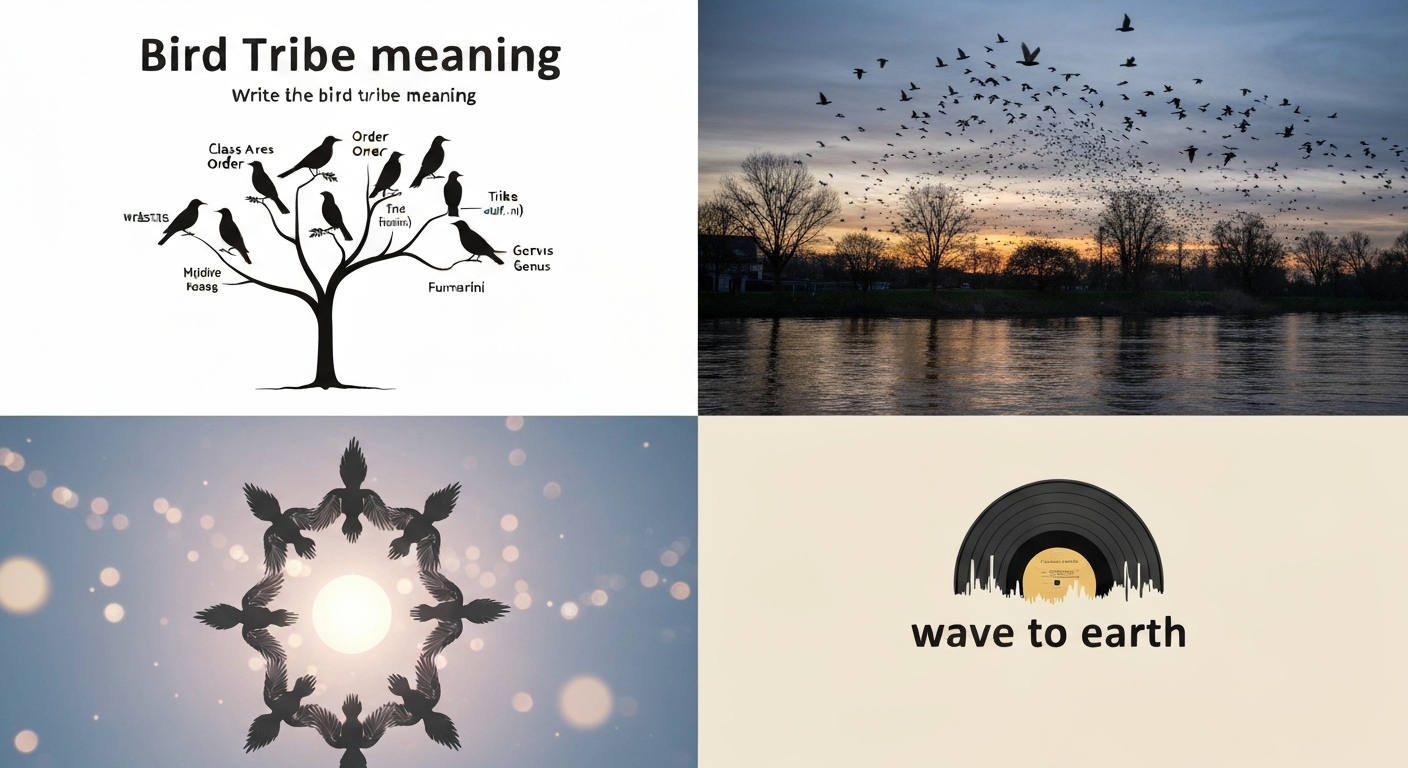
What people actually mean when they say 'bird tribe'
The phrase shows up in enough different contexts that confusion is almost inevitable. Someone searching 'bird tribe meaning' might have just seen the phrase on a spiritual website, read it in a piece of Indigenous Australian literature, come across a music artist called Bird Tribe, or stumbled onto a taxonomy paper. Each of those encounters points to a completely different meaning, and lumping them together is how misinformation about bird symbolism spreads. This article works through each context clearly so you can identify which one applies to your situation.
Three distinct definitions to keep separate
Literal (taxonomic) sense
In zoology, a 'tribe' is a formal taxonomic rank defined by the International Code of Zoological Nomenclature (ICZN). It sits between subfamily and genus, and tribe names always carry the suffix -ini. So a 'bird tribe' in the strict scientific sense means a named clade of related bird genera grouped within a larger family. This is a technical classification tool, not a poetic or cultural label.
Symbolic and cultural sense
Outside science, 'bird tribe' is used as a symbolic or self-identifying label. Contemporary spiritual and new-age communities use 'Bird Tribes' (often capitalized) as an archetypal or quasi-angelic grouping, framing certain people as belonging to a winged or sky-oriented soul lineage. Separately, and with far greater historical depth, some ethnographic and literary translations of Indigenous clan names have been rendered into English as 'bird tribe', particularly in older colonial-era texts and in works like David Unaipon's accounts of Australian Aboriginal traditions. These two symbolic uses are very different in origin, weight, and cultural legitimacy, and should not be confused with each other.
Slang and proper-name sense
Searches of digital corpora show that 'Bird Tribe' as a stable English idiom is uncommon. Most occurrences are proper names: book titles, music artists, or branded spiritual websites. If you see it in a social media bio or group name, it almost certainly functions as a personal identity label rather than a reference to science or established cultural tradition. In online chat, 'bird' itself carries its own distinct slang meanings, the word can mean a person, a gesture, or a term of endearment depending on dialect, but 'bird tribe' as a chat phrase does not have a fixed slang definition. For discussion of how 'bird' is used in online chat and slang, see bird meaning in chat.
The biology: what 'tribe' actually means in ornithology
The rank 'tribe' is recognized in both zoological nomenclature (ICZN) and botanical nomenclature (ICN/IAPT), where it sits between family and genus level. In ornithology specifically, major classification resources like the IOC World Bird List and the Handbook of the Birds of the World (HBW) use tribe-level subdivisions when phylogenetic research supports a named clade within a larger family. A well-cited example is Furnariini, a tribe within the family Furnariidae (the ovenbirds), where molecular studies justified grouping certain genera together below subfamily level.
So when a taxonomy paper refers to a 'bird tribe,' it is making a precise statement about evolutionary relationships. The suffix -ini is the giveaway: Furnariini, Turdini, Fringillini. These are not casual groupings, they reflect phylogenetic analysis and are subject to peer review and periodic revision as new genetic data emerges. Knowing this matters because some spiritual writers borrow the word 'tribe' precisely because it sounds both scientific and ancestral, which can blur the line between evidence-based classification and metaphor.
Collective nouns for birds: where does 'tribe' fit?
English has an unusually rich tradition of specialized collective nouns for animals, tracing back at least to The Boke of Saint Albans (1486), which catalogued 'terms of venery', group names that were part hunting terminology, part social performance among the English gentry. James Lipton's An Exaltation of Larks later popularized many of these for modern readers. The tradition is responsible for phrases like a murder of crows, a parliament of owls, and a murmuration of starlings. Merriam-Webster confirms that while 'flock' is the standard general collective noun for birds, these specialized terms are established idioms with real folkloric and historical roots.
'Tribe' does not appear in these historical compilations as a standard collective noun for any bird species. It is not equivalent to flock, colony, gaggle, murmuration, or parliament in the traditional terms-of-venery system. Using 'a tribe of birds' in a sentence is not wrong in casual speech, but it has no specific ornithological or historical collective-noun status. The table below shows where these terms do and do not overlap.
| Term | Context | Bird type (if specific) | Historical/official? |
|---|---|---|---|
| Flock | General collective noun | Most species | Yes — standard English |
| Murmuration | Collective noun | Starlings | Yes — terms of venery tradition |
| Gaggle | Collective noun | Geese (on ground) | Yes — terms of venery tradition |
| Colony | Collective noun | Seabirds, penguins, herons | Yes — ornithological usage |
| Parliament | Collective noun (poetic) | Owls | Yes — terms of venery tradition |
| Murder | Collective noun (poetic) | Crows | Yes — terms of venery tradition |
| Tribe (taxonomic) | Formal rank (-ini suffix) | Specific bird clades | Yes — ICZN nomenclature |
| Tribe (collective noun) | Casual/informal grouping | None specific | No — not in standard tradition |
What bird behavior actually tells us: flocking, social structure, and migration
One reason the 'tribe' metaphor feels intuitively right for birds is that many species are genuinely deeply social. Flocking is not simply birds clustering together for warmth, it involves coordinated movement, predator vigilance, and information sharing. Starling murmurations, for instance, follow simple rules of alignment and separation at the individual level that produce breathtakingly complex group patterns, a phenomenon studied extensively in computational biology.
Social structure in birds ranges from loose temporary aggregations at food sources to tightly bonded cooperative breeding units. Species like Florida scrub-jays and superb fairywrens engage in cooperative breeding, where non-breeding 'helpers' (usually offspring from previous seasons) assist a dominant pair in raising young. This helper system is the closest behavioral analog to what humans might call a 'tribe', a kin-based social unit with defined roles and shared investment in group survival.
Migration further reinforces the social dimension. Many species migrate in flocks that provide navigational advantage and predator protection. Geese fly in V-formations to exploit aerodynamic uplift from the bird ahead, a behavior confirmed by GPS-tracking studies. None of this is mystical, it is evolution at work, but it is also genuinely remarkable, and it is easy to see why human cultures worldwide have mapped social and spiritual meaning onto these visible expressions of coordinated bird life.
Cultural symbolism: Japan and the USA compared
Bird symbolism in Japan and the United States shares some structural similarities, both cultures have nationally significant bird symbols, but the underlying frameworks are quite different in origin, depth, and religious context. See bird meaning USA for a focused overview of avian symbolism and legal-cultural issues in the United States.
| Dimension | Japan | USA |
|---|---|---|
| Primary national/cultural bird | Crane (tsuru/鶴) | Bald eagle |
| Core symbolic meaning | Longevity, fidelity, good fortune | Freedom, national sovereignty, strength |
| Mythological bird figure | Yatagarasu (three-legged crow, Shinto messenger) | Thunderbird (various Indigenous nations) |
| Religious/ceremonial role | Crane in art/poetry; Yatagarasu in shrine iconography | Eagle feathers in Indigenous ceremony; legally protected |
| Legal dimension | Cultural heritage protection via cultural property law | Bald and Golden Eagle Protection Act; USFWS tribal permits |
| Folk/spiritual tradition | Dense — crane origami, crane legends, crow as divine guide | Varied by region and Indigenous nation; bald eagle as secular civic symbol |
In Japan, the crane's symbolic weight runs through centuries of art, poetry, and ceremony. The legend that folding 1,000 origami cranes (senbazuru) grants a wish is deeply embedded in popular culture. For more on bird meaning in Japanese culture, see Japanese bird meanings. The three-legged crow Yatagarasu, drawn from Shinto tradition and referenced in the Kojiki and Nihon Shoki chronicles, is a divine guide associated with the sun and imperial navigation, a bird 'tribe' in a mythological sense, with a specific sacred identity rather than a general grouping. For further reading on bird Japanese meaning, see resources on Japanese bird symbolism and the cultural role of the crane.
In the United States, the bald eagle was designated as a national symbol in the 1780s and remains the most recognizable avian emblem in the country. But the eagle's meaning in Indigenous contexts is entirely distinct from its civic one. For many Native American nations, eagle feathers carry specific ceremonial significance, and federal law, the Bald and Golden Eagle Protection Act, actually creates legal infrastructure around this, including a National Eagle Repository and a tribal permitting system managed by the U. See Native American Tribal Eagle Aviary, Frequently Asked Questions (U.S. Fish & Wildlife Service) for details on the National Eagle Repository and tribal aviary permits under the Bald and Golden Eagle Protection Act Native American Tribal Eagle Aviary — Frequently Asked Questions (U.S. Fish & Wildlife Service). S. Fish and Wildlife Service. This is a case where the legal system has encoded cultural bird meaning into statute, which is unusual globally.
Spiritual and dream meanings of birds and bird groups
Dreams involving birds are among the most commonly reported and interpreted in cross-cultural dream literature. Rather than prescribing fixed meanings, it is more useful to note the recurring motifs and the interpretive framework most consistently applied across traditions. The general principle in most symbolic systems is that birds, being aerial creatures, tend to represent thoughts, messages, freedom, or spiritual aspiration. A group of birds, or a 'tribe,' amplifies this into themes of community, shared purpose, or collective consciousness.
The 'Bird Tribes' label in contemporary spiritual communities functions similarly: it frames a group of people as sharing an elevated, message-bearing, or spiritually mobile identity. Whether you find that compelling or not, it is worth understanding that this usage is a modern symbolic construction, not an ancient tradition, and it draws loosely on various Indigenous and mythological bird motifs without necessarily being grounded in any specific cultural heritage.
In dream interpretation, context matters more than species. A flock of birds moving away from you carries different emotional weight than birds flying toward you or circling overhead. A single bird entering a house has been treated as an omen in numerous European and Asian folk traditions, though interpretations vary widely by region. Proceed cautiously with any source that gives you a single definitive meaning for a dream bird, the honest answer is almost always 'it depends on the details.'
Common bird dream motifs and what they often (cautiously) suggest
- Flock flying in formation: often associated with a sense of community, social belonging, or collective movement toward a goal
- Bird entering a house: widely interpreted as an incoming message or change, though cultural sources differ on whether this is positive or negative
- Bird unable to fly: frequently linked in dream literature to feelings of restriction, suppressed ambition, or blocked communication
- Singing bird: commonly associated with emotional expression, good news, or the need to listen more carefully to something in waking life
- Bird of prey circling: often interpreted as watchfulness, predatory attention, or a situation that requires strategic thinking
- Dead bird: treated cautiously — some traditions see it as the end of a phase, others as a warning; context within the dream is critical
'Bird wave to earth': what that phrase actually refers to
If you searched 'bird wave to earth meaning,' you are almost certainly looking for information about the South Korean indie band Wave to Earth and their track 'bird,' released on January 2, 2020, as part of their EP wave 0.01. The song is available on Spotify and other streaming platforms. See bird, Wave to Earth (Spotify track page) for the official track listing and release details confirming 'bird' is by Wave to Earth from EP wave 0. For official release and track details, see the Wave to Earth, 'bird' (EP wave 0) listing on major streaming platforms Wave to Earth — 'bird' (EP wave 0). 01 (released Jan 2, 2020) bird — Wave to Earth (Spotify track page). 'Wave to Earth' is the artist name; 'bird' is the track title. The phrase 'bird wave to earth' is not a spiritual saying, a meme, or an ornithological term, it is a search string that combines the song title and artist name. The song itself has a dreamy, introspective quality that has attracted listeners interested in bird-themed or nature-themed music, which may be why it surfaces in searches alongside spiritual bird symbolism.
Everyday encounters with birds: what to notice and what to actually do
People sometimes ask what it means when a bird lands near them, follows them, or behaves unusually. There is a practical layer to this question that often gets lost in symbolic discussions. Most unusual bird behavior has a straightforward explanation: a bird that approaches closely may be habituated to humans through prior feeding, or it may be a fledgling that has recently left the nest and not yet learned fear of humans. A bird that taps on windows is usually responding to its own reflection, perceiving it as a rival. These are behavioral realities worth knowing before reaching for a symbolic interpretation.
That said, noticing birds with attention is genuinely worthwhile regardless of whether you assign symbolic meaning to them. Behavioral ecologists would agree: birds are indicator species. Their presence, absence, or unusual behavior can signal real information about the local environment, weather changes, predator activity, seasonal shifts. Traditional ecological knowledge in many cultures has long encoded this kind of observational wisdom in symbolic or narrative form, which is part of why bird omens persist even in secular contexts.
Practical tips for bird encounters (for people and pet owners)
- If a bird lands very close to you, stay still rather than reaching toward it — sudden movement startles it and prevents you from observing its full behavior
- A bird repeatedly circling or calling in one location often indicates a nest nearby; give the area space rather than investigating closely
- If you have outdoor cats or dogs, persistent dive-bombing from a bird (especially mockingbirds, red-winged blackbirds, or magpies) means a nest is within about 50 feet — redirecting your pet's route for a few weeks is the easiest resolution
- A grounded bird that is not a fledgling and cannot fly may be injured; contact a local wildlife rehabilitator rather than handling it yourself
- Window strikes are one of the leading causes of bird mortality in North America — break up window reflections with tape, window clings, or external screens if birds are repeatedly colliding with glass in your home
A quick checklist for interpreting bird dreams
- Note the species if you recognized it — species-specific symbolism varies enormously across cultures and traditions
- Note whether the bird was alone or in a group — solitary birds and flocks carry different metaphorical weight in most symbolic systems
- Note the bird's direction: flying toward you, away from you, or circling all carry different traditional associations
- Note the emotional tone of the dream — your felt sense of safety, wonder, fear, or joy is usually more diagnostically useful than the bird's species alone
- Cross-reference any symbolic interpretation with your own cultural background — a crow means something very different in Japanese Shinto tradition than it does in Western folklore
- Treat any single interpretation cautiously; recurring dreams with consistent bird imagery are more meaningful than a single isolated occurrence
Common misconceptions worth correcting
One persistent misconception is that 'bird tribe' is an ancient, cross-cultural spiritual concept with deep roots in world mythology. It is not. The phrase as used in spiritual and new-age communities is a modern construction, developed largely in the late 20th and early 21st centuries, that borrows aesthetically from Indigenous and mythological traditions without being traceable to a specific one. This does not make it meaningless to the people who use it as a self-label, but it should not be presented as ancient wisdom.
A second misconception is that 'tribe' as a taxonomic term is interchangeable with 'family' or 'species' in casual discussion. It is not, it is a precise rank with a specific position in the hierarchy. Saying a crow and a raven are in the 'same tribe' is actually taxonomically accurate (both are in tribe Corvini), but saying birds in general form a 'tribe' misuses the term entirely.
A third misconception applies to Indigenous bird symbolism specifically: the tendency to generalize 'Native American bird meaning' as a single unified system. Indigenous nations across North America have distinct, often quite different, relationships with specific bird species. The eagle's ceremonial role among the Lakota is not identical to its role among the Navajo or the Tlingit. Federal law in the United States actually acknowledges this specificity in the permitting framework for eagle feathers, which recognizes tribal religious practices as distinct rather than interchangeable. Anyone writing or reading about bird symbolism in Indigenous contexts should be specific about which nation and tradition is being referenced.
FAQ
What does 'tribe' mean in biological/taxonomic usage when applied to birds?
In zoology a 'tribe' is a formal family‑group rank between subfamily and genus (name endings often -ini). Ornithological checklists and handbooks use tribes where phylogenetic studies justify a named clade (e.g., Furnariini in ovenbirds). This is a technical classification term governed by codes like the ICZN and used in scientific literature, not a loose synonym for 'group' or 'flock.'
How is 'bird tribe' different from common collective nouns like 'flock' or 'murmuration'?
'Bird tribe' (taxonomically) names a lineage; collective nouns describe groups seen together. 'Flock' is the general English collective noun; specialized historic terms ('murder' of crows, 'murmuration' of starlings) are folkloric idioms dating to medieval sources (terms of venery) and modern compilations. Those collective nouns are descriptive/poetic, not taxonomic ranks.
Is 'bird tribe' a common everyday phrase in English?
No — corpus and book searches show the exact phrase is uncommon in standard English. Most occurrences are proper names (book or band titles), spiritual/self‑help group names, or translations of specific cultural clan names rather than a stable idiom in general speech.
What does 'bird tribe' mean in spiritual or new‑age contexts?
In spiritual/new‑age uses, 'Bird Tribe' is often a self‑designation or archetypal grouping (for personality types, spirit guides, or totemic systems). These are cultural or religious labels created by communities or authors and are not scientific classifications; their meanings vary by source and should be traced to the originating tradition or author.
How have 'bird tribe' labels appeared in ethnography or translations of Indigenous terms?
Colonial and older ethnographic writings sometimes render clan or totem names as 'bird tribe' in English. Such uses are context‑specific and must be sourced to particular communities and primary texts. Care is needed: translation choices may obscure local meanings and should not be taken as universal.
What does the phrase 'bird wave to earth' refer to?
The string 'bird wave to earth' most closely matches a song title/track ('bird' by the South Korean band Wave to Earth). Elsewhere it can be encountered as a poetic or meme phrase; interpretation depends on context (song lyrics, social posts, ritual language). If encountered as an online meme or ritual, treat it as a cultural artefact rather than an established symbolic phrase.
Next Article
Bird Meaning Japanese Guide: Symbolism, Dreams, Omens
Understand bird symbolism in Japan, including which birds mean what, dream omens, sightings myths, and real-world scienc