
Bird voice meaning refers to the information, intent, or significance carried by the sounds birds make, and it operates on several layers at once. At the most literal level, ornithologists have spent fifty-plus years documenting how calls and songs encode territory claims, mate attraction, predator warnings, and flock coordination. At a more interpretive level, naturalists and bird-language instructors teach people to read those sounds as a live map of activity in the landscape. And at a cultural level, bird voices have carried spiritual weight, superstition, and idiomatic meaning in human language for as long as people have listened to them. All of these readings are real, but they are not equally testable, and knowing which layer you are working with changes how much you can trust your interpretation.
Bird Voice Meaning: Calls, Culture, Dreams, A Practical Guide

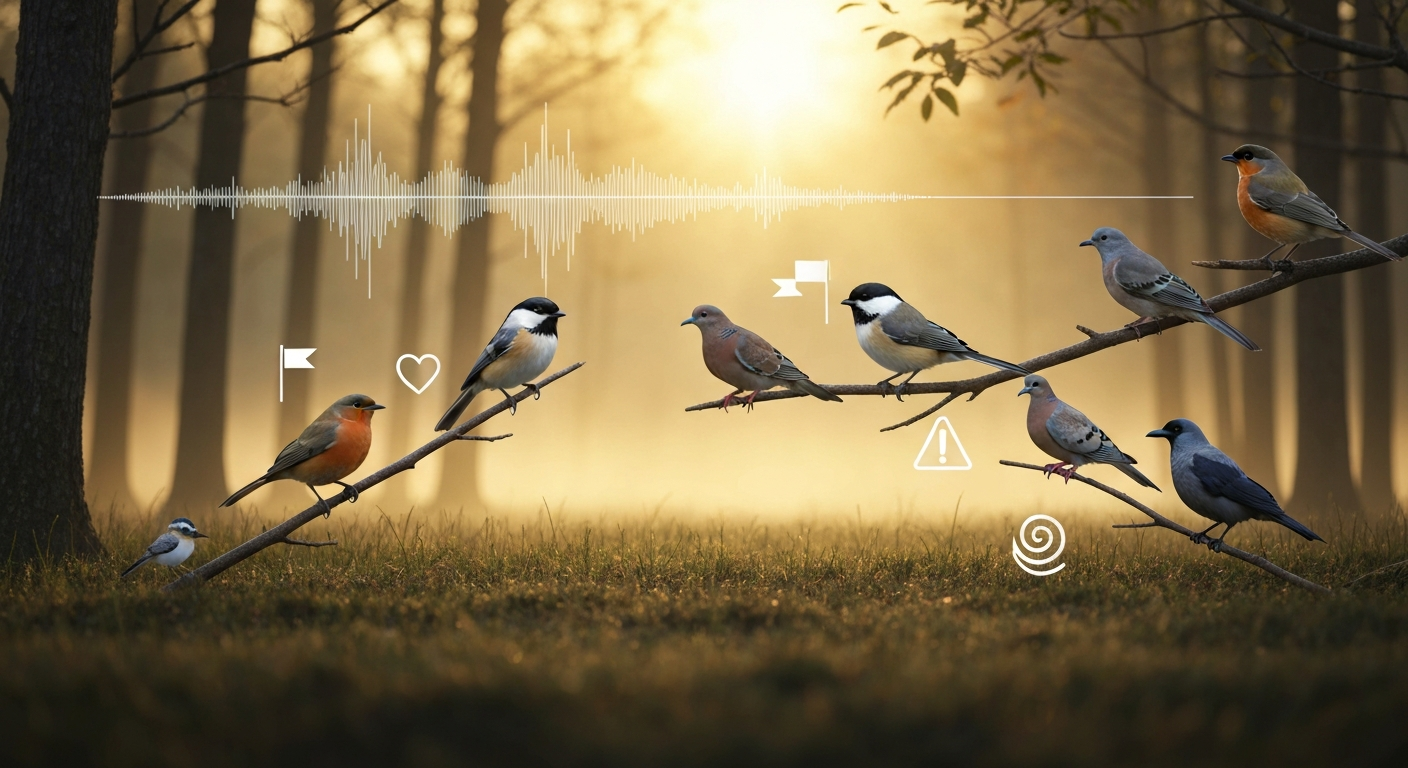
Bird vocalizations 101: calls, songs, alarms, mimicry, and contact notes
The Cornell Lab's Handbook of Bird Biology draws a foundational distinction between songs and calls that every listener should internalize. Songs are typically longer, more complex, and produced primarily by males during the breeding season for territory defense and mate attraction. Calls are shorter, often simpler, and used year-round by birds of any age or sex for immediate communication: staying in contact with a flock, begging for food, or sounding an alarm. That split is useful but not absolute. Some species blur the boundary, and some calls are genuinely complex enough to carry layered information.
Within the call category, ornithologists recognize several functional types worth knowing about. Alarm calls signal danger and often spread across species boundaries because the threat is shared. Contact calls keep flock members located in dense vegetation. Begging calls, produced by nestlings and fledglings, solicit food from parents. Mobbing calls recruit other birds to harass a predator, and they are deliberately loud and directionally easy to locate so that others can home in fast. Flight calls, often very short chips or whistles, are given during migration and are one of the trickiest identification challenges in birding.
Mimicry deserves its own mention because it complicates identification and adds a layer of intrigue to the question of what a bird voice means. Northern mockingbirds, European starlings, marsh warblers, and lyrebirds are among the species that copy other birds (and sometimes other sounds entirely). A mockingbird singing a red-tailed hawk screech in your backyard is not warning you of a hawk; it is likely a male advertising vocal fitness. Context, as always, is the key to meaning.
How bird sounds actually encode meaning
The idea that bird sounds carry specific, decodable meaning is not folklore. It is well-supported science, though the details are more nuanced than popular accounts suggest. Templeton, Greene, and Davis published a landmark 2005 study in Science showing that Black-capped Chickadee alarm calls vary systematically with predator size: the number of 'dee' notes added to the 'chick-a-dee' call increases as the predator gets smaller and more maneuverable (and therefore more dangerous to a small bird). Chickadees hearing those calls change their behavior accordingly. This is not a general alarm sound; it is a graded, information-rich signal.
Research on the full 'chick-a-dee' call system, published in Nature Communications in 2016, found evidence of compositional syntax: the A, B, C, and D note types are arranged according to rules, and note composition and order carry different contextual meaning depending on whether the bird is signaling food, flight, mobbing, or cohesion. Experimental evidence for compositional syntax in bird calls, Nature Communications (2016) Experimental evidence for compositional syntax in bird calls — Nature Communications (2016). That kind of rule-governed structure starts to look a little like language, though researchers are careful not to overclaim. Functional complexity, yes. Grammar in the human sense, not proven.
Alarm and mobbing calls frequently cross species lines. Many passerines respond to other species' alarm calls because the underlying threat is relevant to everyone. This interspecific eavesdropping means that when you learn to recognize a robin's alarm 'tik-tik-tik' or a jay's screaming mobbing call, you are picking up on signals that the entire local bird community also reads and responds to. That is the scientific backbone behind bird-language curricula that teach humans to use bird alarm behavior as a cue to predator presence.
The four core functions of bird vocalizations
- Territory: advertisement songs and call-based boundary defense, typically most intense at dawn and during the breeding season
- Mate attraction: complex songs and duets that signal health, age, and learning ability to potential partners
- Alarm: short, high-pitched (hard to locate) or loud, broadband (easy to recruit) calls depending on threat type and function
- Contact and cohesion: soft calls that keep paired birds or flock members in auditory contact, especially in dense cover or during migration
What trained listeners and bird whisperers can and cannot infer
Naturalist instructors like Jon Young, whose book 'What the Robin Knows' popularized bird-language listening in North America, teach a pattern-based approach: sit quietly in one spot over many sessions, learn the baseline behavior of the birds around you, and notice when and how their vocalizations and movements change. The core insight is solid and backed by science: bird alarm and mobbing behavior does reliably indicate predator presence, and paying attention to those cues gives you real information about your environment. Experienced birdwatchers do this intuitively, and trackers and hunters have done it for centuries.
The honest limit, though, is this: I have not found any peer-reviewed, controlled evaluation that specifically tests popular bird-language training curricula for predictive reliability across diverse settings. The individual scientific components (alarm-call semantics, context-specific call structure) are validated. The packaged interpretive system as a whole has not been independently stress-tested under controlled conditions. That does not make it useless; it means you should treat it as a useful heuristic, not a guaranteed decoding system. A bird whisperer who has spent thousands of hours in the same patch of woods will read bird voices accurately far more often than a weekend visitor, because local knowledge and pattern recognition matter enormously. The skill is real; the claims around it sometimes outrun the evidence.
Human expert listeners also outperform naive listeners in detecting low signal-to-noise events that automated detectors miss. But accuracy depends heavily on experience with the local bird assemblage, recording quality, and call variability. Even expert birders make misidentifications, especially with flight calls, mimics, and species with overlapping vocalizations. Humility about the limits of interpretation applies to everyone, including me.
Cultural, spiritual, and superstitious meanings of bird voices
Across cultures and centuries, specific bird voices have been assigned meanings that go well beyond ornithology. An owl calling at night is an omen of death in many Indigenous North American, West African, and European traditions. A cuckoo's first call of spring has been used across Europe and Asia to forecast how many years remain before a listener marries or dies, depending on who you ask. The dove's cooing has been read as a symbol of peace, mourning, and divine presence in Abrahamic traditions. None of this is ornithological fact, but it is not meaningless either. These associations reflect deep human attentiveness to bird behavior, the emotional register of particular sounds, and the cultural frameworks through which people have interpreted the natural world.
In dream interpretation, hearing a bird voice often carries symbolic weight tied to the species involved: a singing bird can represent freedom, good news, or spiritual communication; a screeching bird may signal warning or anxiety. These readings come from folk tradition and psychological symbolism, not from any behavioral science. The value of engaging with them is personal and cultural, not predictive. If the sound of a mourning dove calling at dawn in your grandmother's garden means something specific to your family's heritage, that meaning is real in the way that human meaning is always real, even when it is not empirically testable.
Common idioms and slang involving bird voice
The phrase 'a little bird told me' is probably the most universally recognized idiomatic use of bird voice in English. It implies receiving a secret or unverifiable piece of information and neatly sidesteps revealing the source. 'Singing like a canary' means confessing or informing, often under pressure. 'Crowing about something' means boasting. These idioms draw on real observations of bird behavior (canaries do sing readily; roosters do crow in a way that demands attention) and have become so embedded in everyday speech that most people use them without thinking about the bird at all. Related digital uses, sometimes explored as 'bird text meaning' in online conversations, play on these same cultural associations in emoji and slang contexts.
Step-by-step: how to interpret a bird's voice in the field
- Stop and listen before you look. Give yourself 30 to 60 seconds of stillness to let your ears orient to the soundscape before you start moving or reaching for your phone.
- Observe behavior alongside the sound. Is the bird exposed or hidden? Moving toward or away from something? Are other birds responding? A call heard while a bird forages quietly means something different from the same call given while the bird flicks its wings and faces a specific direction.
- Record it. A 20-to-30-second recording on your phone at arm's length from the sound source, away from wind and traffic if possible, gives you something to review and share. Even an imperfect recording is better than memory alone.
- Identify the species. Use Merlin Bird ID's Sound ID feature for real-time identification or upload your recording. Cross-check against the Macaulay Library or xeno-canto to confirm you have the right species and call type. Do not skip this step: the species identity determines what the sound functionally means.
- Establish context. Note the time of day (dawn chorus vs. midday vs. dusk), season, habitat, and what was happening around you. An alarm call from a robin that then flies to a branch and stares downward is almost certainly directed at something on the ground near you.
- Cross-reference the call type. Once you know species and context, check a species account (Birds of the World, Cornell's All About Birds, or a regional field guide) to confirm what that call type typically signals for that bird.
- Decide which interpretive layer applies. Are you after the behavioral, ecological meaning? Consult ornithological sources. Are you engaging with cultural or spiritual meaning? Consult the traditions relevant to your background or curiosity. Keep the layers distinct so you do not mistake one for the other.
- Log it. Adding observations to eBird contributes to citizen-science data and builds your own reference base for future sessions.
Recording and identifying bird voices: apps, spectrograms, and clean recording tips
For most people, Merlin Bird ID is the right starting point. Cornell Lab's Sound ID runs in real time, identifies multiple species simultaneously, and pulls from a large corpus of Macaulay Library and xeno-canto recordings. It is free, accurate enough for common species in well-covered regions, and genuinely useful in the field. For uploading and reviewing your own recordings, xeno-canto and the Macaulay Library are the reference archives to know: together they cover most of the world's species with metadata about call type, behavior, and recording conditions. Macaulay Library (Cornell Lab of Ornithology), global archival audio library is a primary, curated archive with extensive metadata widely used by researchers and identification tools Macaulay Library (Cornell Lab of Ornithology) — global archival audio library.
Spectrograms are visual representations of sound that plot frequency against time, with amplitude shown by color or brightness. Reading a spectrogram turns a bird call from a fleeting sound into a stable pattern you can study. For research-grade work, Raven Pro from Cornell's Bioacoustics Research Program is the standard: it handles waveform visualization, annotation, and measurement, and its documentation is detailed and authoritative. Praat, which comes from phonetics research, is another open academic tool that handles spectrogram analysis with precise acoustic feature extraction. For casual use, Audacity's Spectrogram view is free, open-source, and good enough for basic pattern inspection once you understand the FFT window-size tradeoffs (wider windows give better frequency resolution; narrower windows give better time resolution).
Practical tips for better field recordings
- Record in the early morning (the first two hours after sunrise) when bird activity is highest and background noise is lowest
- Point the phone or recorder toward the sound source and minimize distance; even 5 meters can degrade quality significantly in wind
- Cup your hands behind a parabolic or directional microphone to reduce off-axis noise if you use one
- Avoid recording under or near roads, air conditioning units, or rustling foliage in strong wind
- Note species, behavior, location, date, and time immediately after recording; memory of context fades fast
- BirdNET (the deep-learning classifier from the Cornell/Chemnitz team) can analyze recordings automatically and works well for common species but is less reliable in noisy recordings, with overlapping calls, or in regions underrepresented in its training data; always verify outputs against a sound archive
When to follow the science and when symbolism is what you actually need
These are not competing frameworks; they answer different questions. Use ornithological interpretation when you want to know what is actually happening in the environment around you: whether there is a predator nearby, whether a bird is defending territory, whether the dawn chorus you are hearing represents a healthy or depleted local community. The science is good enough to give you reliable answers in those cases, especially when you combine behavioral observation with species ID and sound archive cross-referencing.
Use cultural, spiritual, or symbolic interpretation when the question is about human meaning: what a sound stirs in you emotionally, what it has meant to your ancestors or community, what it might represent in a dream or a significant life moment. There is nothing intellectually dishonest about engaging with the symbolism of an owl's call at midnight if you do it knowing that is what you are doing. The problem only arises when the two layers get confused, when a person interprets a crow calling at a funeral as literal supernatural communication, and then makes decisions based on that interpretation as if it were factual data.
A reasonable decision guide: ask yourself what kind of answer would actually help you. If the answer is practical and environmental, go scientific. If the answer is personal and meaningful, go cultural. If it is both, hold both. You do not have to choose one frame to the exclusion of the other; you just have to keep track of which one you are using.
Common species and what their voices typically mean
| Species | Typical vocal type | Behavioral/ecological meaning | Cultural/symbolic meaning |
|---|---|---|---|
| American Robin | Song (fluted phrases); alarm 'tik-tik-tik' | Song: territory and mate attraction, especially at dawn and dusk. Alarm call: ground predator nearby (cat, snake, human) | Harbinger of spring in North American folklore; song associated with renewal and optimism |
| House Sparrow | Chirps and chattering calls | Contact and flock cohesion; aggressive chirping near nest site signals territorial defense | Associated with commonality and community; 'not a sparrow falls' in Abrahamic symbolism marks divine attention to even the smallest life |
| American Crow | Caw calls; complex rattles and coos | Loud repeated cawing often indicates mobbing of a predator (owl, hawk, or human); softer calls are contact within the group | Widely associated with death, transformation, and intelligence across European, Native American, and East Asian traditions |
| Mourning Dove | Soft, descending coo | Contact and mate solicitation; the coo is typically heard near the nest or between paired birds | Peace, mourning, and spiritual communication; the dove's voice is invoked in multiple religious traditions as a sign of divine presence |
| Great Horned Owl | Deep hoo-hoo hooting | Territory advertisement, especially in winter when great horneds begin breeding; pairs duet with different pitch registers | Omen of death or change in many Indigenous, West African, and European traditions; also associated with wisdom and foresight |
| House Wren | Loud, rapid, bubbling song | Song: male territory defense; wrens have outsized vocal output for their body size and often sing persistently in response to rivals | Associated with busyness, resourcefulness, and good luck in some European folk traditions |
| Black-capped Chickadee | 'Chick-a-dee-dee-dee' calls with variable 'dee' notes | Number of 'dee' notes correlates with predator threat level; more 'dees' = smaller, more dangerous predator. Also used for food discovery and flock cohesion | Often associated with cheerfulness and adaptability; the call is one of the most recognizable sounds in North American backyards |
Myth-busting and a note on ethics
A few things worth saying directly. First, birds are not communicating with you personally. When a crow stares at you and calls, it is reacting to a large animal in its territory, not delivering a message about your life. The tendency to personalize bird behavior is a natural human cognitive habit, not evidence of interspecies communication. Second, mimicry by mockingbirds or starlings does not mean those birds are 'speaking' the sounds they copy in any meaningful sense; they are using them as part of their own vocal display, typically for mate attraction. Third, the popular claim that ancient peoples had a universal 'bird language' they could decode fluently is not historically documented in any way that holds up to scrutiny; what they had was deep, place-based observational knowledge of local species, which is genuinely valuable and something modern bird-language curricula are trying to revive.
On the ethics side: if you are actively working to attract birds by playing back their calls (to lure a bird closer for observation or photography), be aware that playback of territorial songs during breeding season can disrupt nesting behavior and stress birds unnecessarily. The birding community broadly recommends limiting or avoiding song playback during breeding season, especially for sensitive or rare species. Listening, by contrast, costs nothing and takes nothing.
Going deeper: where bird voice meaning connects to related ideas
If the behavioral and ecological side of this topic interests you, the study of bird language as a whole discipline and the figure of the bird whisperer as someone who reads and interprets bird behavior are both worth exploring in their own right. For a concise explanation of bird whisperer meaning and how the term is used, see the discussion of bird whisperer meaning. Bird language basics cover the foundational framework of how to read posture, movement, and sound together as a system, rather than treating vocalizations in isolation. And if you came here from the cultural angle, the broader territory of bird talk meaning and bird text meaning picks up the idiomatic, slang, and digital-communication uses of bird-voice concepts that show up in everyday language. Each of these threads connects back to the same core question: what does it mean when a bird speaks, and who is the intended audience? For a concise definition and practical overview, see our guide to bird language meaning.
FAQ
What is meant by “bird voice” or “bird voice meaning” in different contexts?
“Bird voice” can mean several things depending on context: (1) literal avian vocalizations—calls and songs produced by birds with specific functions (territory, mating, alarm, contact); (2) interpretive systems—'bird language' or 'bird whisperer' methods where people read patterns of sound and behaviour to infer events; (3) cultural/spiritual symbolism—folk, religious, and dream interpretations that assign meaning to hearing particular birds or sounds; and (4) idiomatic/colloquial uses (e.g., “a little bird told me”) where the phrase is metaphorical rather than literal.
How do ornithologists distinguish calls from songs and what meanings do each usually carry?
Field ornithology defines songs vs. calls by function and structure: songs are often longer, complex, and used mainly for mate attraction and territory defence (dawn chorus, stereotyped motifs); calls are shorter, simpler, and serve many functions—alarm signalling, contact, begging, flock cohesion, flight calls. Authoritative sources (Cornell Lab’s Handbook of Bird Biology) provide functional categories and spectrogram examples. Meaning is context-dependent: alarm calls often trigger vigilance or mobbing; contact calls maintain group cohesion; songs advertise territory and individual quality.
Can birds encode specific information in their vocalizations? Are there examples?
Yes—research shows birds can encode graded and specific information. Examples: Black‑capped Chickadee alarm-call structure varies with predator size (Templeton et al. 2005), and Paridae 'chick‑a‑dee' calls show combinatorial note patterns that alter meaning. Many studies document functions like predator signalling, individual recognition, and food calls; however, complexity and semantics vary by species.
What can trained listeners or so‑called 'bird whisperers' reliably infer from bird voices—and what are the limits?
Reliable inferences: trained listeners can often identify species by vocal signature, detect alarm/mobbing contexts, and note changes in activity (e.g., agitation, flocking). Limits: generalisable predictions about precise causes (exact predator species, human intentions) are often impossible without corroborating evidence. Popular 'bird language' training improves pattern recognition and situational awareness but lacks large-scale, controlled validation for broad predictive reliability; scientific studies validate pieces (alarm semantics, call-context links) but not all holistic claims.
How do cultural, spiritual and superstitious meanings fit with scientific understanding?
Cultural and spiritual meanings (omens, animal guides, dream symbolism) are diverse, historically grounded, and meaningful to many people but operate in a different explanatory domain than science. Science documents what vocalizations do (e.g., trigger mobbing); spiritual interpretations assign symbolic significance (e.g., a raven as a messenger). Both can coexist: use scientific methods for factual inference (species ID, alarm) and cultural/spiritual frameworks for personal or communal meaning, but avoid treating symbolic interpretation as biological evidence.
What practical, step‑by‑step checklist should I use when interpreting a bird’s voice in real life?
Checklist: (1) Observe context—time of day, number of birds, behaviour (perching, mobbing, alarm posture). (2) Record the sound—use smartphone or recorder; keep metadata (date, time, location). (3) Note environment—habitat, recent disturbances, predators present. (4) Try immediate ID—visual confirmation or use Merlin/BirdNET for sound ID; consult local field guide. (5) Inspect recordings with sonogram tools (Merlin, Audacity, Raven, Praat) for visual cueing. (6) Corroborate—look for physical evidence (predator, fledglings) or repeatable patterns. (7) Decide interpretation pathway—if immediate safety risk (predator or territorial aggression), act on observable cues; if symbolic/spiritual, note personal meaning but record facts separately. (8) Share with experts/public databases (Macaulay Library, xeno‑canto, eBird) for verification.
Bird Talk Meaning: Everyday, Spiritual, and Dream Guides
Bird talk meaning in everyday, spiritual, behavioral and dream contexts, plus a step-by-step checklist to spot the real