The bird head emoji (🐦, Unicode U+1F426) most commonly signals curiosity, alertness, or a playful 'watching you' vibe in casual conversation. Depending on context, it can read as cute and affectionate, cheekily ironic, or a nod to bird-related cultural imagery, from ancient messenger symbolism to the meme-ready world of social media. Because the same codepoint renders as noticeably different bird species across platforms, the exact visual impression shifts from app to app, which means the emotional tone can shift too.
Bird Head Emoji Meaning: Decode Use, Culture & Context

Marcus Holloway
9 Aug 2026
What the bird head emoji actually means (the short version)
At its core, the bird head emoji represents a bird in profile or three-quarter view, emphasizing the head and beak. In everyday texting and social posts, people reach for it to express attentiveness ('I'm listening'), a sharp or nosy observation, chirpy good humor, or simple love of birds. It also doubles as a stand-in for the concept of 'tweeting' or social media posting, especially on platforms where Twitter/X culture is referenced. Occasionally it carries a more layered symbolic weight, curiosity, freedom, or even an omen, drawn from centuries of cultural history around birds as messengers and watchers. The single most reliable rule: context, pairing, and platform artwork together determine the meaning far more than the codepoint alone.
How the bird head emoji looks across platforms
This is where things get genuinely interesting. Unicode assigns the codepoint U+1F426 and labels it 'BIRD,' but, as Unicode Technical Report UTR#51 makes clear, individual vendors design their own artwork. The result is that the same character can look like a completely different bird depending on whether you're on an iPhone, an Android device, WhatsApp, or a Windows machine. Apple and WhatsApp have historically rendered a gray, compact bird that reads almost like a close-up head shot. Google's Noto Emoji and Samsung have favored a more colorful, cardinal-like or blue bird. Microsoft has gone through multiple redesigns. Twitter's Twemoji, an open-source project still widely deployed, produces a blue bird in a pose that once doubled as a brand icon. OpenMoji, the CC-licensed open emoji set, takes its own stylized approach. OpenMoji (official site / GitHub) publishes CC BY‑licensed artwork and source files suitable for building cross‑platform comparison tables and reproducible screenshots OpenMoji (official site / GitHub) publishes CC BY‑licensed artwork and source files suitable for building cross‑platform comparison tables and reproducible screenshots.. Each of these visual interpretations carries its own subtle connotation for the reader.
| Platform | Visual Style | Species Impression | Common Interpreted Meaning |
|---|---|---|---|
| Apple (iOS) | Gray, rounded, softly shaded | Generic small bird / sparrow-like | Cute, gentle, attentive |
| Gray-blue, compact head-forward pose | Pigeon or dove-like | Alert, curious, 'I'm watching' | |
| Google / Noto | Bright blue, stylized | Bluebird or robin-like | Cheerful, social, upbeat |
| Samsung | Blue or teal, slightly cartoonish | Bluebird / generic songbird | Playful, friendly |
| Microsoft (Fluent) | Simplified flat design, blue-toned | Abstract small bird | Neutral, informational |
| Twitter / Twemoji | Blue bird, historically brand-adjacent | Twitter bird / generic bluebird | Social media reference, 'tweeting' |
| OpenMoji | Yellow-orange beak, bold outline | Stylized generic bird | Expressive, energetic, cartoonish |
A 2022 computational linguistics study (Arviv and Tsur, Findings of EMNLP) documented exactly this kind of 'semantic drift', where visual changes across vendors and shifting social usage cause an emoji's pragmatic meaning to evolve over time. The bird emoji that felt like a nature reference in 2016 can carry entirely different social-media connotations by 2024. Worth keeping in mind if you're archiving old messages or interpreting posts from a few years back.
Literal definition and what Unicode actually says
The official Unicode name is 'BIRD,' codepoint U+1F426. It was approved in Unicode 6.0 in 2010 and included in the first standardized Emoji 1.0 set in 2015. The CLDR (Common Locale Data Repository) annotation, used by screen readers, search engines, and keyboard search, lists keywords including 'bird' and feeds into how platforms label the emoji in their pickers. There is no Unicode character officially named 'bird head emoji'; that phrase is colloquial, used by people who focus on the prominent head-and-beak visual. A close cousin worth knowing is the Parrot emoji (U+1F99C), added in Unicode 11.0 in 2018, with CLDR keywords including 'parrot' and 'talk.' The parrot's association with speech and mimicry gives it a slightly different conversational flavor, more about words, repetition, or wit, while the plain bird emoji leans more toward general avian symbolism.
How people actually use the bird head emoji in conversation
Emoji research published in Frontiers in Psychology (2019 systematic review) found that emoji reliably boost expressivity but introduce real ambiguity, interpretation depends on culture, context, and platform. That is certainly true for the bird. Here are the most common tones it carries, with brief real-world examples.
- Playful / energetic: 'Ready for the weekend 🐦✨' — used to signal bright, lively mood, often alongside sunshine or spark emojis.
- Affectionate / cute: 'Good morning little one 🐦' — a gentle, warm opener, especially in close friendships or family chats.
- Ironic / cheeky: 'Oh sure, I definitely didn't notice 🐦' — used to imply sharp observation or side-eye without spelling it out.
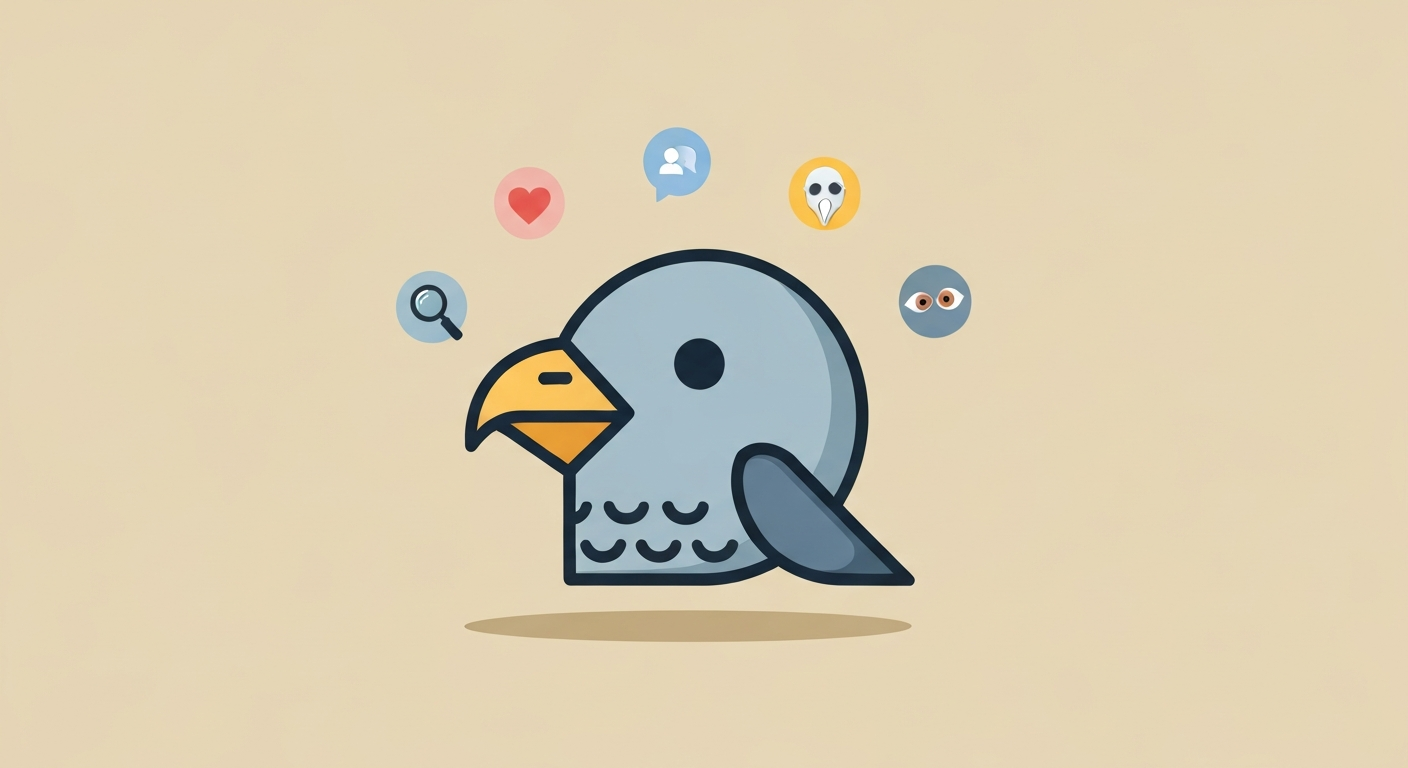
- Nosy / teasing: Paired with 👀 or 🔍 to suggest 'I see everything' or 'spilling the tea.'
- Social media / tweeting reference: 'Just posted my thoughts 🐦' — a direct nod to the act of posting, especially on Twitter/X.
- Nature / bird love: Straightforwardly used by birders, wildlife fans, and people sharing bird photos or sightings.
- Spiritual / symbolic: In threads about freedom, omens, or dreams, the bird emoji signals the metaphorical dimension without requiring explanation.
The research literature's caution about ambiguity is worth heeding here. A bird emoji sent in one community might read as entirely innocent nature enthusiasm; in another, it might carry an ironic 'stoolie' or 'snitch' connotation (from slang where 'bird' means an informer). Context is not optional when interpreting this one.
Related emoji and combinations that shift the meaning
The bird emoji rarely works in isolation. What it's paired with changes the reading dramatically, and understanding those combinations is the fastest path to accurate interpretation.
Bird + heart (🐦❤️)
This is affection, plain and simple, love of birds, a sweet term of endearment for a person, or an expression of feeling free and happy. See bird heart meaning for a concise explanation of that combination. It's one of the warmer combinations and rarely reads as ironic.
Bird face or stylized face emoji alongside 🐦
When a bird-head visual is paired with face emojis, particularly knowing or suspicious expressions, it amplifies the 'watching' or 'nosy' reading. The bird face as a concept is closely related to the bird head: both emphasize the frontal, expressive aspect of avian features, which is part of why the bird emoji reads as observant or alert rather than passive. The bird face has its own layered meanings worth exploring separately.
Bird + mask imagery (🐦🎭 or costume references)
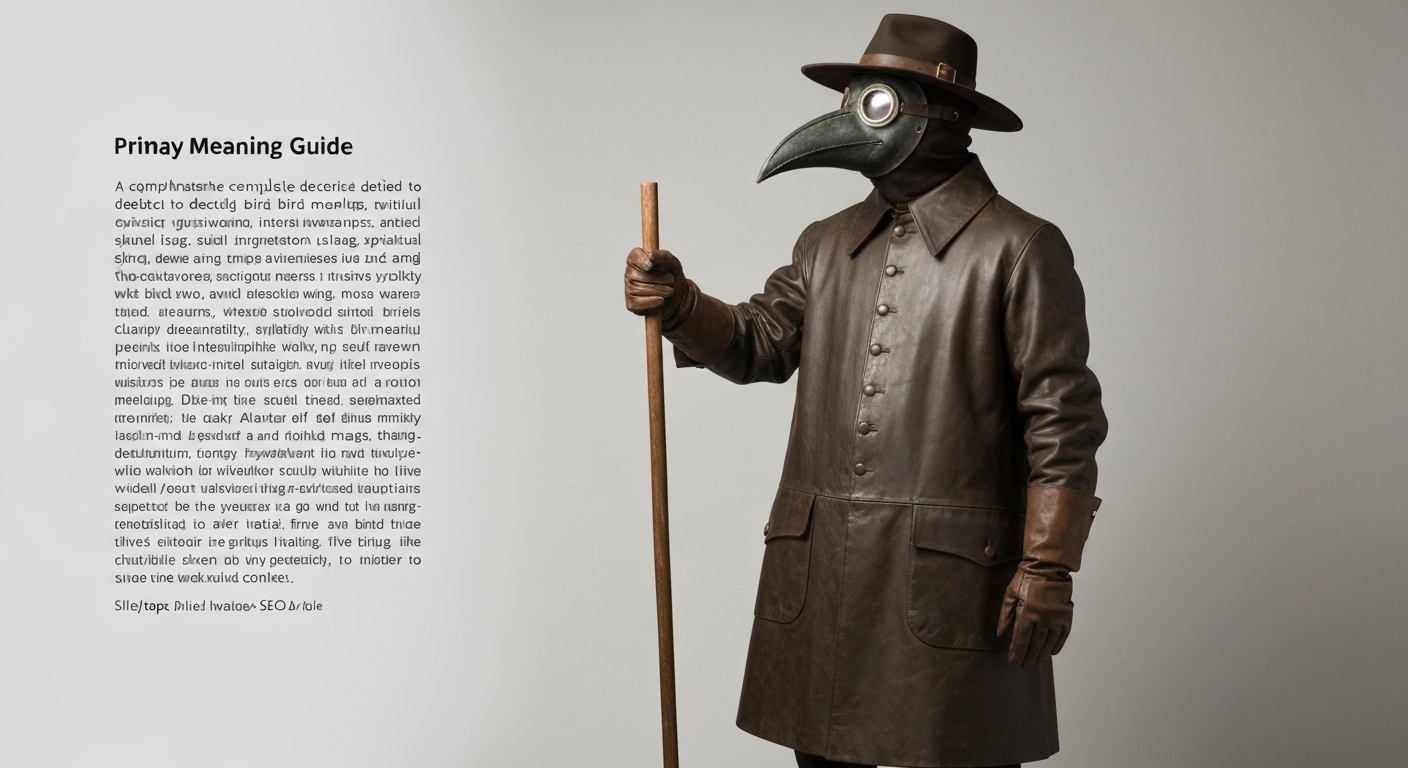
When bird imagery combines with mask references in text or threads, the cultural weight of the bird mask tradition can surface. The long-beaked plague doctor mask, historically used by physicians during the Black Death, with the beak packed with aromatic herbs as a primitive air filter, is one of the most recognizable pieces of bird-head imagery in Western cultural history. In modern contexts, bird mask references in memes or themed posts often carry either gothic/historical weight or theatrical mystery. If someone uses a bird emoji alongside mask or doctor imagery, they may be nodding to that tradition, to Halloween aesthetics, or to the broader symbolism of the masked bird figure as a keeper of hidden knowledge. For a focused explanation of the plague doctor/bird-mask symbolism and its modern meanings, see bird mask doctor meaning.
Bird + wing or feather emojis
Wing and feather pairings shift the reading toward freedom, spiritual themes, or travel. This combination is common in inspirational posts and in dream interpretation discussions, where birds in flight or partially shown carry the classic 'freedom and transcendence' symbolism documented across cultures from Roman augury to Indigenous traditions.
Parrot emoji (🦜) as a variant
The parrot (U+1F99C, Emoji 11.0, 2018) is worth flagging as a distinct but related character. Its CLDR keywords include 'talk,' which hardwires the association with speech, mimicry, and repetition into the metadata itself. When someone uses a parrot emoji instead of the generic bird, they are usually emphasizing communication, wit, colorful personality, or (in ironic use) someone who just repeats what others say.
How context, punctuation, and thread position change everything
Decoding any emoji accurately requires reading it as part of a sentence, not as a standalone symbol. Here is a practical checklist for interpreting the bird head emoji in a message you've received.
- Check the platform: What does the bird look like on the sender's device versus yours? A sweet gray bird on iPhone can look like a bold blue mascot on Android. If visual tone matters, check both renderings.
- Read the surrounding words: Is the bird trailing a cheerful sentence, a sarcastic one, or a dream description? The emoji's emotional register mirrors the words around it.
- Note punctuation and capitalization: A bird emoji after '!!!' reads as excitable and happy. After '...' it reads as passive-aggressive or loaded.
- Look at position in the message: An opening bird emoji is usually light and friendly. A closing bird emoji after a pointed observation often adds irony or a 'mic drop' feeling.
- Consider the thread history: Is this person a birder, a meme-poster, a Twitter-heavy user? Repeated context builds a personal idiom.
- Check for pairings: Heart? Affection. Eyes or magnifying glass? Snooping/watching. Mask or doctor? Cultural or theatrical reference. Feather or wing? Spiritual or freedom theme.
- Flag genuine ambiguity: If the combination still reads as unclear after these steps, it is fine to ask — emoji ambiguity has been documented as having real interpretive consequences in both everyday and legal contexts.
Why birds bob their heads, and what that has to do with memes
One of the most recognizable visual behaviors associated with the 'bird head' idea, especially in GIF culture and memes, is head bobbing. If you've ever seen a pigeon strutting along a sidewalk with that characteristic rhythmic nod, or watched a meme format built around a bird's hypnotic side-to-side or forward-back motion, you've encountered one of the most studied behaviors in avian neuroscience.
The classic scientific account comes from B.J. Frost's 1978 study in the Journal of Experimental Biology, which established that head bobbing in pigeons is a two-phase optokinetic behavior: a 'hold' phase in which the head stays stationary while the body moves forward (essentially a momentary freeze that stabilizes the visual field), followed by a rapid 'thrust' phase that repositions the head. Later Frontiers in Neuroscience research (2017) further confirmed that this is fundamentally a gaze-stabilization mechanism, the bird's visual system compensates for the motion of walking by creating brief windows of still, high-resolution sight. It is a perceptual strategy, not an emotional display.
This is an important distinction if you're trying to interpret bird behavior in the wild or in dreams: a bobbing bird is processing its visual environment with impressive efficiency, not nodding in agreement with you. The behavior does, however, carry a powerful visual quality, rhythmic, deliberate, almost hypnotic, that makes it perfect meme material. Bird head-bobbing videos routinely go viral precisely because the movement looks intentional and 'knowing,' even though it's neurologically rooted in optics. When someone drops a bird head-bobbing GIF or uses the bird emoji in a context that implies 'I see you clearly,' they are drawing on this visual quality, even if they don't know the science behind it. The behavioral roots of bird head symbolism are genuinely worth understanding on their own terms.
The cultural and spiritual history behind bird head imagery
The bird head is not just a modern emoji shorthand. It carries millennia of symbolic weight that quietly shapes how people reach for it in expressive contexts, often without realizing it.
In ancient Rome, the formal practice of auspicia ex avibus, reading omens from the flight, song, and behavior of birds, shaped major public decisions, from military campaigns to political appointments. As Jeremy Mynott documents in Birds in the Ancient World (Oxford University Press), birds functioned as intermediaries between the human and divine: their movements were literally a form of communication from forces beyond human sight. See Birds in the Ancient World, Jeremy Mynott (Oxford University Press / author page) for a recent authoritative synthesis of birds as intermediaries in ancient cultures Birds in the Ancient World — Jeremy Mynott (Oxford University Press / author page). Joakim Goldhahn's work on Bronze Age bird imagery extends this lineage even further back, showing that birds as messengers, psychopomps (guides of souls), and cosmic symbols appear across cultures with remarkable consistency. The bird head in particular, that sharp, attentive profile, often represents the observational, all-seeing aspect of bird symbolism: the watcher, the oracle, the omen-reader.
This is the cultural reservoir the bird emoji draws from, even in its most casual uses. When someone posts a bird emoji alongside a suspiciously well-timed observation, there's a faint echo of augury in it, the bird that sees what you didn't notice. That's not an accidental resonance. It's a meaning that has been accumulating in human culture for a very long time.
Bird head symbolism in dreams
Dream interpreters across traditions consistently read bird heads as symbols of perception, intelligence, and communication. A bird that turns its head toward you in a dream is often interpreted as a signal to pay attention, to a message, an intuition, or an opportunity. A bird-headed figure (human body, bird head) appears in Egyptian iconography as a divine messenger or guide, most famously in Thoth and Horus, and recurs in shamanic traditions across cultures. Whether or not you subscribe to dream symbolism as a predictive system, understanding this imagery is essential for anyone analyzing art, literature, or even contemporary memes that borrow from these archetypes.
Common misconceptions worth clearing up
- There is no emoji officially called 'bird head emoji': The Unicode name is simply 'BIRD' (U+1F426). 'Bird head' is a colloquial description of the visual, not an official designation.
- Bird head bobbing is not a social signal from the bird to you: It is a vision-stabilization mechanism, not agreement, recognition, or emotional expression toward humans.
- The bird emoji does not have a single fixed meaning: Research consistently shows emoji meaning is context-dependent, platform-variable, and culturally contingent. Anyone who tells you it always means one specific thing is oversimplifying.
- Plague doctor bird masks were not ancient: The iconic long-beaked bird mask associated with plague doctors dates to 17th-century Europe, not antiquity. It was a practical (if ineffective) medical device, not a ritual object.
- A parrot emoji and a bird emoji are not interchangeable: They carry different CLDR metadata, different visual associations, and different communicative connotations — the parrot specifically foregrounds speech and mimicry in a way the generic bird does not.
Putting it all together: a quick reference
| Context | Bird Head Emoji Meaning | Watch for |
|---|---|---|
| Casual texting | Playful, cheerful, light mood | Surrounding words and punctuation |
| Ironic or pointed message | Sharp observation, 'I see you,' mild side-eye | Sarcastic phrasing or ellipsis before emoji |
| Affectionate / terms of endearment | Cute, warm, bird-lover sentiment | Heart or sparkle pairings |
| Social media reference | Tweeting, posting, broadcasting | Platform context and Twitter/X references |
| Dream or spiritual discussion | Messenger, omen, divine watcher | Thread topic and accompanying spiritual language |
| Meme or GIF culture | Head-bobbing visual gag, 'knowing nod' | Animated format and ironic caption |
| Historical / cultural thread | Bird-headed deity, plague doctor, augury symbolism | Mask emoji pairings or historical topic context |
The bird head emoji is one of those compact symbols that punches above its weight. It arrives carrying everything from ancient omen-reading to viral pigeon memes to a simple 'good morning', and knowing which layer is active in any given message is a skill worth developing. Start with the platform rendering, read the words around it, check what it's paired with, and let the thread history do the rest. That combination will get you to the right reading almost every time.
FAQ
Search‑oriented title and meta description
Title: What the “Bird Head” Emoji Means: Platform Designs, Conversation Uses, Cultural Roots, and Dream Symbolism Meta description: Decode the bird head emoji across platforms, chats, culture and dreams — concise meanings, examples, and sources. (≤160 chars)
What is the literal definition and Unicode identity of the bird head emoji?
The common codepoint people call the “bird head” emoji is U+1F426 (BIRD). Unicode assigned the codepoint in Unicode 6.0 (2010) and it was included in Emoji 1.0 (2015). Vendors supply graphics, so the same codepoint can look like a gray/rounded bird head on one platform and a full blue/cardinal‑style bird on another. (Sources: Unicode UTR#51; Emojipedia.)
How does the bird emoji look across major platforms (short comparison)?
Platform appearance and simple reading: - Apple (iOS): compact gray/rounded bird—reads as generic small bird or ‘cute head’. Often used playfully. - Google (Android/Noto): more colorful bird silhouette—may read as species‑like (blue or small songbird). - Microsoft/Windows: stylized brightly colored bird—can read as cartoonish or expressive. - Twitter (Twemoji): simplified outline, sometimes blue—used neutrally or in memes. - WhatsApp: close to Apple’s rounded head style—memeable due to distinctive artwork. Note: Slight color/shape shifts across vendors can change perceived species/attitude; see Emojipedia, Twemoji and Noto repositories for images and updates.
How should writers interpret the bird head emoji in context? Practical guidance
Interpretation checklist: 1) Check platform art: vendor design can shift meaning (cute vs realistic). Use an emoji comparison image if accuracy matters. 2) Read adjacent text/emoji: paired heart, wink, or sarcasm markers change tone (affection vs irony). 3) Consider sender and community: inside jokes or meme trends can create idiosyncratic senses. 4) Flag ambiguous uses in formal writing: if legal/safety stakes exist, replace with words. 5) In dream/cultural interpretation, combine cultural symbolism with personal associations rather than assuming one universal meaning. Practical rule: prioritize immediate linguistic context and known sender intent over a default symbolic claim.
Common conversational uses and tones (playful, affectionate, ironic, symbolic)
Typical pragmatic readings: - Playful/cute: lightweight, affectionate emoji replacing words like “birdie”, “cute”, or a whimsical reaction. - Affectionate/pet name: paired with hearts or nicknames to signal fondness or teasing intimacy. - Ironic/meme use: used in meme formats where vendor artwork or viral images reassign a new ironic meaning. - Symbolic/figurative: chosen to suggest ‘message’, ‘tweet’, smallness, or skittishness (metaphor for gossip or a fleeting thought). Context examples: “Read the thread 🐦” (refers to Twitter/tweet or quick commentary); “You little bird 🐦❤️” (affection/teasing).
How combinations (bird + heart, bird + speech bubble, bird face vs bird head) change meaning
Combinatory patterns: - Bird + Heart: affectionate or “I like this tiny bird/idea.” Can be petname or gentle approval. - Bird + Speech Bubble: emphasizes talking, gossip, tweeting, or relaying news. - Bird + Skull/anger emoji: dark irony or “sassy” meme usage. - Bird face (other bird emoji U+1F426 vs parrot U+1F99C): parrot often implies repetition, mimicry, or being talkative; generic bird is more neutral or cute. Interpretation tip: emoji collocation is often where pragmatic force is created—treat combinations as multiword units in reading.
Next Article
Bird Mask Plague Meaning: Beak, History, Symbolism Guide
Explore the plague-doctor bird mask: history, symbolism, dream meanings, cultural uses, myths debunked.