
The plague-doctor bird mask, that long-beaked, glass-eyed silhouette, is a symbol of early modern medicine, death, and the desperate human urge to protect against invisible danger. It was a real costume worn by some physicians during European plague outbreaks, most visibly documented in 17th- and 18th-century sources, and its beak was designed to hold aromatic substances thought to purify 'bad air.' Today it carries layered meanings: protection, mortality, anonymity, the limits of knowledge, and a dark theatricality that has made it one of the most recognizable images in Western cultural history.
Bird Mask Plague Meaning: Beak, History, Symbolism Guide

Marcus Holloway
27 Jul 2026
What the bird mask actually means: a quick definition
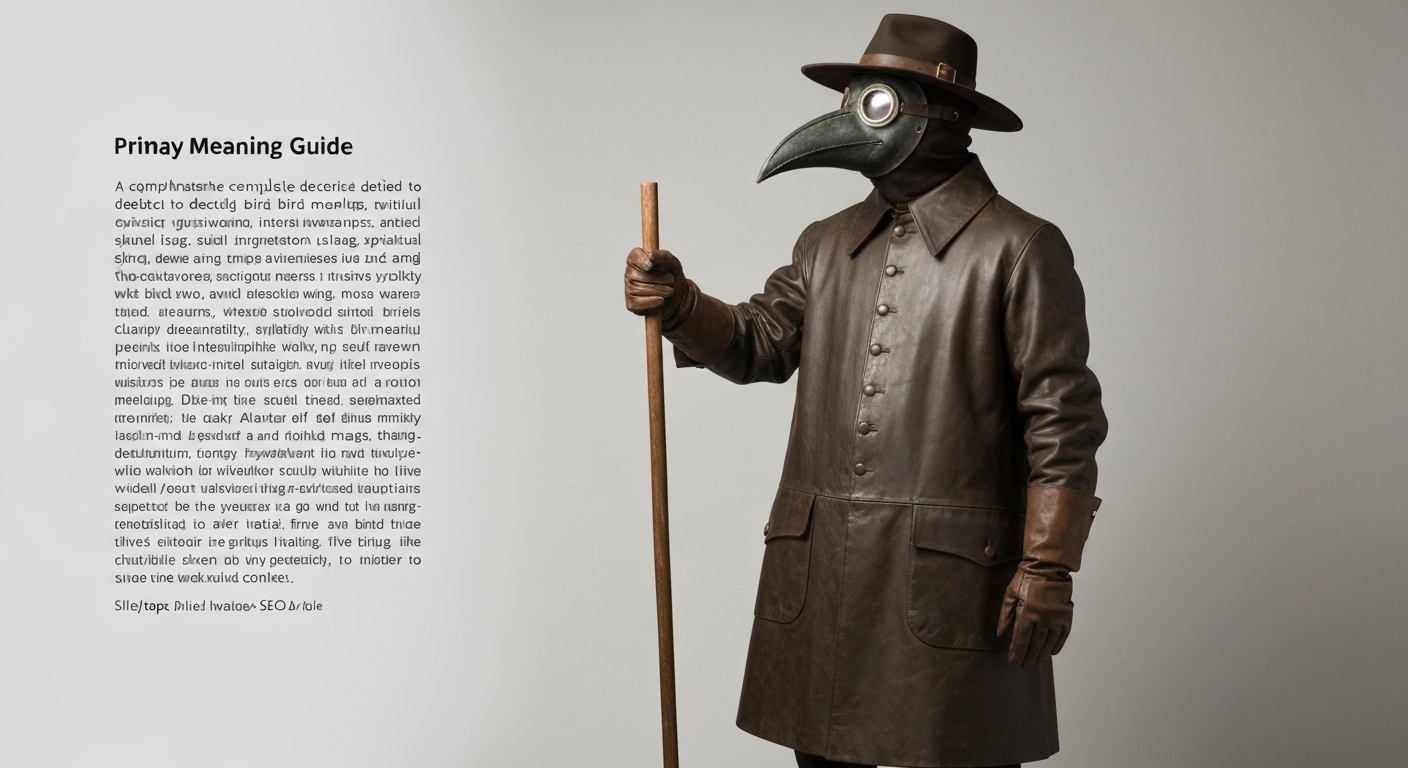
When people search for 'bird mask plague meaning,' they are almost always asking about the plague-doctor costume: a full-length waxed or leather overgarment, wide-brimmed hat, glass-lens goggles, a walking staff, and above all the long curved beak, typically 15 centimeters or roughly 6 inches in length. The beak is the defining feature, and it is why the figure looks bird-like. It was not decorative. The beak functioned as a kind of fixed nasal receptacle, packed with aromatic herbs, roses, camphor, vinegar-soaked sponges, and other fumigants that physicians believed would filter out the miasma, the 'bad air,' responsible for plague. The symbolic weight that surrounds this image today, death, pestilence, anonymous authority, dark protection, grew partly from lived historical fear and partly from satire and theatre that exaggerated and stylized the original costume into something mythic.
Where the plague-doctor mask actually comes from
The familiar beak-mask silhouette is not medieval. This is one of the most common misconceptions worth clearing up immediately. Despite popular associations with the 14th-century Black Death, there is no reliable visual or textual evidence for a beaked plague-doctor mask in that period. The iconography we recognize today is an early modern phenomenon, first appearing solidly in mid-17th-century French and Italian sources.
The most widely reproduced early image is a satirical copper engraving titled Der Doctor Schnabel von Rom, published by Paul Fürst around 1656. It depicts a beaked, cloaked physician figure accompanied by mocking verses that compare the doctor to a raven, already encoding a bird-of-death symbolism into the image. Surviving impressions are held in major collections including the British Museum. A second crucial source is Jean-Jacques Manget's Traité de la peste, published in Geneva in 1721, whose frontispiece shows a full-figure beaked costume and whose text describes in practical detail a leather gown, glass-eyed beak, and aromatic filling.
Many popular accounts credit the French court physician Charles de L'Orme (also spelled Delorme, 1584-1678) with formalizing the full head-to-toe costume during the 1619 Paris epidemic. Many modern accounts attribute an early formalization of the full head‑to‑toe ‘plague doctor’ outfit to Charles de L'Orme, who is said to have recommended a protective dress during the 1619 Paris epidemic; this attribution is long‑standing in secondary literature but is debated by recent scholarship Charles de L'Orme recommended a protective dress during the 1619 Paris epidemic. This attribution has circulated in secondary literature for generations, but recent specialist scholarship urges real caution here. Herbert J. Mattie's 2023 analysis in the European Journal for the History of Medicine and Health examines the conflicting textual and image traditions, including de L'Orme biographies and the 1656 and 1721 prints, and argues that the de L'Orme story is a composite, over-simplified reconstruction rather than a single documented origin. The honest historical position is that the costume emerged from accumulating early modern practice and was then fixed into a recognizable stereotype partly through print satire.
It is also worth knowing that plague doctors themselves were not a standardized, uniformed corps across Europe. Municipal hiring records from the 16th through 18th centuries show great variation in training, dress, and duties. Some civic plague doctors were paid to certify deaths, record cases, provide basic care, and perform autopsies; their clothing varied considerably. Earlier sources, including Niall Ó Glacáin's Tractatus de Peste (1629), reference leather coats, gauntlets, and masks containing fumigants, suggesting protective dress practices existed before the iconic silhouette was codified in print.
The anatomy of the mask: beak, lenses, cloak, and what went inside
Breaking down the full costume helps clarify both its practical logic and its visual power. Each component had a rationale, even if that rationale was built on incorrect science.
| Component | Description | Intended Purpose |
|---|---|---|
| Beaked mask (nose ~15 cm) | Fixed nasal cavity, often leather or metal, curved like a bird's bill | Hold aromatic fumigants to 'purify' inhaled miasmatic air |
| Glass-lens eye covers | Two round glass inserts sealed into the mask | Protect eyes from miasmatic exposure; also allowed vision in a sealed face covering |
| Waxed/oiled leather overgarment | Full-length coat of waxed leather or treated linen | Repel bodily fluids and miasma; barrier against contaminated material |
| Wide-brimmed hat | Broad hat worn over the mask | Signal professional status; minor physical shield from droplets |
| Leather gloves and boots | Full limb coverage | Prevent skin contact with infected persons or materials |
| Wooden walking staff/cane | Long rod carried by the physician | Examine or reposition patients without direct touch |
The beak filling itself is described in period sources as a mixture of roses, herbs, camphor, balsams, and vinegar-soaked sponges. Manget's 1721 text explicitly describes small nasal apertures at the tip of the beak allowing the physician to breathe through the aromatic layer. The Wellcome Collection holds a photograph of a Venetian lazaretto mask with a bronze beak (catalogue image V0029672), though the provenance of that specific object is noted as uncertain. As for surviving physical artifacts, very few genuine examples exist. Only two well-known beak-mask artifacts are held in German museum collections, one at the Deutsches Medizinhistorisches Museum in Ingolstadt and one at the Deutsches Historisches Museum in Berlin, and both have been subjected to material and provenance analysis by Marion M. Ruisinger (2020) in NTM that raises serious questions about whether they were functional protective equipment or later historicizing reconstructions.
Did the mask actually work? Miasma theory, real protection, and honest limits
The short answer is: partly, for the wrong reasons. The aromatic beak was based on miasma theory, the belief that plague spread through corrupted, foul-smelling air. We now know that plague is caused by the bacterium Yersinia pestis, primarily transmitted to humans through infected flea bites (bubonic and septicemic forms) and through respiratory droplets or aerosols in person-to-person pneumonic plague. Stuffing a beak with herbs does nothing to kill a flea or filter out aerosolized bacteria effectively.
However, some elements of the costume did offer incidental real-world protection, even if the reasoning behind them was wrong. The waxed or oiled leather overgarment and gloves created a physical barrier against contact with infected bodily fluids. More usefully, a smooth, waxed outer surface is a poor environment for fleas to cling to, which means the garment may have meaningfully reduced flea attachment compared to rough woolen clothing. The wooden staff reduced direct physical contact with patients. The overall picture, pieced together by historians and evaluated against WHO and CDC guidance on plague transmission, is that the ensemble could reduce certain exposure pathways, but it would not have prevented transmission by fleas effectively, and it would not have been a reliable respiratory filter against pneumonic plague aerosols. About Plague, Centers for Disease Control and Prevention (context on transmission and control) explains that protective clothing can reduce exposure to infected fluids and flea attachment but would not prevent transmission by infected fleas or by pneumonic droplets About Plague — Centers for Disease Control and Prevention (context on transmission and control). The physicians who wore it were taking serious risks, and many died.
Symbolic meanings: what the bird mask represents
The plague-doctor bird mask carries a cluster of meanings that have accumulated across centuries. These are not mutually exclusive; the image can hold several of them simultaneously, which is part of what makes it so persistent and emotionally resonant.
- Death and mortality: the beaked figure became associated with death itself, partly through the satirical tradition (Der Doctor Schnabel comparing the doctor to a raven) and partly because plague doctors were ubiquitous at scenes of mass dying. The bird-of-death reading maps onto existing European symbolism of ravens and crows as death omens.
- Protection and medicine: at the same time, the figure represented someone willing to enter the space of contagion to help others. The costume was a visible statement of medical intention, a shield taken up against a lethal threat.
- Anonymity and dehumanization: the mask removes individual identity. The wearer becomes a function rather than a person, which can read as either reassuring (a professional role) or sinister (an unknowable figure). This anonymity is a recurring theme in how the image is used in art, horror, and costume.
- The limits of human knowledge: because the costume was built on a fundamentally wrong theory of disease, it has become a potent symbol of intellectual humility, of people doing their best with incomplete understanding in the face of catastrophe.
- Institutional authority and fear: the plague doctor arrived with official civic sanction. The costume marked someone with both power (to certify death, to quarantine) and association with collective dread.
- Carnival and transgression: through its adoption into Venetian carnival and commedia dell'arte as the character Il Medico della Peste, the mask also carries theatrical, carnivalesque meanings: role reversal, masked identity, and the festive confrontation with death.
Art, theatre, Venice, and the visual legacy
The plague-doctor image did not stay in medical history. It migrated into culture through two main channels: satirical print and theatrical costume.
On the satirical side, broadside prints like Der Doctor Schnabel von Rom (1656) circulated the beaked figure widely as a figure of mockery, lampooning physicians as scavengers, profiteers, or death itself. These prints did enormous cultural work: they fixed the visual stereotype in popular imagination and loaded it with cynicism about the medical profession. The image of the doctor-as-raven was a criticism that resonated in a period when plague doctors often charged high fees and had limited tools to offer.
On the theatrical side, the costume was absorbed into Italian commedia dell'arte and, most enduringly, into the tradition of Venetian carnival masquerade. In Venice, the Medico della Peste became a recognized carnival character, the beaked mask transformed from a functional garment into an art object and costume piece. This is why Venetian mask-makers still produce the long-beaked mask today, sold as both art and costume across the world. The trajectory from practical (if misguided) PPE to carnival mask to global pop-culture icon is one of the more remarkable transformations in the history of any object.
The visual legacy also extends to fine art, illustration, and book culture. Manget's 1721 frontispiece image, in particular, became one of the most reproduced historical medical illustrations, seeding the beaked figure into centuries of visual reference. By the 20th century, the silhouette was already iconic enough to be used without explanation as a shorthand for plague, pandemic, and historical dread.
How the bird mask relates to other bird imagery and motifs
The plague-doctor mask is technically a human face covered to look like a bird, but it sits within a much broader tradition of bird-headed figures in culture and symbolism. Understanding where it overlaps and where it diverges from other bird motifs gives useful interpretive context.
Bird-face and bird-head imagery appear across cultures as markers of transformation, liminality, and spiritual authority. Ancient Egyptian iconography is the most familiar example: gods like Horus (falcon-headed), Thoth (ibis-headed), and Ra share the bird-head convention as a marker of divine power and access to realms beyond the human. When you see a bird-headed human figure in this context, it signals that the being operates across boundaries that ordinary humans cannot cross. The plague-doctor mask participates in this visual grammar even if unintentionally: the beaked physician was literally a person crossing the threshold between the living and the dead. For more on how bird-face imagery functions symbolically across cultural traditions, that deeper layer of meaning is worth exploring separately. For more on that wider symbolic field, see bird face meaning for a deeper exploration of bird-face symbolism.
Bird head bobbing is a behavioral cue in actual birds, often signaling attentiveness, courtship display, or territorial assertion. For a fuller explanation of bird head bobbing meaning in actual birds, see the separate note on bird head bobbing meaning. That behavioral meaning is quite distant from the plague-mask context, but both tap into the human tendency to read bird movement and bird form as meaningful, as communicating something about awareness, vigilance, or the presence of threat.
The bird head emoji (most commonly the bird or parrot emoji in digital use) carries a completely different register: playfulness, commentary, and internet-culture shorthand. For a quick guide to the bird head emoji meaning in digital communication, consult the related entry on bird head emoji meaning. The distance between that casual digital symbol and the plague-doctor beak is enormous, but both show how bird imagery collapses across registers of meaning depending on context.
The bird heart motif, found in folk art, tattoo culture, and decorative traditions, often fuses bird symbolism (freedom, spirit, the soul's journey) with the heart as a symbol of love and emotional life. This is a gentler, more intimate register than the plague mask, but both draw on the deep association between birds and the human soul that appears across so many traditions. And if the plague-doctor mask has a direct sibling topic, it is the broader category of bird mask doctor meaning, which explores the physician-in-bird-disguise archetype in more depth. For a focused exploration of the physician-in-bird-disguise archetype, see the article on bird mask doctor meaning. For a focused discussion of the symbolism behind bird-and-heart designs, see bird heart meaning.
The bird mask in modern culture: costumes, horror, memes, and what goes wrong
The plague-doctor mask is now a fixture of Halloween, cosplay, horror fiction, video games, and internet visual culture. That popularity is understandable: the silhouette is genuinely striking, historically grounded, and carries enough symbolic weight to feel meaningful in a wide range of creative contexts. But a few patterns in modern use are worth flagging honestly.
Costumes and cosplay
The plague-doctor costume is one of the most popular choices for historically-themed Halloween dress and cosplay. Most modern versions lean into the horror aesthetic: exaggerated black leather, dramatic beaks, theatrical goggles. This is fine as creative expression, and the Venetian carnival tradition gives it a long historical precedent. If you are making or wearing the costume with any claim to historical accuracy, it is worth knowing that the original costume was waxed leather or treated linen in whatever neutral colors were available, not necessarily black, and that the full ensemble (hat, staff, gloves, boots) is what gives the historical figure its complete visual identity. The beak alone, without the rest, is more theatrical shorthand than historical reconstruction.
Horror, games, and film
The plague-doctor figure appears in video games (including prominent uses in titles like Bloodborne and various strategy games), horror literature, and film. In these contexts it typically functions as a figure of dread, anonymity, and death, drawing on the symbolic meanings outlined above rather than historical accuracy. This is a legitimate creative tradition, the satirical print-makers of the 17th century were also not trying to document reality neutrally. The image has always carried theatrical and emotional weight beyond its literal origins.
Memes and internet culture
During the COVID-19 pandemic especially, the plague-doctor image circulated heavily in meme culture, sometimes humorously (comparisons between 17th-century miasma prevention and modern mask debates), sometimes as dark commentary on pandemic experience. The image works well in this context because it is pre-loaded with meaning about human helplessness against disease, institutional response, and the aesthetics of protection. It is a useful cultural shorthand, as long as it is not mistaken for accurate historical information.
Common myths worth correcting
Several persistent myths circulate about the plague-doctor mask that are worth addressing directly. The claim that plague doctors wore the beaked mask during the Black Death (14th century) is not supported by evidence: the beaked silhouette is a 17th-century and later phenomenon. The idea that Charles de L'Orme single-handedly invented the costume in 1619 is an over-simplification challenged by recent scholarship. The claim that dozens of original beak-masks survive in museums is exaggerated: only a handful of artifacts with credible provenance exist, and even those have been questioned. And the widespread idea that the waxed costume and aromatic beak provided robust, effective plague protection is incorrect: it offered some incidental barrier benefits but not a reliable defense against flea-transmitted or pneumonic plague. These corrections do not make the image less fascinating; if anything, a mask built on wrong science and fixed in popular memory through satire is more interesting than a straightforwardly functional one.
Dream and spiritual interpretation
If the plague-doctor bird mask appears in a dream or is felt to carry spiritual significance, the interpretive framework that makes the most sense draws on its core symbolic cluster: you are encountering an archetype of protected approach to death or danger, of anonymous authority, of medicine that is doing its best under uncertainty. In a dream context, seeing the beaked figure might suggest confronting mortality, navigating a situation that demands protection or distance, or encountering an authority figure whose motives are unclear. The bird symbolism adds a layer of liminality: the figure crosses between worlds, between life and death, between the healthy and the infected. As with all dream symbolism, personal associations matter more than fixed rules, but the mask's cultural weight gives it a particular density that tends to register as heavy, solemn, or foreboding rather than neutral.
FAQ
What is the 'bird mask' of the plague doctor — a concise definition?
The 'bird mask' (or beak) is the distinctive cone‑shaped facial apparatus associated with early‑modern plague doctors: a rigid, elongated beak fitted with glass eyepieces and small nasal apertures, often attached to a leather or oil‑cloth hood. Historically it was a component of a full head‑to‑toe protective ensemble used by some physicians and civic caregivers from the 17th century onward.
When and where did the beaked plague‑doctor image first appear historically?
The beaked silhouette appears in mid‑17th‑century iconography and prints (not earlier Black Death sources). Notable early images include Paul Fürst’s satirical engraving Der Doctor Schnabel von Rom (c.1656) and the frontispiece to Jean‑Jacques Manget’s Traité de la peste (1721). The motif is primarily early modern Italian/French in origin rather than medieval.
Who invented the beak mask and is Charles de L’Orme its inventor?
A long‑standing attribution names Charles de L’Orme (physician to the French court, early 1600s) as an originator, but modern scholarship treats that origin story as composite and debated. Primary images and texts emerge across decades; recent analyses caution against a single‑person origin narrative.
What was the practical purpose of the beak and the rest of the costume?
Contemporaries filled the beak with aromatic herbs, flowers, camphor or vinegar‑soaked sponges to ‘purify’ inhaled air against miasma. The waxed/leather gown, gloves and boots provided a physical barrier against contact with infectious fluids and possibly reduced flea attachment. The beak as a scent reservoir had little proven filtration value; the ensemble likely reduced some contact exposure but did not reliably stop flea transmission or aerosolized pneumonic plague.
Are there surviving original beak masks or artifacts?
Only a very small number of putative 17th–18th‑century beak masks survive in museum collections (e.g., Ingolstadt, Berlin), and material/provenance studies raise questions about whether they were functional PPE or later historicizing objects. Some museum items (e.g., a Venice lazaretto oil‑cloth mask with bronze beak) have uncertain provenance.
Why does the plague‑doctor beak carry symbolic meanings of death and medicine?
Satirical broadsides and prints used a birdlike, scavenger image to lampoon physicians as death‑dealers or profiteers (e.g., Fürst’s 1656 print equated the doctor with a raven). The costume combined professional signals (hat, staff) with a grotesque beak, reinforcing associations of medical authority, anonymity, and mortality. Over time the striking silhouette became shorthand for sickness, death, and medical intervention.
Next Article
Bird Mask Doctor Meaning: Symbolism, Folklore, Dreams
Decode bird mask doctor meaning in folklore, art and dreams, with symbolism, disambiguation tips, and practical interpre