"Bird church" can mean several genuinely different things depending on where you encountered the phrase. It might describe birds literally gathering near or inside a church building (a behavioral question), a spiritual or symbolic omen people read into that gathering, a folk or literary metaphor for birds assembling the way humans do on Sunday mornings, or even a named community or sanctuary project. The fastest way to get a useful answer is to figure out which of those contexts you're actually in, then follow the explanation that fits.
Bird Church Meaning: Spiritual, Superstition, and Real Explanation

Marcus Holloway
19 May 2026
What people usually mean when they say "bird church"
The phrase shows up in at least four distinct ways online and in real life, and they don't overlap much. Knowing which one applies to your situation saves a lot of unnecessary confusion.
- Spiritual or symbolic question: Someone saw birds at, in, or around a church and wants to know if it means something religiously or spiritually. This is probably the most common reason people search the phrase.
- Superstition or omen interpretation: A bird flew into the church, landed on a grave, or appeared during a service, and someone wants to know if it's a good or bad sign.
- Literary or playful metaphor: Writers and bloggers (including a well-known Thought Catalog piece) use "bird church" to describe birds gathering routinely, likened to attending a Sunday service. It's evocative, not theological.
- A named project or sanctuary: At least one community in Port Rowan, Ontario, uses "bird churches" to describe intentionally designed bird-friendly shelter structures. A website called birdchurch.net also uses it as a brand/community label. Neither of these is a superstition or a sighting.
If you read the phrase in a story, poem, or blog post, it's almost certainly the metaphor usage. If you physically watched birds at a real church and felt something about it, you're in spiritual/superstition territory. If you're researching a community project or a brand, that's its own thing entirely.
Why birds actually gather near churches (the ornithological reality)
Before diving into what birds near a church might symbolize, it helps to understand why they're there in the first place, because the practical answer is usually more mundane and more interesting than any omen.
Churches are ideal bird habitat
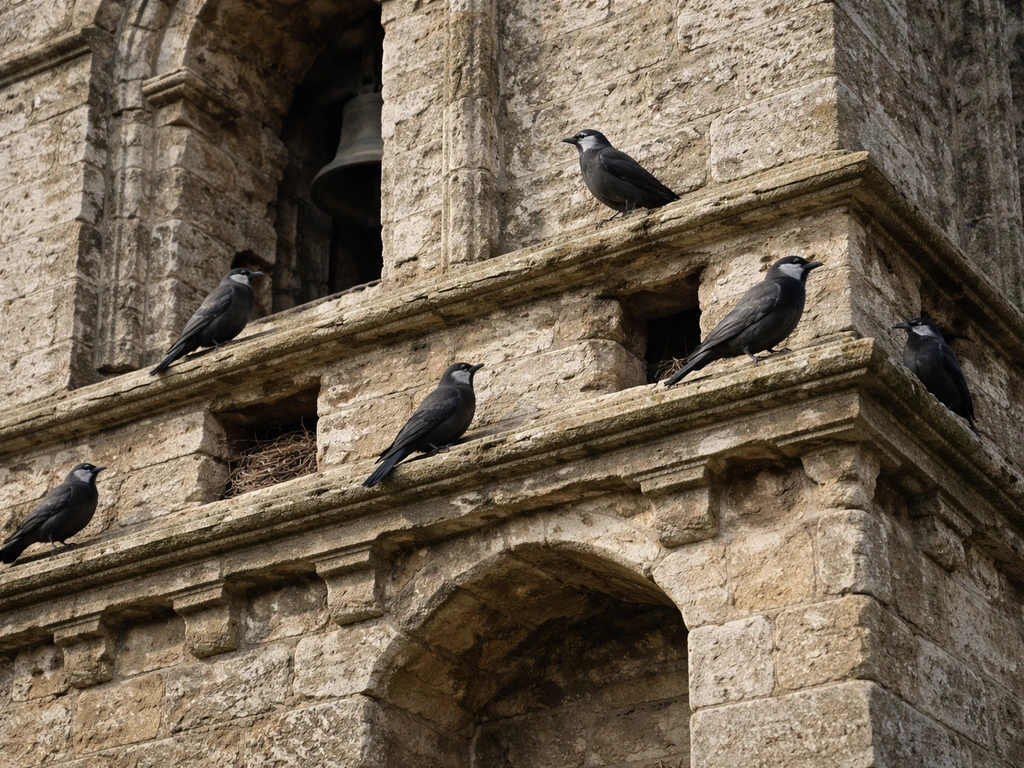
Old stone churches, in particular, are basically five-star bird hotels. Bell towers offer protected cavities. Eaves and ledges provide sheltered nesting spots. Churchyards with old trees and low human disturbance create excellent foraging habitat. The 1911 Encyclopaedia Britannica noted that jackdaws "nearly always choose holes" and that "nearly every church tower and castle is more or less numerously occupied." That's not folklore; it's accurate natural history.
- Jackdaws: Classic church-tower nesters. They've been using bell towers and steeple cavities across Europe for centuries.
- Chimney swifts: Breed in small numbers in church towers and other hollow structures; unmated birds roost communally in summer, which can produce dramatic aerial gatherings.
- Barn swallows: Commonly nest under eaves and on ledges of older buildings, including churches.
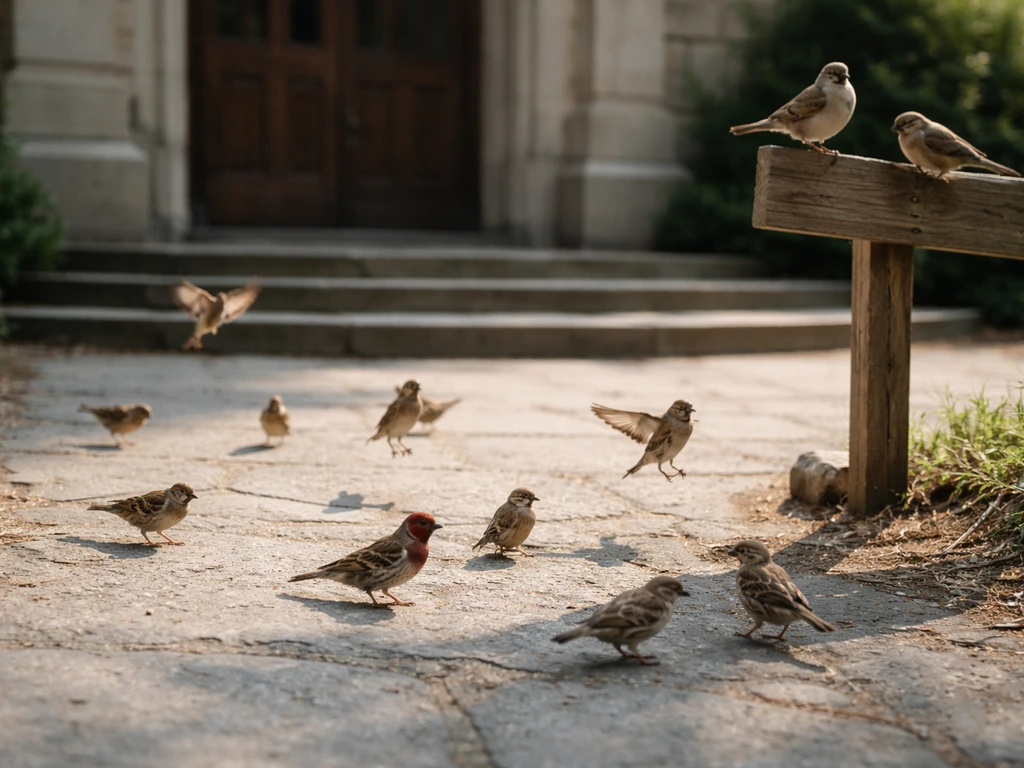
- House sparrows and starlings: Among the most frequent roof and eave nesters on any human structure, including churches.
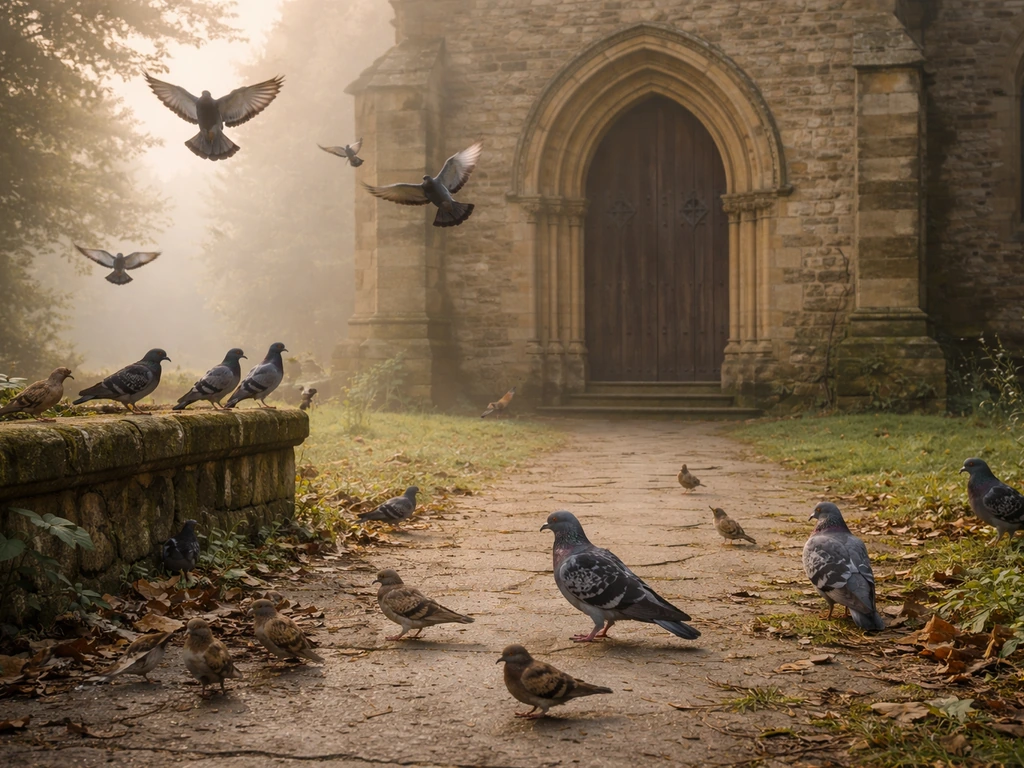
- Pigeons and doves: Roost on ledges and cornices; virtually every urban church has a resident pigeon population.
Seasonal timing matters too. A large group of birds swirling around a church tower in late summer is very likely a chimney swift or swallow pre-migration roost, not a portent. Columbus Audubon notes that breeding pairs may nest in church bell towers and that unmated chimney swifts may roost together in summer groups, which can explain late spring and summer gathering near towers chimney swift or swallow pre-migration roost.
Cavity nesters like jackdaws and starlings are most visible in early spring when they're prospecting for nesting sites. Cavity nesters like jackdaws and starlings depend on suitable cavities and nest-site context, and the Purple Martin Conservation Association provides nest and location identification guidance that applies broadly to cavity-nesting birds.
If you're seeing birds "gathering" at a specific time of day, that's often communal roosting behavior driven by safety in numbers and temperature regulation, not spiritual significance.
The spiritual and cultural symbolism of birds in church spaces
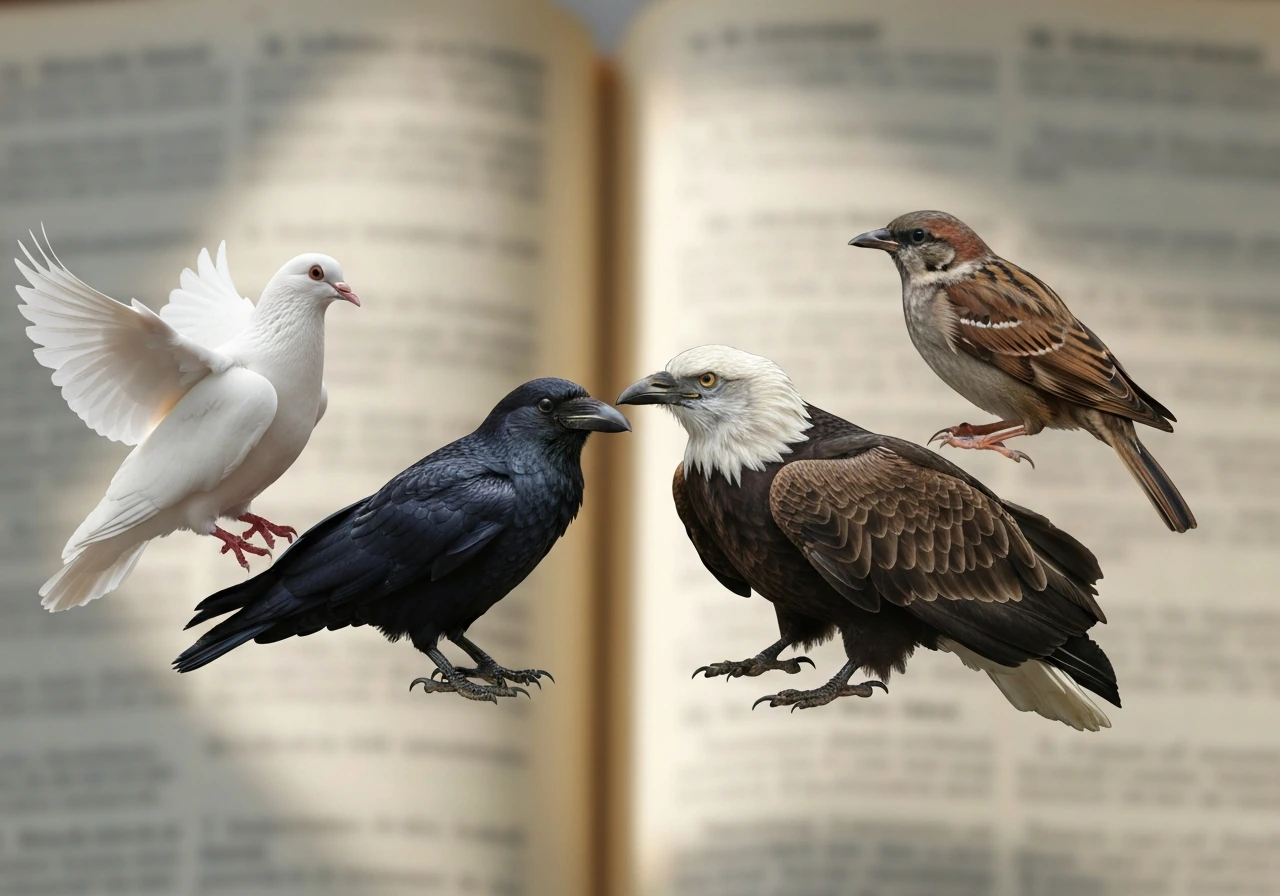
Birds carry deep symbolic weight in Christian tradition, and that tradition is old enough to feel woven into the architecture of the church itself. The dove is the most prominent example: in Genesis, Noah's dove returns with an olive branch, signaling the end of the flood and God's renewed covenant. In the New Testament, the Holy Spirit descends on Jesus at his baptism in the form of a dove. These images are so foundational that dove imagery appears in baptisteries, altarpieces, and stained glass across nearly every Christian tradition.
Beyond doves, the broader Christian use of bird symbolism is extensive. Eagles appear in scripture as symbols of renewal and divine strength. Sparrows appear in Matthew and Luke as examples of God's care for even the smallest creatures. Pelicans, in medieval Christian iconography, were symbols of Christ's sacrifice because of the (incorrect but poetic) belief that they fed their young with their own blood. If you're interested in how birds connect to scripture specifically, those threads run deep through both the Old and New Testaments.
In Welsh folklore, jackdaws nesting in church steeples were considered sacred or at least auspicious. The association between these specific birds and specific holy buildings created a cultural layer of meaning on top of the perfectly logical ecological reason the birds were there. That layering is how most bird-church symbolism works: real behavior, interpreted through a spiritual lens over generations.
The practice of reading omens from bird behavior is called ornithomancy, and it's genuinely ancient, appearing in Greek, Roman, and pre-Christian traditions before being absorbed into and adapted by folk Christian practice. So when someone senses that a bird appearing at a church "means something," they're participating in a tradition that goes back thousands of years.
Superstitions about birds at churches: what's worth knowing and what to set aside
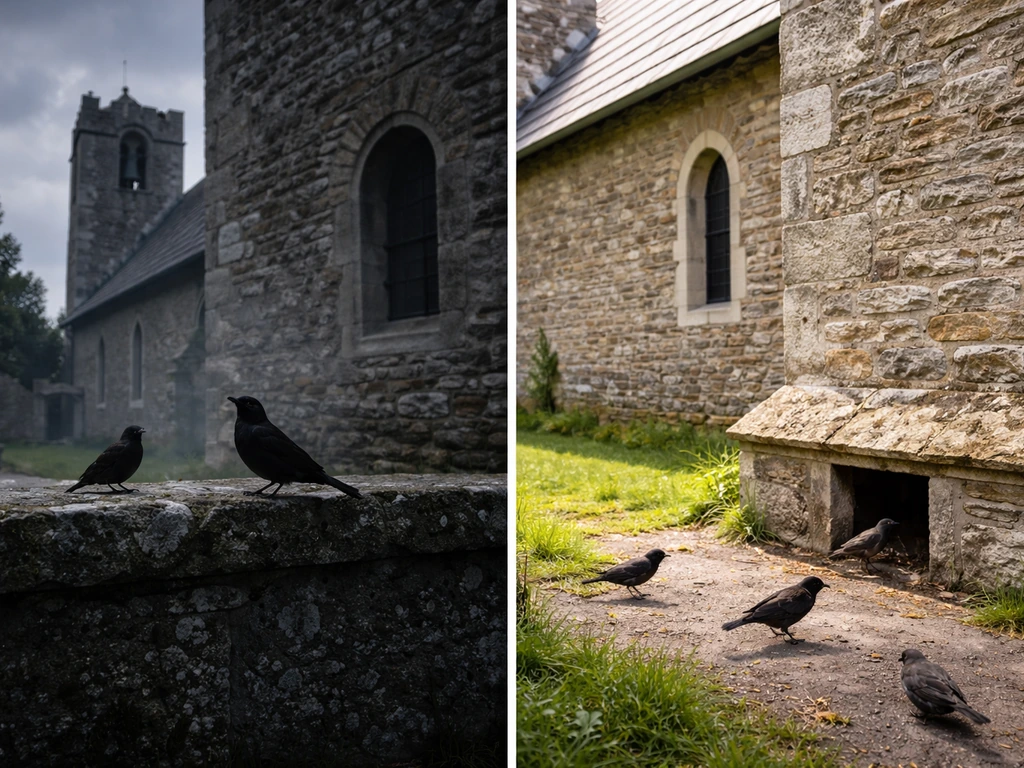
There's a long list of bird omens people associate with churches and religious events, and some are worth understanding culturally even if they don't hold up to scrutiny.
| Superstition | What people believe | What's actually going on |
|---|---|---|
| Bird flies into a church during a service | Sign of an incoming death or divine message | Windows and open doors confuse birds; reflective glass and indoor light are common attractants. This happens constantly and most of the time nothing follows. |
| Bird lands on a grave during a funeral | Soul of the deceased or a visiting spirit | Churchyards are quiet, undisturbed spaces with old trees and good insect life. Birds forage there routinely regardless of human events. |
| Jackdaws or crows nesting in a church tower | Bad luck or omen of community misfortune | These birds have nested in church towers for centuries across Europe. The association with doom is cultural, not causal. |
| A white bird (dove) appearing near a church | Blessing, peace, or divine approval | Doves and pigeons are common around churches. White or light-colored birds stand out visually, which may explain why people notice them more. |
| Bird tapping repeatedly on a church window | A spirit trying to communicate | Window-tapping is extremely common territorial behavior, especially in spring. The bird sees its own reflection and treats it as a rival. |
The death-omen superstition connected to birds entering buildings is well-documented by folklorists, and Snopes has addressed variants of it. The short version: the belief is widespread and old, but there's no reliable correlation. Birds fly into buildings constantly because of glass and light, and the overwhelming majority of those incidents don't precede unusual events. The ones that do get remembered; the thousands that don't get forgotten. That's confirmation bias, not prophecy.
That said, dismissing these beliefs entirely misses the point. They encode something real about how people relate to nature and to the sacred. A bird appearing unexpectedly at a funeral is genuinely striking. Whether you read it as coincidence, as comfort, or as meaningful is a personal and spiritual choice, not a factual one.
How to interpret your specific bird-church sighting
If you had a real-world experience with a bird at a church and you're trying to make sense of it, a few structured observations will help you narrow down what's actually happening. If you want the church-related meaning, check the article section on the bird definition church context.
- Identify the species if you can. Size, shape, bill type, plumage color, and behavior are your main clues. A glossy black bird hopping around a bell tower is almost certainly a jackdaw or starling, not a mysterious visitor. A small brown bird in the eaves is likely a house sparrow. Species identity changes the interpretation entirely.
- Note how many birds there were. A single bird behaving unusually (flying inside, tapping on glass) is different from a large flock roosting on the steeple. Flocks have behavioral explanations; solitary unusual behavior is what tends to prompt spiritual readings.
- Record the time of year and time of day. Spring means nesting behavior. Late summer means pre-migration roosting. Dusk gatherings are communal roost formation. Dawn activity is territorial singing. Seasonal and daily timing explains most "mysterious" bird events.
- Observe what the bird was actually doing. Foraging, singing, nesting, roosting, chasing its reflection, flying confused indoors? Each behavior has a different practical explanation.
- Note the church's architectural features. Does it have a bell tower, open eaves, broken windows, or thick ivy? These features predict which species are likely and why they're there.
- Consider the emotional and ritual context for you personally. Were you at a funeral, a wedding, a quiet visit? Human emotional state strongly influences how we interpret ambiguous events. This doesn't invalidate a spiritual reading; it just helps you be honest about where the meaning is coming from.
Dream usage and phrase contexts: confirming which "bird church" you mean
If you dreamed about a bird church, or read the phrase somewhere and couldn't place it, context is everything. In dream interpretation, a bird in a sacred space often draws on the same symbolic reservoir as waking symbolism: freedom, the soul, divine presence, transition. A bird trapped in a church in a dream might represent spiritual longing or feeling constrained by religious expectation. A bird singing freely in a church might suggest spiritual peace or a sense of rightness. Dream symbolism here overlaps significantly with the broader cultural and biblical bird symbolism mentioned above. In some readers, a bird showing up in a sacred place is linked with prophetic bird meaning and messages worth reflecting on.
If you encountered "bird church" as a phrase in writing, check these markers to confirm which usage it is:
- Is it capitalized as a title or proper noun? That suggests a brand, project name, or literary title (like the Penn State Behrend literary journal piece, or birdchurch.net).
- Is it used in a sentence describing bird behavior with human-like routine? Then it's the playful metaphor usage, birds attending their own version of Sunday services.
- Is it in a spiritual or religious discussion about omens, blessings, or signs? That's the symbolism/superstition context.
- Is it in a news or community story about bird-friendly structures? That's the sanctuary/habitat meaning from places like Port Rowan, Ontario.
If you're still not sure, search the exact phrase alongside the source name or platform. The four usages above are genuinely distinct and rarely overlap. The metaphorical and literary usage in particular is sometimes mistaken for a spiritual one because the language is evocative, but the intent is usually secular and poetic.
Practical next steps: what to actually do now
If you have birds nesting in or on your church building
Many nesting species that use church buildings are legally protected, especially in the UK and parts of the US. House sparrows, swallows, and swifts are among the species you cannot legally disturb during active nesting in many jurisdictions. If you're managing a church building and need to address nesting, contact your local wildlife authority or a professional pest management company before doing anything. The RSPB recommends waiting until chicks have fledged before blocking entry points.
If you're dealing with bird droppings
Large accumulations of bird droppings are a genuine health concern, not just a nuisance. Disturbing dried droppings can release spores that cause histoplasmosis, a fungal lung infection. The CDC is explicit about this: if you're cleaning up a significant accumulation of bird or bat droppings, you should wear an N95 respirator at minimum and wet the surfaces before cleaning to suppress dust. For large accumulations, the CDC recommends hiring a professional hazardous-waste handling company rather than doing it yourself. Don't use bare hands, and keep pets away from areas under heavy bird activity.
If you want to prevent birds from entering the building
- Install bird-proof netting or wire mesh over eaves, gaps in roof tiles, and bell tower openings during the non-breeding season.
- Use anti-perch spikes on ledges and window sills where pigeons or starlings congregate.
- Apply window collision deterrents (frosted film, UV-reflective tape, or exterior screens) on large clear windows that birds strike regularly.
- Seal broken windows and gaps in tower walls before the spring nesting season begins.
If your interest is spiritual or symbolic
You don't need to choose between taking a sighting seriously and being grounded about it. When people ask for the bird revelation meaning, they usually mean what the sighting symbolizes in a spiritual or cultural context, not just the natural behavior behind it. A bird appearing at a meaningful moment can carry real personal significance without requiring you to believe it's literally supernatural.
If you want to explore the Christian symbolism thread further, the biblical and Catholic traditions have rich, specific frameworks for bird meaning that go well beyond vague omens. If you are specifically wondering about bird meaning in a church context, focus on the symbolism and the tradition behind it rather than assuming a single fixed omen.
If you're specifically asking about the bird Catholic meaning, the dove and other birds in Christian art are often read as signs of the Holy Spirit, renewal, care, or sacrifice. For a deeper look at the bird biblical meaning tied to Christian symbolism, it helps to consider how specific birds are described in scripture biblical and Catholic traditions. The dove, the eagle, the sparrow, and even the raven all carry distinct theological weight in scripture and in church history.
If you want to document the sighting properly
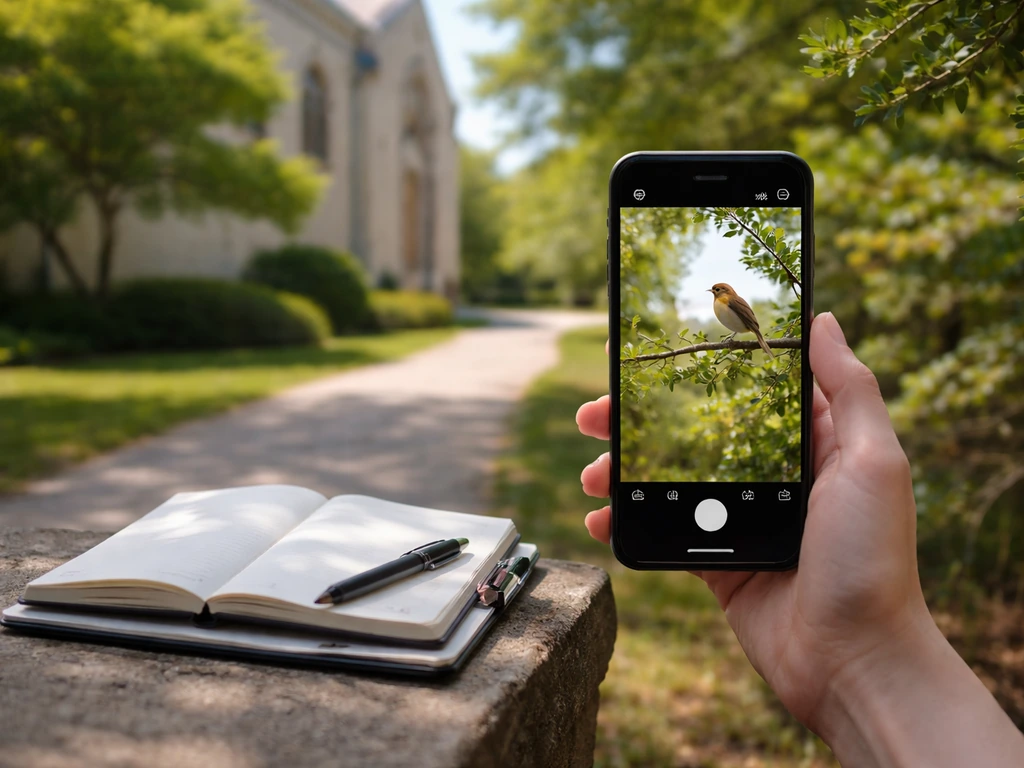
If you saw something genuinely unusual, a rare species or unexpected behavior at a church location, note the date, time, location, species description (size, bill shape, plumage colors, behavior), and the number of birds. Cornell's eBird platform accepts exactly this kind of observation and contributes it to real ornithological records. If you think it might be a rare or unusual species, the All About Birds reporting guidance recommends detailed notes on every field mark you observed. That's useful whether you're interested in the science, want to share the sighting, or just want to remember it clearly.
FAQ
Is bird church meaning the same thing in every situation?
Yes, but the “bird church meaning” you should use depends on whether you mean a literal bird congregation at a specific church (ecology and timing) or the phrase used as symbolism in a text or conversation (metaphor). If you share the setting, like “I saw swifts spiraling around the steeple at 7 pm” or “it appeared in a novel,” the interpretation shifts a lot.
How can I tell if it’s an omen versus normal bird behavior?
A good rule of thumb is to separate “what the birds are likely doing” from “what people feel it means.” If birds are flying in repeated circuits, calling, or collecting at dusk, you are probably seeing roosting or commuting behavior. If your interpretation is spiritual, treat it as personal reflection rather than a cause-and-effect prediction.
What clues help distinguish pre-migration or nesting activity from superstition at a church?
Season and location help. Late-summer swirls around towers often match swifts and swallows preparing for migration roosts, while early spring activity can reflect cavity-nesting species scouting entrances. If you tell me the month and the approximate species (even “small gray bird” versus “dark jackdaw-sized”), I can narrow the likely category.
Does a bird flying into a church always mean something bad is coming?
If a bird flew into the church, don’t assume it predicts a specific event. Common causes include glass reflections, bright interior light, and disorientation. If it keeps happening, look for contributing factors like reflective windows, open doors during peak movement times, and exterior lights at night.
Are Christian bird symbols in churches universal, or do they vary by tradition?
Many bird-related church meanings are tied to Christian art and scripture, but they are not all equally “literal” or universal. For example, dove imagery has strong baptism and covenant associations, while other birds can be symbolic in certain traditions without being a single fixed omen. The specific bird matters, but so does your denomination or cultural background.
Can I take the sighting spiritually without ignoring the natural explanation?
In most cases, yes. In ornithomancy, people interpret behavior through a spiritual lens, but modern readers can still assign personal meaning while acknowledging that the underlying drivers are ecological. A practical approach is to write down what you observed first (species, timing, behavior) before deciding what it “means to you.”
What does bird church meaning usually imply in dreams, and how does the bird’s condition matter?
Dream “bird church” symbolism often hinges on whether the bird is free, trapped, or interacting with people. Free flight commonly aligns with ideas of release or spiritual comfort, while distress or confinement can point to feeling restricted by expectations. It also helps to recall your emotions in the dream, not just the imagery.
How can I identify whether “bird church” is metaphorical or spiritual-omen language?
If the phrase is being used in writing or online, check intent signals: is it describing an actual event you could verify, or is it using vivid language to build atmosphere? Metaphor uses often focus on themes like community, faith, or gathering, while spiritual-omen uses often include claims about predicting outcomes.
What should a church do if birds are nesting, without risking legal or safety problems?
If you are cleaning, blocking access, or managing nesting, treat the birds as legally protected in many places during active nesting. The safest workflow is to confirm nesting activity first, then use local wildlife authority guidance or a professional before sealing entry points, because delaying at the right time can prevent illegal harm.
Is bird droppings cleanup at a church actually dangerous, or is it mostly a nuisance?
Not necessarily. Large droppings areas are a health concern because disturbed dust can carry fungal spores that affect lungs. If the area is heavy or you see piles under roosts, use an appropriate respirator, wet surfaces before cleaning, and consider professional hazardous-waste handling rather than DIY cleanup.
What’s the best way to document a bird event at a church if I want clarity and accuracy?
You can record useful details without turning it into superstition. Note date, time, exact location on the building (tower, eaves, window ledge), species traits (size, color pattern, bill shape), flock size, and what they did for 1 to 2 minutes. Then you can decide later whether it felt meaningful.
What should I do if the bird at the church looks unusual or rare?
If it’s a rare species or unusual behavior, it’s worth verifying rather than relying on the phrase alone. Use a field guide or observation checklist to confirm field marks, and submit notes to an observer network or local bird group. The “meaning” can stay personal, but the identification should be evidence-based.
Next Article
Bird Biblical Meaning: What Scripture Says About Birds
Discover bird biblical meaning from Scripture, including doves, sparrows, ravens, dreams, omens, and how to interpret sa