
SEO Title: Bird Dung Meaning: Literal Definition, Symbolism, Slang, and Science Meta Description: Discover what bird dung means literally, spiritually, and in slang. Covers guano vs manure, superstitions, dream meanings, health risks, and cleanup tips.
Bird Dung Meaning: Symbolism, Science, Cleanup Guide & Safety

Marcus Holloway
24 Jul 2026
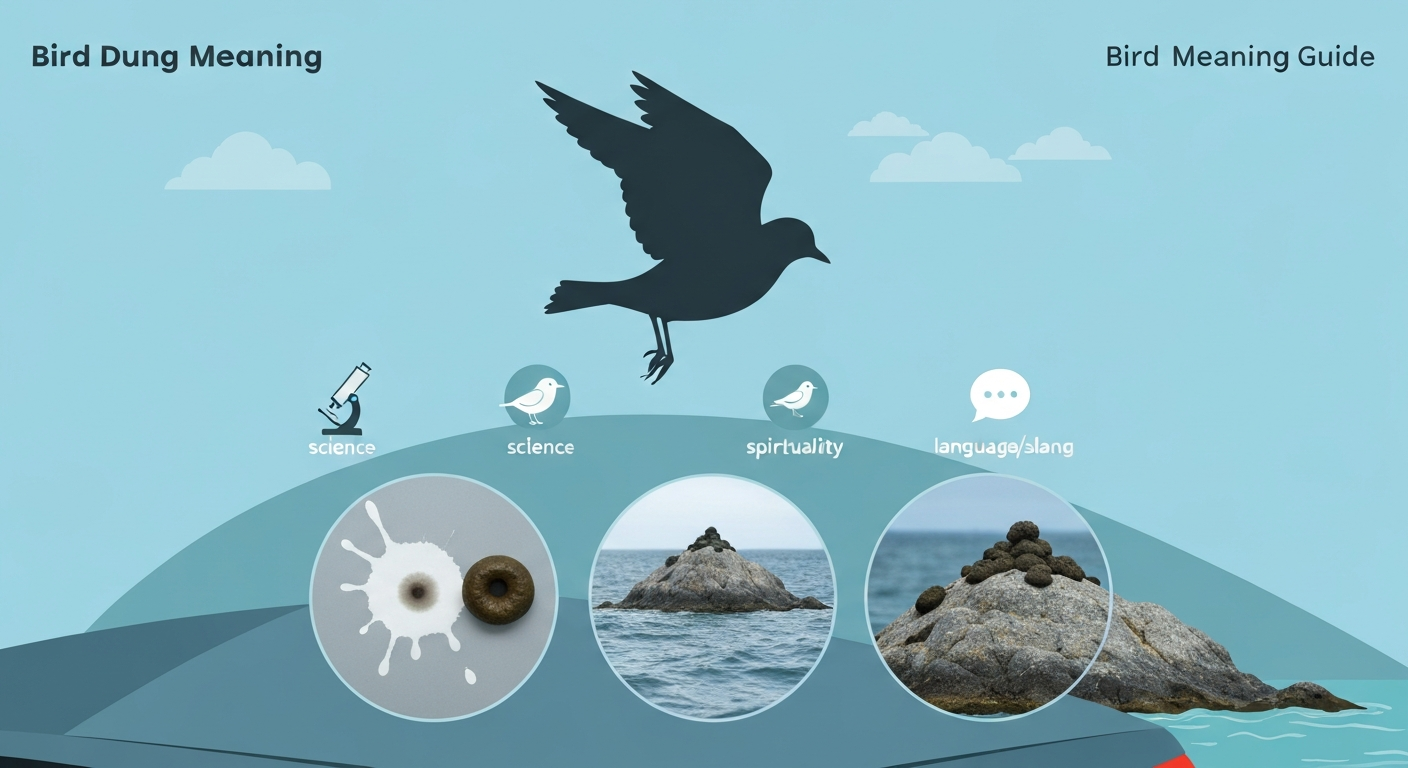
Why bird dung meaning is worth understanding
Bird dung means the excrement produced by birds, but that single sentence barely scratches the surface of why so many people end up searching for it. You might be a gardener trying to figure out whether what just landed on your tomato bed is a free fertilizer or a health hazard. You might be a dream interpreter wondering what a bird pooping on you last night was trying to tell you. You might be a language enthusiast tracking down the origins of slang. Or you might be someone who just got hit on the shoulder by a passing pigeon and wants to know what the folklore says about your luck. This guide is for all of you. It covers the literal biology, the cultural and spiritual traditions, the slang and wordplay, and the practical cleanup advice, all in one place.
What bird dung actually means: the straightforward definition
Bird dung is the solid and semi-solid waste excreted by birds. Standard dictionaries define dung as animal feces broadly, while droppings is the more neutral, everyday term applied specifically to individual bird deposits. The word dung is older and has a slightly rural or agricultural feel, which is why you often see it in farming and ecology writing. Droppings feels more clinical and is common in ornithology and pest-control contexts. Both terms refer to the same thing: the combined output of a bird's digestive and excretory systems, deposited wherever the bird happens to be at the time.
Biologically, bird dung is not exactly like mammal waste. Birds do not urinate separately. Instead, they excrete uric acid (a white or pale paste called urate) alongside their solid fecal matter. The white wash you see on a car hood or park bench is the urate portion, while the darker center is the fecal portion. This combined package is what makes bird droppings look distinct from most other animal waste, and it also affects how those droppings behave as fertilizer and how they are cleaned up.
Alternate terms you will run into: a quick glossary
The vocabulary around bird dung varies depending on whether you are talking to a farmer, an ecologist, a sailor, or a comedian. Here are the main terms and what each one signals:
| Term | Context / Typical Use | Tone |
|---|---|---|
| Bird dung | General, agricultural, literary | Neutral to formal |
| Bird droppings | Ornithology, pest control, health guidance | Clinical / neutral |
| Bird poop | Everyday conversation, casual writing | Informal / friendly |
| Bird turd | Colloquial speech, humor | Blunt / humorous |
| Bird manure | Gardening, agriculture, composting | Practical / agricultural |
| Guano | Historical trade, ecology, fertilizer industry | Technical / historical |
| Whitewash | Vernacular for the streaky deposit on surfaces | Casual / descriptive |
If you are exploring the more colorful end of this vocabulary, bird turd is worth its own look as a term that has migrated into figurative speech and slang. Similarly, bird manure is called guano in formal agricultural and ecological writing, which is a distinction that matters when you are shopping for fertilizer or reading conservation literature.
Common misspellings and search variants: how to find what you need
If you landed here after typing something that looked a little different, you are not alone. People search for bird-related topics using phonetic spellings and slang variants that do not match standard dictionary entries. Two of the most common variants floating around right now are gerhl and guhl, which are phonetic representations of the word girl as used in certain slang contexts (often associated with phrases like bird gerhl or bird guhl). Those searches are really about slang meanings of the word bird as it applies to people, particularly in British and urban dialects, rather than about literal excrement. If that is what you are after, you will find more useful information in dedicated guides to those terms.
For literal bird dung searches, common misspellings include brid dung, bird dunng, and bird dong. Searching for bird droppings, bird feces, or bird excrement will return the most authoritative scientific and health sources. If you are looking for the fertilizer product specifically, searching guano fertilizer or seabird guano will get you there faster than bird dung fertilizer.
The science: what bird droppings are actually made of
A bird dropping has three components in one package. The dark central mass is fecal matter, the digested remains of food that passed through the gastrointestinal tract. The white or cream-colored paste surrounding or capping it is urate, the excreted form of uric acid. Birds evolved to excrete uric acid rather than urea (as mammals do) because uric acid is far less toxic and can be stored in an egg without harming the embryo. The third component is a small amount of clear fluid from the cloaca, which is the single posterior opening birds use for both waste excretion and reproduction. This combined composition means bird droppings are relatively concentrated in nitrogen, especially compared to diluted mammal urine, which is why they affect surfaces (and fertilize soil) so intensively.
Guano vs bird manure: what is the difference and why it matters
The word guano comes from the Spanish, which borrowed it from the Quechua word wanu, meaning dung or fertilizer. Historically, guano referred specifically to the accumulated deposits of seabird (and bat) excrement found on rocky islands and coastal cliffs, particularly in arid regions like the Peruvian coast, where low rainfall meant the deposits built up over centuries rather than washing away. Those deposits were and remain spectacularly rich in plant-available nitrogen and phosphorus.
Bird manure is the broader agricultural term for any bird excrement used as a soil amendment, including fresh or composted chicken litter, pigeon droppings, and similar poultry byproducts. The key agronomic difference is nutrient concentration. Fresh seabird guano has been documented with high delta-15N values and elevated total nitrogen and phosphorus concentrations relative to most terrestrial organic fertilizers in field and growth-chamber studies. Conventional poultry litter and composted manures generally have lower immediate plant-available nitrogen per dry mass, though nutrient content in any organic fertilizer varies widely depending on the source animal's diet, the storage method, and processing. Purdue Extension manure-management guidance recommends laboratory nutrient analysis before applying any organic material, and cautions about salinity and burn risk from over-application.
| Material | Primary Nutrients | Typical N-P-K Range (dry weight) | Best Use |
|---|---|---|---|
| Seabird guano (raw) | High N, high P | ~10-10-2 to 12-11-2 (varies by species/diet) | Concentrated fertilizer, low application rates |
| Bat guano | High N, moderate P | ~10-3-1 (varies) | Soil amendment, potting mixes |
| Chicken litter (composted) | Moderate N, P, K | ~3-2-2 (varies widely) | Broad field and garden application |
| Processed guano products | Labeled N-P-K guaranteed analysis | Varies by product registration | Commercial horticulture, organic certification |
Extension guidance is consistent: calculate any manure or guano application using a lab analysis and your crop's nutrient requirements. Credit phosphorus and potassium fully in the year of application, and use mineralization factors to estimate available nitrogen. Do not guess on application rates, especially with concentrated seabird guano, because over-application burns plants and risks nutrient runoff.
What bird droppings do for ecosystems
Bird dung is one of the most underappreciated nutrient-transport systems on Earth. Seabirds in particular forage at sea and return to breed on land, physically carrying marine-derived nitrogen and phosphorus back to island and coastal habitats. Peer-reviewed ecological studies show that seabird guano can substantially elevate nitrogen and phosphorus inputs to island ecosystems, altering soil chemistry, changing plant community composition, and supporting elevated productivity in the vegetation surrounding colonies. A 2026 paper in Biogeosciences documents how these guano nutrient subsidies vary by species and diet (piscivore seabirds versus herbivorous birds produce different nutrient ratios), and can even drive morphological and geomorphic change on sandy islands over time.
In marine environments, nutrients from guano deposited on coastal rocks and reefs wash into nearshore waters, stimulating phytoplankton growth and supporting food webs. Coral reef systems near active seabird colonies have measurably higher fish biomass in some studies, a chain of effects that runs from a seabird's gut straight to reef ecology. On land, the high nitrogen content of guano accelerates decomposition of organic matter and can shift vegetation from low-nutrient adapted species toward nitrogen-demanding fast growers, sometimes helping and sometimes disrupting native plant communities depending on the scale.
Cultural and spiritual meanings of bird dung
The superstition that being pooped on by a bird brings good luck is one of the most widespread pieces of avian folklore in the Western world, found in British, Russian, Turkish, and Italian folk traditions among others. The most common cultural logic behind it runs something like this: the odds of being hit are low, and rarity has historically been coded as fortune. Some traditions link the good luck specifically to the bird species involved. A white dove or swallow deposit is considered especially auspicious in several European traditions, while a crow or raven dropping reads more ambiguously across cultures.
Across different cultural traditions, the interpretation shifts considerably. In some South Asian folk contexts, bird droppings on a threshold or entrance are read as a sign that the home will receive visitors or that prosperity is incoming. In parts of West Africa, specific birds defecating near a person are interpreted through divination frameworks where the bird species, the direction of flight, and the location of the dropping all carry specific meaning. I want to be honest here: these traditions are richly varied and highly localized, and anyone exploring them seriously should consult tradition-specific sources rather than generic luck lists.
Dream interpretations
In dream interpretation frameworks, bird poop appearing in a dream is almost universally coded as positive, particularly in folk-psychology and popular dream dictionaries. The most common interpretation is unexpected financial gain or good news arriving from an unexpected source, which mirrors the waking superstition about luck. Being pooped on by a bird in a dream is often read as a sign that abundance is incoming, or that something you have been worrying about will resolve itself without intervention. Dreaming of large quantities of bird droppings, such as finding guano on a roof or clearing it from a car, is sometimes interpreted as a call to clean up a situation in your waking life before moving forward. These are cultural and psychological readings, not scientific claims, and they vary by interpretive tradition.
Symbolism by species: a quick note
The species of bird matters a great deal in symbolic readings. A pigeon dropping carries different cultural weight than an eagle dropping, even if the biology is identical. Pigeons are urban, common, and associated with both peace and pestilence depending on who you ask. Eagles, owls, and ravens carry heavier symbolic freight in most traditions, and a dropping from one of those birds would be interpreted through the lens of whatever that species means in the tradition you are working with. If you are doing serious symbolic or spiritual interpretation, it is worth looking up the specific bird rather than treating all bird dung as a single category.
Slang, puns, and bird dung in language
Bird dung has not made a huge independent mark in English slang, but its close relative bird turd has, and the broader vocabulary around it feeds into puns, idioms, and wordplay in interesting ways. For a detailed look at bird turd meaning in slang and figurative speech, see our dedicated discussion of that term. Bird puns as a category are extremely active in English, partly because bird names and bird behaviors map easily onto human situations. The phrase for the birds, meaning worthless or contemptible, dates to American military slang from World War II and is a polite euphemism for something involving bird excrement. Whitewash as a metaphor for covering up truth or scandal also draws on the visual image of bird lime (another old term for droppings) coating surfaces.
In British English, the word bird has long been used as informal slang for a young woman (related to the terms gerhl and guhl that appear in some search queries), and that usage is entirely separate from any connection to dung or droppings. The linguistic overlap between bird-the-animal and bird-the-slang can make some searches ambiguous, which is worth keeping in mind if you are doing language research.
Health risks you should actually know about
Most incidental contact with bird droppings, a splash on your arm, a drop on your head, is low risk and easily managed with basic hygiene. The genuine health concerns arise with accumulated, dried droppings, particularly in enclosed or semi-enclosed spaces like attics, building ledges, HVAC systems, and under bridges.
The two primary biological hazards are fungal. Histoplasma capsulatum, the fungus that causes histoplasmosis, thrives in soil enriched by bird (and bat) droppings, and is found across large regions of North America, particularly the Ohio and Mississippi River valleys. Cryptococcus species are similarly associated with accumulated pigeon droppings in urban environments. Both are transmitted primarily by inhaling spores from disturbed, dried material. CDC outbreak epidemiology has linked histoplasmosis cases directly to building cleanouts, demolition work, and cave exploration where bird or bat guano had accumulated. Epidemiology of Histoplasmosis Outbreaks, United States, 1938–2013, Emerging Infectious Diseases (CDC journal) A review titled "Epidemiology of Histoplasmosis Outbreaks, United States, 1938–2013 — Emerging Infectious Diseases (CDC journal)" documents outbreaks linked to disturbance of bird or bat droppings and occupational exposures such as building clean‑outs, bridge work, and cave exploration.. A third hazard, psittacosis (caused by Chlamydia psittaci), is a bacterial respiratory disease associated mainly with parrots, parakeets, and poultry, transmitted through contact with infected birds or their dried droppings.
For workplace and large-scale cleanup situations, NIOSH and CDC guidance is clear: keep the material wet to prevent aerosolization, use an N95 or higher NIOSH-approved respirator, wear eye protection and gloves, and bag and dispose of contaminated materials according to local regulations. Large accumulations in confined spaces should be handled by trained professionals. Bird droppings near air intakes or inside ductwork are a specific building-health concern and have been implicated in indoor outbreak events.
If a bird poops on you right now: what to actually do
For the overwhelming majority of people, getting hit by a bird dropping is a minor inconvenience rather than a health event. Here is the practical sequence based on CDC hand-hygiene and public-health guidance:
- Do not touch your face, eyes, or mouth before cleaning up.
- Rinse the affected area with clean running water immediately.
- Wash thoroughly with soap and water for at least 20 seconds.
- If the dropping landed on a cut or open wound, wash the wound carefully, cover it, and monitor for signs of infection.
- Wash or spot-clean affected clothing before wearing again.
- Seek medical attention only if you develop fever, respiratory symptoms, or signs of wound infection in the days following. For most healthy adults, casual contact requires no further action.
The good-luck superstition, while scientifically unsupported, does at least serve a useful psychological function: it reframes an annoying event as something positive, which is not the worst coping mechanism available. Whether you choose to interpret it as fortune or just rinse it off and move on is entirely up to you.
Separating myths from facts
A few claims about bird dung circulate persistently that are worth correcting directly. The idea that bird droppings are sterile because birds have high body temperatures is false. While the high uric acid content does create an inhospitable environment for some microorganisms, droppings can and do carry viable pathogens including Salmonella, Campylobacter, and the fungal and bacterial agents described above. The opposite extreme, that a single bird dropping on the skin will make you seriously ill, is also an exaggeration. Risk scales with exposure type, accumulated quantity, and whether material is inhaled, not with brief surface contact. The luck superstition is culturally real in the sense that it exists and is widely held, but there is no mechanism by which pigeon excrement predicts financial windfalls. And guano is not simply a premium version of any organic fertilizer: its nutrient concentration and the risk of nutrient burn mean it requires the same careful application math as any other concentrated amendment.
Where to go from here
If this guide pointed you toward a more specific question, there are several natural next steps. The ecological and agricultural role of accumulated seabird excrement is explored in depth in material on what bird manure is called and how it is classified. The figurative and humorous register of bird waste vocabulary, including compounds and puns built around these terms, is worth exploring if language is your focus. And if a dream brought you here, the species of bird you saw matters as much as the act itself, so species-level symbolism guides will give you more precise interpretive tools than any general dung entry can.
FAQ
What is the clear, simple definition of "bird dung" for readers of Bird Meaning Guide?
Bird dung (also called droppings, guano, or bird poop) is the combined solid fecal material and white urate excreted by birds. Unlike mammals that excrete liquid urine, birds eliminate nitrogenous waste as urate, producing the familiar mixed‑texture deposits commonly seen on perches, vehicles, and paths.
What alternate terms should I know and how are they used?
Common alternate terms: "droppings" (neutral, everyday), "dung" (broad term for animal feces), "turd" (coarse/slang), "manure" (used agriculturally), and "guano" (technical/historical term for accumulated seabird/bat excrement used as fertilizer). Tone varies: "guano" and "manure" are technical/neutral; "turd" is informal; "droppings" is family‑friendly.
What are common misspellings or search variants to include for SEO?
Include misspellings/search variants such as: "gerhl," "guhl," "guano" (often misspelled as "guanoo"), "bird poo," "bird poop," "bird droppings," and typos like "bird dung meaning" (word order variants). These reflect user behavior and phonetic errors.
Scientifically, what is bird dung made of and why does it look like both white and dark material?
Bird droppings contain two parts: dark fecal material (digestive waste) and a white paste of urate (the bird form of nitrogenous waste derived from uric acid). The urate appears white and pasty because birds concentrate nitrogenous wastes to conserve water; the mix affects nutrient chemistry and decomposition.
What's the difference between guano and other manures?
Guano refers specifically to accumulated seabird (and sometimes bat) droppings that have built up and often been mined as fertilizer; it is typically higher in plant‑available nitrogen and phosphorus per dry mass than many terrestrial manures. "Manure" broadly includes feces from farm animals (chicken, cow, pig) and varies widely by species, diet, and storage—so nutrient content and application rates differ.
How valuable is guano as a fertilizer compared with regular manures?
Seabird guano is often richer in readily available N and P and can produce strong fertilization effects on plants. However, nutrient content varies by source and processing; agricultural guidance recommends lab nutrient analysis and using extension bulletins (e.g., Purdue Extension) to calculate application rates and avoid salt or burn damage.
Next Article
Bird Gerhl Meaning: Guide to Droppings, Folklore & Cleanup
What 'bird gerhl' means: misspellings, bird droppings (guano), folklore, dreams, health, cleanup & uses.