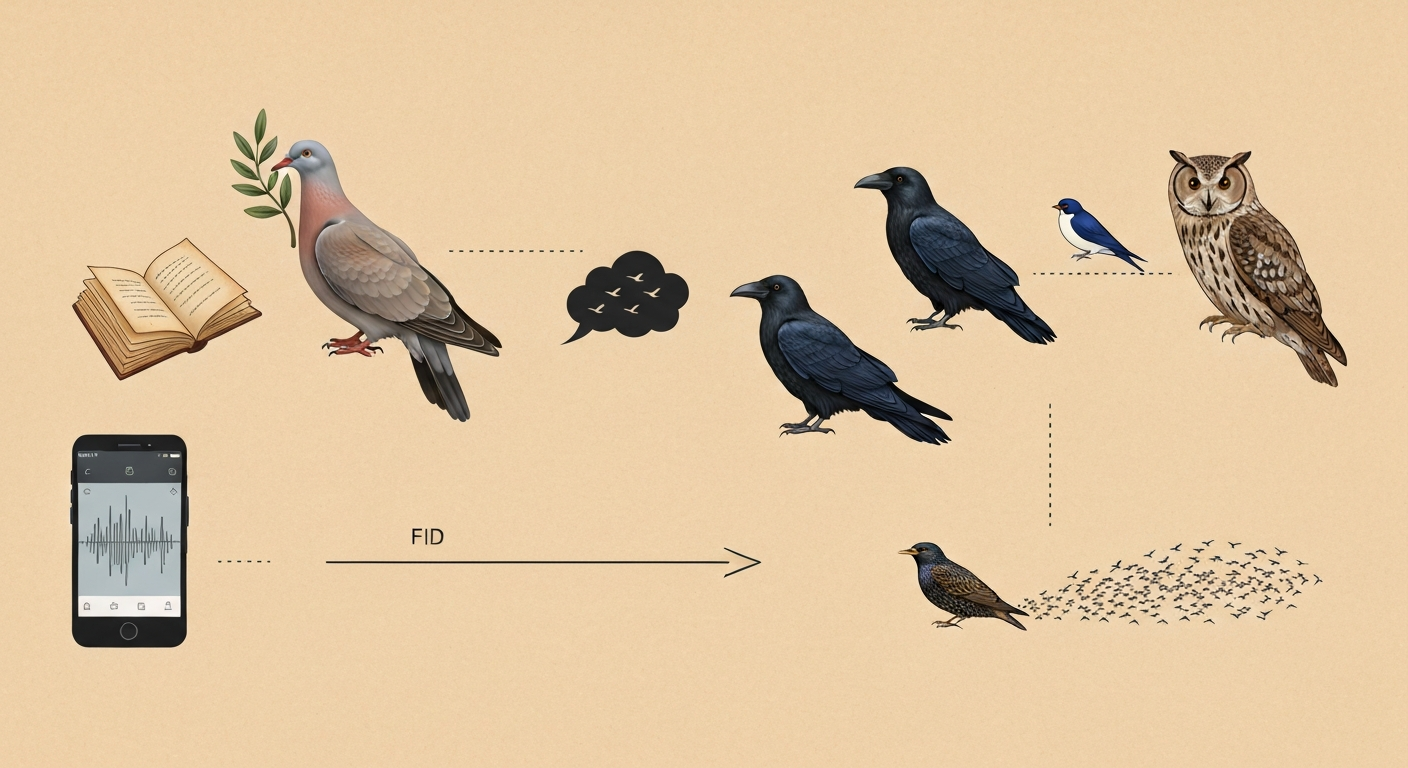
Bird species meaning covers a genuinely wide range of things depending on who is asking. At its core, it refers to understanding what a particular bird species signifies, whether that means its scientific identity and behavior, its cultural or spiritual symbolism, its appearance in dreams or omens, or even its use as a slang term or nickname. There is no single correct layer to focus on: a robin sighting can mean 'spring is here' to an ornithologist tracking migration and 'a message from a lost loved one' to someone steeped in folk tradition, and both interpretations deserve to be taken seriously on their own terms.
Bird Species Meaning: Complete Guide to Symbolism & ID

Marcus Holloway
12 Aug 2026
What people actually mean when they search 'bird species meaning'
This phrase attracts at least four distinct types of readers, and it is worth knowing which one you are before diving in. First are birdwatchers or curious observers who spotted an unfamiliar bird and want to identify it scientifically, learn its range and behavior, and understand what role it plays in the ecosystem. Second are people exploring cultural history, folklore, or spiritual traditions who want to know what a particular species has symbolized across different societies and time periods. Third are dreamers and sign-readers who woke up with a vivid bird image in their head and are wondering what it might mean symbolically. Fourth are people who encountered bird-related language in a slang, social-media, or colloquial context, such as 'the bird app' or being called a 'sparrow.' Each of these readers needs a different lens, and a good bird species reference serves all of them.
The five core contexts for bird meanings
1. Cultural symbolism
Cultural symbolism is the most historically documented context for bird meanings. Specific species have been tied to nations, deities, virtues, and values across thousands of years. The bald eagle is the national symbol of the United States, chosen in 1782 for its perceived strength and freedom. The crane carries longevity and good fortune in Japanese, Chinese, and Korean traditions. The peacock represents divine beauty and immortality in Hindu iconography and early Christian art. These associations are not accidental or random: they usually trace back to a species' actual, observable behavior (the eagle's predatory power, the crane's long lifespan) which was then amplified and formalized through art, myth, and governance. When you see a bird used as a national emblem or in traditional ceremony, cultural symbolism is what you are reading.
2. Spiritual and omenic meaning
Birds have functioned as messengers between the human and divine in virtually every major spiritual tradition on Earth. In the Hebrew Bible, Noah sends a raven and then a dove from the ark in Genesis 8:6 to 12, with the dove's return carrying an olive branch becoming one of the most enduring peace symbols in Western culture. In many Indigenous cultures of the Pacific Northwest, Raven is a creator and trickster figure, not merely an animal but a cosmic agent documented in ethnographic collections including artifacts held by the British Museum. The ancient Romans practiced augury, the formal reading of bird flight and behavior to determine divine will. These spiritual meanings are deeply culture-specific, which means a crow is a death omen in some European folk traditions but a revered ancestor figure in others. The key is always to ask: whose spiritual framework are we working within?
3. Behavioral and ornithological meaning
This is the scientific layer, and it is the most verifiable. Ornithological meaning refers to what a species' presence, behavior, or vocalization actually tells you about the natural world around you. Seeing swallows flying low over a field genuinely indicates the presence of low-flying insects, which are often more abundant before rain, so the old weather-prediction lore has a behavioral basis. Hearing a woodpecker drumming means a territory is being established or defended. Cornell Lab's All About Birds platform and BirdLife International's species factsheets are the authoritative sources for this layer: they document scientific names, ranges, foraging behaviors, vocalizations, and conservation status. The American Robin (Turdus migratorius), for instance, is not a true harbinger of spring because it migrates based on food availability, not calendar date, meaning some robins overwinter in northern states. Behavioral context corrects a lot of popular misconceptions.
4. Slang and nickname usage
Birds show up constantly in informal language, and the meanings can be completely detached from the actual animal. 'Birding the app' or references to 'the bird app' now almost universally refer to the social media platform formerly known as Twitter, whose logo was a stylized blue bird and whose rebranding to X did not fully erase the bird association in popular usage. Calling someone an 'old crow,' a 'wise owl,' or a 'free bird' invokes cultural shorthand that may not reflect the species' actual behavior at all. Nicknames with bird origins are common across sports teams, military units, and personal monikers. Understanding slang and nickname usage requires cultural context rather than ornithological knowledge, and it is worth keeping those layers separate to avoid confusion.
5. Superstition and dream interpretation
Dream and superstition meanings are the most subjective layer, and also the most frequently misrepresented online. Academic dream research, including frameworks like the Hall and Van de Castle content-analysis system and reviews published in peer-reviewed journals, confirms that animal imagery appears in a measurable proportion of dreams but does not support specific predictive meanings like 'dreaming of an owl means death is near.' What it does support is that birds in dreams often map onto themes of freedom, perspective, aspiration, and transition, which are the categories most consistently associated with flying creatures across many cultures. The honest approach, which I try to take throughout this site, is to treat dream symbols as prompts for personal reflection rather than fixed prophecies, and to label popular dream-dictionary claims clearly as 'popular modern interpretation' rather than empirically supported fact.
How to interpret a bird sighting or dream: a practical method
The biggest mistake people make when trying to decode a bird sighting or dream is jumping straight to symbolic meaning without first grounding the encounter in observable reality. Here is the process I recommend, which balances ornithological fact-checking with genuine openness to cultural and personal meaning.
- Identify the species accurately. Before consulting any symbolic meaning, confirm what bird you actually saw or dreamed about. Use a tool like Cornell Lab's free Merlin Bird ID app, which offers photo identification and sound identification trained on the Macaulay Library dataset. Misidentification leads to misinterpretation.
- Check the natural context. Is the bird behaving normally for its species? A crow gathering in a large roost is doing exactly what crows do in winter; it is not an omen. A bird repeatedly tapping on a window is responding to its own reflection, not delivering a message. Behavioral ornithology explains most 'unusual' sightings.
- Identify your cultural framework. Symbolic meanings are not universal. Ask which tradition or cultural context is most relevant to you or to the person whose tradition you are exploring. A raven means one thing in Pacific Northwest Indigenous cosmology and something quite different in Victorian Gothic literature.
- Weigh the evidence label. For each meaning you encounter, ask whether it comes from a primary ethnographic or textual source (strongest), a documented regional folkloric tradition (solid but culturally bounded), a popular modern interpretation (treat with caution), or an unsourced claim with no verifiable origin (low weight).
- Apply personal relevance last. After you have grounded the sighting in biology and cultural context, ask what the encounter means to you personally given your own history and emotional state. This is where genuine reflection happens, but it works better when it is not the first step.
Common mistakes and misconceptions when decoding bird meanings
- Assuming one meaning applies globally. Owls represent wisdom via Athena in classical Greek tradition and death omens in several European and some Indigenous folk traditions. Neither meaning is universally 'correct.'
- Treating robin sightings as definitive spring arrival. American Robins overwinter in many northern U.S. states by moving to wooded areas and eating berries; Cornell Lab data confirms they are year-round residents across much of their range, not strict spring migrants.
- Confusing species within a group. 'Crow' and 'raven' carry different cultural weights but are often used interchangeably in popular symbolism. Ravens (Corvus corax) are considerably larger, have distinct vocalizations, and occupy different ranges than American Crows (Corvus brachyrhynchos). The distinction matters when cultural meanings are species-specific.
- Over-relying on dream dictionaries. Modern online dream dictionaries typically lack sourcing. Academic dream research using content-analysis methods does not support fixed predictive meanings for specific bird species in dreams.
- Reading slang or metaphorical bird references as literal. When someone mentions 'the bird app' or says someone 'flew the coop,' they are using figurative language, not describing ornithological events.
- Ignoring conservation context. Describing a species as a 'sign of abundance' when it is actually in decline (like many grassland sparrow species) is both factually inaccurate and potentially harmful to conservation awareness.
How the species entries on this site are organized
Each species entry in this reference follows a consistent structure so you can quickly find the layer of meaning you are looking for. The entry opens with the species' common name and scientific name, followed by a brief behavioral and ecological note drawn from ornithological sources like Cornell Lab's All About Birds and BirdLife International factsheets. Then it moves through cultural symbolism (what the bird has represented in human societies), spiritual and omenic meanings (with tradition-specific attribution), slang and nickname usage (colloquial and pop-cultural appearances), and finally dream and superstition interpretations (clearly labeled by evidence strength). Wherever a claim is widely repeated but unsupported, it is noted as popular modern interpretation or explicitly debunked.
Species entries: common birds and what they mean
Robin (American Robin: Turdus migratorius / European Robin: Erithacus rubecula)
Scientifically, the American Robin is one of North America's most abundant songbirds: Partners in Flight estimated approximately 370 million breeding individuals as of 2019, and Cornell Lab rates its conservation status as Low Concern. It is primarily a ground-foraging thrush known for its orange-red breast, its characteristic head-tilting behavior while hunting earthworms (which relies on sight, not hearing, despite the popular myth), and its loud, flute-like song at dawn and dusk. The European Robin is an entirely different species in the Old World flycatcher family but shares the red-orange breast coloring that gave both their common name.
Culturally, the robin is one of the most beloved birds in both British and American folk tradition. In the UK, the European Robin's association with Christmas likely traces to Victorian-era postmen, who wore red waistcoats and were nicknamed 'robins,' appearing on greeting cards alongside the birds. In North American Indigenous traditions, particularly among some Algonquian peoples, the robin's arrival is genuinely tied to seasonal change and renewal. Spiritually, many people in contemporary Western practice interpret a robin sighting as a message from a deceased loved one, a belief that appears to be a modern folk tradition rather than one with deep historical roots in primary ethnographic texts. In dreams, robins broadly associate with new beginnings and renewal, consistent with their spring behavioral profile.
Crow and Raven (Corvus brachyrhynchos / Corvus corax)
These two corvids are among the most symbolically loaded birds in human culture and are frequently confused. The Common Raven (Corvus corax) is larger (wingspan up to 4 feet), solitary or in pairs, and associated with wilderness and mountainous terrain. The American Crow (Corvus brachyrhynchos) is smaller, gregarious, forms massive winter roosts, and thrives in urban and suburban environments. BirdLife International tracks both species; Corvus corone (Carrion Crow, the European equivalent) has a stable conservation status in most of its range. Both are demonstrably intelligent: corvids have passed mirror self-recognition tests and have shown planning and tool-use behaviors in controlled studies.
In Pacific Northwest Indigenous traditions, Raven functions as creator, transformer, and trickster, a role documented in ethnographic collections and artifacts held by institutions including the British Museum. This is one of the most robustly sourced bird-meaning traditions in the world: primary oral histories, material culture, and living ceremonial practices all confirm it. In European folklore, crows and ravens became associated with death and ill omen largely because of their scavenging behavior on battlefields, a behavioral observation that was then spiritualized. Edgar Allan Poe's 1845 poem 'The Raven' is arguably the single most influential text cementing the raven-as-harbinger image in modern Western consciousness, but it is literary rather than folkloric in origin. In slang, 'old crow' is a dismissive term for an unpleasant older woman, now considered offensive. In dreams, crows and ravens commonly associate with transformation, intelligence, and the shadow self in Jungian-influenced interpretations, though these are popular modern frameworks rather than empirically validated predictors.
Pigeon and Dove (Columba livia / Zenaida macroura / Columba palumbus)
The feral pigeon (Columba livia domestica) is one of the most urbanized birds on Earth, descended from rock doves domesticated for food and message-carrying for thousands of years. Wild Rock Doves still exist in coastal cliff habitats, but the pigeon most people encounter in cities is fully feral. The Mourning Dove (Zenaida macroura) is a separate North American species, slender and long-tailed, more commonly associated in American culture with peaceful, gentle qualities. Doves cooed from pens in ancient temples as offerings; their homing instinct was used in wartime communication as recently as World War II.
The dove is arguably the single most globally recognized peace symbol, tracing directly to the Genesis 8 narrative where Noah's dove returns with an olive branch, a primary textual source with enormous historical reach. In Christian iconography the dove represents the Holy Spirit. In Greek mythology, doves were sacred to Aphrodite. The urban pigeon, however, carries nearly opposite cultural associations, frequently described as a pest or 'rat with wings,' a phrase coined and popularized in New York City in the 1960s and reflecting urban anxieties rather than the bird's actual ecological role. In slang, 'stool pigeon' or simply 'pigeon' refers to an informer, tracing to the practice of using a tied-down pigeon as a decoy to attract other birds. In dreams, doves broadly represent peace, love, and resolution, consistent with their deep cultural encoding across multiple traditions.
Sparrow (multiple Passer and Melospiza species)
The House Sparrow (Passer domesticus) is one of the most widespread birds in the world, introduced across the Americas, Australia, and much of Africa from its Eurasian origin, and now considered an invasive species in many regions where it competes with native cavity-nesting birds. The Song Sparrow (Melospiza melodia) is a native North American species with significant regional variation; Cornell Lab identifies it as one of the most variable species in North America by subspecies. Native sparrow populations, particularly grassland species, are in measurable decline, making the 'common sparrow' framing ecologically complicated.
Culturally, the sparrow's symbolic weight comes largely from its perceived ordinariness and ubiquity. In the Christian New Testament (Matthew 10:29), sparrows are used to illustrate divine care for even the humblest creatures: 'Are not two sparrows sold for a penny? Yet not one of them will fall to the ground outside your Father's care.' This makes the sparrow a powerful symbol of humility, divine attention, and the value of the small and overlooked. In East Asian traditions, sparrows sometimes appear as omens of good luck and cheerful domesticity. In slang, 'Jack Sparrow' as a pirate name plays on the bird's association with small, quick, and unpredictable characters. In dreams, sparrows often represent community, simplicity, and contentment, or in some traditions, impending domestic change.
Hawk and Falcon (Buteo jamaicensis / Falco peregrinus)
The Red-tailed Hawk (Buteo jamaicensis) is the most commonly seen large hawk in North America, frequently perching on highway poles and fence posts. The Peregrine Falcon (Falco peregrinus) is the fastest animal on Earth in a stoop (recorded at over 240 mph), and made a remarkable recovery after near-extinction from DDT poisoning, now breeding on urban skyscrapers across North America. Both are raptors but belong to different orders, a distinction that matters because 'hawk' and 'falcon' are sometimes used interchangeably in cultural symbolism even though their biological relationship is distant.
Hawks and falcons are among the most consistently positive bird symbols in human culture. In ancient Egypt, the falcon-headed god Horus represented divine kingship and the sky; the pharaoh was considered the living embodiment of Horus, making the falcon one of the most politically significant bird symbols in history. In many Indigenous North American traditions, hawks are messengers between the human and spirit world and are associated with clarity of vision and focus. Falconry, which dates back at least 3,000 years in Central Asia and the Middle East, created an entire cultural vocabulary around raptors: a 'haggard' (adult wild-caught falcon) and an 'eyas' (nestling) are terms still used today. In contemporary slang, 'hawk' refers to someone with aggressive, confrontational political views (versus 'dove'), a usage that traces directly to pre-Civil War American political discourse. In dreams, hawk or falcon imagery broadly associates with focus, clear perspective, and messages worth paying attention to.
Owl (Bubo virginianus / Strix aluco / multiple Strigiformes)
Owls are nocturnal or crepuscular birds of prey found on every continent except Antarctica. The Great Horned Owl (Bubo virginianus) is among the most powerful and widely distributed owls in the Americas; the Tawny Owl (Strix aluco) is the familiar 'twit-twoo' owl of British woodland. All owls share adaptations for low-light hunting: asymmetrically placed ears for three-dimensional sound location, facial discs that direct sound, and silent flight enabled by specialized feather structure. None of these adaptations have any magical basis, though they are genuinely remarkable.
The owl's symbolic life is one of the most richly documented contradictions in bird symbolism. In classical Greece, the Little Owl (Athena noctua) was the companion of Athena, goddess of wisdom, and appeared on Athenian coins: this is the origin of the 'wise owl' trope in Western culture and it has a direct, traceable primary source in ancient texts and material culture. In contrast, many European folk traditions associated owls with death and witchcraft, largely because their nocturnal habits, eerie vocalizations, and appearance near cemeteries (hunting rodents attracted to grain stores near burial grounds) made them easy to cast as ill omens. Both the wisdom tradition and the death-omen tradition are well-documented in folklore scholarship, including public-domain compilations like Ernest Ingersoll's 'Birds in Legend Fable and Folklore.' In many Indigenous North American traditions, owl sightings or calls carry serious spiritual weight as death warnings, and these are living traditions that should be respected rather than dismissed as superstition. In slang, being called 'owlish' suggests a studious, bespectacled appearance. In dreams, owl imagery most commonly associates with hidden knowledge, transition, and the unknown.
Swallow (Hirundo rustica / Tachycineta bicolor)
The Barn Swallow (Hirundo rustica) is the most widespread swallow in the world, breeding across North America, Europe, and Asia and wintering in South America, Africa, and Southeast Asia. The Tree Swallow (Tachycineta bicolor) is the most studied migratory passerine in North America due to its use of nest boxes, making it a key species for climate change research because its egg-laying dates have shifted measurably earlier over the past 40 years. Both species are aerial insectivores, consuming insects entirely in flight, and their presence in an area is a reliable indicator of insect abundance and ecosystem health.
Swallows are among the most consistently positive bird symbols across cultures. The tradition of swallows as good luck for ships traces to their behavior of following fishing boats for insects and then heading toward land, making them practical navigation aids as well as symbols of hope for returning home. European sailors historically tattooed swallows to mark 5,000 nautical miles traveled. In many European folk traditions, a swallow nesting in your eaves is good luck and to destroy the nest is bad luck, a belief that has the incidental effect of protecting a genuinely beneficial insect-control species. In Japanese and Chinese traditions, swallows entering a home are auspicious, associated with happiness and family prosperity. In dreams, swallows frequently represent travel, homecoming, and positive transitions.
Goose (Branta canadensis / Anser anser)
The Canada Goose (Branta canadensis) is one of North America's most recognizable waterfowl, originally a migratory species whose urban non-migratory populations have expanded dramatically due to suburban lawn habitat and reduced hunting pressure. The Greylag Goose (Anser anser) is the wild ancestor of most domestic goose breeds in Europe. Geese are highly social, mate for life in most species, and are well-documented for their aggressive nest defense and their V-formation flight, which reduces aerodynamic drag for trailing birds.
Culturally, geese occupy a complex symbolic space. In ancient Egypt, the goose was associated with the primordial creation (Geb, the earth god, was sometimes shown as a goose). In Roman history, geese famously warned the Capitol garrison of a Gallic night attack in 390 BC, making them symbols of vigilance. In European fairy tales, geese are associated with the domestic and the humble ('The Goose Girl,' 'Mother Goose'), and golden eggs in 'The Goose That Laid the Golden Eggs' make the species synonymous with squandered abundance. 'Wild goose chase,' meaning a futile pursuit, originates in a 16th-century equestrian race where riders had to follow a lead horse at erratic intervals, mimicking the flight pattern of geese, not literally chasing birds. In dreams, geese often represent community, navigation, and the tension between belonging and freedom.
Heron (Ardea herodias / Ardea cinerea)
The Great Blue Heron (Ardea herodias) is the largest heron in North America, standing up to 4.5 feet tall with a wingspan exceeding 6 feet. The Grey Heron (Ardea cinerea) is its Old World equivalent and one of Europe's most familiar wading birds. Both species are solitary hunters, standing motionless at water edges for extended periods before striking with extraordinary speed. They nest colonially in tall trees in groups called heronries or rookeries (in British usage), which can contain hundreds of nests.
Herons are strongly associated with patience, stillness, and self-reliance in most symbolic traditions that address them. In ancient Egypt, the Bennu bird, the mythological progenitor of the phoenix, was likely modeled on the Grey Heron: it was associated with the sun god Ra and the creation of the world, making the heron one of the oldest bird symbols in recorded human history. In many Native American traditions, the heron represents self-determination and the ability to progress by following one's own instincts. In Celtic traditions, herons are associated with the transitions between worlds, particularly the boundary between land and water. In Japanese and Chinese art, herons (especially white herons) represent purity, patience, and longevity. In dreams, heron imagery commonly associates with stillness, clarity, and the wisdom to wait for the right moment.
Hummingbird (Archilochus colubris / Selasphorus rufus and others)
Hummingbirds are exclusively found in the Americas and represent one of the most physiologically extreme groups of birds in the world. The Ruby-throated Hummingbird (Archilochus colubris) is the only breeding hummingbird in eastern North America and crosses the Gulf of Mexico in a single non-stop flight of up to 500 miles during migration. Their wings beat 40 to 80 times per second; their hearts can beat over 1,200 times per minute during flight; and they enter torpor at night to conserve energy, dropping their heart rate to as low as 50 beats per minute. These are genuinely extraordinary facts that require no symbolic embellishment.
Symbolically, hummingbirds are among the most spiritually significant birds in Mesoamerican and South American traditions. In Aztec belief, the god Huitzilopochtli (whose name translates roughly as 'Hummingbird of the South') was the patron of the sun, war, and the Aztec people; fallen warriors were believed to reincarnate as hummingbirds. This is one of the most robustly documented bird-meaning traditions in the Western Hemisphere, with primary sources in Aztec codices and Spanish colonial ethnographic accounts. In many contemporary Latino and Indigenous traditions, hummingbirds continue to represent joy, resilience, the souls of loved ones, and the ability to accomplish the seemingly impossible. In broader North American popular culture, hummingbirds have been adopted as symbols of lightness, adaptability, and living fully in the present moment. In dreams, hummingbird imagery is almost universally associated with joy, speed, and the preciousness of fleeting moments.
Quick-reference table: species meanings at a glance
| Species | Scientific Notes | Common Behaviors | Cultural / Spiritual Meanings | Slang / Nickname Examples |
|---|---|---|---|---|
| Robin | Turdus migratorius (NA) / Erithacus rubecula (EU); ~370M breeding in NA (2019) | Ground forager, dawn singer, year-round in much of range | Renewal, spring, deceased loved ones (modern folk); Christmas symbol (UK) | 'Round robin' (circular distribution); 'robin redbreast' (affectionate) |
| Crow / Raven | Corvus brachyrhynchos / Corvus corax; high intelligence, tool use documented | Large roosts (crows); solitary/pairs (ravens); scavengers and generalists | Creator/trickster (Pacific NW Indigenous); death omen (European folk); wisdom (many) | 'Old crow' (offensive slang for older woman); 'eat crow' (admit error) |
| Pigeon / Dove | Columba livia (feral pigeon); Zenaida macroura (Mourning Dove); homing instinct | Urban scavenging (pigeon); ground feeding, gentle flight (dove) | Peace, Holy Spirit, Noah's covenant (dove); wartime messenger (pigeon) | 'Stool pigeon' / 'pigeon' (informer); 'dove' (peace advocate) |
| Sparrow | Passer domesticus (House Sparrow, invasive); Melospiza melodia (Song Sparrow, native) | Sociable, ground-feeding, cavity-nesting | Humility, divine care (Christian NT); good luck, domesticity (East Asia) | 'Jack Sparrow' (pirate archetype); 'sparrow' (small, quick person) |
| Hawk / Falcon | Buteo jamaicensis (Red-tailed Hawk); Falco peregrinus (Peregrine, fastest animal in stoop) | Soaring, perch-hunting, territorial | Horus/divine kingship (Egypt); messenger/clarity (Indigenous NA); recovered from DDT | 'Hawk' (political aggressor); 'hawkish' (confrontational); falconry terminology |
| Owl | Bubo virginianus / Strix aluco; asymmetric ears, silent flight, nocturnal | Nocturnal hunting, territorial hooting, solitary | Wisdom/Athena (Greek); death omen (European folk); serious spiritual warning (many Indigenous NA) | 'Owlish' (studious-looking); 'wise old owl'; 'night owl' (late sleeper) |
| Swallow | Hirundo rustica (Barn Swallow); global breeding range; aerial insectivore | Aerial feeding, migratory, colonial nesting | Safe return, good luck for sailors; auspicious nesting (European, East Asian folk) | Nautical tattoo symbol; 'one swallow does not make a summer' (proverb) |
| Goose | Branta canadensis (Canada Goose); mates for life; V-formation reduces drag for trailing birds | Highly social, aggressive nest defense, urban adaptation | Vigilance (Roman Capitol); domestic/fairy-tale (European); creation (Egyptian) | 'Wild goose chase' (futile pursuit); 'goose is cooked' (situation is hopeless); 'silly goose' |
| Heron | Ardea herodias (Great Blue); up to 4.5 ft tall; colonial nesting in heronries | Motionless stalking, solitary hunting, patient strike | Bennu/phoenix origin (Egyptian); patience, self-reliance (many Indigenous NA); purity (East Asia) | 'Heron' as a name conveying stillness or elegance; no major slang usage |
| Hummingbird | Archilochus colubris; wings 40-80 beats/sec; Gulf of Mexico non-stop migration; enters torpor | Hovering, high-speed flight, territorial aggression despite tiny size | Huitzilopochtli/warrior souls (Aztec); joy, resilience, loved ones' souls (contemporary Latino/Indigenous) | 'Hummingbird' used as a nickname for fast, energetic, or joyful individuals |
What related searches actually mean: bird app, bird hide, bird nickname, and bird-related meaning
People searching for bird species meaning often arrive via related queries that are worth addressing directly, because each one signals a different need. 'Bird app meaning' almost always refers to the social media platform formerly known as Twitter, which used a stylized blue bird as its logo for most of its history. The phrase 'the bird app' became widespread shorthand among users discussing the platform across other social media, and understanding it requires zero ornithological knowledge. If you are specifically interested in bird identification apps rather than social media, Cornell Lab's Merlin Bird ID is the most widely recommended free tool available, offering photo ID, sound ID, and guided identification trained on the Macaulay Library and eBird datasets. Merlin Bird ID FAQs, Cornell Lab / eBird Support provides official guidance on Merlin’s photo and sound ID features and its integration with eBird and the Macaulay Library Merlin Bird ID FAQs — Cornell Lab / eBird Support.
A 'bird hide' (British English) or 'bird blind' (American English) is a camouflage shelter or screen used at nature reserves and wetlands to observe birds without disturbing them. It is a piece of birding infrastructure, not a metaphor or slang term. The RSPB and other major conservation organizations have hides as standard features of their reserves. If you want to use one, the basic etiquette is simple: enter quietly, avoid sudden movements, keep children and dogs calm, and leave nesting or feeding birds undisturbed, as recommended by Audubon and major reserve organizations. For the cultural and symbolic implications of encountering or using a hide, see our short guide on bird hide meaning. You can also build a simple backyard version using natural materials or camouflage netting.
A 'bird nickname' refers to a personal or group nickname derived from a bird species name, whether it is a sports team (the Baltimore Orioles, the Philadelphia Eagles, the Louisville Cardinals), a military unit callsign, or a personal moniker. These nicknames draw on the same symbolic associations covered in the species entries above: eagles for power and freedom, robins for cheerfulness, hawks for aggression and focus. Exploring these naming patterns is a genuinely interesting window into which symbolic qualities a community wants to claim for itself. And 'bird-related meaning' as a general search phrase typically signals a reader who is at the beginning of their exploration and needs exactly the kind of foundational overview this article provides.
What the evidence actually supports: fact-checks and debunked myths
Here is a clear breakdown of which types of bird meaning claims have strong support, which are culturally valid but regionally specific, and which are popular myths with no reliable foundation.
| Claim | Evidence Level | Verdict |
|---|---|---|
| Raven as creator/trickster in Pacific Northwest Indigenous traditions | Primary: ethnographies, oral histories, material culture (British Museum and others) | Well-supported; living tradition |
| Dove as peace symbol from Noah's ark (Genesis 8) | Primary: Hebrew Bible text, traceable through centuries of Western art and theology | Well-supported; primary textual source |
| Owl as symbol of wisdom via Athena in classical Greece | Primary: ancient texts, coins, material culture (Athenian tetradrachm) | Well-supported; documented origin |
| Hummingbird warriors / Huitzilopochtli in Aztec belief | Primary: Aztec codices, Spanish colonial ethnographic accounts | Well-supported; primary sources extant |
| Robin sighting means a deceased loved one is present | No primary ethnographic source identified; modern folk tradition | Popular modern interpretation; not historically deep |
| Dreaming of an owl predicts death | Academic dream research (Hall & Van de Castle; Domhoff) does not validate predictive dream symbols | No empirical support; popular dream-dictionary claim |
| Swallows flying low predicts rain | Partial behavioral basis: low-flying insects precede rain; swallows follow insects | Partially supported behaviorally; not mystical |
| Robin as a strict spring arrival indicator | Cornell Lab data shows American Robins overwinter in northern states | Myth; based on incomplete observation of migratory behavior |
| A crow landing near you is a death omen | European folkloric tradition, not universal; no behavioral basis | Culturally bounded belief; no empirical support |
| Birds tapping on windows are delivering messages | Behavioral explanation: territorial response to reflected image | Debunked as supernatural; behavioral explanation is well-established |
Practical resources for going deeper
For species identification, Cornell Lab's All About Birds website (allaboutbirds.org) is the most comprehensive free ornithological reference available for North American species, with range maps, life history data, photos, and sound recordings for every species. BirdLife International's Data Zone covers global species with IUCN conservation status, range maps, and population trend data. For identification in the field, the free Merlin Bird ID app from Cornell Lab handles photo identification and live sound identification; it is trained on millions of observations from the eBird citizen-science database and the Macaulay Library sound archive. These tools remove the guesswork from species identification before you move on to interpretation.
For cultural and folkloric depth, Ernest Ingersoll's 'Birds in Legend Fable and Folklore' is available as a public-domain text and remains one of the most comprehensive English-language compilations of bird symbolism across traditions. For dream interpretation with academic grounding, Calvin Hall and Robert Van de Castle's content-analysis system is the standard methodology; G. William Domhoff's work at UC Santa Cruz provides accessible reviews of what quantitative dream research actually shows about animal imagery in dreams. For Indigenous North American bird traditions specifically, the most respectful approach is to consult tribally authored sources, cultural centers, or peer-reviewed ethnographic literature rather than generic 'Native American symbolism' websites, which frequently decontextualize and homogenize diverse traditions.
If you are interested in building or using a bird hide, the RSPB's reserve network and Audubon Society's local chapters offer guided visits where experienced observers can show you how to use a hide effectively. For a DIY approach, BirdGuides and similar birding photography resources publish detailed field techniques. And if your interest is in the slang and pop-cultural dimensions of bird meaning, the site's coverage of the bird app, bird nicknames, and bird-related language expressions provides the dictionary layer that ornithological sources understandably skip.
Suggested images and captions for this article
- Hero image: American Robin (Turdus migratorius) standing on a suburban lawn, head tilted, in natural morning light. Caption: 'The American Robin's head-tilt while hunting worms relies on eyesight, not hearing — one of many behaviors that ground its rich symbolic life in observable fact.' Alt text: American Robin standing on grass with head tilted to one side.
- Raven profile portrait: Common Raven (Corvus corax) perched on a branch in a coniferous forest setting. Caption: 'The Common Raven's intelligence and its role as creator-trickster in Pacific Northwest Indigenous traditions make it one of the most symbolically documented birds in the world.' Alt text: Large Common Raven perched on a branch, facing camera.
- Barn Swallow in flight: Hirundo rustica mid-air against a blue sky. Caption: 'Barn Swallows were tattooed on sailors for every 5,000 nautical miles traveled — a tradition rooted in the bird's actual behavior of flying toward land.' Alt text: Barn Swallow in flight with forked tail clearly visible against clear sky.
- Great Blue Heron hunting: Ardea herodias standing motionless at a water edge at dawn. Caption: 'The Great Blue Heron's patient, motionless hunting style is the behavioral origin of its symbolic association with stillness and self-reliance across many traditions.' Alt text: Great Blue Heron standing still at the edge of a calm lake at dawn.
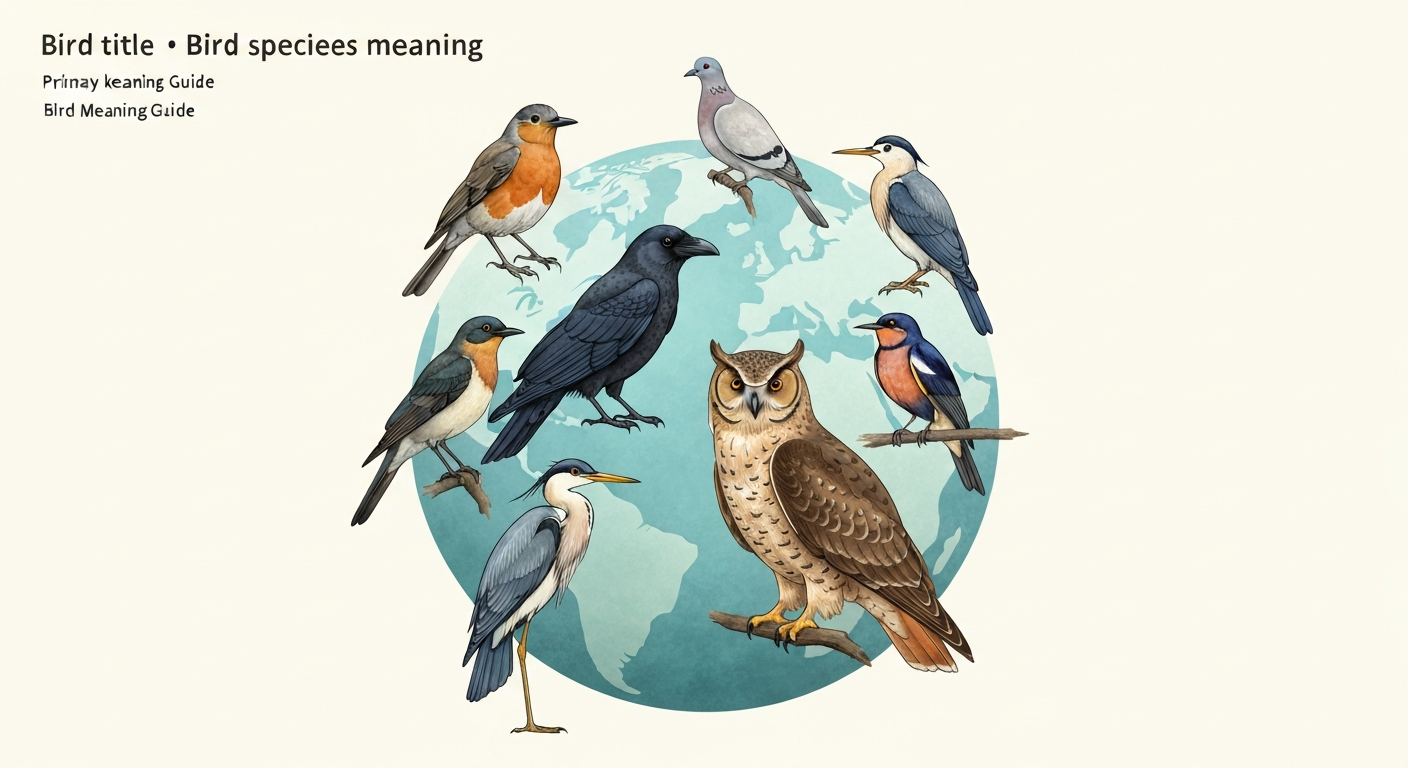
- Comparison infographic: Simple illustrated grid showing all ten species side-by-side with their primary cultural symbol (olive branch for dove, wisdom lamp for owl, etc.). Caption: 'Ten common species, ten layers of meaning — scientific, cultural, and symbolic.' Alt text: Illustrated grid of ten bird species with their primary symbolic associations labeled.
- Ruby-throated Hummingbird hovering at a flower. Caption: 'The hummingbird's connection to Huitzilopochtli, the Aztec god of sun and war, is one of the best-documented bird-meaning traditions in the Americas.' Alt text: Ruby-throated Hummingbird hovering at a red tubular flower, wings blurred with motion.
Using bird meanings responsibly
Bird species meaning is genuinely layered, and the most honest approach is to hold multiple frames at once without collapsing them into each other. The behavioral explanation for a bird tapping on your window is real and well-established: it is territorial response to a reflection. The cultural or personal meaning you draw from that encounter is also real, but it belongs to a different category of knowledge. Neither cancels the other out. The problems arise when people present popular modern interpretations as ancient universal truths, or when they dismiss Indigenous and folkloric traditions as primitive because they do not match a scientific framework. Both moves flatten something genuinely complex.
When you encounter a bird meaning claim anywhere, the most useful questions to ask are: Who originated this interpretation? In what cultural context? Is this a primary source tradition or a modern synthesis? And does the behavioral biology of this species give the symbolism any grounding in observation? Start with accurate identification using a tool like Merlin, layer in the cultural context that is genuinely relevant to your situation, and be honest with yourself about the strength of evidence behind any interpretation you choose to act on. That combination of scientific precision and cultural openness is what makes bird meaning genuinely useful rather than just comforting noise.
FAQ
What does the phrase "bird species meaning" refer to?
"Bird species meaning" can mean multiple things: (1) the natural-history identity and traits of a bird species (common and scientific name, range, behaviour, conservation status); (2) culturally assigned symbolism (myth, folklore, religion, art); (3) spiritual or omenic interpretations (what people think sightings or dreams portend); (4) slang, nicknames, or app/icon meanings; or (5) practical context-specific definitions (e.g., what "bird hide" or "bird app" refers to). Good articles clarify which intent is being addressed.
What are the five core contexts for interpreting bird meanings?
The five core contexts are: (1) Cultural symbolism: regional myths, literature, art; (2) Spiritual/omenic meaning: prophetic or religious interpretations and rituals; (3) Behavioral/ornithological explanation: species ecology, behaviour, and identification; (4) Slang/nickname usage: colloquialisms, sports/team mascots, social-media or app icons; (5) Superstition/dreams: folk dream-dictionaries vs. content-analysis dream research.
How should I weigh scientific ornithology vs. folklore when interpreting a sighting or dream?
Use a clear methodology: (1) identify the species reliably (photo, song, markings); (2) record the objective context (location, time, behaviour); (3) consult ornithological sources first for behavioural explanations (All About Birds, BirdLife, eBird); (4) consult cultural/ethnographic sources for regional symbolism and note provenance and evidence strength; (5) state whether an interpretation is naturalistic, folkloric, or personal; and (6) avoid inferring universal meaning—label claims as primary text/ethnography, regional folklore, popular interpretation, or unsupported.
Which reputable sources should I use when documenting species-level scientific notes?
Use authoritative ornithological and conservation sources: Cornell Lab’s All About Birds and eBird, BirdLife International species factsheets, Partners in Flight population estimates, and Macaulay Library archives. Cite primary sources for range, behaviour, and IUCN status to ensure reliable scientific notes.
How can I document cultural and spiritual meanings responsibly?
Document cultural meanings by citing ethnographic records, museum collections, religious texts, and folklore scholarship. Note geographic and cultural specificity, avoid claiming a motif is 'universal,' and label evidence strength (e.g., 'regional folklore,' 'scriptural source,' 'modern popular reading'). When covering Indigenous meanings, rely on primary Indigenous sources, museum attributions, or peer-reviewed ethnography and respect cultural sensitivities.
What common bird species should have species-by-species entries in a general reference?
Prioritise common and frequently queried species such as: American Robin (Turdus migratorius), Northern Cardinal (Cardinalis cardinalis), Blue Jay (Cyanocitta cristata), American Crow / Carrion Crow (Corvus brachyrhynchos / Corvus corone), Raven (Corvus corax), Barn Owl / Great Horned Owl (Tyto alba / Bubo virginianus), Pigeon/Dove (Columba livia, family Columbidae), Hummingbird (Trochilidae), Sparrow (Passeridae / house sparrow Passer domesticus), Bald Eagle (Haliaeetus leucocephalus). Use eBird and Google Trends to regionalise priorities.
Next Article
Bird Related Meaning: Guide to Symbolism, Sightings & Science
Explore bird related meaning: cultural symbolism, species meanings, dream notes, apps, and evidence levels.