A bird squawk is a loud, harsh, and often abrupt call that birds produce across several distinct behavioral situations: alerting flockmates to a predator, holding a flock together in flight, defending territory, and sometimes even signaling readiness to breed. The word itself is onomatopoeic, recorded in English since the 19th century, and both Merriam-Webster and Oxford define it the same way: a loud, harsh, shrill, or discordant cry. That acoustic roughness is not random. Research on bird vocalization consistently links broadband, noisy call structures to high-stakes or agonistic contexts, which is why a squawk nearly always means something urgent is happening.
Bird Squawk Meaning: What a Squawk Reveals About Birds and Sounds

Marcus Holloway
4 Aug 2026
Who this guide is for
Whether you heard a jarring screech outside your window at dawn, spotted a phrase in a dream-interpretation forum, or came across 'squawk' used as slang on social media, this guide covers all of it. Birdwatchers looking for a behavioral framework, homeowners wondering whether a squawking bird is a bad omen, spiritual seekers trying to decode what the sound meant in a dream, and anyone curious about the slang differences between a 'tweet' and a 'squawk' will all find practical, grounded answers here. I have tried to be clear about what is verified ornithological science versus what belongs to folklore and cultural tradition, because both are worth understanding and neither should be confused with the other.
What ornithologists actually mean by 'squawk'
In formal ornithology, 'squawk' is not a rigidly defined technical term the way 'song' or 'alarm call' is, but the acoustic profile it describes maps directly onto what researchers call a broadband, noisy call. Cornell Lab's Handbook of Bird Biology draws a key functional distinction: songs are typically longer, more complex vocalizations used mainly for territorial advertisement and mate attraction, while calls are shorter, context-driven signals covering alarm, contact, flight, begging, and mobbing. A squawk sits firmly in the 'call' category. It is a short to medium-length vocalization, usually under one second, spectrally rough, often with an abrupt onset and little harmonic structure. That combination of traits makes it immediately distinguishable from the clean, flute-like whistle of a thrush or the sustained trill of a warbler.
The theoretical backbone here comes from Eugene Morton's 1977 Motivation-Structural (MS) rules, published in the American Naturalist. Morton showed, across many bird and mammal species, that harsh, low-pitched, broadband sounds tend to correspond to aggressive or hostile motivational states, while tonal, higher-pitched, narrowband sounds tend to correspond to fear or appeasement. Modern experimental work, including a 2024 Scientific Reports study, has reinforced this pattern. So when you hear a squawk, its acoustic 'roughness' is not coincidental. It is a structural cue that both the species' own flockmates and eavesdropping neighbors are wired to take seriously.
How a squawk actually sounds
If you have ever startled a heron at a pond and heard that raw, throaty explosion of sound as it lifted off, you already have a solid reference point. A squawk is typically louder than the bird's normal contact calls, coarser in texture than a whistle or warble, and short enough that it hits you before you have fully processed it. On a spectrogram, the standard visualization tool used in bioacoustics software like Raven Pro or the free Sonic Visualiser, a squawk appears as a dense, vertically spread blob of energy, broad across frequency bands rather than the clean horizontal stripe of a tonal whistle. That visual 'messiness' is exactly what the ear perceives as harshness.
- Tone: harsh, rough, and often described as raspy or grating, lacking the clean harmonic structure of song
- Duration: short to medium, typically tens of milliseconds up to about one second depending on species and context
- Onset: usually abrupt, with energy building fast rather than the gradual ramp of a whistle
- Frequency range: spectrally broadband, with energy spread across multiple frequency bands rather than concentrated in a narrow band
- Harmonic structure: low or absent, appearing as broadband noise on a spectrogram rather than clear parallel lines
- Volume: comparatively loud relative to the bird's other calls, often carrying over significant distances
- Repetition: frequently repeated in rapid succession during alarm or agonistic events, more spaced out in contact calls
Why birds squawk: the behavioral picture
The same rough acoustic form can show up in several very different situations, which is why context always matters as much as the sound itself. Cornell Lab's overview of bird call types identifies the main functional categories as alarm and distress, contact and aggregation, aggression and agonistic signaling, begging by juveniles, and flight or dispersal calls. Cornell Lab's 'The Language of Birds' overview lists alarm/distress, contact/aggregation, aggression/territorial, begging, and flight/dispersal calls as the main functional call categories The Language of Birds — Cornell Lab (overview of call types and behavioural functions). A squawking crow in your backyard might be mobbing a hawk, rallying its family group, or squabbling with a neighboring crow over a food cache, and those three scenarios have completely different implications for what you should do or what you are witnessing. The sections below break each major context down in detail.
Alarm squawks: the predator warning system
Alarm calls are probably the most universally recognized reason a bird squawks, and the science behind them is richer than most people realize. The landmark example comes from black-capped chickadees. A 2005 Science study by Templeton, Greene, and Davis showed that chickadees actually encode information about predator size into their mobbing calls: the ratio of 'chick-a-dee-dee' call notes varies with how dangerous the predator is, and other birds respond differently depending on how many 'dee' notes they hear. Larger, slower predators like owls trigger more dee notes and stronger responses; smaller, faster raptors produce fewer notes but faster flight from the area.
What makes this especially relevant for squawk interpretation is that cross-species eavesdropping is well documented. Nuthatches, for example, eavesdrop on chickadee alarm variants and adjust their own behavior accordingly, as demonstrated in published experimental work. So when one species squawks an alarm, it does not only communicate within the species. It can trigger vigilance, flushing, or mobbing behavior across an entire mixed-species flock. If you hear sustained, urgent squawking from multiple species at once in the same area, a predator or significant disturbance is almost certainly present nearby.
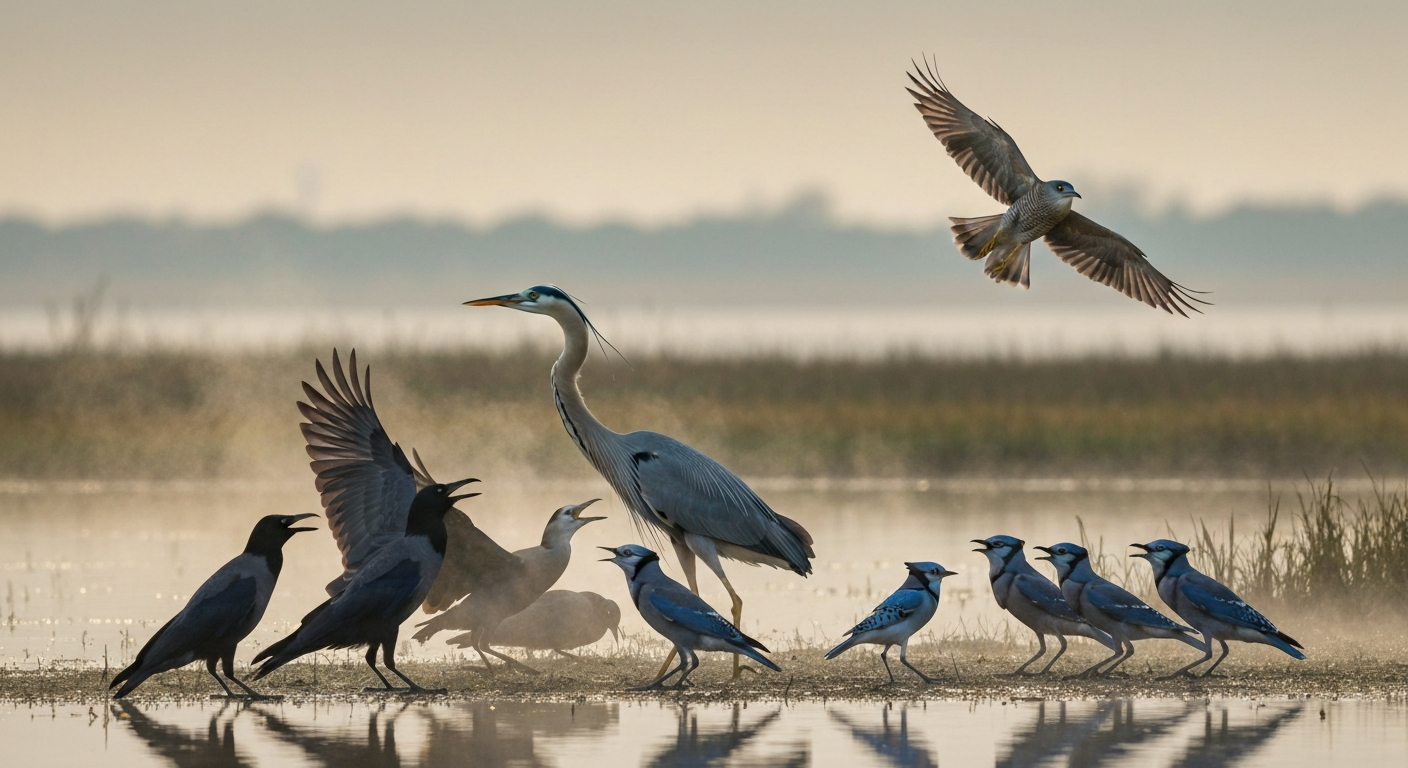
How to recognize an alarm squawk in the field: it tends to come in rapid, repeated bursts rather than single calls; other birds in the area often freeze, look upward, or flush; and the calling bird is frequently facing or tracking a specific direction. Common squawkers in alarm contexts include American Crows, Blue Jays, Steller's Jays, herons, and many parrot species. If you want reference audio, the Macaulay Library at Cornell holds excellent crow alarm call recordings that work well as an ear-training baseline.
Contact squawks: staying connected across distance
Not every squawk signals danger. Birds in flocks, mated pairs, and family groups use short, loud calls to maintain cohesion when visual contact is limited. These contact calls can have a squawk-like quality, particularly in corvids, parrots, and waterfowl. A flock of Canada Geese honking as they fly is a recognizable version of this, but even quieter woodland species use sharp, carrying notes to say 'I am here, where are you?' The calls are typically less frantic and more evenly spaced than alarm calls, and they often occur during movement: when birds are flying, foraging in dense cover, or navigating between roost sites at dusk and dawn.
One practical way to distinguish a contact squawk from an alarm squawk is to watch the group's overall behavior. If the birds keep moving and feeding relatively calmly while calling, you are almost certainly hearing contact calls. If birds freeze, flush, or begin mobbing behavior, alarm is the more likely driver. In dreams and spiritual contexts, many traditions interpret repeated bird calls in pairs or groups as a sign of connection, communication across distance, or news traveling toward you. I think it is worth knowing that this symbolism actually has a grounded behavioral parallel: contact calls are literally birds communicating across space to maintain bonds.
Aggression and territory: when squawks are warnings directed at rivals
Morton's MS rules predict that the harshest, broadest-spectrum calls occur in aggressive and agonistic contexts, and field observation consistently bears this out. Territorial squawks tend to come in sustained, escalating sequences during active disputes: two crows chasing each other, a mockingbird dive-bombing a cat, or a heron standing its ground at a feeding spot. The calls are often accompanied by visible threat postures, wing spreading, or direct physical approach toward the rival.
Seasonality is a useful clue here. Territorial squawking peaks during breeding season when competition for nesting sites and food resources is highest. If you are hearing sustained, aggressive-sounding squawking from the same spot over consecutive days in spring and early summer, boundary disputes between neighbors of the same species are a likely explanation. From a homeowner's perspective, this is generally nothing to worry about and will resolve once territorial boundaries are established. Applied wildlife management does use playback of alarm and distress calls to disperse nuisance birds in settings like airports and landfills, with documented short-term effectiveness, though habituation is a real limitation of those approaches.
Mating, courtship, and breeding squawks
Squawk-type calls appear in reproductive contexts too, though they play a more supporting role than melodic song does in mate attraction. During courtship, some species use calls that have a squawk-like harshness to signal physical condition or readiness to pair. Juvenile begging calls, which are often among the loudest and most persistent squawks you will hear in summer, are a direct reproductive investment: young birds in the nest and recently fledged juveniles produce sharp, high-energy calls to solicit feeding from parents. These are sometimes mistaken for distress or alarm calls by listeners unfamiliar with the context.
The timing and location again help identify these. Begging squawks come from a fixed point, often a nest or a low branch near the nest, and they follow a rhythmic pattern that intensifies when a parent is nearby. Adult pair-bond calls during the breeding season can include short, lower-intensity squawk notes exchanged between partners at close range, functioning more like contact calls within a bonded pair than like the territorial broadcasting that song provides. In cultural and spiritual traditions, birds calling persistently near a home during nesting season are frequently interpreted as signs of incoming change, new beginnings, or fertility, interpretations that carry a poetic resonance with the actual biology even if they are not grounded in ornithological evidence.
How squawks compare with caws, cries, tweets, and rings
One of the most common sources of confusion is sorting out how 'squawk' relates to other bird sound terms that get used loosely in everyday language and on social media. For a focused explanation of what a bird cawing meaning typically signifies across cultural and behavioral contexts, see bird cawing meaning. A caw is a squawk-adjacent sound, most familiar from crows and ravens, but it tends to have slightly more tonal structure and a recognizable pitch, putting it at the noisier end of 'harsh calls' rather than pure broadband squawks. A cry is even broader as a term, often used for longer, more sustained calls or for sounds with emotional weight, as in a loon's cry or a hawk's scream. A tweet is the opposite end of the spectrum: short, high-pitched, and relatively tonal, the kind of soft chirp most closely associated with small songbirds. The term 'ringing' in a bird-sound context is ambiguous and worth a note: it can describe the clear, bell-like quality of some thrush and wren songs, but 'bird ringing' as a term in British English specifically refers to what North Americans call bird banding, the process of attaching a numbered ring to a bird's leg for identification and tracking. These are completely different things despite sharing a word.
| Term | Acoustic character | Typical context | Example species |
|---|---|---|---|
| Squawk | Loud, harsh, broadband, short to medium duration | Alarm, aggression, contact, begging | Herons, crows, jays, parrots |
| Caw | Loud, somewhat harsh but with more tonal structure | Contact, alarm, territorial (corvids) | American Crow, Rook |
| Cry | Sustained, often mournful or piercing | Long-distance contact, distress, territorial | Common Loon, Red-tailed Hawk |
| Tweet / chirp | Short, high-pitched, tonal | Contact, song fragments, begging (small birds) | House Sparrow, American Robin |
| Ring / ringing | Clear, bell-like, harmonic | Song, territorial advertisement | Winter Wren, Song Thrush |
Cultural and spiritual meanings of a bird squawking
Across many cultural traditions, a bird squawking near your home or directly at you carries symbolic weight. In numerous European folk traditions, a sudden harsh bird call near a window was interpreted as a warning of approaching news, sometimes good and sometimes bad depending on the species involved. Crows and ravens squawking in particular have been read as omens in Celtic, Norse, and East Asian traditions, where these birds were understood as messengers between the living and the dead or as scouts reporting on distant events. It is worth separating these traditions from any claim of literal predictive power: they reflect a long human history of paying close attention to animal behavior as an environmental signal, which was genuinely useful for survival even if the interpretations layered on top were symbolic rather than scientific. For a more detailed look at how different bird cries are interpreted across cultures and what they commonly signify, see our bird cry meaning resource (cdd0e416-2350-4c02-b10a-cb51ac69fe2d).
In dream interpretation, hearing a bird squawk is commonly interpreted as an urgent message from the unconscious, a call to pay attention to something you have been avoiding. Some traditions link it specifically to warnings about relationships or communication, drawing on the behavioral reality that squawks are high-stakes signals. Others frame it as a signal of breaking free from constraints, partly because the loudest squawks in nature often accompany a bird fleeing or flushing from cover. None of these interpretations have empirical backing, but they carry a coherent symbolic logic rooted in the bird's actual behavior, which is exactly the kind of folk wisdom this site takes seriously without overstating.
Common superstitions and what the science actually says
- Superstition: A bird squawking at your window means death or disaster is coming. Science check: Window-striking and window-adjacent calling are usually caused by territorial males attacking their own reflection during breeding season, not warnings of misfortune.
- Superstition: A crow squawking an odd number of times is an ill omen. Science check: Crow call sequences are context-driven (predator presence, flock cohesion, food discovery) and not numerologically organized. Odd or even repetition depends on behavioral arousal, not symbolic messaging.
- Superstition: A bird squawking at dawn signals incoming visitors. Science check: Dawn chorus and early-morning calling peaks are driven by hormonal rhythms and low ambient noise, which carries calls farther. The correlation with social events is coincidental.
- Superstition: Repeated squawking from the same bird over days means someone in the household will receive news. Science check: Persistent calling from a fixed location in spring and summer almost always means a nest is nearby. The bird is not interested in your household; it is managing its territory.
'Squawk' in human language and on social media
Outside ornithology, 'squawk' has a well-established role in everyday English as a verb meaning to complain loudly and unpleasantly. Oxford notes this usage directly alongside the bird definition, and it carries all the acoustic connotations of harshness and urgency intact. In aviation, a squawk code is a four-digit transponder code assigned by air traffic control, completely unrelated to birds except etymologically. On social media, 'squawk' has been used informally to contrast with Twitter's 'tweet': if a tweet is a small, polished, tonal message, a squawk is a loud, raw, unfiltered one. Some decentralized platforms and alternative social networks have played with bird and sound vocabulary in their branding, though none have established 'squawk' as a formal term the way 'tweet' became synonymous with Twitter posts.
Practical advice for listeners: identifying and responding to squawks
If you want to reliably identify what a squawk means when you hear one, the most useful habit is a quick three-point check before reaching for an interpretation. First, watch the bird's behavior and the behavior of nearby birds: are they fleeing, mobbing, or just moving and calling? Second, note the location and timing: is it a fixed spot during breeding season (likely nest defense or begging), or is it a moving flock at dusk (likely contact calls)? Third, try to identify the species if you can, because a Blue Jay's squawk in response to a passing hawk means something quite different from a parrot squawking because it is bored and wants attention.
- Listen for repetition rate: rapid, urgent bursts usually indicate alarm; slower, more evenly spaced calls suggest contact or low-level aggression
- Watch the direction: alarm squawks are usually directed toward a threat; contact calls are often given while the bird moves in a specific direction
- Check for flock response: if nearby birds of multiple species react, you are almost certainly looking at an alarm situation
- Note the season: spring and summer squawking near a fixed point is heavily weighted toward territorial defense or juvenile begging
- Use a free app like Merlin Bird ID from Cornell Lab to record and identify species, which immediately narrows down the behavioral context
- If squawking is persistent near your home and you cannot identify a threat or nest, check for reflective surfaces like windows or mirrors that might be triggering territorial display behavior
When to actually be concerned
Most bird squawking requires no action from you at all. The exceptions worth noting are: a bird squawking directly at the ground or a specific low spot, which can sometimes indicate a predator (cat, snake) is stalking a nest and the parent is giving alarm; sustained distress squawking from a bird that appears injured or trapped; and very persistent nighttime squawking, which is unusual enough to be worth investigating since most songbirds are not active callers after dark. Applied wildlife management research confirms that alarm and distress call playbacks can disperse problem birds in settings like airports and commercial facilities, though habituation is a real issue over time, so this approach is most effective as a short-term measure.
Species to know by their squawks
A handful of species are so strongly associated with squawk-type calls that they are worth knowing by name. The American Crow (Corvus brachyrhynchos) is probably the most familiar squawker in North America, with a wide range of harsh calls documented extensively in the Macaulay Library at Cornell, including alarm and contact call examples that work beautifully as reference points for ear training. The Common Raven (Corvus corax) has a deeper, throatier version, with Macaulay Library recordings capturing both its signature croak and its harder, harsher calls. Great Blue Herons produce one of the most startling squawks in nature, a guttural, prehistoric-sounding alarm call when flushed from water. Blue Jays are versatile and load: they can produce piercing alarm squawks that reliably clear a backyard feeder, and they are also accomplished mimics of Red-tailed Hawk calls. In the parrot family, almost every species uses loud squawk-like calls for contact and alarm, which is why captive parrots can be such persistent squawkers in domestic settings.
A note on bioacoustic tools if you want to go deeper
If you are genuinely curious about what a squawk looks like as data, the free tool Sonic Visualiser lets you load any audio recording and generate a spectrogram. Using a Hann window at a window length of 512 or 1024 samples (at 44. See seewave package reference (example settings used in published bioacoustic papers) for these spectrogram parameters. 1 kHz, that is roughly 12 or 23 milliseconds of resolution) with 50 to 75 percent overlap will give you a clear picture of a squawk's broadband, blob-like spectrogram signature compared with the clean horizontal lines of a tonal whistle. Raven Pro from Cornell's Bioacoustics Research Program is the more powerful research tool, with the same kind of Hann window and overlap settings. Both tools are referenced in peer-reviewed bioacoustics research and let you see the acoustic 'roughness' that your ear perceives as harshness in a squawk made visible.
FAQ
What is a "bird squawk" — a simple definition?
A squawk is a short, loud, harsh or discordant bird vocalization. The term is onomatopoeic and used in dictionaries for over a century to describe noisy, often abrupt calls. In ornithology it usually refers to a call (a context‑dependent signal), not a long melodic song.
How does a squawk sound acoustically?
Acoustically a squawk is typically short (tens of milliseconds to ~1 second), broadband/noisy (energy spread across many frequencies), with abrupt onsets and little sustained harmonic structure. On a spectrogram it often appears as a vertical, energy‑filled blob rather than a narrow tonal trace.
Which acoustic measurements and spectrogram settings best show squawks?
Common practice uses a Hann/Hamming window with FFT sizes between 512–2048 samples (at 44.1 kHz this gives ~11–46 ms windows), high overlap (50–90%), and linear or dB scaling. These settings balance time and frequency resolution so short broadband squawks appear clearly. Tools: Raven Pro, Sonic Visualiser, or Seewave (R).
What behavioural and ecological causes produce squawks?
Squawks occur in multiple contexts: alarm/distress (predator alerts, sudden threats), contact/aggregation (keeping flock cohesion), aggression/agonistic interactions (chases or territorial disputes), mating/competition (short harsh notes in displays), begging (juvenile distress), and disturbance/flight‑calls. Interpretation depends on species, context and accompanying behaviour.
What bioacoustic principles link squawk form to function?
Motivation‑Structural (MS) rules summarize that harsh, broadband, lower‑pitched signals are often used in hostile or alarm contexts, while tonal, higher‑pitched signals are used for affiliative or appeasing contexts. Experimental and comparative studies support these general trends, though exceptions and species specifics exist.
How do I reliably identify a squawk in the field or a recording?
Listen for a short, abrupt, harsh note that sounds discordant or raspy rather than musical. Note context: presence of predators, flock agitation, chases, or fledglings. Check spectrograms for broadband vertical energy. Compare against reference recordings for the suspected species (e.g., Macaulay Library, xeno-canto) to confirm.
Next Article
Bird Blindness Meaning: Causes, Signs, and What to Do Now
Bird blindness meaning: spot signs, tell vision loss from other issues, and take safe action or get urgent vet care.