
In real estate, a bird dog is an unlicensed deal-finder who scouts for off-market or distressed properties, passes the lead details to an investor or wholesaler, and collects a fee when that lead converts. Mainstream consumer finance sites define a bird dog as someone who locates promising unlisted properties and passes leads to buyers. They do not negotiate contracts, hold earnest money, or close deals. The entire job is finding, qualifying, and handing off. It is one of the lowest-barrier entry points into real estate investing, and it is also one of the most legally misunderstood roles in the business.
Bird Dog Meaning in Real Estate: Definition, Fees & How To

Marcus Holloway
13 Jul 2026
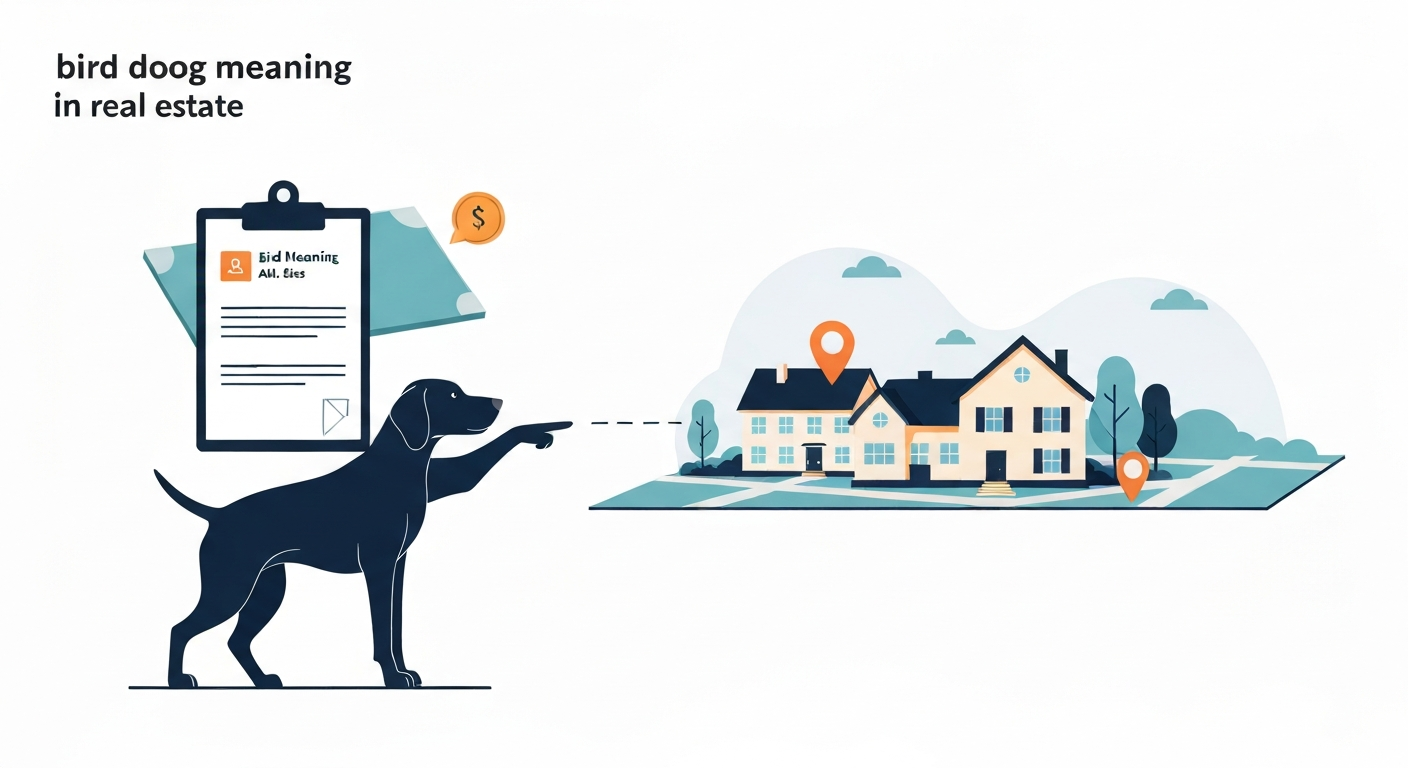
This article covers the plain-language definition of a bird dog in real estate, the hunting metaphor behind the name, how the workflow fits into wholesaling and sales, a day-to-day breakdown of duties, how bird dog fees are structured and negotiated, a comparison of bird dogs against similar roles, and the legal and tax considerations you need to know before you take your first fee. It also gives you a quick-reference map to every related search you might have landed here from, including the bird dog exercise, military usage, and slang meaning.
What a bird dog actually does in real estate
A real estate bird dog is a person, typically unlicensed, who finds properties with investment potential and passes that information to a buyer, investor, or licensed broker in exchange for a fee. The term appears constantly in investor forums and wholesaling communities, but the actual job description is simpler than the hype suggests: you find leads, you document them, you hand them off. What you do not do is negotiate purchase prices, execute purchase agreements on behalf of another party, or perform any act that legally requires a real estate license.
Bird dogs typically focus on off-market properties: homes that are vacant, tax-delinquent, in pre-foreclosure, or otherwise not listed on the MLS. Their value is in local knowledge and legwork. An investor sitting in an office cannot physically drive every neighborhood looking for boarded windows or overgrown lawns. A bird dog can, and they get paid when that physical scouting turns into a deal.
The role is used most actively by real estate wholesalers and fix-and-flip investors, though some buy-and-hold landlords also use bird dogs to source rental properties before they hit the open market. The bird dog is not an agent, not a wholesaler, and not a contractor. They sit entirely outside the transaction itself.
Where the name comes from: the hunting metaphor
The phrase comes directly from hunting. Bird dogs, breeds like pointers, setters, and spaniels, are trained to locate game birds in the field and point toward them or flush them out so the hunter can take the shot. The dog does the finding; the hunter does the taking. In real estate, the metaphor maps almost perfectly: the bird dog finds the deal and points at it, and the investor moves in for the close.
Merriam-Webster records the verb 'to bird-dog' as meaning to watch closely or to seek out doggedly, which reflects how broadly the metaphor spread beyond hunting. The figurative use predates modern real estate investing by decades and shows up in military, sales, and general slang contexts as well. On this site, you can find a deeper look at the expression's full linguistic history and cultural spread in the bird dog expression meaning article, and a broader treatment of the non-real-estate slang usages in the bird dog definition slang piece.
How the bird dog workflow fits into wholesaling and sales
Bird dogging sits at the very front of the real estate deal pipeline. In wholesaling, the typical chain looks like this: a bird dog identifies a distressed property and delivers the lead to a wholesaler. The wholesaler contacts the owner, negotiates a purchase contract at a below-market price, and then assigns that contract to a cash buyer (usually a rehabber or landlord) for a higher price, keeping the spread as profit. The bird dog is paid a flat fee or small percentage when the wholesaler successfully closes or assigns the deal.
In a sales context, the logic is similar. A bird dog surfaces a potential opportunity, a motivated seller or a property meeting specific investment criteria, and hands it to someone with the capital and licensing to act on it. This is why the role overlaps thematically with referral-based selling in other industries. If you have read about bird dog meaning in sales elsewhere on this site, you will recognize the same hand-off structure applied to client prospecting.
- Bird dog drives or canvasses neighborhoods for distressed, vacant, or off-market properties
- Bird dog documents the property address, condition notes, and any available owner contact information
- Bird dog submits the lead to an investor or wholesaler using an agreed format (email, spreadsheet, or CRM entry)
- Investor or wholesaler contacts the owner, performs due diligence, and decides whether to pursue
- If the investor moves forward and closes (or assigns) the deal, the bird dog receives their agreed fee
- Fee is paid as a flat amount, a percentage of the assignment fee, or according to a tiered agreement
Day-to-day duties: what a bird dog actually delivers
The day-to-day work of a bird dog is less glamorous than investor seminars make it sound, but it is concrete and learnable. If you are thinking about doing this, here is what your actual deliverables look like.
- Drive-by scouting: systematically canvas target neighborhoods for vacant, boarded, or visibly distressed properties
- Skip tracing: use public records, county assessor websites, or paid tools to find the property owner's contact information
- Lead documentation: record address, estimated condition, any visible issues, photos if permitted, and owner contact details
- Initial outreach: in some arrangements, the bird dog makes first contact with the owner to gauge motivation before passing the lead
- Lead submission: deliver a formatted lead sheet (address, photos, condition notes, owner info, estimated ARV if available) to the investor
- Follow-up tracking: keep a log of submitted leads and their status so you know which ones converted
- Market familiarity: stay current on which neighborhoods, zip codes, or property types the investor is actively buying
- Compliance basics: avoid making any representations about property value, contract terms, or investment potential to the seller
Notice that last point. The moment a bird dog starts discussing price, terms, or telling a seller what they should accept, they are edging into territory that most states define as brokerage activity, which requires a license. Staying strictly in the 'find and hand off' lane is not just good practice, it is the legal foundation of the whole arrangement.
Bird dog fees: how they are structured and what they are worth
Bird dog fees vary widely depending on market, deal complexity, and investor preference. The most common structures are flat fees, percentage-based fees, tiered fees, and success-only arrangements. All four exist in practice, and which one you agree to matters a lot for how much you actually earn.
| Fee Structure | How It Works | Typical Range | Best For |
|---|---|---|---|
| Flat fee | Fixed dollar amount paid per deal that closes, regardless of deal size | $500 to $2,000 per deal | New bird dogs, investors who want cost predictability |
| Percentage-based | A percentage of the investor's profit or assignment fee on the deal | 2% to 5% of profit or assignment fee | Experienced bird dogs in higher-value markets |
| Tiered | Higher fee unlocks after a threshold of deals closed or lead quality improves | Starts flat, escalates with volume | Ongoing bird dog relationships with active investors |
| Success-only | No fee unless the investor closes; the bird dog bears all prospecting risk | Varies, often higher flat to compensate for risk | Investors with tight budgets; motivated bird dogs |
Success-only structures are the most common in practice because investors are reluctant to pay for leads that do not close. From a bird dog's perspective, this means volume matters: you need enough leads in your pipeline that the percentage that convert actually generates meaningful income. A deeper breakdown of fee structures, sample agreement language, and what to watch for in a fee contract is covered in the bird dog fee meaning article on this site.
Practical fee examples and how to negotiate
Here is what bird dog fees look like in real numbers. Suppose an investor assigns a wholesale deal for a $15,000 assignment fee. At a 5% bird dog fee, you would earn $750. At a flat $1,000 agreement, you earn $1,000 regardless. If the deal is larger, say a $40,000 assignment, the percentage model pays out $2,000 at 5%, which is meaningfully better than a fixed $1,000 flat fee. The math matters, and you should run it against the deals your investor typically does before you agree to a structure.
When negotiating, a few things give you leverage: exclusivity (you are only working with one investor in a territory), lead quality (you pre-screen for motivated sellers rather than just addresses), and volume (you commit to delivering a minimum number of leads per month). An investor who regularly closes bird-dog-sourced deals at $1,500 flat will often move to a tiered model once you prove consistency. Start simple, document everything in writing, and treat the first few deals as a track record you are building.
One practical note on timing: make sure your written agreement specifies when the fee is paid. Some investors pay at contract signing, others at close of escrow, others at assignment. 'When the deal closes' sounds clear but can mean different things in a wholesale context where the investor assigns the contract rather than actually closing. Get specific language in writing before you deliver your first lead.
Bird dogs versus similar roles: how they compare
One of the most common points of confusion is how a bird dog differs from a wholesaler, a licensed referral agent, or a lead generator. They all sit near the front of the deal pipeline, but their legal status, compensation rights, and transaction involvement are meaningfully different.
| Role | Licensed? | Negotiates contracts? | Holds equitable interest? | How paid | Legal exposure |
|---|---|---|---|---|---|
| Bird dog | No | No | No | Finder's fee from investor | High if they cross into brokerage activity |
| Wholesaler | Typically no (varies by state) | Yes (their own contract) | Yes (as buyer in assignment) | Assignment fee spread | Medium to high depending on state and volume |
| Referral agent | Yes (licensed) | No (refers out) | No | Referral fee from licensed broker | Low if properly disclosed |
| Lead generator | No | No | No | Per-lead or subscription fee | Low for general marketing; higher if tied to settlement services |
| Buyer's agent | Yes | Yes | No | Commission from sale | Low within normal practice |
The wholesaler comparison is especially worth understanding. A wholesaler actually enters into a purchase contract with the seller, giving them equitable interest in the property. That contract is then assigned to the end buyer. A bird dog never holds that contract position. They hand the lead and step back. The distinction matters legally because several states, including Illinois, have started treating repeated wholesaling activity as brokerage requiring a license, under statutes like the Illinois Real Estate License Act (225 ILCS 454).
Legal and ethical realities you cannot skip
This is the part of the bird dog conversation that does not get enough attention in investor communities. The legality of paying an unlicensed person to find real estate deals is not uniform across states, and in some situations it is prohibited outright regardless of how you label the arrangement.
State-level licensing rules
California treats finders carefully under Business and Professions Code Sections 10130 through 10139. Finder's Fee Agreement (California), firsttuesday (industry forms/training) provides broker-oriented templates and training material documenting payments to unlicensed finders consistent with California law Finder's Fee Agreement (California) — firsttuesday (industry forms/training). Licensed brokers may engage unlicensed finders, but only for activities that stop well short of brokerage. The California DRE has brought disciplinary actions (including documented accusation files in public hearing records) against brokers who compensated unlicensed finders for activity that crossed into negotiation or representation. North Carolina's Real Estate Commission has issued direct warnings to licensees about paying unlicensed persons for activities that qualify as brokerage. Florida's DBPR has addressed similar questions through declaratory statements. The consistent message across these states: if the activity looks like brokerage, a license is required regardless of what you call the person doing it.
RESPA and federal considerations
RESPA Section 8 (12 U.S.C. Section 2607) prohibits giving or accepting any fee, kickback, or thing of value for referring settlement service business in transactions involving federally-related mortgage loans. This means that if the deal your bird dog sourced involves a mortgage, the fee structure needs careful structuring. Bona fide services actually performed are a recognized exception, but the CFPB has issued explicit compliance warnings (Bulletin 2015-05) that marketing-service arrangements functioning as disguised referral payments can violate Section 8. If you are an investor paying bird dog fees on deals that involve mortgage financing, get legal counsel familiar with RESPA before you rely on informal internet templates.
NAR ethics and licensed participants
If a licensed REALTOR is involved anywhere in the transaction, the 2026 NAR Code of Ethics requires disclosure of any financial benefits and prohibits undisclosed compensation from multiple parties. A licensed agent who refers a seller to an investor while also receiving a bird dog fee without disclosure is in direct violation. The disclosure requirement is not optional, and it applies regardless of whether the payment is called a referral fee, a bird dog fee, or anything else.
Tax reporting obligations
From the investor's side, bird dog fees paid to independent contractors are reportable as nonemployee compensation. The IRS requires payers to file Form 1099-NEC for such payments, historically at a $600 threshold, though legislative changes have adjusted thresholds for payments made in 2026 and beyond (check current IRS instructions for Forms 1099-MISC and 1099-NEC for the applicable year). From the bird dog's side, this income is self-employment income and is subject to self-employment tax on top of ordinary income tax. The IRS worker classification rules (Publication 15-A) will treat most bird dogs as independent contractors rather than employees, but the control-versus-independence test applies, and misclassification creates liability for the investor.
Common misconception worth clearing up directly: bird dogs are not licensed real estate brokers or agents. Calling yourself a bird dog does not create legal cover for performing brokerage acts without a license. The label is informal. The licensing laws are not.
How to start as a bird dog: practical steps
If you want to start bird dogging, the barrier to entry is genuinely low, but the margin for casual effort is also low. Here is a realistic starting sequence.
- Research your state's rules on finder's fees and unlicensed activity before you take a single dollar. A 30-minute call with a real estate attorney is money well spent.
- Find one or two active cash buyers or wholesalers in your market. Local real estate investment association (REIA) meetings are the fastest way to do this.
- Agree on a written fee arrangement before you submit any leads. Verbal agreements are nearly impossible to enforce when a deal closes six weeks later.
- Define what a qualifying lead looks like for your investor: specific property types, zip codes, condition thresholds, and owner motivation signals.
- Build a simple tracking system: a spreadsheet or free CRM where you log every lead submitted, date, status, and outcome. This is your proof of delivery and your income forecast.
- Start with one method of lead generation, driving for dollars (literally driving neighborhoods to spot distressed properties) is the lowest cost and most reliable for beginners.
- Expand to public records: county tax delinquency lists, probate filings, and pre-foreclosure notices are all public data and highly targeted.
- As you gain experience, explore direct mail, bandit sign responses, and digital lead channels, but only after you have closed a few deals with direct scouting.
The bird dog method: a note on the broader concept
You will sometimes see the phrase 'bird dog method' used to describe not just the role but an entire lead-generation philosophy: systematically building a network of eyes and ears in a market who feed you deals in exchange for fees. Investors who run bird dog programs treat it as an outsourced prospecting operation, paying per result rather than maintaining a full-time acquisitions team. The bird dog method article on this site covers this strategy in more depth, including how investors structure and manage a bird dog network at scale.
Other meanings of 'bird dog' you might have been searching for
Because this site covers the full landscape of bird-related meanings, here is a quick reference for every other context this phrase appears in, along with where to find deeper coverage on this site. If you meant the exercise meaning of "bird dog" (a core-stability move used in fitness), see the bird dog exercise meaning article for a clear explanation and demonstration.
- Bird dog in sales: the same hand-off logic applied to client or lead referral in non-real-estate sales roles. A bird dog in sales spots a potential customer and passes them to a closer. The bird dog meaning in sales article covers this in full.
- Bird dog in the military: a term used in U.S. military contexts to describe forward observers, reconnaissance personnel, or the Cessna O-1 Bird Dog aircraft used for forward air control. The bird dog meaning military article covers the history and usage.
- Bird dog as general slang: broadly means to closely watch, follow, or doggedly pursue someone or something. Merriam-Webster documents this figurative use. The bird dog definition slang piece explores the full range of colloquial usage.
- The bird dog exercise: a core stability movement in fitness and physical therapy where you extend one arm and the opposite leg from a quadruped position. It trains spinal stability and is named for the posture's resemblance to a hunting dog on point. The bird dog exercise meaning article covers the mechanics and benefits.
- Bird dog expression meaning: the broader metaphorical and idiomatic history of the phrase, tracing how it migrated from hunting fields into military, business, and everyday speech. Find that full treatment in the bird dog expression meaning article.
Debunking the most common bird dog misconceptions
- Misconception: calling yourself a bird dog makes unlicensed brokerage legal. It does not. The activity determines the legal requirement, not the job title.
- Misconception: bird dogs always get paid. Most bird dog arrangements are success-only, meaning you earn nothing if the investor does not close on your lead.
- Misconception: bird dogging is the same as wholesaling. Wholesalers enter contracts and hold equitable interest. Bird dogs do not.
- Misconception: RESPA does not apply to bird dog fees. It can, depending on how the transaction is financed and how the fee is structured.
- Misconception: you need a large network to start. One reliable investor and consistent local scouting is enough to close your first few deals.
What to do next
If you are evaluating bird dogging as a side income or entry point into real estate, start with your state's licensing rules and one clear written agreement with an investor. The fee structures, workflows, and tools are learnable quickly. The legal exposure is the part that catches people off guard, and it is the part that is worth spending an hour on before you submit your first lead. For more on how fees are calculated and documented, the bird dog fee meaning article on this site walks through sample agreement language and what to watch for. If you are an investor building a bird dog program rather than operating as one, the bird dog method article covers network structuring and management in depth.
FAQ
What is the plain‑language definition of “bird dog” in real estate?
A bird dog in U.S. real estate is an unlicensed deal‑finder who locates potential sellers or off‑market properties and passes the lead details to an investor, wholesaler, or licensed broker in exchange for a fee. A true bird dog typically does not negotiate contracts, show property, or close deals — they identify prospects and deliver contact information and basic property facts.
Where does the term “bird dog” come from and why is the hunting metaphor used?
The term borrows from hunting: a bird dog flushes or finds game for a hunter. Figuratively, a real estate bird dog ‘sniffs out’ leads and points them to a buyer. Historical dictionary usage (Merriam‑Webster) shows figurative ‘‘bird‑dog’/to bird‑dog’ meaning to pursue/search out predates investor jargon; the hunting metaphor conveys scouting and pointing rather than closing.
How does the bird‑dog workflow fit into sales, wholesaling, and investor pipelines?
Typical workflow: 1) prospecting (knock, skip‑trace, driving for dollars, ads), 2) qualifying (basic condition, ownership, contact), 3) delivering the lead (call, text, email, CRM entry), 4) receiving payment if the buyer converts the lead. In wholesaling, bird dogs supply leads to wholesalers who then negotiate contracts. In investor pipelines, bird dogs expand lead volume without adding salaried staff.
What are typical bird dog fee models and amounts?
Common fee structures: 1) Flat fee per qualified lead ($50–$1,000 depending on market and lead quality), 2) Percentage of profit or wholesale fee (5%–30% of the profit or assignment fee), 3) Tiered fees (higher for signed contracts or closed deals). Typical starter ranges in many U.S. markets: $200–$1,000 for a contracted property that closes; lower fees ($25–$200) for basic contact leads. Exact amounts vary by market, deal scarcity, and buyer preferences.
Sample short contract language for paying a bird dog (finder’s fee agreement)
Sample clause (short): “Finder will identify and introduce potential property located at [address/criteria]. If Buyer enters into a purchase contract within [X] days of introduction or closes the purchase, Buyer will pay Finder a fee of $[amount]/[percent] payable at closing. Finder is not authorized to negotiate, sign contracts, or act as broker. This Agreement does not create an employment or broker relationship. Finder is responsible for tax reporting on fees. This Agreement governed by [State] law.” (Adapt to state rules; have counsel review.)
Scripts and outreach templates a bird dog can use
Cold‑call opener: “Hi, I’m [Name]. I work with local investors looking to buy houses quickly. I noticed your property at [address]. Would you consider selling if the price and timeline were right?” Text template: “Hi [Name], investor interest in [address/neighborhood]. Selling now? Reply for a fast, no‑obligation offer.” Lead‑handoff email to buyer: “Lead: [name, phone, address, property condition, motivation]. Source: [finder name]. Date found: [date]. Permission to contact: [yes/no].” Keep records of consent and conversation notes.
Next Article
Bird Dog Expression Meaning: Hunting and Slang Uses
Learn bird dog expression meaning in hunting and slang, how to tell contexts apart, plus origins and examples.