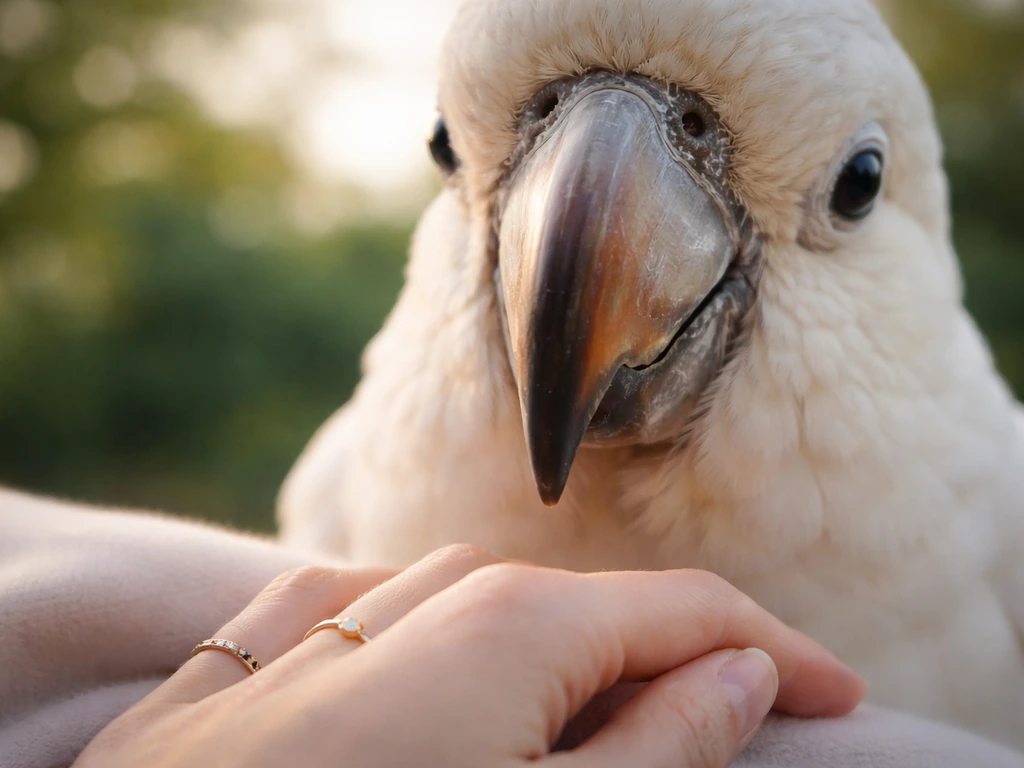
If you're looking at a bird with its upper beak missing or severely damaged, treat it as a genuine emergency. This bird cannot eat, drink, or defend itself normally, and without help it will likely die within days. Your first move is to contain the bird safely, keep it warm, dark, and quiet, and contact a licensed wildlife rehabilitator or avian vet today. RSPCA guidance also recommends placing injured birds in a carrier or container and keeping them in a quiet, dark environment until transport, warming only as needed without overheating blank" rel="noopener noreferrer">keep it warm, dark, and quiet. Do not give it food or water while you arrange transport. That's the core of it. Everything else below helps you assess what you're dealing with, act correctly, and understand why people sometimes frame this sight in spiritual terms (and when that framing gets in the way of actually helping the bird). If you came here after seeing the phrase “bird beak meaning” on Urban Dictionary, treat it as cultural slang rather than a real medical clue bird beak meaning on Urban Dictionary.
Bird Missing Top Beak: What to Do Today and Likely Causes

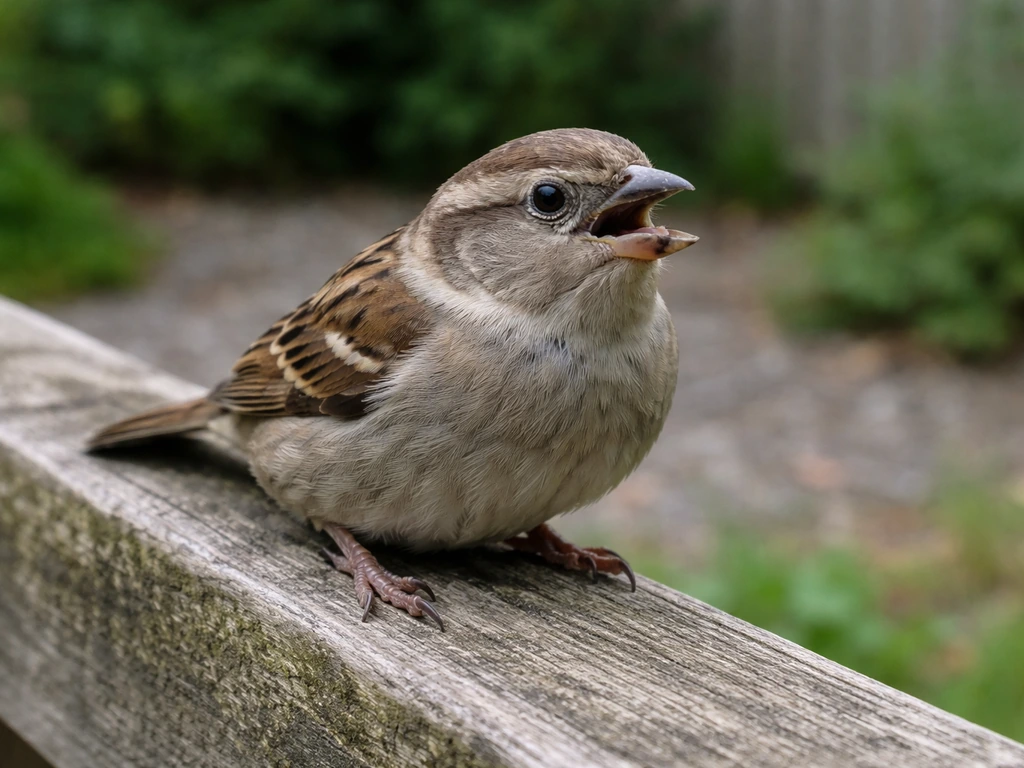
Quick safety check: how urgent is this?
A missing or heavily damaged upper beak is almost always urgent. The upper beak (rhinotheca) is how a bird grabs food, cracks seeds, tears prey, and grooms itself. Without it, the bird faces rapid starvation. On top of that, beak tissue is loaded with blood vessels and nerves, so a fresh injury can involve significant bleeding and pain. If the bird is actively bleeding, in visible distress, unable to stand, breathing with its mouth open, or showing any signs of shock (unresponsive, eyes half-closed, lethargic and unmoving), that is a same-day emergency. Get professional help immediately, not tomorrow.
Even if the bird looks calm, do not assume it is fine. Birds are prey animals and mask symptoms instinctively. A bird sitting still and letting you approach is almost certainly in serious trouble, not tame.
What a 'missing top beak' actually looks like
The appearance varies a lot depending on the cause, and identifying the pattern helps you communicate clearly when you call for help. Here are the main visual presentations:
- Acute traumatic avulsion: the upper beak is partially or fully torn away, leaving a raw, bleeding wound with exposed bone or soft tissue. The injury line looks abrupt and fresh.
- Fracture with displacement: the upper beak is still partly present but cracked, angled, or hanging; there may be dried blood or a scab forming around the break.
- Congenital or developmental deformity: the beak is present but misaligned, crosses the lower beak (scissor beak), or curves abnormally. There's no open wound, just a structural mismatch. The bird may have lived with this for some time.
- Disease-related deterioration: the beak surface looks rough, discolored, or eroded rather than cleanly broken. In avian keratin disorder (AKD), the keratin layer overgrows and deforms; in trichomoniasis, you may see yellow, cheesy-looking material around the mouth or throat rather than a structural break.
- Necrotic or lesion-based damage: soft tissue lesions near the beak, particularly at the beak-skin junction or inside the mouth, can suggest avian pox or bacterial/fungal infection.
When you call a rehabber, describe what you see as specifically as possible: Is there exposed bone? Is it bleeding? Is there discoloration or growths? Does the beak appear to have been cleanly broken off, or is the damage gradual and irregular? These details help them triage over the phone.
Most likely causes of upper beak damage
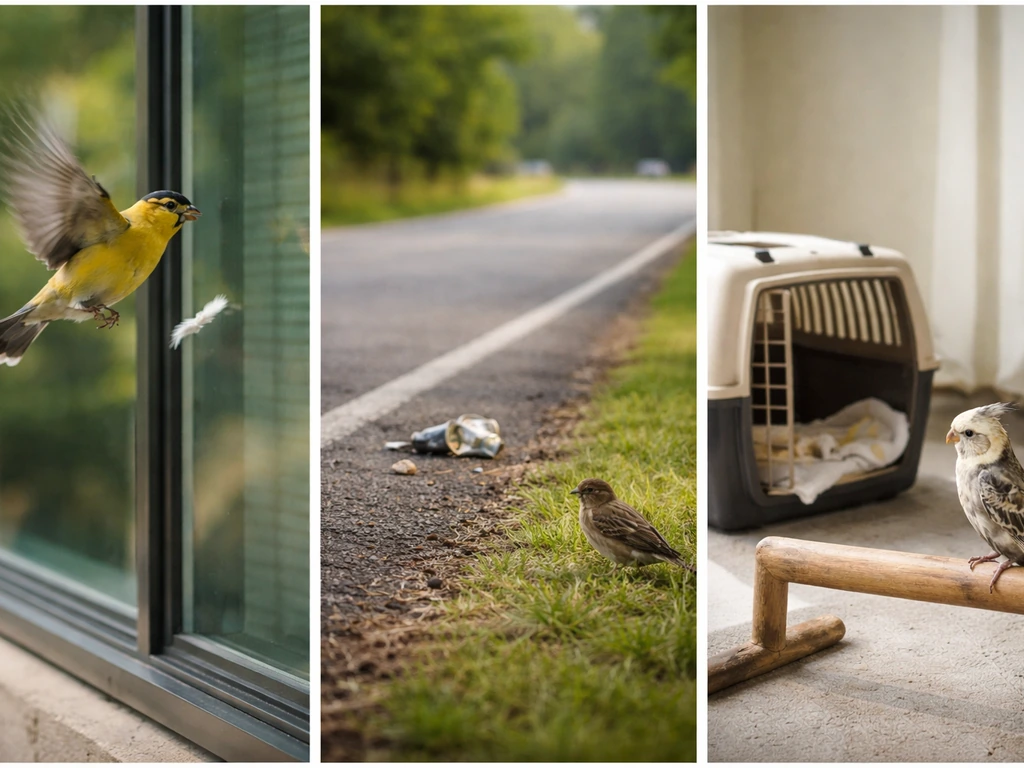
Knowing the probable cause matters because it affects how you handle the bird and what the rehabber or vet needs to know. These are the most common explanations, roughly in order of how often you're likely to encounter them:
| Cause | What it typically looks like | Urgency level |
|---|---|---|
| Window or vehicle strike (trauma) | Fracture or avulsion with bleeding; bird may be dazed or in shock | High: same-day professional care needed |
| Predation attempt (cat, hawk, dog) | Torn or crushed beak with irregular wound edges; may be punctures nearby | High: infection risk on top of injury |
| Entanglement (fishing line, netting) | Beak worn, cut, or deformed by constriction; may be swelling | High: entanglement may still be present |
| Cage or feeder accident (pet birds) | Fracture from impact or getting caught on wire; localized clean break | Moderate to high depending on extent |
| Avian keratin disorder (AKD) | Gradual overgrowth, rough surface, cross-beak or curving deformity, no acute wound | Moderate: chronic but debilitating |
| Trichomoniasis / canker | Yellow caseous masses in mouth/throat; beak structure may be intact but swallowing blocked | High: can cause starvation or suffocation |
| Avian pox (wet form) | Moist lesions in mouth/throat; soft tissue damage rather than beak fracture | High: respiratory complications possible |
| Congenital deformity (scissor beak) | Misalignment visible from birth with no wound or bleeding | Variable: depends on severity and feeding ability |
Trauma causes (window strikes, cats, vehicle impacts) are probably the most common thing you'll encounter in a backyard or urban setting. Cat attacks in particular are under-reported as a cause of severe beak injuries because the crushing force of a cat bite can avulse or fracture the beak even if the cat doesn't kill the bird outright. Birds with any cat contact also face serious risk from Pasteurella bacteria in cat saliva, which can be fatal within 48 hours even without visible wounds.
What to do right now: the do's and don'ts
Do these things
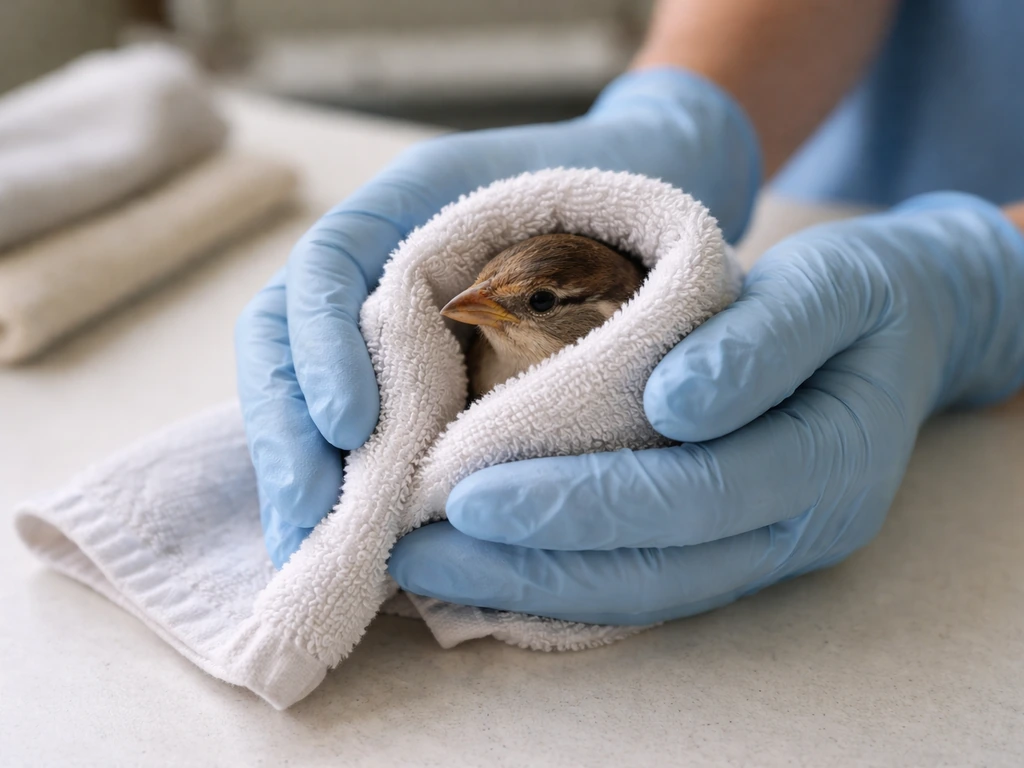
- Put your own safety first. Injured birds can bite and scratch hard, especially raptors or larger species. Use gloves or a towel to pick up the bird if you need to move it.
- Place the bird in a dark, quiet container: a shoebox, paper bag, or small cardboard box lined with a paper towel or cloth works well. Punch a few small air holes in the lid.
- Keep it warm. Place the container on top of a heating pad set to low, or tuck a warm (not hot) water bottle wrapped in a towel beside it. Avoid direct heat that could overheat the bird.
- Minimize handling. Once the bird is contained, leave it alone. No looking in, no noise, no pets or children nearby. Stress kills injured birds.
- Call a licensed wildlife rehabilitator immediately. In the US, you can search through the National Wildlife Rehabilitators Association directory or call your state's wildlife agency. In the UK, the RSPCA handles wildlife emergencies. Tell them the species if you can guess it, the injury you see, and your location.
- If you must transport the bird, keep the container covered and in a quiet part of the car. Drive directly to the rehabber or vet without stopping.
Don't do these things
- Do not give food or water. This is the single most important don't. An injured bird can aspirate liquid into its lungs, and giving the wrong food can cause additional harm. Multiple wildlife rehab organizations are explicit about this: no food, no water, until you speak with a professional.
- Do not try to splint or bandage the beak yourself. The beak has a complex blood supply and nerve network; improper handling can worsen bleeding and cause more pain.
- Do not leave the bird outside 'to recover on its own.' A bird with a missing upper beak cannot self-recover. It will starve.
- Do not put the bird in a wire cage where it might injure itself further trying to escape.
- Do not assume it's 'just resting.' If a wild bird lets you approach and pick it up, it is in crisis.
Getting professional help: who to call and what to say
Your best option is always a licensed wildlife rehabilitator. These are people trained and permitted specifically to treat wild animals, and many have avian specialists on their roster. Bird beak pliers are tools used by technicians to gently grasp the beak area during certain veterinary or rehabilitation procedures bird beak pliers definition. A general-practice vet can provide emergency stabilization (pain management, wound cleaning, fluid support), but for a wild bird with a beak injury, an avian vet or wildlife rehabber is who you really want.
To find help quickly, try these routes:
- Search 'wildlife rehabilitator near me' or use the NWRA (National Wildlife Rehabilitators Association) or IWRC (International Wildlife Rehabilitation Council) online directories.
- Call your local animal control office: even if they don't handle birds directly, they almost always know who does in your area.
- Call a local Audubon Society chapter: they typically maintain lists of local rehabbers.
- In the UK: call the RSPCA (0300 1234 999) or the RSPB for guidance.
- For pet birds specifically: call an avian vet directly; this is a clinical case, not a wildlife situation.
When you call, give them: your location (city, neighborhood), a description of the bird (size, color, species if you know it), and a clear description of the injury. Tell them whether there's active bleeding, whether the bird is conscious and upright, and whether it was found near a window, road, or cat. That information helps them triage and tell you whether to come in immediately or whether they'll dispatch someone.
What to realistically expect from treatment
Recovery timelines depend heavily on how much of the beak is gone and whether the underlying bone is damaged. Beak keratin grows slowly, and a major avulsion may never fully regenerate. Some birds, like a great horned owl with an upper beak fracture, can show meaningful healing over several weeks as the cracked keratin stabilizes and strengthens. Others with full avulsions may need to be managed in a care setting permanently if they can't feed independently. Disease-related damage, like severe trichomoniasis, carries a worse prognosis the longer it goes untreated because birds may die from starvation or airway blockage before they can receive help. The honest answer is that a rehabber or vet needs to assess the bird before anyone can tell you whether it's a treatment-and-release case or a long-term care situation.
What the symbolism crowd says, and what's actually useful
If you searched 'bird missing top beak' hoping for a spiritual or symbolic interpretation, you're not alone. Birds have carried symbolic weight across virtually every human culture, and unusual or injured birds often get pulled into omen-reading traditions. Across various folklore traditions, a damaged or deformed bird beak has been read as a sign of broken communication, a disrupted message from the spirit world, or an omen of hardship coming. Some people associate the upper beak specifically with 'speaking power' or the ability to 'voice truth,' drawing on broader beak symbolism that connects bird calls to messages between worlds.
Audubon has documented many of these bird superstitions as part of cultural history, framing them as folklore rather than factual guidance. It is understandable to wonder about bird beaks meaning women, but a missing or damaged beak is usually a physical injury and needs prompt care. That framing is the right one. There is no ornithological or verified spiritual tradition that identifies a bird with a missing upper beak as a specific omen with predictive power. What you're much more likely to be seeing is the result of a window strike, a cat attack, or a disease process. Treating the sight primarily as a spiritual sign, rather than as a welfare emergency, can lead someone to do nothing while the bird dies in front of them. Wildlife centers also emphasize that potentially injured wildlife should be handled with safety first, since animals may bite or scratch, and getting help quickly is the priority blank" rel="noopener noreferrer">welfare emergency.
That said, if the symbolic meaning resonates for you on a personal level, there's nothing wrong with holding both: you can acknowledge the emotional or spiritual dimension of encountering an injured bird while also taking immediate practical steps to help it. The cultural instinct to find meaning in unusual wildlife encounters is genuinely ancient and widespread, and it doesn't have to be in conflict with also calling a rehabber. The symbolism of a bird losing its 'voice' or 'power' can be a moving personal reflection. Just don't let it substitute for action. This site covers beak symbolism and meaning in broader cultural contexts elsewhere, and those lenses are worth exploring once the bird is in safe hands. If you’ve seen this trend discussed in a video, the bird beaks meaning on TikTok is usually referring to a real injury or illness, not a prediction beak symbolism and meaning.
Preventing this from happening again
If you're finding injured birds regularly in your yard, there are concrete things you can do to reduce the risk. Window strikes are one of the leading causes of beak trauma and head injuries in wild birds. Applying window decals, UV-reflective film, or external screens to glass surfaces that birds commonly fly toward reduces collision rates significantly. The key is breaking up the reflective surface so birds perceive it as a solid barrier. Placing feeders either within 3 feet of a window (too close to build up fatal speed) or more than 30 feet away (far enough that birds don't misread the reflection) also helps.
Cat predation is another major factor. Even well-fed domestic cats are effective hunters, and a cat that spends time outdoors will hunt birds. Keeping cats indoors, or allowing outdoor access only in an enclosed 'catio,' removes one of the biggest beak-injury and mortality risks for backyard birds.
Entanglement is worth taking seriously too. Fishing line, loose netting, twine, and string left in yards or near water can wrap around a bird's beak, legs, or wings and cause slow, severe injury. Dispose of fishing line in dedicated recycling containers (many tackle shops accept it), and avoid offering yarn or string as nesting material because birds can become fatally entangled in long fibers. If you find fishing line or netting near a water source, removing it is a direct injury-prevention action.
Finally, if you maintain a bird feeder or birdbath, keep it clean. Trichomoniasis spreads at communal feeding and drinking sites, and a contaminated feeder can infect multiple birds before you notice anything is wrong. Clean feeders and birdbaths at least once a week with a dilute bleach solution (one part bleach to nine parts water), rinse thoroughly, and dry before refilling.
FAQ
Is it really okay to not offer food or water to a bird with a missing top beak while I wait for help?
Yes, it’s safer to wait. A bird may aspirate liquid or choke if the mouth and swallowing mechanics are compromised, and dehydration is usually less immediately dangerous than aspiration. Focus on warmth, darkness, and quiet, then transport or handoff to a licensed wildlife rehabilitator as directed.
What should I do if the bird is bleeding from the beak or looks like it is in shock?
Keep handling minimal and prevent further injury. Use a clean, nonstick cloth or sterile gauze to gently cover the area only if it’s actively bleeding, and avoid packing or pushing material into the wound. If the bird is unresponsive or breathing with an open mouth, consider it a same-day emergency and do not delay for longer-term “first aid” attempts.
Can I keep the bird overnight at home if the rehabber can’t take calls right away?
Sometimes, but only as a short bridge. Place it in a ventilated, dark container (a small box with holes), keep it warm (not hot, use a heat source outside the container), and minimize light and noise. Do not try to feed, and try again for intake before morning if possible.
What container and temperature are best for temporary holding?
Use a secure container that prevents flapping, add soft cushioning so it cannot injure its head, and keep it dark. Aim for warmth around the container rather than placing a heat pad directly under the bird, because overheating can be as dangerous as cold. If you notice panting or extreme restlessness, the temperature is too high.
How can I tell whether the upper beak loss is from trauma versus disease or infection?
You can’t confirm at home, but patterns help triage. Trauma often looks like a fresh break, jagged keratin, or exposed tissue after a clear event (cat, window, road). Disease may be associated with abnormal growths, discoloration, or signs of poor body condition and lethargy. When you call, describe what you see (bleeding, exposed bone, irregular tissue, growths) so the rehabber can guide urgency and likely cause.
Should I try to find the missing piece of beak or take photos for the rehabber?
Photos can help a lot. Take clear pictures from a couple angles in good light, then stop handling. Don’t waste time hunting for fragments. If there’s exposed tissue, keep the camera approach gentle to avoid additional stress or bleeding.
Is it ever okay to attempt DIY treatment like cleaning the wound or using ointments?
Generally no. Without veterinary guidance, cleaning solutions or topical products can irritate tissue, interfere with healing, or increase the risk of infection. The priority is safe containment and professional triage. If there is severe bleeding, basic covering is preferable to applying creams.
What if the bird is a juvenile, or it seems to be acting tame and lets me pick it up?
Still treat it as an emergency. Young birds and injured birds may be less able to flee and may appear calm because they are weak, not because they are safe to handle. Wear gloves if possible to reduce stress and protect yourself from potential bites.
How should I transport the bird if I’m driving to a vet or rehabber?
Keep the container dark and still, and secure it so it cannot slide. Avoid opening the container during the drive, and keep heat and fumes low (no air vents blasting directly on it). If you can, place the container on a stable surface and drive carefully to avoid sudden jolts.
If the bird seems unable to swallow, can it still survive until it reaches care?
It might, but don’t assume it will. Upper beak damage can prevent normal feeding and grooming, and birds can decline quickly. When you call, mention whether the bird is trying to open its mouth, whether it can take food, and whether breathing seems labored so they can advise urgency.
Could a missing top beak affect the bird’s breathing or ability to vocalize?
Yes. Even if the airway isn’t directly injured, severe mouth and beak trauma can make normal swallowing harder and can contribute to breathing changes, especially if there is swelling or infection. Tell the rehabber whether the bird’s mouth is open, whether it is making distress sounds, and whether you see wheezing or excessive panting.
If I suspect a cat attack, what extra information should I include when I call?
Say so explicitly. Cat bite injuries can cause hidden infection even when the beak damage looks “just fractured.” Mention whether you saw any cat involvement, whether there are puncture marks elsewhere, and whether there is swelling, even if the beak is the most obvious injury.
Can I still help the bird if I cannot reach a wildlife rehabilitator today?
Try an avian-capable emergency vet or an animal hospital that treats wildlife, and keep searching for a licensed wildlife service. If you get a voicemail or intake line, describe key details (bleeding status, exposed tissue, ability to stand, found near window or road or cats). These specifics help them prioritize.
What prevention steps are most important if I’m seeing these injuries repeatedly?
Focus on the highest-impact causes: break up window reflections, manage cats (indoor or catio), and reduce entanglement risks by removing loose string and fishing line. Also clean feeders and birdbaths regularly to lower disease spread. If you can, track locations and times you find injured birds to target the fixes.
Bird Beaks Meaning for Women: Symbolism, Dreams, and Omens
Meaning of bird beaks for women in symbolism, dreams, and omens, plus beak-shape guidance and debunked folklore.