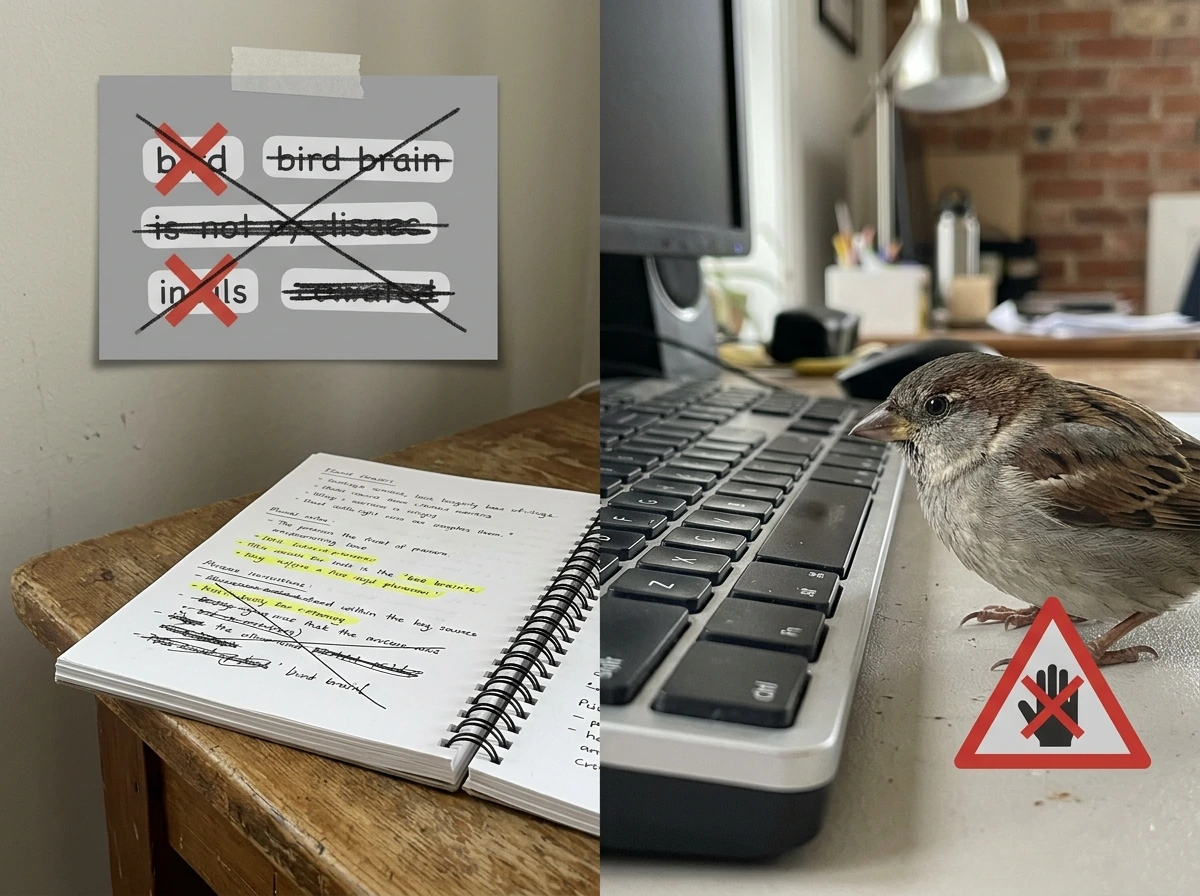
If someone called you a bird-brain, they were not paying you a compliment. In standard English, 'bird-brain' (also written 'birdbrain' or 'bird brain') means a stupid or silly person, and the adjective form 'bird-brained' means exactly what it sounds like: lacking intelligence or good sense. That is the short answer. But the phrase has a longer history, a few layers of tone depending on who says it and why, and a surprising scientific twist that makes the insult somewhat ironic today. Here is everything you need to know.
Bird Brain Meaning: Idiom Definition, Origins, and Usage

Marcus Holloway
23 Mar 2026
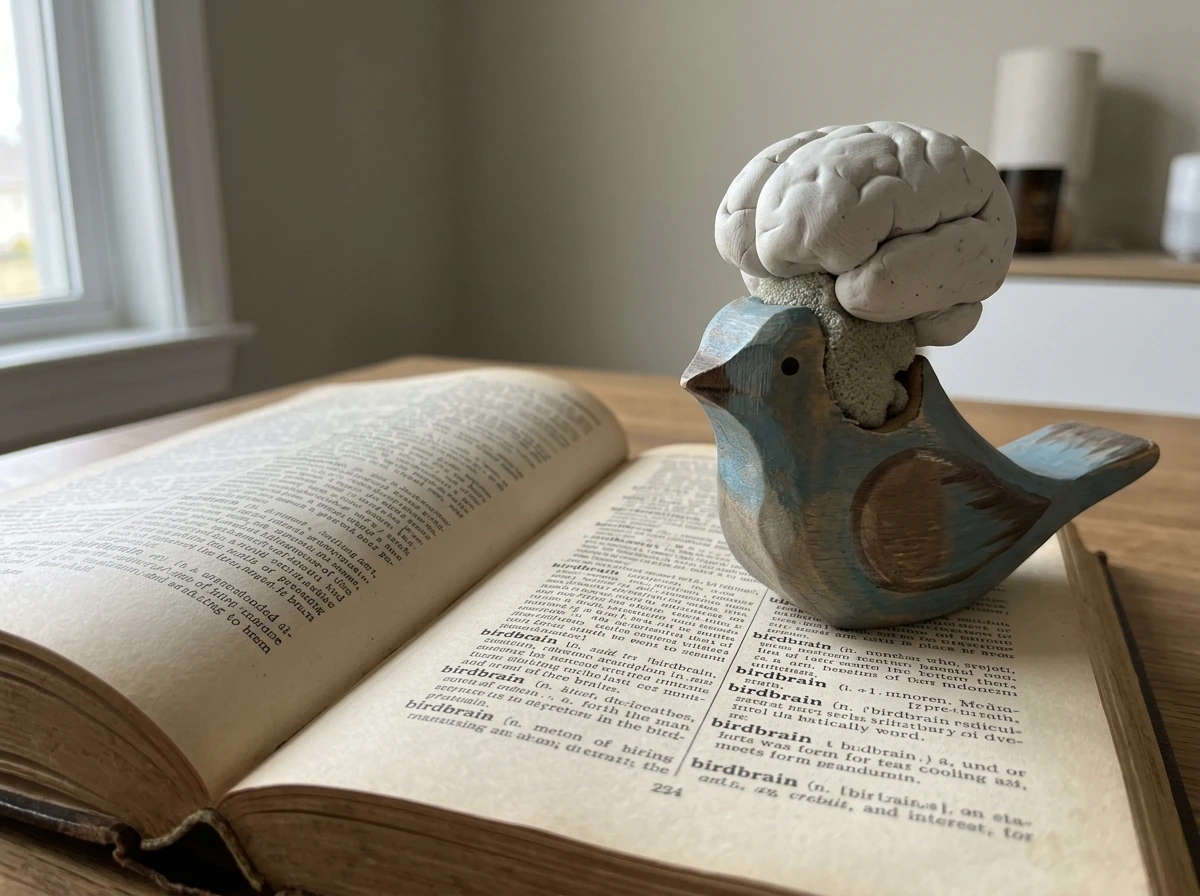
What 'Bird-Brain' and 'Bird Brains' Actually Mean

The core meaning is consistent across major dictionaries. Collins defines 'birdbrain' as 'a stupid or silly person.' The Britannica Dictionary goes with 'a stupid person.' Dictionary.com and UsingEnglish.com agree: bird-brained means silly or stupid in informal usage. Whether you see it written as one word (birdbrain), hyphenated (bird-brain), or two words (bird brain), the meaning is the same.
The variant 'bird for brains' (as in 'you've got birds for brains') is just a colorful extension of the same idea, implying that instead of a functioning human brain, a person has something as small and supposedly simple as a bird's brain rattling around up there. Same insult, slightly more theatrical delivery.
The plural 'bird brains' usually just refers to multiple people being called out as stupid, or it appears in scientific and cultural discussions about the actual neuroanatomy of birds, which is a completely different topic (and one I will come back to at the end).
Where the Phrase Came From
The idea of birds being feather-headed is older than the modern phrase. An earlier version, 'bird-witted,' is traceable back to around the 1600s in English, implying the same flighty, easily distracted quality. The specific term 'bird-brained' is attested from 1910, and 'birdbrain' as a standalone noun entered recorded English around 1920 to 1925. Mensa UK puts the lifespan of this insult at nearly 500 years when you count the earlier 'bird-witted' form.
The phrase took hold because of a historical belief that birds have very small, simple brains relative to mammals, and therefore must be dim-witted. Wikipedia's article on avian brains notes that the colloquial term 'bird-brain' arose directly from earlier misinterpretations of bird neuroanatomy. People looked at a bird skull, concluded the brain inside must be primitive, and started applying that logic to anyone they considered foolish. As we now know from decades of cognitive research, this assumption was badly wrong, but the phrase stuck long after the science moved on.
Urban Dictionary vs Standard Dictionary: What's the Difference?
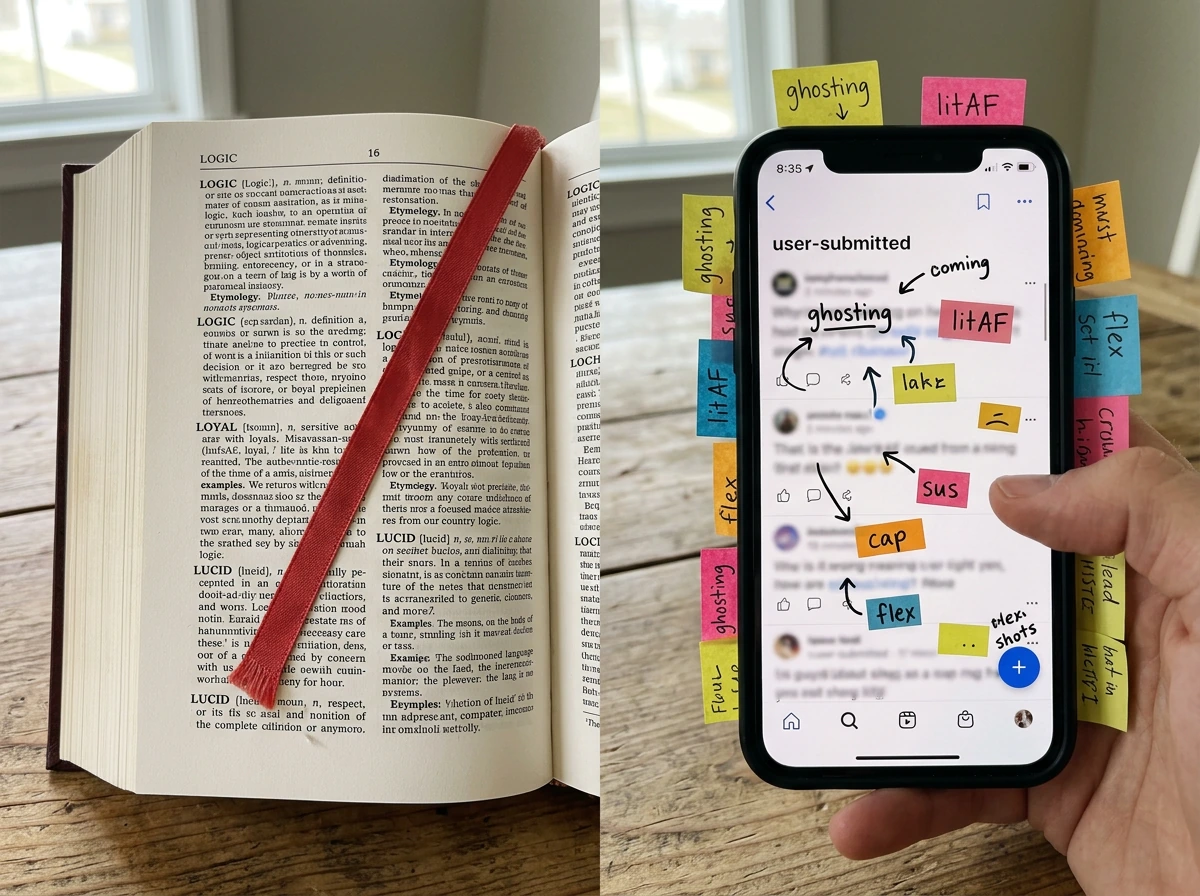
Standard dictionaries are in near-total agreement: bird-brained means stupid or silly, and birdbrain means a stupid person. That is the definition you will find in Collins, Britannica, and Dictionary.com. Clean, simple, consistent.
Urban Dictionary is messier, which is honestly its whole personality. The Urban Dictionary page for 'bird-brained' includes the standard negative definitions (ranging from mildly insulting to 'dumber than a rock'), but it also has at least one entry that flips the meaning entirely, defining 'bird-brained' as a positive: 'Wise, intelligent, graceful and humble... Eco-minded,' with an example of a 'bird-brained scientist' being complimentary. This is a crowd-sourced site, so anyone can submit a definition, and that flip is almost certainly a deliberate subversion rather than a documented shift in how English speakers actually use the word.
Urban Dictionary's negative entries add texture that standard dictionaries skip. Some frame the insult as something aimed mostly at children or immature people ('usually attributed to a child or immature person'). Others describe it as an 'airhead' or 'overexcited' kind of stupid rather than a cold, calculated stupidity. And then there are the more aggressive compound phrases on Urban Dictionary that stack additional gendered or profane insults on top, which carry a much higher offense level than plain 'bird-brain' ever would.
| Source | Definition | Tone |
|---|---|---|
| Collins English Dictionary | A stupid or silly person | Neutral/clinical |
| Britannica Dictionary | A stupid person | Neutral/clinical |
| UsingEnglish.com | Someone who is stupid | Conversational, standard |
| FastSlang | Playful between friends, or a serious intelligence insult | Context-dependent |
| Urban Dictionary (negative) | Dumber than a rock; silly, immature behavior | Mild to harsh insult |
| Urban Dictionary (positive, subversive) | Wise, intelligent, eco-minded | Deliberate flip/humor |
The takeaway: if you are trying to understand what 'bird-brain' means in a real conversation, stick with the standard dictionary definition. The Urban Dictionary positive entry is a cultural wink, not a usage trend.
How People Actually Use It in Conversation
Tone and intent do most of the work here. FastSlang draws a useful distinction: 'bird brain' can be playful between close friends, or it can land as a genuine put-down depending on delivery and relationship. Think of the difference between a parent gently teasing a child ('Oh, you little bird-brain, you forgot your lunch again') versus someone in a meeting saying it with real frustration about a colleague's decision-making. Same words, very different impact.
The phrase tends to show up in a few recurring situations. It targets someone who made a scatter-brained mistake, someone acting impulsively without thinking, or someone the speaker views as naive or easily distracted. It rarely gets aimed at someone for a single, isolated error. More often it implies a pattern, a persistent silliness or lack of careful thinking.
In published writing, you will see it applied dismissively in opinion pieces and cultural commentary. Dictionary.com pulls real examples from the Washington Post, Science Magazine, and The Guardian, all using 'bird-brained' to wave off ideas or behaviors as foolish. That is the standard register: casual enough to feel informal, pointed enough to sting a little.
Is 'Bird-Brain' Offensive? And What to Say Instead
It depends on context, but calling someone a bird-brain is fundamentally an insult about their intelligence. Science News has made the case that it is time to retire the phrase, noting it is essentially a way of calling someone stupid and that many people will take offense. The Guardian describes it plainly as a phrase denoting someone who is stupid. At minimum, it is dismissive. At worst, depending on tone and target, it can be genuinely hurtful.
The playful version exists, but it only works when the relationship is close enough and the situation light enough that nobody reading it could mistake it for real contempt. When in doubt, that is a good reason to reach for something less loaded.
If you want to describe someone as scatterbrained or forgetful without the bite, here are some softer options that carry the 'airheaded' quality without the implied stupidity:
- Scatterbrained (distracted, disorganized, but not necessarily unintelligent)
- Ditsy (light, informal, implies forgetfulness rather than stupidity)
- Absent-minded (the classic polite version, often implies someone smart but distracted)
- Flighty (focuses on impulsiveness and inconsistency rather than intelligence)
- Airheaded (still informal and mildly teasing, but less sharp than bird-brained)
If you are on the receiving end of 'bird-brain' and it bothered you, the cleanest response is a direct, calm one: 'I would prefer you not say that.' bird brain content warning If it came from a friend in a joking context that missed the mark, letting them know it landed poorly is usually enough. If it was meant seriously, it deserves a direct response rather than letting it pass.
Wait, Were You Looking for Bird Symbolism Instead?
This is worth a quick note, because this site covers bird meanings in a lot of directions. If you landed here looking for the spiritual or symbolic meaning of birds, or specifically the symbolic meaning of a bird's mind or intellect in mythology and culture, you are in the wrong article. This is worth a quick note, because this site covers bird meanings in a lot of directions. If you landed here looking for the spiritual or symbolic meaning of birds, or specifically the symbolic meaning of a bird's mind or intellect in mythology and culture, you are in the wrong article. 'Bird brain' as covered here is a human colloquial phrase, a figurative insult about a person's intelligence. It has nothing to do with what birds symbolize spiritually or culturally. It has nothing to do with what birds symbolize spiritually or culturally.
If you want to explore bird symbolism, birds carry rich meaning across many traditions: doves represent peace, love, and in Christian tradition the Holy Spirit (notably in the imagery of Jesus' baptism). Different species carry entirely different layers of meaning depending on cultural context. That is a completely separate thread from the idiom, and there are dedicated articles on this site covering exactly that territory.
The short version for disambiguation: 'bird brain' as an expression refers to a human being called silly or stupid. It is slang, not symbolism. If you are researching what birds mean spiritually or in dreams, that is a different search path entirely.
How to Read It in Context: Practical Next Steps
When you encounter 'bird-brain' or 'bird-brained' in the wild, here is a simple framework for figuring out what is actually going on:
- Check the relationship. Close friends using it between themselves almost always means playful teasing. A stranger or an authority figure using it almost always means a genuine put-down.
- Check the tone. Is there warmth or frustration behind it? Light teasing reads completely differently from contemptuous dismissal.
- Check what it is attached to. 'That was a bird-brained idea' (targeting a decision) is softer than 'you're such a bird-brain' (targeting a person directly).
- Decide whether to address it. If it stung, say so plainly. If it was clearly affectionate and landed fine, there is nothing to do. If you are unsure, asking 'Did you mean that as a joke?' opens the conversation without escalating.
- If you are writing it yourself, pause and ask whether 'scatterbrained,' 'forgetful,' or 'impulsive' would do the job without the baggage. Usually they will.
One final irony worth knowing: the entire premise of the insult is scientifically outdated. Research over the past few decades has shown that birds, including crows, parrots, and ravens, demonstrate problem-solving, tool use, memory, and social intelligence that rivals or exceeds many mammals. National Geographic has covered this shift directly, and IPM notes that the 'bird brain as insult' framework is tied to beliefs about bird cognition that modern neuroscience has largely overturned. So when someone calls you a bird-brain, you can honestly say the analogy does not even hold up anymore. Birds are, by any reasonable measure, quite smart.
For a deeper look at the adjective form and how it functions specifically, the related article on 'bird-brained meaning' goes further into the grammatical and cultural nuances. For a deeper look at the adjective form and how it functions specifically, the related article on 'bird-brained meaning' goes further into the grammatical and cultural nuances. And if you have seen 'bird brain' pop up in a specific song title, media reference, or online community context, there are dedicated articles on those variants too. bird brain meaning song
FAQ
Does “bird brain meaning” ever refer to birds or bird intelligence? (Or is it always an insult about a person?)
Usually it will mean “you are being silly or unintelligent,” not anything literal about birds. If the context is a joke among close friends, it can be playful teasing, but in workplaces or with strangers it is commonly read as a real put-down.
What does “bird brains” mean, and is it the same insult?
In most modern uses, “bird brains” is plural only because multiple people are being criticized, for example “Those guys are bird brains.” If you see it in a science or animal context, it is likely about real avian brains, not the idiom.
What’s the difference between “bird-brained” and “birdbrain/bird-brain” in a sentence?
“Bird-brained” (adjective) most often describes a person’s behavior or decision-making in the moment, like “a bird-brained idea.” “Birdbrain” or “bird-brain” (noun) targets the person more directly, like “Don’t be a birdbrain.”
Is “bird brain” ever considered a harmless joke? What can go wrong?
A common mistake is treating it as a mild, neutral phrase. Delivery matters, but even when intended lightly, many people hear it as “stupid,” so it can escalate conflict quickly.
How should I respond if someone calls me a bird-brain and I want to shut it down without starting a fight?
If it bothered you, a direct boundary works best: state the preference, then move on. For example, “Please don’t call me that. If you disagree, say what you mean about the decision.” This redirects from insult to the actual issue.
If I want to sound critical, what safer alternatives can replace “bird-brain”?
If you are the one using it, consider whether you would say the same thing to that person in front of others. In a meeting, with someone you supervise, or with anyone outside your close circle, it is safer to avoid it and use neutral alternatives like “careless,” “impulsive,” or “forgetful.”
What does “birds for brains” mean, and is it stronger than “bird brain”?
“Bird for brains” has the same core insult, just with more theatrical wording. Because it is less common, some listeners may find it more performative or more mocking, especially if tone is sarcastic.
If I see “bird-brained” online, can it be used non-offensively like a meme?
Yes. When the phrase is used in a comment thread, it can be used sarcastically or as a “cultural wink,” but that depends entirely on local norms. Treat it as an insult unless you can clearly tell it is affectionate and contextually safe.
Next Article
Bird Brain Content Warning Explained and How to Use It
Plain-English guide to bird brain content warnings: meanings, misconceptions, and ready wording to use responsibly.